
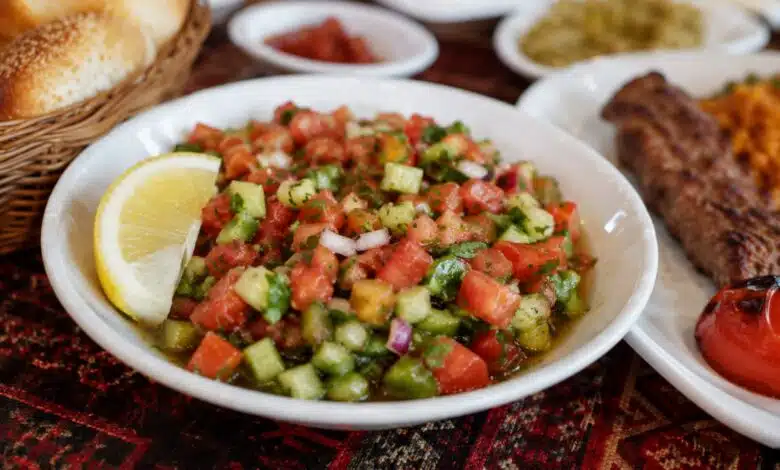
There is a certain kind of restaurant order that looks almost too simple to care about. A bowl of chopped tomatoes and cucumber arrives between the bread and the grill platter, glossy with lemon and olive oil. Then you take one bite and understand why the table needed it. Çoban salatası is not decorative greenery. It is the cool, sharp, juicy counterpoint that makes a Turkish meal feel complete.
The difficulty is not eating it. The difficulty is finding the right name on an English-language menu, knowing whether the “house salad” in a delivery app is actually Çoban salatası, and recognizing the difference between a freshly chopped bowl and a tired container that has spent too long surrendering its texture to salt.
I would treat this salad the way I treat a white shirt in a wardrobe: the idea is simple, which means every detail shows. The tomatoes need flavor. The cucumber needs snap. The onion should wake up the bowl without taking over the conversation. And the dressing should make the vegetables taste more like themselves, not hide them.
Çoban salatası, usually translated as Turkish shepherd salad, is a chopped salad made mainly with tomatoes, cucumber, onion and green pepper, commonly finished with lemon juice, olive oil and salt. Search for it at Turkish restaurants, kebab grills, pide and lahmacun shops, bakery-cafés and Turkish markets. Use both “coban salatasi” and “shepherd salad” when searching, because many menus omit Turkish characters or use a simplified English description.
The bowl in eight lines
The first bite should taste like the table just opened a window
A good Çoban salatası is not shy, but it is clean. The tomato gives juice and sweetness. The cucumber snaps. Onion supplies the sharp line. Green pepper adds freshness and, depending on the variety, a little heat. Lemon lifts everything. Olive oil rounds the edges without making the salad heavy.
That is why the bowl works so well beside charred lamb, grilled chicken, köfte or a cheese-rich pide. It does not compete with the main dish. It resets your mouth and makes the next bite of warm food taste exciting again.
What Çoban salatası is, without turning it into a recipe lecture
At its core, Çoban salatası is a Turkish chopped salad. The canonical ingredients are straightforward: tomatoes, cucumber, onion and green pepper. Parsley is common. Lemon juice, olive oil and salt form the most familiar dressing. Some kitchens use vinegar. Some add sumac. A small amount of pomegranate molasses may appear, particularly when the restaurant likes a deeper sweet-sour finish.
The salad is usually served cool or at room temperature, not buried in ice-cold dressing. It is built around vegetables rather than leaves. Lettuce may appear in a restaurant adaptation, but a bowl dominated by lettuce has moved away from the classic identity.
The dish is also not defined by cheese. Feta can be pleasant, and restaurants sometimes add it because diners recognize the combination, but large blocks of cheese are more likely to make the bowl read as Greek-style salad. Çoban salatası should still be identifiable after the cheese is removed.
The core
Tomato, cucumber, onion and green pepper. These should carry the dish. If one is missing, the restaurant may still serve a good chopped salad, but the menu description deserves a closer look.
The accent
Parsley, lemon, olive oil, salt, vinegar, sumac or a little pomegranate molasses. These should sharpen the vegetables, not turn the salad into a sauce delivery system.
Why a simple salad can reveal the kitchen
There is nowhere to hide. A stew can soften a tough vegetable. A sauce can distract from a weak tomato. Çoban salatası has no such safety net. If the produce is pale, watery or old, you will know immediately.
That makes it an unexpectedly useful restaurant test. The kitchen has to choose decent tomatoes, chop consistently, balance onion and acidity, and serve the bowl before time destroys its texture. When those details are right, the salad can be more memorable than a far more elaborate side dish.
Appetizer, side dish or shared plate?
All three are possible. In a full-service Turkish restaurant, a larger bowl may sit in the middle of the table and stay there through several courses. At a kebab shop, a smaller portion may arrive beside the entrée. A lunch menu may include it automatically, while a dinner menu sells it separately.
It is also worth resisting the urge to call every cold Turkish dish “meze.” Çoban salatası can be part of a meze-heavy meal, but many restaurants simply treat it as the salad—the fresh element that belongs beside bread, grill smoke and rice.
Six doors where the salad is most likely waiting
“Turkish restaurant” is the obvious answer, but the business format matters. It changes the portion, the freshness window and even where the salad hides on the menu.
Full-service Turkish restaurant
Check salads, cold starters and sides. A large bowl may be designed for the whole table. This is also where you are most likely to see Çoban salatası offered beside gavurdağı salatası, giving you a useful comparison.
Kebab grill
The salad may arrive automatically with Adana kebab, Urfa kebab, lamb şiş, chicken şiş, döner or köfte. It might not have a glamorous menu position because the restaurant treats it as part of the plate.
Pide or lahmacun shop
This is an excellent place to look. Hot bread, meat toppings and cheese need something raw and acidic beside them. The salad may be sold separately or included in a lunch combination.
Turkish bakery-café
A café may offer a smaller version with börek, simit sandwiches or a daily lunch plate. The name is often translated more aggressively for English-speaking customers.
Turkish market
Prepared-food counters sometimes sell the salad in refrigerated containers. This is convenient, but it makes the packed-on time and amount of collected liquid especially important.
Broader Mediterranean restaurant
You may find a close cousin rather than the exact dish. Check whether the restaurant is using “Mediterranean salad” as a broad marketing label for feta, olives, lettuce or chickpeas.
What if the salad is visible but not listed?
This happens often. Customer photos show a small chopped salad beside mixed grill, yet the online menu says nothing about it. That usually means one of three things: it is included automatically, it is listed only under add-ons, or the menu has not been updated.
Call and ask one narrow question: “Do you serve Çoban salatası or Turkish shepherd salad as a separate order?” That is much more effective than asking whether the restaurant “has salad.”
A freshness audit you can do before the second bite
The salad does not need to be photogenic in a precious, arranged way. It does need to look awake.
The tomato is the main character
Weak tomatoes make a weak Çoban salatası. It is that simple. If the tomato is pale and refrigerator-cold, the salad may have the correct ingredients and still taste like very little. A good tomato releases juice that joins the lemon and olive oil at the bottom of the bowl. That liquid is not waste. It is part of the pleasure, especially with bread.
Overripe tomatoes create the opposite problem. They collapse, turn the dressing pulpy and make the salad feel old even when it was just chopped. The ideal tomato has flavor and structure at the same time.
Cucumber is not filler
Cucumber gives the bowl its clean snap. Some kitchens peel it fully; others leave the skin; others create stripes. None of those choices matters if the cucumber is crisp. Thick, bitter skin or watery seed cavities matter much more.
Onion should have manners
I like the sharpness onion brings, but raw onion is not supposed to hijack the table. White and red onions both appear. Some cooks rinse sliced onion briefly or salt it to soften the aggression. That is not cheating. It is balance.
Green pepper can change the entire personality
A mild pepper makes the salad bright and grassy. A hotter pepper gives it a lively edge that works beautifully with fatty meat. The only problem is surprise. If you are sensitive to heat, ask before assuming that every green pepper is mild.
The dressing should be invisible in the best way
You should notice brightness, not a layer of sauce. Lemon juice, olive oil and salt are enough. Vinegar, sumac or pomegranate molasses can add character, but once the dressing becomes sticky, creamy or candy-sweet, the bowl stops feeling like Çoban salatası.
Knife work changes the mood more than people expect
Çoban salatası is generally chopped smaller than Greek salad. That smaller cut is not just visual. It lets tomato, cucumber, onion and pepper meet in the same bite.
Consistency matters because the ingredients behave differently. Tiny tomato pieces soften quickly. Large onion pieces bully the palate. Oversized cucumber turns the meal into a sequence of separate bites. Good chopping makes the bowl feel composed without making it feel fussy.
The comparison room: similar ingredients, different identities
Tomato, cucumber and onion travel across borders very well. That is exactly why diners confuse several salads that belong to different culinary contexts. The right comparison is not “which one is authentic?” It is “what is this restaurant actually serving?”
How I would style the table around it
Çoban salatası is at its best when the rest of the meal gives it something warm, smoky or rich to push against. Think of it as contrast, not decoration.
The classic grill table
Order one chopped salad for the table, one grilled main, one starch and bread. This is enough. The table does not need seven dips to feel generous.
The lighter vegetarian table
Pair the salad with mercimek köfte, börek or pide, a bean dish and herbs. The meal feels abundant because the textures change from bite to bite.
The bread-first dinner
Pide or lahmacun can feel heavy without something raw. A bright chopped salad turns the meal from “bread plus topping” into a table with movement.
Mercimek köfte is the link I would not skip
The combination is particularly smart because the two dishes solve different parts of the meal. Mercimek köfte brings earthy lentils, bulgur, spice and a soft, compact texture. Çoban salatası brings juice, crunch and acidity. Together they make a satisfying meatless lunch without trying too hard.
The Vesti guide to finding mercimek köfte at restaurants and Turkish markets explains how those lentil-and-bulgur patties appear on menus and prepared-food counters.
Ayran makes sense, but not because every Turkish meal needs a cliché
Ayran works because it is cool, salty and dairy-based. The salad is acidic and fresh. Grilled or spicy food sits between them. That is a complete flavor structure, not just a list of traditional items.
Read what ayran tastes like before ordering it, especially if you expect something sweet. For the wider cultured-drink question, the comparison of ayran, kefir, tan and lassi helps separate drinks that are often grouped together too casually.
The takeout clock starts the moment salt touches tomato
Çoban salatası can travel well, but it does not improve while sitting in a plastic container. Salt and lemon pull moisture from the vegetables. The finer the chop, the faster the texture softens.
For a wider look at dishes that survive the ride, Vesti’s breakdown of which foods keep their texture during takeout is the better companion.
At a Turkish market, the clock is already running
A prepared-food counter can be a wonderful place to buy Çoban salatası, especially when you are assembling lunch with mercimek köfte, börek, hummus or stuffed vegetables. It can also be the place where the salad shows its age most clearly.
Look at the packed-on date, but do not stop there. A salad can still be within its labeled period and no longer have the texture you want. The vegetables should remain distinct. The parsley should look green. The onion should not have turned translucent. A lake of watery dressing is a warning when the cucumber and tomato already look soft.
The broader Vesti field guide to judging bakery, refrigerated and prepared-food sections is useful when the salad is only one part of a larger international-market trip.
Dietary questions: usually simple, never worth guessing
Vegetarian and vegan
The basic salad is vegetarian and usually vegan. Vegetables, lemon, olive oil and salt are the foundation. A restaurant may add cheese, yogurt dressing or honey, so a vegan diner should still read the description.
Gluten
The core ingredients are naturally gluten-free. Cross-contact can occur in a restaurant kitchen, especially where bread is handled constantly. Anyone with a medical restriction should ask the restaurant about preparation rather than relying on the ingredient list alone.
Dairy
Dairy is not required. Feta-style cheese is an adaptation, not a rule. A creamy dressing should be treated as a restaurant-specific variation.
Heat
Most versions are tangy rather than hot. Green peppers vary, though, and some kitchens add pul biber or hotter pepper. A diner who is sensitive to spice should ask one direct question.
Nuts
Nuts are not a standard part of Çoban salatası. Walnuts are more closely associated with some versions of gavurdağı salatası. Cross-contact and kitchen-specific additions still matter.
The seven disappointments I would fix first
1. Tomatoes that taste like cold water
This is the most damaging problem because tomato should lead the bowl. More dressing will not create tomato flavor.
2. Giant vegetable pieces
Large chunks make every bite separate. The salad loses the mixed, spoon-friendly quality that gives it character.
3. Onion in a bad mood
Too much harsh onion turns a fresh salad into a dare. Onion should sharpen the dish, not punish the diner.
4. Sweet bottled dressing
A syrupy dressing covers the produce and gives the salad a generic chain-restaurant flavor.
5. Lettuce padding the bowl
A few leaves are one thing. A bowl mostly composed of lettuce is no longer the chopped vegetable salad the name promises.
6. Feta becoming the entire personality
Cheese can be delicious, but once it dominates the visual and flavor profile, the salad is moving toward another style.
7. Hot food steaming the salad
This is a packaging failure, not a recipe problem. Grilled meat and rice should not share a sealed compartment with cold chopped vegetables.
The search plan I would use before driving across town
Begin with the exact dish, then widen the language. Restaurant websites and delivery platforms are inconsistent enough that one spelling is rarely sufficient.
Open the menu before trusting the search result
Use the browser’s find function for coban, çoban, shepherd, tomato, cucumber and salad. Check salads, cold starters, sides and kebab plate descriptions. Delivery apps sometimes hide the item under “extras.”
Use customer photos as evidence, not a promise
Photos can reveal the chop, portion and whether the salad is included with a plate. They cannot confirm that the restaurant still serves it. Check dates. A photo from three years ago is a clue, not a current menu.
Call only when the trip depends on it
Ask whether the restaurant currently serves Çoban salatası as a separate order. That phrasing avoids confusion with a small generic side salad and gives the employee something precise to answer.
A first order that lets the salad do its job
Order one shared Çoban salatası, one main dish, one starch and one drink. That is enough to understand the role of the salad without burying it under a parade of cold starters.
For a vegetarian table, use mercimek köfte as the anchor. Add Çoban salatası, bread, a warm pastry or bean dish and tea. It feels generous without becoming random.
Why this is a dish worth ordering twice
The first serving tells you whether the restaurant understands the salad. The second tells you whether the kitchen is consistent.
Tomato season changes the bowl. A weekday lunch version may be chopped more finely than a busy Saturday dinner version. Dine-in may be excellent while delivery arrives too wet. One restaurant may lean into parsley and lemon; another may use more pepper and olive oil.
Those differences are not automatically mistakes. They are the reason a simple dish remains interesting. The question is whether the bowl still tastes balanced, fresh and recognizably itself.
How to read reviews without being fooled by the wrong clues
Restaurant reviews can help, but salad reviews are rarely written with much precision. One person calls the bowl “too wet” when they simply dislike tomato juice. Another praises it as “fresh” because the vegetables were cold. A third uploads a beautiful photo from two summers ago, when the tomatoes were completely different.
I would look for repeated observations rather than one dramatic opinion. If several recent diners mention crisp vegetables, generous portions or a strong lemon dressing, that pattern is useful. If several people complain that the salad arrived warm beneath grilled meat, the problem may be packaging rather than the recipe.
Useful review clues
“Freshly chopped,” “ripe tomatoes,” “served separately,” “good with the kebab,” “large enough to share,” and “not overdressed” all describe qualities you can actually evaluate.
Weak review clues
“Authentic,” “weird,” “basic,” or “not like the salad I know” tell you very little unless the reviewer explains the ingredients, texture or restaurant context.
Photos are strongest when they show scale
A close crop can make a tiny side portion look like a full table salad. Look for photos that include plates, cutlery or the grill platter beside the bowl. That gives you a better sense of whether the restaurant’s “large” salad is truly shareable.
Also check the vegetables rather than the filter. A saturated image can make pale tomatoes look magnificent. You are looking for distinct pieces, fresh herbs and a reasonable amount of liquid—not cinematic color grading.
Tomato season changes the answer more than the menu does
The menu name may stay exactly the same all year, while the salad itself changes dramatically. In warm months, ripe tomatoes can carry the bowl with very little help. In colder months, the kitchen may rely more heavily on lemon, pepper, herbs or pomegranate molasses to create interest.
This does not mean winter Çoban salatası is automatically disappointing. It means your expectations should be realistic. A careful restaurant may use smaller tomatoes with better flavor, adjust the cut or serve a different seasonal salad when the produce is weak.
If a restaurant temporarily removes the dish rather than serving a poor version, I would consider that a sign of judgment rather than failure.
Portion size, pricing and the quiet art of not over-ordering
Salad pricing varies more than the ingredients suggest. A small kebab-shop side may be inexpensive because it is built into the plate. A full-service restaurant may charge more for a large bowl meant for several diners. Delivery apps can also inflate the price once packaging and service fees are added.
Before ordering two salads for two people, check whether the restaurant uses individual or shared portions. A bowl described as “large” may easily serve three people when the table also includes meze, bread and a grill platter.
Value is not only about volume. A huge bowl of pale tomatoes and filler lettuce is not better value than a smaller serving made with ripe produce. For this dish, quality per bite matters more than quantity per inch of bowl.
What to do with leftovers without pretending they will stay crisp
Çoban salatası is best on the day it is made. Refrigeration slows deterioration, but it does not reverse the effect of salt and acid. By the next day, the vegetables will usually be softer and the bowl more liquid.
That does not always make it useless. Spoon the leftovers over rice or bulgur, tuck them beside grilled chicken, or use the tomato-lemon liquid with bread. The texture will be different, so stop expecting the salad to behave like a newly chopped one.
For takeout, the smartest strategy is still prevention: request dressing separately and combine only the amount you plan to eat.
Dine-in, counter service and catering are three different versions of the same idea
At a sit-down restaurant, the salad may be chopped close to service and brought in a ceramic bowl with enough dressing to spoon over bread. At a counter-service grill, speed matters more. The same vegetables may be prepared in batches, portioned quickly and tucked beside rice or kebab.
Catering changes the equation again. A tray prepared for twenty people needs sturdier vegetables, lighter salting and careful timing. If you are ordering Çoban salatası for an event, ask whether the dressing can be supplied separately and whether the kitchen recommends mixing it just before guests eat.
None of these formats is automatically better. The useful question is whether the restaurant has adjusted the preparation to the way the salad will be served. A beautiful dine-in bowl may fail in a catering tray if it is dressed hours too early; a sturdy catering version may feel less delicate but arrive in much better condition.
The bowl I would choose
I would choose the one with tomatoes that actually taste like summer, cucumber that still snaps, onion cut small enough to behave, green pepper with a little personality, and enough lemon to wake everything up. No unnecessary tower of feta. No sugary dressing. No exhausted lettuce filling space.
Çoban salatası is humble food with nowhere to hide. That is precisely why a good one feels so satisfying.
Frequently Asked Questions
What is Çoban salatası?
Çoban salatası is a Turkish chopped salad made mainly with tomatoes, cucumber, onion and green pepper. Parsley is common, and the usual dressing is lemon juice, olive oil and salt. It is served as a side, shared salad or fresh accompaniment to kebabs, köfte, pide, rice and bulgur.
What does Çoban salatası mean in English?
The usual English translation is “shepherd salad.” Menus may also call it Turkish shepherd salad, coban salad or Turkish tomato cucumber salad.
How do you pronounce Çoban salatası?
A useful English approximation is choh-BAHN sah-lah-TAH-suh. The Turkish letter ç sounds similar to the English “ch” in “chair.” Restaurant staff will usually understand the unaccented wording “coban salatasi” as well.
Is Çoban salatası the same as Greek salad?
No. Both can contain tomatoes, cucumber and onion, but Greek salad is commonly cut into larger pieces and usually gives feta and olives a central role. Çoban salatası is generally chopped smaller and is built around fresh vegetables, lemon and olive oil.
Does Turkish shepherd salad contain feta?
Not necessarily. Feta is not required for the classic identity of the salad. Some restaurants add cheese as a variation, but the bowl should still be recognizable as a tomato-cucumber-onion-pepper salad without it.
Is Çoban salatası vegan and gluten-free?
The basic ingredients are usually vegan and naturally gluten-free. Restaurant variations may include cheese, yogurt dressing or another added ingredient, and cross-contact is possible in kitchens that handle bread constantly. Ask the restaurant when a medical allergy or strict dietary requirement matters.
Where can I find Çoban salatası near me?
Start with Turkish restaurants, kebab grills, pide and lahmacun shops, Turkish bakery-cafés and Turkish markets with prepared-food counters. Search both “coban salatasi” and “Turkish shepherd salad,” then check the salad, side-dish and kebab sections of the current menu.
What should I order with Çoban salatası?
It works especially well with grilled lamb or chicken, Adana kebab, köfte, pide, lahmacun, rice, bulgur and beans. For a meatless meal, pair it with mercimek köfte, börek, bread and fresh herbs. Ayran is a cooling drink choice, while sparkling water keeps the meal lighter.
Does Çoban salatası travel well for takeout?
It travels well for a short trip when it is packed cold and separately from hot food. For a longer delivery, ask for the dressing on the side. Salt and lemon pull water from tomatoes and cucumber, so the salad becomes softer the longer it sits.
Can I buy Çoban salatası at a Turkish market?
Yes, some Turkish markets sell it in refrigerated containers or at prepared-food counters. Choose the freshest batch, check how much liquid has collected, and look for vegetables that remain distinct and crisp. It is best eaten promptly rather than stored for several days.


