
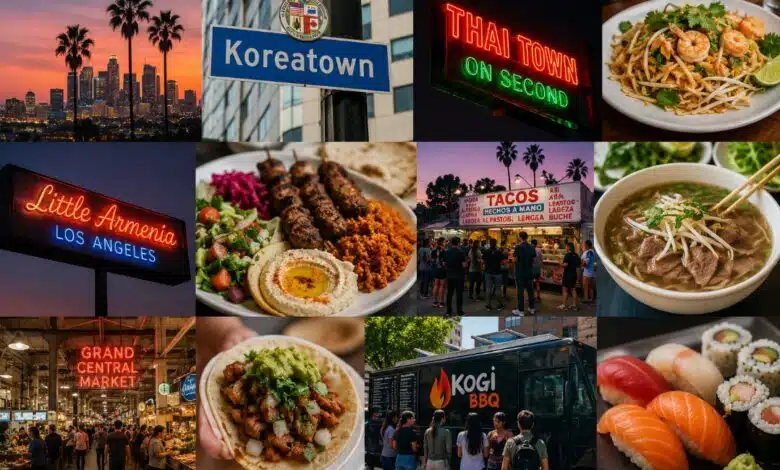
Los Angeles is not a city where you “do the food scene” by making one reservation downtown and congratulating yourself. The real pleasure is geographic. Breakfast might begin with a Korean soup in Koreatown, lunch could be Armenian lahmajune near East Hollywood, and dinner may end with skewers, noodles or tacos in a completely different part of the basin. The city eats in neighborhoods, shopping centers, parking lots, markets, food halls and sidewalks—and the distance between two excellent meals can be longer than the meal itself.
This guide is designed as a decision map rather than a ranking. It explains what each major food district is good at, how to choose a realistic route, which formats deserve attention beyond restaurants, and where markets, trucks and pop-ups fit into an LA food day. I am not going to pretend you can cover Koreatown, Thai Town, Little Armenia, East LA, Little Tokyo and Sawtelle before dinner without spending half the day in traffic. The stylish choice is not doing more. It is choosing a route that makes sense.
Los Angeles is best explored through focused food neighborhoods rather than one citywide restaurant list. Choose one or two nearby districts per day: Koreatown for Korean barbecue, soups and late-night dining; Thai Town for regional Thai food; Little Armenia and nearby Glendale for Armenian bakeries and grills; Boyle Heights and East LA for Mexican markets, mariscos, tamales and street food; Little Tokyo for historic Japanese food culture; and Sawtelle Japantown for dense, walkable noodles, desserts and pan-Asian dining.
The first truth about eating in LA: distance is an ingredient
Los Angeles rewards appetite, but it punishes bad logistics. A restaurant that looks twelve miles away can feel close on a Sunday morning and impossible at six on a weekday. Parking changes the mood. So does the difference between a neighborhood you can walk for two hours and one where every stop requires moving the car.
Plan around clusters, not individual viral dishes. If you drive across the city for one bowl, make sure the neighborhood gives you a bakery, market, dessert counter or second meal worth exploring nearby. That is how a food day starts feeling like Los Angeles rather than a sequence of errands.
A city day should have rhythm, not culinary panic
Use the quietest traffic window for a destination breakfast, bakery or market. This is when noodle soups, rice porridge, Armenian pastries, tamales and Japanese sweets make more sense than an elaborate tasting menu.
Choose a walkable neighborhood or a market with several vendors. Lunch is the easiest time to compare one savory dish, one snack and one drink without overcommitting.
This is for grocery shopping, bakery boxes, coffee, shaved ice, boba, mochi or a reset. If you are already full, stop ordering “just because you are there.”
Build the night around one district with depth. Koreatown is the obvious late-night choice, but Thai Town, Little Tokyo and many taco corridors also reward staying put rather than racing across town.
Koreatown after dark: one table, many decisions
Koreatown is one of the easiest places in Los Angeles to understand why “Korean food” is far too broad a plan. A group can sit around tabletop barbecue, but another block may specialize in cold noodles, spicy stews, ox-bone soup, fried chicken, porridge, raw seafood, dumplings or late-night drinking food. The neighborhood is compact by LA standards, yet the menu choices are enormous.
I would not begin by searching “best Korean restaurant.” Decide what kind of evening you want. Do you want smoke, noise and a table full of side dishes? A quiet bowl of soup? A noodle dinner followed by karaoke? A casual fried-chicken night? The answer changes the restaurant more than a star rating does.
The barbecue night
Best for a group willing to share. Check whether the restaurant is à la carte or all-you-can-eat, whether staff cook at the table, and whether the menu leans beef, pork or mixed cuts. A lower advertised price can become less attractive when premium meats, drinks and parking are added.
The soup night
Better for one or two diners, colder weather or a quieter mood. Look for specialties rather than expecting every kitchen to excel equally at seolleongtang, galbitang, gamjatang, tofu stew and knife-cut noodles.
Read the banchan before judging the table
The small side dishes are not random decorations. They establish salt, acid, crunch and freshness around the main meal. Their number varies by restaurant and service style, so do not use quantity alone as a quality test. A few thoughtful dishes can be more useful than a crowded table of tired ones.
For first-time Korean barbecue, ask how much meat the server recommends for the group before ordering. Diners often over-order because each plate looks modest on the menu and forget that rice, stews, noodles and side dishes accumulate.
Markets are part of the experience
Korean supermarkets can extend the meal into the next day. Look at prepared banchan, marinated meats, frozen dumplings, noodles, seaweed, produce, bakery counters and refrigerated drinks. If the labels or cold cases feel unfamiliar, use Vesti’s practical guide to shopping an international food market with more confidence.
Thai Town: stop ordering by color and start ordering by region
Thai Town in East Hollywood is one of the most rewarding places to move beyond a familiar pad thai order. Menus may include dishes associated with Central Thailand, Isan, Northern Thailand or Southern Thailand, alongside the standards that keep a restaurant accessible to a broad audience.
The smartest first move is not “make it authentic spicy.” Heat level and regional identity are not the same thing. Ask what the restaurant does particularly well. A kitchen known for boat noodles, papaya salad, khanom jeen, grilled meats or Southern curries is telling you where to focus.
Do not let the menu’s English names flatten the food
“Spicy salad,” “fish curry” or “rice noodles” may describe several very different dishes. Read the ingredient line, ask about the regional style and notice whether herbs, fermentation, coconut milk or grilled components define the plate.
When one food seems to have several names across menus, that is not necessarily inconsistency. Translation often prioritizes convenience over precision. Vesti’s explanation of why traditional dishes change names in English is especially relevant in neighborhoods where menus serve both community regulars and first-time diners.
Little Armenia: bakery bags, grilled meat and the geography beyond the sign
Little Armenia sits in East Hollywood close enough to Thai Town that the two can share a day, but the food rhythm is different. Armenian eating often invites bakery stops, market browsing, grilled meats, soups, spreads and pastries rather than one single restaurant destination.
The official neighborhood is historically significant, but Los Angeles Armenian food culture extends far beyond its boundaries, especially into Glendale and surrounding communities. Treat Little Armenia as an entry point, not a container for every Armenian business in the region.
The bakery is not an afterthought
An Armenian bakery can solve breakfast, lunch and tomorrow’s snack in one visit. Look for flatbreads, lahmajune, savory pastries, cheese-filled breads, cookies and cakes. Ask what came out recently, what reheats well and what should be eaten immediately.
A grill meal should still have contrast
Kebab, lula-style ground meat, chicken, rice and lavash can become heavy if every element is warm and soft. Add pickles, herbs, tomato, onion, a fresh salad or a yogurt-based side. The meal becomes more complete without becoming larger.
Markets reveal the everyday table
Restaurants show celebration and hospitality. Markets show breakfast, weekday dinner and pantry habits. Look for cheeses, herbs, preserves, dried fruit, nuts, breads, prepared salads, frozen items and imported beverages. The most useful purchase is not always the most exotic; it is often the bread or cheese that makes tomorrow’s breakfast better.
Boyle Heights and East LA: eat with the street, not against it
Boyle Heights and East Los Angeles are not interchangeable labels, but they connect through history, family businesses, markets, street vending and a food culture that cannot be reduced to one taco list. This is where breakfast can mean tamales or pan dulce, lunch can become mariscos, and the walk back to the car may produce fruit, churros or a second snack you did not plan.
The right attitude is observational. Notice where people are stopping, what is being cooked to order and which vendors have a rhythm of regular customers. Street food is dynamic: hours shift, weather matters, social media updates move locations, and a vendor present last month may not be there today.
Use markets as anchors
El Mercado de Los Angeles—widely known as El Mercadito—offers a dense mix of food, retail and cultural atmosphere. It is useful not because every stall should be sampled, but because it lets you compare prepared foods, sweets, groceries and restaurant-style meals in one place.
A farmers market or community market serves a different purpose. It may be better for produce, prepared snacks and a slower neighborhood morning. Check the current operating day before building the trip around it.
A balanced Eastside food afternoon
How to judge a truck or stand without romanticizing it
A line can indicate popularity, but it can also reflect slow service. A polished truck can serve excellent food, and an improvised stand can be highly organized. Look at turnover, ingredient handling, menu clarity and whether the specialty matches what people are ordering.
Little Tokyo: history, lunch and the discipline of choosing one lane
Little Tokyo is one of the best LA districts for a food day that does not require moving the car after every bite. Restaurants, confectioners, cafés, markets and cultural institutions sit close enough to reward walking. That density also creates a problem: visitors try to eat ramen, sushi, curry, mochi and dessert in one afternoon and end up appreciating none of them.
Choose a lane. A noodle lunch plus sweets. Sushi plus a market. A café break after a museum. Japanese curry followed by shopping. The neighborhood is richer when the food is connected to time and place rather than treated as a checklist.
The historic-sweets route
Begin with a light lunch, then leave room for wagashi, mochi or another traditional confection. Pay attention to texture and seasonality instead of ordering the most colorful box.
The market-and-dinner route
Shop after lunch when you know which flavors you enjoyed. Buy noodles, sauces, tea or frozen foods that connect to the meal rather than random packaging that looks interesting.
Ramen lines need a strategy
A long line may be worth it, but decide before joining. Check whether the restaurant specializes in a broth style you actually want, whether the wait is seated or standing, and whether another nearby shop offers a different but equally appealing noodle experience.
Little Tokyo is more than ramen
Sushi, udon, soba, okonomiyaki, curry, izakaya food, bakeries and sweets all belong in the conversation. A district guide becomes less useful when one famous dish erases everything else.
Sawtelle Japantown: the compact Westside crawl
Sawtelle Japantown is smaller and more linear than Little Tokyo. That makes it excellent for comparison eating—one noodle dish, one snack and one dessert—provided you resist the temptation to treat every storefront as a required stop.
Japanese American history remains part of the district, while the current food mix extends across Japanese and other Asian cuisines. Ramen, tsukemen, yakitori, sushi, Japanese pasta, curry, desserts, Filipino flavors, Korean food, Thai food and boba can appear within a few blocks.
The noodle crawl should not mean three full bowls
Share when possible. Choose contrasting styles: a rich broth and a lighter bowl, or ramen and tsukemen rather than three versions of the same thing. Add a grilled snack or dessert to change texture.
A Sawtelle evening for two
Parking changes the best arrival time
The strip feels easy once you are walking, but arrival can be the frustrating part. Go earlier than peak dinner, use a garage when available and avoid circling endlessly for the perfect free space. A small parking fee is often cheaper than beginning the evening irritated.
Markets, food halls, trucks and pop-ups are not backup plans
Los Angeles food culture does not live only in permanent dining rooms. Some of the city’s most interesting cooks begin at markets, weekly events, shared kitchens or short-term collaborations. The format can reveal experimentation that would be difficult inside a conventional restaurant menu.
Grand Central Market
Downtown’s historic market is useful when a group wants different cuisines without splitting up. It also works as an introduction to the city’s market culture, although popular vendors and central seating can become crowded.
Smorgasburg Los Angeles
The weekly open-air market at ROW DTLA is built for trying newer concepts, pop-ups and small businesses. Check the current vendor list and schedule rather than assuming a favorite seller appears every week.
Neighborhood supermarkets
Korean, Japanese, Armenian, Thai, Mexican and other specialty markets show the everyday side of the city. Prepared foods, bakeries, frozen sections and produce can be as revealing as restaurant menus.
How to follow a pop-up without wasting the drive
Food trucks are restaurants with moving logistics
Judge the food, but also respect the format. Menus may be shorter, seating limited and service affected by weather or event traffic. Order the specialty rather than requesting a heavily customized version that slows the line.
For any meal that needs to survive a drive back across the city, Vesti’s explanation of which dishes travel well and which lose texture quickly can save a beautiful dinner from poor packaging.
Four LA food routes that respect geography
East Hollywood afternoon into evening
Downtown Japanese and market day
Westside compact crawl
Eastside market and street-food day
If this is your first LA food trip, choose by appetite—not fame
Read LA restaurant reviews like a local weather report
A rating tells you less than the pattern underneath it. LA restaurants are reviewed for parking, service speed, portion size, music volume, delivery delays and food—all mixed into one number. Separate the issues before deciding whether they matter to your visit.
Useful repeated clues
Long waits at a specific hour, dishes selling out, valet-only parking, cash preferences, strong spice levels, large shared portions and menu changes are practical facts when several recent diners mention them.
Clues that need context
“Not authentic,” “too loud,” “small menu” and “strange texture” are opinions without enough information. Look for a description of what was ordered and what the diner expected.
Recent menu photos can be more useful than the restaurant homepage
They reveal current prices, portion language and seasonal specials. Still, confirm directly when a dish is the sole reason for the visit. Businesses change faster than search results.
How to control the budget without flattening the experience
Los Angeles can be generous at every price level, but small costs accumulate: parking, delivery fees, drinks, service charges and over-ordering. The easiest savings come from structure.
Cheap food is not automatically “more local,” and expensive food is not automatically more refined. Judge whether the format, ingredients and labor make sense for the price.
Dietary needs are manageable when the question is specific
Los Angeles offers extensive vegetarian, vegan, halal, kosher and gluten-aware dining, but no neighborhood label guarantees every restaurant meets the same standard.
Ask about the component, not the cuisine
“Is Korean food gluten-free?” is too broad. Ask whether a specific marinade contains soy sauce, whether noodles are wheat or rice, whether a fryer is shared, or whether a broth contains meat.
Markets can be easier than mixed menus
Sealed products provide ingredient labels and allergen statements. Prepared-food counters require more conversation. When an allergy is serious, uncertainty is a reason to choose a different item, not an invitation to guess.
Plant-based diners should look beyond substitute meat
Thai vegetable dishes, Armenian spreads and breads, Korean temple-inspired items, Mexican beans and masa dishes, Japanese tofu, noodles and market foods can create more interesting meals than choosing only restaurants built around imitation meat.
The LA food mistakes that make a good city feel exhausting
Planning by distance alone
Twelve miles is not a reliable unit of time in Los Angeles. Plan by neighborhood and hour.
Ordering every famous dish
A restaurant can have one viral item and five quieter dishes that better fit your appetite. Fame is information, not an obligation.
Ignoring markets
You miss bakery counters, prepared foods, produce, frozen specialties and the everyday side of a community’s food culture.
Moving the car after every bite
This destroys rhythm. Walk, shop, sit, notice the neighborhood and let hunger return.
Treating all “Asian” or “Latin” food as one category
LA’s strength is specificity. Regional Thai food, Korean soup specialists, Japanese districts and Mexican regional cooking deserve their own vocabulary.
Trusting an old pop-up post
Always verify the current date, location and sellout status.
A realistic two-day plan for a visitor who loves food
Menu intelligence: how to order well when the cuisine is unfamiliar
Los Angeles rewards curiosity, but curiosity works better with structure. The least useful approach is ordering five dishes because each one sounds “iconic.” The better approach is to create contrast: one rich item, one fresh item, one starch, and one dish that reveals the restaurant’s specialty.
Ask one intelligent question
“What do people come here for?” is useful. “What is not too heavy?” is useful. “Which noodle dish is best for someone who likes sour flavors?” is useful. A vague request for “the most authentic thing” asks the server to solve a cultural argument and your appetite at the same time.
Good ordering is not about proving expertise. It is about giving the kitchen enough information to guide you toward a meal you will actually enjoy.
Weather changes the best Los Angeles food plan
LA weather is often described as easy, but food days still respond to heat, rain and the difference between inland and coastal temperatures. A Koreatown barbecue dinner can feel perfect after sunset and punishing at noon on a very hot day. A bowl of noodles may be exactly right during a cool marine-layer morning on the Westside.
Hot days
Build around cold noodles, salads, fruit drinks, ceviche-style seafood, shaved ice, boba or lighter grilled food. Schedule markets early and avoid leaving bakery or refrigerated purchases in the car.
Cool evenings
Soups, stews, barbecue and late-night noodles become more appealing. Koreatown, Thai Town and Little Tokyo can all support a warm dinner followed by a short walk.
Rain
Parking and sidewalk vending become less predictable. Choose a compact district, a market with indoor seating or one restaurant worth staying in. This is not the day for a five-stop truck crawl.
Reservations, waits and the art of having a real backup
Some of LA’s most interesting meals are easy walk-ins. Others require planning. The problem begins when a reservation becomes the entire day’s emotional center and every earlier stop is rushed to protect it.
For a major dinner, reserve the evening and keep the afternoon nearby. If the restaurant does not take reservations, arrive early, understand the wait system and choose a backup in the same neighborhood—not across the city.
A backup should still feel like a choice
“Anything nearby” is not a backup plan. In Koreatown, identify a soup restaurant if barbecue is impossible. In Sawtelle, choose a second noodle style. In Thai Town, know which kitchen offers a different regional specialty. The evening stays coherent even when the original plan changes.
How to carry Los Angeles home without buying edible souvenirs you will never use
The best take-home food has a clear future. Bread for breakfast. Tea you will brew. Frozen dumplings for a weeknight. A spice blend connected to a dish you just ate. A box of sweets you know who will share.
Avoid treating an international market like a museum gift shop. Beautiful labels are not a meal plan. Buy one pantry product, one refrigerated or frozen item, and one ready-to-eat food. That is enough to extend the neighborhood experience without filling a cabinet with mysteries.
Good travel purchases
Tea, coffee, sealed sweets, dried noodles, spice blends, sturdy bread, crackers, preserves and packaged snacks usually travel well.
Purchases that need a plan
Fresh cheese, prepared salads, frozen food, raw meat, cream pastries and seafood require temperature control and a direct trip home.
The second visit is when Los Angeles starts making sense
First visits are about orientation. You notice the neon, the line, the menu words you do not recognize. The second visit is when you begin comparing. You try a different broth in Koreatown. You return to Thai Town for the regional dish you skipped. You buy the Armenian bread you watched everyone else carrying.
A strong city guide should leave room for that return. Los Angeles is too large and too changeable for one permanent list. Restaurants close, cooks move, pop-ups become permanent, markets change vendors and neighborhoods evolve.
The useful habit is simple: keep notes on dishes, not just business names. Write down the noodle style, the bread, the chile, the dessert texture. Even if the restaurant changes, your understanding of what you enjoy becomes more precise.
The LA meal I remember is usually attached to a block
It is rarely just the plate. It is the bakery box on the passenger seat, the market aisle after lunch, the neon outside a noodle shop, the family arguing cheerfully over barbecue, the dessert you carried two blocks because you were too full to eat it immediately.
Los Angeles becomes a better food city when you stop trying to conquer it. Choose a neighborhood, understand what it does well, order with curiosity and leave enough room to notice where you are.
Frequently Asked Questions
What are the best Los Angeles neighborhoods for international food?
Koreatown, Thai Town, Little Armenia, Boyle Heights and East LA, Little Tokyo, and Sawtelle Japantown are strong starting points. Each works differently: Koreatown is ideal for group dinners and late-night food, while Little Tokyo and Sawtelle are easier to explore on foot.
Can I visit Koreatown, Thai Town and Little Tokyo in one day?
Technically yes, but it is rarely the most enjoyable plan. Little Tokyo and Downtown pair naturally, while Thai Town and Little Armenia make a better East Hollywood route. Save Koreatown for an evening when you can stay for dinner, dessert or nightlife instead of rushing to another district.
Which Los Angeles food neighborhood is easiest without a car?
Little Tokyo is especially walkable and connected to Downtown transit. Thai Town, Little Armenia and Koreatown also have useful rail or bus access, although the exact restaurant may still require a walk. Sawtelle is compact once you arrive, but reaching it can be less convenient without a car depending on your starting point.
Where should I go for Japanese food in Los Angeles: Little Tokyo or Sawtelle?
Choose Little Tokyo for historic context, markets, traditional sweets and a broader cultural outing. Choose Sawtelle for a compact Westside restaurant crawl with dense noodles, desserts and pan-Asian options. Both are worthwhile, but they create different days.
How do I find current Los Angeles food trucks and pop-ups?
Check the business’s own social account on the day of your visit. Confirm the address, service hours, preorder rules and sellout notices. Pop-up schedules move too quickly for an old map listing or article to be treated as permanent.
Is Grand Central Market worth visiting for food?
It is useful for groups who want different cuisines, visitors exploring Downtown and anyone who enjoys historic market settings. Go with a plan to share or choose one vendor; trying to eat from many stalls at once can become expensive and unfocused.
What should I eat in East LA and Boyle Heights?
Look beyond a single taco checklist. Depending on the day and location, you may find tacos, birria, mariscos, tamales, pan dulce, fruit, raspados, churros, pupusas and market restaurants. Vendor schedules change, so verify current locations when making a special trip.
How many Los Angeles food neighborhoods should I plan per day?
One or two nearby districts is usually enough. A focused route gives you time for a restaurant, market, bakery and dessert without spending the entire day in traffic or searching for parking.
What is the best Los Angeles neighborhood for a group dinner?
Koreatown is one of the strongest choices because Korean barbecue, shared dishes and late-night options work naturally for groups. Thai Town is also excellent when everyone is comfortable sharing curries, salads, noodles and grilled dishes.
How can I eat well in Los Angeles on a smaller budget?
Use lunch pricing, share signature dishes, visit bakeries and markets, and choose neighborhoods where you can walk between stops. Check parking costs before leaving, and buy one specialist dessert instead of adding multiple restaurant courses. The goal is not to eat the cheapest food; it is to spend on the parts of the day that matter most.


