
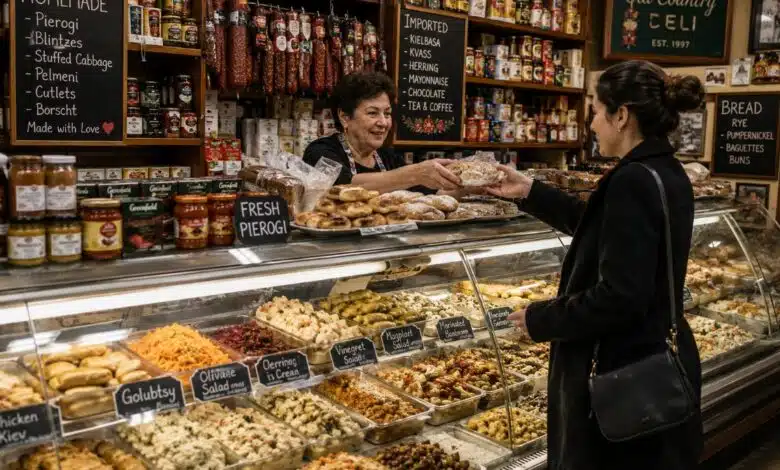
An immigrant deli is rarely just a place to buy lunch. It is a room where language, memory and appetite negotiate with the present. A grandmother points through the glass at a salad her children stopped making at home. A new customer asks whether a dumpling is more like pierogi or ravioli. Someone orders a holiday cake three weeks early because the bakery knows exactly which version the family expects.
The shelves tell one story, the prepared-food counter tells another, and the customers complete both. Imported jars preserve flavor vocabulary. Family recipes preserve technique. Holiday orders preserve timing. The deli owner, meanwhile, translates all of it into portions, labels, reheating advice and prices that make sense in a new city.
This article looks at immigrant delis as living archives—not museums frozen in nostalgia, but practical businesses that keep food traditions usable. They preserve by cooking, adapting, explaining, selling, remembering and sometimes arguing over what a dish should be called.
Immigrant delis preserve food traditions by keeping family recipes in daily circulation, importing culturally specific ingredients, preparing labor-intensive dishes people no longer make at home, maintaining holiday food calendars, and serving as informal community centers. They also adapt recipes, names and portion sizes for new generations without necessarily erasing the original culinary identity.
The prepared-food counter is where memory becomes dinner
The glass case is practical theater. Stuffed cabbage sits beside cutlets, roast vegetables, salads, dumplings, soups and cakes. The dishes may come from different regions, religions or family branches, yet the counter gathers them into one visual sentence: this is what our customers still want to eat.
Prepared food matters because tradition often disappears first at the point of labor. Rolling dough, grinding meat, fermenting cabbage, simmering broth and forming dozens of dumplings require time, space and confidence. A deli keeps those techniques available after the household stops performing them every week.
The counter also preserves proportion. A recipe written in a notebook may say “add enough flour” or “cook until ready.” The deli cook knows what the filling should feel like, how thin the wrapper should be, how much sauce belongs in one tray and how the dish changes after refrigeration.
This practical knowledge is difficult to archive in words. It lives in hands, timing, equipment and repetition. When a deli makes the same dish every week, the technique remains embodied rather than merely remembered.
What the counter preserves
Texture, portion, seasoning, sequence, reheating behavior and the relationship between dishes. A cabbage roll beside mashed potatoes and beet salad says more than three isolated recipes.
What the customer preserves
Demand. Customers ask for the sourer soup, the thinner dough, the meatless holiday version or the cake with the old filling. Their preferences pressure the deli to remember.
The deli counter also decides what is “everyday”
Some dishes become restaurant specials, while others remain deli staples. A dumpling that feels festive in one family may be a weekday lunch in another. A salad associated with holidays at home may become a permanent prepared-food item because customers want it year-round.
That shift does not necessarily weaken tradition. It can make the dish more accessible. What changes is the calendar and context, not always the recipe itself.
Vesti’s guide to reading an Eastern European deli counter is useful when the display is full of familiar-looking dishes with unfamiliar names, especially salads, cutlets, stuffed vegetables and chilled meals.
A family recipe becomes a business recipe without losing its accent
Many immigrant delis begin with a household repertoire: one person’s soup, another relative’s pastry, a grandmother’s pickling method, an uncle’s sausage seasoning. Turning those recipes into a business requires translation of a different kind.
This is where preservation becomes editing. The deli may reduce salt for a wider customer base, make portions smaller, label allergens, separate sauce, or offer a vegetarian variation. None of those decisions automatically destroys authenticity. Authenticity is not the absence of change; it is the continuity of a recognizable culinary logic.
The recipe often carries several places at once
A family may have moved through multiple countries before opening a deli. The food can carry Ukrainian, Polish, Jewish, Armenian, Russian, Georgian, Balkan, Central Asian or Middle Eastern influences in combinations that do not fit one neat national label.
Customers sometimes demand a purity the family never lived. “That is not how it is made in my region” may be true and still irrelevant to another family’s regional history. Delis preserve plural traditions, not one official cookbook.
Repetition protects technique
A dish made once a year can drift. A dish made every week develops muscle memory. The deli cook notices flour humidity, cabbage softness, meat fat, potato texture and the way dough behaves in cold weather. That repetition keeps the recipe alive as a craft.
At the same time, commercial repetition can standardize a dish that was once flexible. One benefit of a strong deli is that customers may still ask for variations: less sweet, more sour, no meat, extra dill, thinner slices, frozen rather than cooked. The conversation keeps the recipe from becoming entirely fixed.
Imported products preserve a vocabulary of taste
The shelves around the deli counter matter as much as the food inside it. Mustard, preserves, mineral water, tea, candies, canned fish, pickles, grains, noodles, spice blends, cookies and frozen foods allow customers to reconstruct meals at home.
Imported products preserve taste memory in a precise way. A certain sour cherry preserve, smoked fish, rye crispbread or sunflower candy can trigger recognition that a generic substitute does not. The label, package shape and brand may be part of the memory.
What each shelf quietly teaches
Substitution can be practical, but it changes the dish
Immigrant cooking has always adapted to available ingredients. A deli may use local cabbage, American flour, a different cut of meat or domestically produced cheese. The result can remain recognizably traditional while tasting slightly different.
Imported products reduce that distance when a specific ingredient carries the flavor structure. But imported does not automatically mean better. Fresh local produce may outperform a tired imported item. Good delis understand which ingredients must travel and which are better sourced nearby.
For readers navigating unfamiliar refrigerated cases, bakery shelves and imported labels, Vesti’s practical international food market guide explains freshness, turnover and packaging without treating the store like an exotic attraction.
The holiday calendar keeps dishes from drifting out of memory
Holiday food is one of the strongest ways immigrant delis preserve tradition because the demand returns on a schedule. Customers may cook less during the year but still expect particular breads, cakes, fish, dumplings, meats or salads for religious and family celebrations.
Holiday foods preserve sequence, not only ingredients
A holiday meal is often defined by order: what appears first, what is blessed, what remains meatless, what is eaten after fasting, what belongs with tea, and which dish must be present even if hardly anyone finishes it.
A deli preserves that sequence by grouping foods, offering complete packages and reminding customers what pairs with what. A bakery may know that one bread belongs to a specific celebration, while another is everyday. A prepared-food counter may separate meatless and meat versions because the distinction matters beyond flavor.
Commercial success can save a rare dish
Some dishes survive because holiday demand makes production financially possible. A labor-intensive pastry or fish preparation may not sell every week, but a concentrated seasonal market keeps the technique in the kitchen.
The risk is simplification. If one best-selling item becomes the entire public image of a holiday, smaller regional foods can disappear. Strong delis often preserve depth by taking special orders, rotating lesser-known items and explaining them to customers who are willing to ask.
Names change at the counter because the customer has to point at something
Immigrant delis are places of constant translation. A dish may have a name in one language, a transliterated spelling, an English description and a nickname used by regular customers. The label must fit on a small card and still help someone decide what to buy.
This process can flatten distinctions. Several dumplings become “pierogi.” Different cutlets become “meat patties.” A salad with a specific cultural identity becomes “Russian salad” or “house salad.” Yet without some translation, new customers may never try the dish.
The best labels do both: keep the original name and add a clear description. That respects the food while making the counter usable.
The spoken explanation is part of preservation
A staff member who says “this one is sour, this one is smoked, this one is usually served cold” is doing cultural work. They are teaching use, not merely ingredients.
Pronunciation, reheating, serving temperature and pairings all travel through these conversations. The person behind the counter becomes an interpreter between culinary systems.
Vesti’s article on why dishes appear under different names helps explain why the same food can look inconsistent across delis, restaurants and family kitchens without being fraudulent.
A neighborhood deli often knows more than the menu reveals
The deli may function as a bulletin board, recommendation desk, language bridge, informal job network and place to hear community news. Customers ask where to buy a specific medicine, find a church, hire a musician, order a cake or send a package.
Food creates the reason to enter, but trust is the deeper product.
For recent immigrants
The store offers familiar ingredients, familiar language and a place where practical questions can be asked without embarrassment.
For later generations
The deli provides access to foods they may recognize emotionally but not know how to cook, pronounce or fit into a full meal.
The deli can hold regional differences under one roof
A store serving a broad immigrant community may stock products from several countries and prepare dishes that overlap across borders. This creates convenience but also tension. Customers may insist on one spelling, one national origin or one correct filling.
Those disagreements show that the food matters. The deli becomes a public place where identity is negotiated through ordinary purchases.
Local customers change the role too
Non-community customers may first arrive because of a sandwich, pastry, dumpling or social-media recommendation. If the deli explains the food well, curiosity can become regular patronage. That broader customer base may help keep a traditional business financially viable.
The danger is turning the deli into a performance for outsiders. Strong businesses do not need to make every item theatrical or “Instagrammable.” The most meaningful food may remain beige, practical, chilled, wrapped or sold by weight.
The next generation preserves by changing the format
Children of deli owners often inherit more than recipes. They inherit long hours, thin margins, supplier relationships, multilingual service and the pressure to represent a community correctly.
Some continue the original model. Others add online ordering, modern packaging, delivery, catering, social media, coffee service, updated interiors or clearer labeling. These changes can look cosmetic, but they may determine whether the business survives.
Modernization can protect labor
A new generation may reduce the menu, standardize orders or stop making an item that is too labor-intensive and rarely purchased. That can feel like loss, but an unsustainable menu preserves nothing if the business closes.
The more interesting question is what remains central. Does the deli still make its own soups, salads, dumplings or breads? Does it continue holiday production? Does someone in the kitchen understand the original method even when the retail format changes?
Social media can preserve and distort
A short video can teach thousands of people how a pastry is folded or how a deli counter is arranged. It can also reduce a complex business to one photogenic cheese pull.
The strongest deli storytelling shows process, people and context—not only abundance. A tray of dumplings is more meaningful when customers understand why the dish is made, how it is served and when families order it.
Different delis preserve different kinds of continuity
The phrase “immigrant deli” covers businesses with very different food systems. One may center cured meat and sandwiches. Another may function as a grocery with a hot counter. Another may be a bakery, butcher and catering kitchen at once.
These examples overlap, and that overlap is part of the story. Borders, migration and mixed families create counters that resist simple classification.
Readers looking for the restaurant, bakery and grocery differences can use Vesti’s Polish food discovery guide, Ukrainian food near-you guide and Russian food restaurant and market guide as practical examples of how immigrant food appears across business formats.
Takeout changes the dish, so the deli has to preserve more than flavor
A prepared dish eaten at home is not the same as one served immediately. Steam softens crust. Sauces leak. Cold salads warm beside hot trays. Bread becomes damp. Good delis preserve tradition through packaging instructions as much as recipes.
Frozen food can be a form of cultural continuity
Frozen dumplings, cutlets, breads and pastries allow customers to keep traditional food in the home without buying it fully prepared every time. For busy families, frozen food may preserve the tradition more effectively than a beautiful but impractical restaurant plate.
The key is instruction. Boil from frozen or thaw first? Bake covered or uncovered? Pan-fry after boiling? The deli that explains these details transfers technique along with the product.
Vesti’s article on which foods survive takeout and delivery helps readers understand why some deli foods arrive beautifully while others need separation, venting or reheating.
Preservation is not the same as freezing food in time
The word “preserve” can make immigrant food sound static, as if the deli’s job were to reproduce one exact past forever. Real food traditions have always changed through season, class, migration, marriage, technology and ingredient availability.
A deli can preserve continuity while changing format. A soup may be sold in microwave-safe containers. A holiday cake may be offered in smaller sizes. A dumpling filling may become vegetarian. A label may use English. A recipe may reduce an ingredient that became difficult to source.
What makes change feel respectful?
Continuity remains visible
The flavor structure, technique, serving context or cultural name is still recognizable. The change solves a practical problem rather than hiding the dish.
The customer is not misled
A modern variation is labeled honestly. The deli does not present a fusion version as the only traditional form.
What makes change feel hollow?
When the business keeps only the visual stereotype and removes the technique, context and community relationship. A decorative folk pattern on a package does not preserve a food tradition if the product bears no meaningful connection to the dish.
Preservation is strongest when customers can still ask questions and receive answers grounded in practice.
How to shop an immigrant deli without treating it like a museum
Curiosity is welcome. Performance is not required. You do not need to know every pronunciation before entering, but you should be willing to read, ask and listen.
Do not ask staff to rank an entire culture
“What is the best food from your country?” is too broad. Ask what the deli makes in-house, what is fresh today, what people order for holidays or which dish travels well.
Notice turnover
A prepared-food counter should look active. Fresh batches, changing trays and regular customers are useful signals. A full case is not automatically a fresh case.
Read the store as a system
The bread may belong with the soup. The sour cream may belong with the dumplings. The mustard may belong with the sausage. The counter, shelves and freezer often explain one another.
What disappears when the deli disappears
When an immigrant deli closes, a neighborhood loses more than retail square footage. It may lose a commercial kitchen that knew how to make a rare pastry, a supplier willing to import a small-volume product, a place where older customers used their first language and a counter where younger customers learned what their families ate.
Recipes can move online. Technique can be recorded. Products can be shipped. But the combination of food, conversation, timing and community is harder to replace.
Supporting the deli means using it
Buy prepared food on an ordinary week, not only during a cultural festival. Order holiday foods early. Ask whether catering is available. Purchase frozen items that fit your household. Recommend the store accurately rather than describing it as a curiosity.
Preservation is economic. A dish remains on the counter because people buy it often enough for someone to keep making it.
The future may look smaller and more focused
Some delis will survive by narrowing the menu, specializing in one region, moving production off-site or combining retail with online ordering. That may change the classic crowded-store image, but it can keep the culinary knowledge alive.
The question is not whether the deli looks exactly as it did twenty years ago. The question is whether the community can still find the flavors, techniques and holiday foods that make the store matter.
The invisible labor behind the counter often has a woman’s hands
Many food traditions survive because women carried them through domestic kitchens long before the recipes became commercial products. When a deli opens, that household knowledge may enter a public business for the first time. The labor becomes visible in trays, batches and price tags, but the skill itself is often still described as “just cooking.”
It is not just cooking. It is planning, sourcing, soaking, rolling, filling, tasting, correcting and knowing when a dish will hold for service. It is remembering which customer wants the less-sweet cake and which holiday order needs a meatless version.
What customers see
Neat rows of dumplings, salads, pastries and stuffed vegetables ready for purchase.
What the work contains
Years of repetition, timing, hand strength, sensory memory and the emotional pressure of representing family food in public.
Commercialization can give this labor income, recognition and continuity. It can also turn one person’s knowledge into an exhausting production schedule. A respectful deli culture values the cook as a craftsperson, not merely as someone who can reproduce nostalgia cheaply.
Recipes often survive through correction rather than instruction
A younger worker may learn by being told the dough is too stiff, the filling too wet or the soup not sour enough. The language can sound imprecise, but the sensory standard is exact. Over time, the learner develops the same judgment.
Recording recipes can help, but written measurements should not replace apprenticeship. The most durable preservation combines both: notes for consistency and experienced tasting for correction.
A deli preserves atmosphere as well as recipes
Memory is not only flavor. It is the smell of smoked meat near the entrance, yeast from the bakery, dill from the cold case, cardboard boxes stacked by the register and coffee poured into a small paper cup. It is the sound of two languages changing in the same sentence.
These details matter because food traditions are social environments. A jar purchased online may preserve the product, but not the conversation about how it should be served. A frozen dumpling shipped across the country does not recreate the counter where someone recommends sour cream, fried onion or butter.
The sensory archive
Modern renovation can improve cleanliness, accessibility and comfort without erasing this atmosphere. The goal is not to preserve clutter for nostalgia. It is to keep the store legible as a place with a specific food culture.
Children often learn the tradition by choosing one thing from the case
A child does not need to understand migration history to remember a deli. They remember the cookie, the sausage slice, the dumpling, the bright drink or the ritual of carrying a cake to the car.
Those small choices matter because later generations may not inherit full household cooking routines. They may inherit fragments: one soup, one holiday bread, one brand of candy, one pronunciation. The deli gives those fragments somewhere to reconnect.
Recognition can come before knowledge
An adult customer may know that a salad belongs at every family celebration without knowing its formal name. They may recognize the dumpling by shape but not know how the dough is made. The deli allows participation before expertise.
Over time, repeated visits can deepen that relationship. The customer asks questions, learns names, buys ingredients and perhaps tries cooking the dish at home. Commercial access becomes a bridge back to technique.
During crisis, the deli can become a practical form of solidarity
When war, displacement, economic instability or natural disaster affects an immigrant community, the local deli often becomes a gathering point. Fundraisers appear at the register. Donation boxes fill. Customers exchange news, organize deliveries and ask how to help relatives abroad.
Food is not a substitute for political action or material aid, but the store offers infrastructure: a known location, trusted owners, regular foot traffic and a network of suppliers and customers.
In these moments, the deli’s role as a community institution becomes impossible to dismiss. The prepared-food counter is still important, but trust is what makes the place useful.
Tradition has a cost, and the receipt tells part of the story
Customers sometimes compare deli prices with supermarket prices without comparing the labor. Hand-formed dumplings, stuffed vegetables, layered cakes, smoked meats and holiday breads require time. Imported ingredients, refrigeration, skilled staff and small production runs add cost.
A low price can make traditional food accessible, but permanently underpricing labor threatens the business that preserves it. The tension is real: a community deli must remain affordable enough for regular customers while charging enough to survive.
Price also shapes which traditions survive
A dish that customers consider too ordinary to pay for may disappear from commercial production even if it carries deep cultural value. Meanwhile, a photogenic pastry may survive because it sells well to a broader audience.
Delis constantly negotiate between community meaning and economic reality. Supporting them means understanding that cultural preservation cannot depend on invisible or underpaid labor forever.
Good deli etiquette is mostly about patience and proportion
Busy counters can feel intimidating, especially when regular customers order quickly in another language. The solution is not to disappear or demand a private culinary lecture during the lunch rush.
Pronunciation effort is welcome; perfection is not required
Use the label, point politely or describe the item. Staff are usually more interested in helping you buy the correct food than evaluating your accent.
Do not turn difference into spectacle
Avoid filming staff or customers without permission, mocking unfamiliar packaging or describing ordinary community food as “crazy.” Curiosity is useful when it remains respectful.
The deli preserves tradition by making it useful
Food traditions do not survive because they are admired from a distance. They survive because someone still cooks the soup, orders the cake, buys the dumplings, argues about the filling, asks for the holiday version and teaches a child what to eat with it.
An immigrant deli keeps memory edible. That is a humble form of cultural work, and one of the most important.
Frequently Asked Questions
What is an immigrant deli?
An immigrant deli is a food business that serves a specific immigrant community or several related communities through prepared foods, groceries, bakery items, meats, cheeses, frozen foods and imported products. Some look like classic sandwich delis, while others function more like small markets with hot and cold counters.
How do immigrant delis preserve family recipes?
They keep recipes in regular production. A dish that may no longer be made at home every week is still cooked, portioned and sold by people who understand its texture, seasoning and serving style. Repetition also preserves practical knowledge that written recipes often leave out.
Why are holiday foods important in immigrant delis?
Holiday demand gives labor-intensive dishes a reliable season. Delis can produce breads, cakes, dumplings, fish, meats and salads in larger batches while helping families maintain familiar meal traditions even when they do not have time or space to cook everything themselves.
Are deli recipes exactly the same as recipes in the home country?
Not always. Ingredients, equipment, customer preferences and food regulations may require changes. Families also bring regional and personal variations. A deli can preserve a recognizable tradition without reproducing one supposedly universal version.
Why do the same dishes have different names in different delis?
Menus may use the original language, transliteration, an English description or a local nickname. Regional differences and migration histories also affect naming. The clearest labels keep the traditional name and add a practical ingredient description.
What should I ask at an immigrant deli counter?
Ask what is made in-house, what is freshest today, how a dish is usually served and how it should be reheated. These questions are more useful than asking for the single most authentic or most popular item.
Are imported products always better than local substitutes?
No. Some imported brands or ingredients carry a specific flavor that customers value, but fresh local produce, dairy or meat may be better than an imported item that has traveled poorly. Good delis decide carefully which products need to be imported and which are best sourced nearby.
How can I support an immigrant deli?
Shop there regularly, order holiday foods early, use catering when appropriate and buy prepared or frozen foods that fit your real household. Accurate recommendations and repeat business help keep labor-intensive dishes economically possible.
Do immigrant delis serve only members of their own community?
Usually not. They may be essential community spaces, but many also welcome customers who are new to the cuisine. Clear labels, patient explanations and practical serving advice help unfamiliar diners shop respectfully.
What is the difference between an immigrant deli and an international market?
An immigrant deli usually places stronger emphasis on prepared foods, meats, cheeses, bakery items or family recipes, while an international market may have a broader grocery selection. Many businesses combine both formats, so the distinction is often one of emphasis rather than a strict category.


