
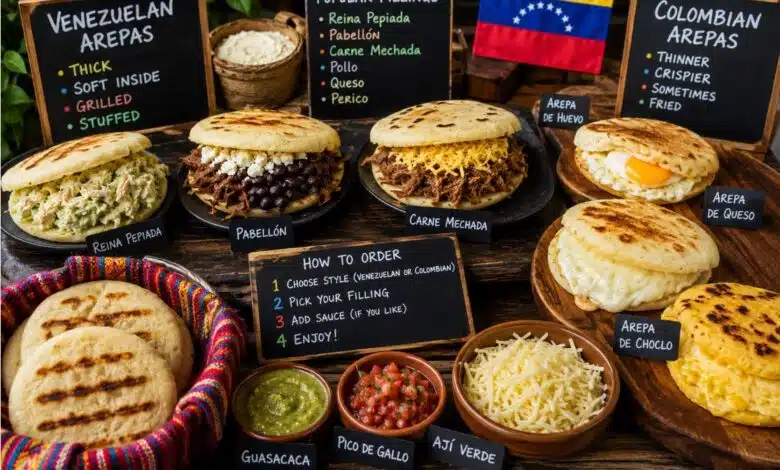
The first mistake people make with arepas is asking for “the authentic one” as if one corn cake represents two countries, dozens of regions and every breakfast table from Caracas to Bogotá. An arepa can be thin or thick, grilled or fried, split and filled or served beside eggs, cheese and meat. It can be street food, bakery breakfast, restaurant lunch or a late-night answer to hunger.
So I am not organizing this as a museum of definitions. I am organizing it like the moment at the counter when the menu is longer than expected and the person behind you already knows exactly what they want.
First choose the country style. Then the format. Then the filling. Then decide whether you want breakfast, a full meal or something portable. By the end, the word “arepa” should feel less like one dish and more like a language you can actually order in.
Arepas are round corn cakes associated especially with Venezuela and Colombia. Venezuelan arepas are often thicker, split open and generously filled with meats, beans, cheese, avocado or eggs. Colombian arepas vary widely by region and are often served flatter, topped or alongside a meal, with cheese, egg, butter or other local additions. Order by asking how the arepa is cooked, whether it is filled or served on the side, and which fillings define the restaurant.
At the counter, “arepa” is only the beginning of the sentence
One menu lists reina pepiada, pabellón, domino, perico and catira. Another lists arepa de queso, arepa de choclo, arepa con huevo and arepa paisa. A third simply says “arepa with cheese” and leaves all the regional history off the sign.
None of this is inconsistency. It is the point. Arepas are flexible enough to become breakfast, side dish, sandwich, snack and street food without losing their core identity as cooked corn cakes.
The menu’s structure tells you how the business understands the dish. A Venezuelan counter may organize by named fillings. A Colombian bakery may organize by dough style, cheese, egg or regional type. A general Latin restaurant may offer only one simplified version.
When the menu names the filling
Expect the arepa to function like a complete handheld meal. The filling is the identity.
When the menu names the dough style
Expect texture, cheese, corn type or cooking method to matter as much as what sits inside or beside it.
Choice one: Venezuelan or Colombian is a useful distinction, not a competition
Both countries have deep arepa traditions, and neither can be reduced to one national standard. The practical difference for a diner is usually format.
Venezuelan arepas
Often thicker and designed to be split open. The pocket holds shredded meat, chicken salad, beans, cheese, avocado, eggs or combinations substantial enough to become a full meal.
Colombian arepas
More often vary by regional dough, thickness and cooking style. They may be topped with butter or cheese, served alongside eggs or meat, stuffed with egg, or made from sweet corn.
This distinction helps at the counter, but it should not become a rigid rule. Venezuelan arepas can be plain or lightly filled. Colombian arepas can be stuffed. Family and regional practices overlap.
Choice two: the dough tells you how the arepa wants to be eaten
Arepa dough is commonly made from precooked cornmeal, water and salt, though regional versions may use fresh corn, cheese, fat or other additions. Texture changes with grind, hydration, thickness and cooking method.
A good arepa should not be dry just because cornmeal is involved
The outside may be crisp or toasted, but the interior should remain tender. A dry, chalky center suggests poor hydration, overcooking or an arepa held too long.
Thickness is functional
A thick arepa must be strong enough to hold filling without becoming a dense brick. A thin arepa should not be so brittle that it shatters. The ideal texture depends on the role.
Choice three: choose the filling by texture, not only by name
Filled arepas can become heavy quickly. The smartest order balances soft filling, salty cheese, fresh herbs, avocado, beans or crisp vegetables.
Reina pepiada
Pabellón
Domino
Pelúa
Catira
Named fillings are shorthand, not universal formulas
One restaurant may use more avocado, another more mayonnaise, another a different cheese. Read the ingredient line and ask about the kitchen’s version.
Colombian arepas make more sense when you order by region or occasion
Colombian arepas are remarkably varied. Some are everyday accompaniments. Others are sweet, cheesy, fried or filled enough to become meals.
Do not assume “plain” means unimportant
An arepa served beside eggs, beans, meat or soup can function like bread at the table. Its simplicity is useful. It absorbs sauce, carries butter or cheese and gives the meal structure.
Fresh corn changes the entire personality
Arepa de choclo tastes sweeter and softer because the corn itself leads. It pairs naturally with salty cheese. Someone expecting a neutral corn cake may be surprised.
Breakfast is where arepas reveal how ordinary and essential they can be
Breakfast arepas are not always dramatic. They may arrive with butter and cheese, eggs, perico, ham, beans or shredded meat.
Perico is a useful breakfast word
In Venezuelan food contexts, perico commonly refers to scrambled eggs with tomato and onion. Inside an arepa, it creates a soft, savory breakfast filling that benefits from cheese or avocado.
Breakfast arepas should not feel like leftover dinner
Heavy shredded meat and beans can be delicious in the morning, but a bakery or café should still offer lighter cheese, egg or sweet-corn options.
Vesti’s guide to international breakfast dishes worth knowing places arepas beside other morning foods that can be simple at home and elaborate in restaurants.
Street-food arepas are designed around speed, heat and one-handed optimism
A street-food arepa must cook quickly, hold filling and survive movement. That often means stronger crust, generous wrapping and sauces applied with more confidence than restraint.
What street food does well
Immediate heat, crisp surfaces, bold fillings, visible cooking and portions that feel generous.
Where it can fail
Overfilling, leaking sauces, wet bottoms, long holding and an arepa too fragile to carry.
Watch the griddle or fryer
Turnover matters. Arepas cooked continuously for active demand usually have better texture than a stack held warm for a long time.
Sauces should sharpen, not dissolve
Garlic sauce, cilantro sauce, hot sauce and avocado-based sauces can be excellent. Too much liquid turns a handheld arepa into a plate problem.
Restaurant arepas can be cleaner, prettier and less revealing
A restaurant may serve the arepa sliced, plated with salad, accompanied by fries or arranged as part of a tasting menu. Presentation can help, but it may also hide whether the corn cake itself is good.
Taste the edge before the center
The first bite of exposed arepa tells you about corn flavor, crust and moisture before the filling takes over.
A side salad can rescue a rich filling
Reina pepiada, pabellón and cheese-heavy fillings benefit from something acidic or crisp. A small salad, pickled onion or fresh tomato gives the plate movement.
Fries are not always the best side
Corn cake plus rich filling plus fries can become a wall of starch. Beans, salad, avocado or plantain may create a more interesting plate.
Bakery and market arepas live on a different clock
In a bakery, arepas may be pre-cooked, reheated, filled to order or sold chilled for home. In a market, they may appear in refrigerated packages, frozen sections or prepared-food counters.
Ready-to-eat bakery arepa
Refrigerated packaged arepa
Frozen arepa
Vesti’s international food market guide helps with freshness, frozen sections and prepared-food turnover when arepas are sold outside a restaurant.
Choose the filling by mood, because appetite is more useful than hierarchy
I want something fresh
I want something deeply comforting
I want vegetarian
I want breakfast
I want the corn to matter most
Sauce is where an arepa can become brilliant or impossible to hold
Arepa dough is mild enough to welcome sauce, but the filling may already contain avocado, cheese, mayonnaise, beans or meat juices.
Ask for sauce on the side for takeout
The arepa continues absorbing moisture during the trip. A sauce that is perfect at the counter may destroy texture twenty minutes later.
Takeout arepas need architecture, not optimism
A filled arepa is compact, but it is not invincible. Steam, sauce and heavy fillings soften the shell. Cold fillings warm beside hot meat.
Which fillings travel best?
Shredded beef, chicken and cheese, beans and cheese, or plain cheese generally travel better than very wet avocado salads or egg-filled fried arepas.
Vesti’s guide to foods that hold up during takeout and delivery explains why moisture separation matters so much for filled breads and corn cakes.
Dietary questions are simple only when the filling is simple
Gluten
Traditional arepa dough is made from corn and may be naturally gluten-free, but cross-contact can occur on shared griddles, fryers and prep surfaces. Packaged seasoning, sauces and fillings also need checking.
Vegetarian
Cheese, eggs, beans, avocado, plantain and vegetable fillings create many options. Confirm whether beans or sauces are cooked with meat stock or animal fat.
Vegan
Beans, avocado, plantain and vegetables can work when cheese, mayonnaise and butter are omitted. Ask about dough additions and griddle fat.
Dairy
Cheese appears frequently, including inside the dough of some styles. A plain arepa is not automatically dairy-free.
Fried food
Arepa con huevo and other fried versions may share oil with gluten-containing or meat products. Diners with medical restrictions should ask directly.
A first arepa order should reveal the dough and the filling separately
Do not begin with the largest possible combination unless hunger is the only goal. Choose one arepa where the dough remains visible and the filling has a clear identity.
First Venezuelan order
Reina pepiada for something cool and approachable, or domino for a vegetarian combination of beans and cheese.
First Colombian order
Arepa de queso or arepa de choclo to understand how cheese and corn shape the product before moving to heavier regional styles.
Order one, then decide whether you need another
Filled Venezuelan arepas can be much more substantial than they look. A large pabellón arepa may equal a full lunch.
Taste one exposed edge before adding sauce. You should be able to identify toasted corn, tenderness and salt.
The ordering mistakes that make arepas harder than they are
Assuming every arepa is stuffed
Many Colombian arepas are served plain, topped or beside other food.
Assuming every arepa is small
A generously filled Venezuelan arepa can be a full meal.
Ordering by the longest ingredient list
More components can hide the corn cake and create texture problems.
Adding every sauce immediately
Taste the filling first. The arepa may already be creamy, salty or spicy.
Calling arepas “Latin sandwiches” and stopping there
The comparison helps explain the handheld format but erases side-dish, breakfast and regional dough traditions.
Expecting wheat-bread texture
Corn dough has a different crumb and bite. Tender does not mean fluffy like brioche.
Comparing Venezuelan and Colombian styles only to declare a winner
The comparison is useful for ordering, not ranking entire food cultures.
Packaged arepas are useful when you treat them as a base, not a finished miracle
Refrigerated and frozen arepas can create a fast breakfast or lunch. Texture depends on reheating.
Griddle or skillet
Oven or toaster oven
Microwave
Build contrast at home
Add beans, eggs, cheese, avocado, shredded meat, pickled onion or tomato. Avoid combining five soft fillings without anything acidic or crisp.
Do not overfill before the arepa is fully hot
A cold center under warm filling feels dense and unfinished. Reheat first, split second, fill last.
Regional variation is not confusion; it is the reason the dish stays alive
Arepas change because corn, cheese, cooking equipment, breakfast habits and migration histories change. A coastal fried arepa and an inland cheese arepa do not need to resemble each other closely to belong to the same family.
Restaurants outside Venezuela and Colombia may adapt size, fillings and language for local customers. The useful question is whether the kitchen explains the style honestly.
Respectful adaptation
Keeps the corn cake recognizable, names the inspiration and describes nontraditional fillings clearly.
Empty adaptation
Uses “arepa” as a trendy label for any corn-based sandwich without preserving texture or context.
Food traditions remain visible when variation is explained rather than hidden.
The texture audit: an arepa should be sturdy without feeling armored
The best arepas have structural confidence. They hold filling, survive handling and still feel tender enough to bite without tearing the meal apart. This balance is harder than it looks.
Too soft, and the arepa collapses under beans, avocado or shredded meat. Too dry, and every bite feels chalky. Too thick, and the filling becomes an accent inside a wall of corn. Too thin, and the shell cracks before the last bite.
Steam can help and hurt
Freshly cooked arepas often need a brief rest so the interior sets. Seal them too quickly, and trapped steam softens the crust. Leave them uncovered too long, and the surface dries.
This is why a counter that finishes arepas to order usually offers better texture than one holding a large stack for hours.
Cheese changes more than richness
Cheese may be mixed into the dough, melted inside, tucked into the split arepa or served on top. Each format creates a different experience.
Cheese in the dough
Cheese inside
Cheese on top
Salt balance matters
Cheese, shredded meat, beans and sauce can all carry salt. A well-built arepa keeps one element fresh or mild—avocado, tomato, egg or plain corn dough.
Portion size is the hidden reason some first orders go wrong
Arepas look compact, but thick dough and rich fillings make them substantial. A large Venezuelan arepa can easily be lunch. Two may be too much unless they are small or shared.
Snack-size arepa
Useful for tasting, breakfast or adding to a larger plate. Often simpler in filling.
Meal-size arepa
Thicker, more generously filled and often difficult to eat neatly without a plate.
Ordering for two
Share one rich filling and one simpler style. A pabellón arepa plus arepa de queso gives more range than two overloaded meat combinations.
Ordering for a group
Choose several contrasting fillings rather than repeating chicken and cheese in slightly different forms. Include one vegetarian option and one simple cheese or corn-focused arepa.
What to drink with arepas depends on the filling
Coffee belongs naturally with breakfast arepas, especially cheese, eggs or sweet corn. Fresh fruit drinks work with grilled meat, beans and fried styles. Malt beverages and sodas may appear in casual counters, while water is often the smartest choice with very rich fillings.
One drink should not compete with five fillings
The more complex the arepa, the simpler the drink should be. A rich pabellón filling rarely needs a heavily flavored beverage.
How to read arepa reviews without letting one photograph decide everything
Customer photos reveal size, filling generosity and whether the arepa arrives intact. They do not always reveal texture, freshness or whether the shell was held too long.
Useful review clues
Made to order, crisp exterior, tender center, filling temperature, sauce separation, portion size and whether the arepa remained intact during takeout.
Weak review clues
“Authentic,” “huge,” “cheap” or “Instagram-worthy” without describing dough, filling or service.
Check what regulars reorder
A restaurant’s best-known filling may not be the most revealing. Repeated praise for plain cheese arepas, breakfast arepas or one regional style can indicate stronger fundamentals.
Recent menu photos matter
Names, sizes and combinations change. If one specific filling is the reason for your visit, verify the current menu rather than relying on an old review.
Arepas in a bakery follow the bakery clock
Morning arepas may be fresher, simpler and built for breakfast. Lunch brings meat, beans and more elaborate fillings. Late-day packaged arepas may be designed for reheating rather than immediate eating.
Vesti’s guide to recognizing a good neighborhood bakery explains how production cycles, filling quality and takeaway affect products beyond bread and pastry.
Arepas are family food because they can be customized without becoming separate meals
One person can choose cheese, another beans, another chicken and another plain butter. The base remains the same, which makes arepas useful for families with different appetites.
For children
Cheese, egg, ham or mild chicken are approachable. Very large filled arepas may be difficult to hold, so smaller sizes or split portions work better.
For mixed dietary needs
A table can include meat, vegetarian and vegan fillings while using the same corn base. Cross-contact still matters in shared kitchens.
For breakfast gatherings
Serve plain arepas with eggs, cheese, avocado, beans and meat separately. Everyone assembles their own without the kitchen preparing several unrelated dishes.
Late-night arepas are generous, but the best ones still respect structure
After a long evening, rich fillings feel appealing: shredded beef, cheese, plantain, beans and sauces. This is where overfilling becomes most tempting.
A good late-night arepa remains edible from first bite to last. The bottom does not dissolve. The filling does not fall out immediately. The shell remains warm.
A balanced arepa is easier to eat and lets the corn cake remain part of the experience.
Choose one dominant richness
If the filling contains beef, beans, cheese and plantain, go lighter on sauce. If the arepa contains creamy chicken and avocado, fresh herbs or hot sauce may help more than extra cheese.
Six complete arepa orders that actually make sense
1. First Venezuelan lunch
2. Vegetarian comfort order
3. Colombian breakfast
4. Sweet-corn snack
5. Full dinner
6. Street-food test
The corn should survive the filling
A great arepa is not merely a container. Even under shredded meat, avocado or cheese, the corn should still be present in aroma and flavor. This is why the first bite from an exposed edge matters so much.
Some arepas taste sweeter because of fresh corn. Others taste toastier from the griddle. Fried versions bring deeper browned flavor. Cheese in the dough adds salt and richness, but the best examples still feel recognizably corn-based.
When corn leads
The arepa can be served simply with butter, cheese, eggs or coffee. The dough itself is the attraction.
When filling leads
The arepa needs enough structure and flavor to remain part of the meal rather than disappearing beneath sauce.
Why bland dough is a problem
A bland arepa forces the filling to carry every part of the experience. Restaurants may compensate with more cheese, sauce and meat, making the final order heavier without making it better.
Time of day changes the best arepa order
Breakfast favors cheese, eggs, butter, ham and sweet corn. Lunch supports chicken, beef, beans and avocado. Late-night counters lean toward larger, richer fillings and more sauce.
The menu may not change by hour, but your appetite should. The largest arepa is not automatically the best value when you only wanted a snack.
A few ordering phrases make the counter easier
You do not need perfect Spanish. Clear questions about style, filling and size are enough.
The goal is not to perform expertise. It is to leave with the arepa that matches your appetite.
The second arepa should teach you something new
If your first order was a heavily filled Venezuelan arepa, make the second visit simpler. Try cheese, sweet corn or a plain grilled style so you can focus on the dough. If your first order was a Colombian breakfast arepa, return for a filled lunch version and notice how structure changes.
Reordering the same favorite is comforting, but comparison builds understanding. One visit teaches filling. The next teaches corn, thickness, griddle flavor and regional style.
Change only one variable at a time: country style, cooking method, filling or time of day. You will understand the difference instead of simply eating a second large meal.
A well-chosen arepa should feel specific, balanced and complete—not merely oversized, overloaded or famous. The corn still needs its own clear distinct voice.
The arepa you should order is the one whose format matches your appetite
Choose Venezuela when you want a filled handheld meal. Choose a Colombian regional style when corn, cheese, egg or the arepa’s place beside breakfast matters more than a dramatic filling.
Then taste the edge. If the corn cake is good on its own, everything inside it has somewhere meaningful to belong.
Frequently Asked Questions
What are arepas made from?
Arepas are commonly made from precooked cornmeal, water and salt. Regional versions may include fresh corn, cheese, butter or other additions.
What is the difference between Venezuelan and Colombian arepas?
Venezuelan arepas are often thicker, split and generously filled. Colombian arepas vary widely by region and are often thinner, cheesier, sweeter, fried or served beside a meal rather than used as a stuffed sandwich.
What is the best arepa filling for a first-time order?
Reina pepiada is approachable if you like chicken and avocado. Domino—black beans and white cheese—is a strong vegetarian choice. For Colombian styles, start with arepa de queso or arepa de choclo.
Are arepas eaten for breakfast?
Very often. Breakfast versions may include cheese, butter, eggs, perico, ham, beans or shredded meat. Some are served plain beside a larger breakfast plate.
Are arepas gluten-free?
Traditional corn arepas may be naturally gluten-free, but shared griddles, fryers, sauces and fillings can create cross-contact. Ask the restaurant when a medical restriction matters.
What is reina pepiada?
Reina pepiada is a Venezuelan arepa filling made with chicken and avocado, usually mixed into a creamy salad. It is cool, rich and mild.
What is arepa de choclo?
Arepa de choclo is a Colombian sweet-corn arepa. It is softer and sweeter than a standard white-corn arepa and is commonly paired with cheese.
What is arepa con huevo?
Arepa con huevo is a fried Colombian arepa associated especially with the Caribbean coast. An egg is placed inside the dough, and some versions include meat.
Do arepas travel well for takeout?
Plain and moderately filled arepas travel reasonably well. Very wet sauces, avocado-heavy fillings and long sealed trips can soften the shell, so sauce on the side is helpful.
How should packaged arepas be reheated?
A skillet, griddle, oven or toaster oven usually restores the exterior better than a microwave. Heat the arepa fully before splitting and adding fillings.


