
Vesti Food Atlas · Practical venue guide
A food hall, a public market and a food court can all place several vendors under one roof, yet they create very different meals. The distinction shows up in the price of lunch, the kind of seating you find, whether you bus your own tray, how carefully vendors are curated and whether the building is designed for quick convenience or for lingering.
The distinction that matters
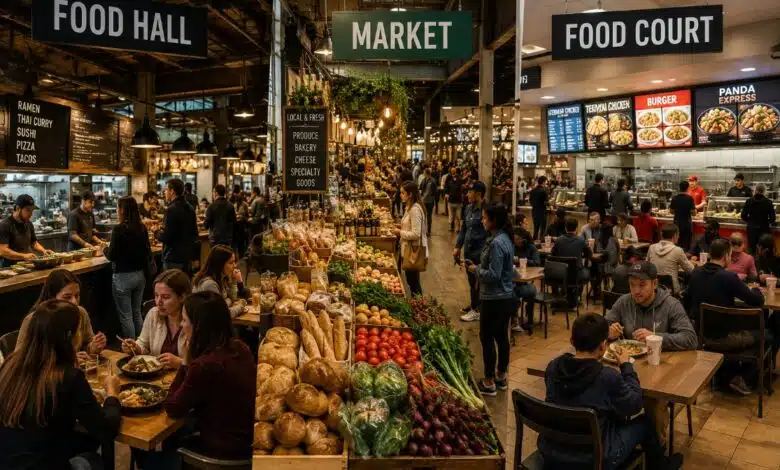
A food court is usually built around speed and shared seating, a food hall is organized around a curated mix of independent food businesses, and a market combines food shopping with prepared meals. The names are not legally fixed, so real places often overlap. Look at how the venue functions—what it sells, how you order, where you sit and whether groceries are part of the experience—rather than trusting the sign above the door.
Three buildings, three different promises
The easiest way to understand these formats is to ask what the building promises before you even look at a menu. A food court promises that several people can buy different meals quickly and still sit together. A food hall promises variety with a point of view: local vendors, chef-driven counters, specialty drinks, carefully designed surroundings or some combination of those ideas. A market promises access to food itself—produce, meat, bread, spices, cheese, prepared dishes and the people who sell them—even when there are tables and ready-to-eat meals nearby.
Those promises affect almost every practical detail. Food courts often sit inside shopping centers, airports, office complexes, hospitals or transportation hubs because they solve the problem of feeding many people efficiently. Food halls are more likely to turn dining into the destination. Markets may serve tourists, neighborhood shoppers, home cooks and lunch customers at the same time.
None of the three is automatically more authentic, more affordable or better. A plain food court can contain an excellent family-run counter. A handsome food hall can feel expensive and repetitive. A historic market can be deeply useful to residents or gradually shift toward tourism. The label gives you a starting point; the vendor list tells you what the visit will actually be like.
The food court: speed, familiarity and one shared table
A food court is the most straightforward of the three formats. Several quick-service vendors face a common seating area, and each counter usually operates its own line, register, menu and pickup process. You order, carry your tray to a table and clear it afterward according to the venue’s system.
The classic food court is attached to another reason for being in the building. You may be shopping, catching a flight, working nearby or taking a break between errands. The meal is designed to fit around that activity. Menus tend to be easy to scan, portions are standardized and dishes are selected for fast production. Even when the vendors are independent, the overall rhythm remains practical: choose, pay, collect, sit, leave.
What food courts do especially well
They make mixed preferences easy. One person can order noodles, another pizza, another a salad and another dessert without negotiating a single restaurant menu. This is useful for families, coworkers and groups with different budgets. It can also be easier for a cautious eater who wants a familiar brand while someone else tries a regional specialty.
Food courts often offer the simplest seating rules. The tables belong to the shared area rather than to an individual vendor, so customers do not need to coordinate service timing. The person with a made-to-order dish can join someone whose food was ready immediately.
Where the format can disappoint
The convenience can flatten the experience. Ventilation, noise and crowds may make the room feel hectic. The shared tables may be practical rather than comfortable. Menus are often optimized for broad appeal, which can mean fewer regional details or a reduced version of a cuisine.
There is also a hidden timing problem. If four people order from four counters, their food may be ready at different moments. The person who receives a hot bowl first may watch it cool while everyone else waits. A good group solves this by choosing vendors with similar preparation times or by agreeing that nobody needs to wait ceremonially before eating.
The food hall: a restaurant collection with editorial taste
A food hall usually treats the vendor lineup as the main attraction. Instead of simply filling available counters, the operator often selects businesses to create a particular mix: perhaps handmade pasta, regional tacos, a bakery, specialty coffee, oysters, natural wine, dumplings, ice cream and a cocktail bar. The best food halls feel edited rather than accidental.
That curation changes how people use the space. Visitors may arrive specifically to browse, compare and spend time there. The architecture, music, lighting and communal tables become part of the experience. Some halls occupy renovated factories, railway buildings, department stores or warehouses; others are newly built but borrow the visual language of an urban market.
Why the food may cost more
A food hall often includes smaller businesses paying for a prominent location, specialized equipment and shared operating services. Vendors may use higher-cost ingredients, produce food in smaller batches or sell dishes that require more labor than standard quick-service meals. The venue itself may also be positioned as a leisure destination. You are paying not only for calories but for access to several concepts in one designed environment.
That does not mean every item is expensive. The smartest food-hall order is frequently a focused dish rather than a full restaurant-style meal: one bowl, one sandwich, a few dumplings, a pastry or a shared plate. The cost rises quickly when a visitor treats every counter as a course and adds premium drinks.
The vendor mix matters more than the decor
A beautiful room can still contain six versions of the same fashionable food. Before visiting, read the vendor list. Look for meaningful differences in cuisine, technique, meal type and price. A hall with a bakery, seafood counter, vegetarian kitchen, regional noodle specialist and family-run grill offers more useful variety than one dominated by burgers, fried chicken and dessert counters with different branding.
A strong food hall lets a group disagree about dinner without making the meal feel fragmented.
Food halls are particularly good for a low-pressure tasting trip. You can share one item, walk around, then decide what deserves a second order. The weak version of this strategy is buying five rich dishes at once and discovering that everything cools before you can appreciate it.
The market: ingredients, prepared food and the life around both
A market is the broadest and oldest of these ideas. Its core function is trade in food and household provisions, not merely restaurant service. A public market may contain produce stalls, fishmongers, butchers, bakers, cheesemongers, spice sellers, specialty grocers and flower vendors alongside counters serving breakfast, lunch or snacks.
Some markets are enclosed halls. Others spread across open-air stalls, permanent shops or several buildings. Some operate daily; others appear only on particular mornings or seasons. The prepared-food section may be central, or it may occupy just one aisle among vendors supplying home cooks.
Why markets feel different from food halls
In a true market, the ingredients have their own importance. You can watch residents buy greens, bread, meat, dried chiles or fruit while another customer eats a hot meal made from the same food culture. This creates a connection between restaurant dishes and the pantry that supports them.
The vendor mix may be less polished and more practical. Signs can be handwritten. Seating may be scarce. A stall may specialize in one product for decades rather than launch a broad, camera-ready concept. The experience can be more rewarding, but it asks the visitor to pay attention. The best item may not have the loudest branding.
Not every place called a market is a grocery market
The word market is used generously. Some contemporary “markets” are essentially food halls with decorative produce displays. Others are retail developments where most vendors sell prepared meals, gifts and drinks. Conversely, a market with serious grocery trade may also contain one of the area’s strongest lunch counters.
Use a simple test: can you buy meaningful ingredients for cooking at home? If the answer is yes—fresh produce, raw proteins, bread, spices, cheese, grains or specialty groceries—the place functions as a market even if it also has excellent prepared food. If nearly every vendor sells finished dishes for immediate consumption, the operation behaves more like a food hall.
Price is shaped by format, but not controlled by the label
Food courts are often expected to be the least expensive, food halls the most expensive and markets somewhere in between. That pattern is common, but it is not reliable enough to plan a budget. Location, vendor type, portion size and drinks matter more than the building’s name.
A food court may contain budget combos, yet an airport food court can charge far more than a neighborhood restaurant. A food hall may have premium counters, but a simple rice bowl or slice can be reasonable. A market can offer inexpensive snacks beside costly seafood, imported cheese and specialty products.
Compare the usable meal, not the sticker price
A twelve-dollar snack and a sixteen-dollar bowl are not competing offers if the first leaves you hungry. Look at protein, starch, vegetables, portion size and whether sides are included. At markets, remember that a pastry, coffee and specialty drink can quietly cost as much as a full lunch.
For groups, set expectations before everyone scatters. “Around twenty dollars per person” is more useful than assuming the entire venue is cheap. At a food hall, one person may see a casual lunch while another sees an opportunity for cocktails and shared plates.
Seating tells you how long the venue expects you to stay
Shared seating exists in all three formats, but it does not mean the same thing. In a food court, tables support quick turnover. In a food hall, communal tables may encourage lingering, sharing and ordering another round. In a market, seating can be secondary to shopping and may disappear entirely during busy periods.
Food-court seating
Expect practical tables, bright lighting and the possibility that cleaning staff move continuously through the area. During peak hours, finding one table for a large group may be harder than buying the food. Some food courts limit outside food or reserve sections for particular tenants, though open seating is more common.
Food-hall seating
Food halls often mix long communal tables, bar seats, lounge areas and smaller tables. The setting may be comfortable enough for a casual date or meeting, but the rules can be confusing. A table near a full-service bar may belong to that bar rather than to the entire hall. Signs, table numbers or staff instructions usually clarify this.
Market seating
Markets reward flexibility. There may be stools at a counter, outdoor benches, a small dining area or no seating at all. A person expecting a leisurely lunch can be disappointed by a wonderful stall with nowhere to sit. Check photos of the actual seating—not only close-ups of food—before planning a group visit.
Service ranges from tray pickup to a hybrid restaurant system
Food courts usually follow the clearest self-service model: order at the counter, receive a number or wait nearby, collect the food and carry it to a table. Food halls often mix several service styles. One vendor may text when an order is ready, another may use a pager, a bar may provide table service and a dessert counter may operate as pure takeaway.
Markets can be even more varied. A butcher counter, bakery and lunch stall may all have different queue customs. Some require taking a number. Some expect customers to order first and pay at another register. Others have a line that looks informal but is understood by regulars.
The polite way to handle an unfamiliar counter
Pause long enough to observe. Look for an order sign, ticket dispenser, pickup shelf or register. If the system is still unclear, ask one precise question: “Do I order here?” Staff can answer that quickly. A long explanation about being new to the market is unnecessary when a simple procedural question solves the problem.
At busy stalls, decide before reaching the register. Questions about ingredients and allergens are appropriate, but reading the basic menu while holding the front of the line creates stress for everyone. Step aside, scan the choices, then return ready to order.
Tips and service charges
Counter-service tipping customs vary by country and city. A payment screen may suggest restaurant-level percentages even when the interaction lasts a few seconds. Follow local norms and your judgment about the service received. Also check whether a service charge has already been added, particularly at bars or venues with centralized ordering.
Vendor mix: chains, independents and the question of curation
The vendor lineup reveals more about a venue than its branding. Food courts historically favor chains because chains can handle volume, standardized equipment and long operating hours. Yet many modern food courts include local independents, particularly in multicultural shopping centers where family businesses serve regional dishes to nearby communities.
Food halls often advertise independent vendors, chef names or local sourcing. The strongest halls balance novelty with usefulness. They include breakfast, substantial meals, lighter food, drinks and dessert rather than treating every counter as a luxury snack.
Markets may contain the most diverse business types because not every vendor is competing for the same meal occasion. A produce seller, spice shop, bakery and hot-food stall can coexist without duplicating one another. This creates a broader picture of a food culture.
How to evaluate variety honestly
A venue can be culturally diverse while still feeling commercially narrow. Read actual menus. “Asian,” “Mediterranean” and “Latin” are broad labels; regional names, specific dishes and preparation styles tell you whether the counter offers depth.
Groups, children and the politics of choosing one table
All three formats solve a social problem: people can eat together without agreeing on one kitchen. The solution works best when the group establishes a few rules before splitting up.
First, choose the table strategy. One person can hold seats while others order, but some venues discourage occupying tables without food during busy periods. Another option is to order in pairs, with half the group staying near the table. For large groups, arrive outside the main lunch or dinner rush whenever possible.
Families with children
Food courts usually provide the easiest combination of high chairs, familiar foods, restrooms and quick service. Food halls can also work well, though crowds, bar-centered layouts and expensive small plates may be less convenient. Markets are exciting for children who enjoy browsing, but narrow aisles and limited seating can make strollers difficult.
Do not assume every vendor has a children’s menu. A better strategy is to identify adaptable foods: plain rice, bread, dumplings, grilled meat, fruit, soup or a simple sandwich. Ask whether sauces can be served separately rather than requesting an entirely new dish during a rush.
Dietary restrictions
Multiple vendors increase choice, but they do not eliminate cross-contact. Shared kitchens, fryers and preparation surfaces may be common. A person with a serious allergy should ask the individual vendor—not the venue’s general information desk—about ingredients and kitchen practices. A vegan label, gluten-conscious description or “no nuts added” statement answers only one part of the safety question.
A first visit works better as an edit than a marathon
The temptation at a large venue is to order too much because every counter competes for attention. A better first visit has a small plan. Walk the entire space once without buying anything. Notice the longest lines, but do not treat popularity as proof. Read menus, watch portion sizes and identify one item that represents what each vendor does particularly well.
Then choose a structure for the meal.
The practical lunch
Order one complete meal from a single counter. Add a drink only if it is distinctive or genuinely needed. This is the best way to compare value and portion size.
The tasting visit
Two people share two or three small items from different vendors. Choose contrasting foods—perhaps one broth, one baked item and one grilled dish—rather than three fried snacks.
The market morning
Begin with coffee or breakfast, shop for ingredients, then choose one prepared item to eat or carry home. The meal becomes part of the market rather than the entire purpose of the visit.
Photographs help, but look at real customer images rather than only polished promotional shots. They reveal tray size, table crowding, disposable packaging and whether a “small plate” is truly shareable.
When a line is worth joining
A long line can indicate quality, limited production, social-media attention or simply slow service. Watch what people are receiving. If every order is assembled carefully and the food looks specific to that vendor, waiting may be sensible. If the line barely moves because the ordering system is confused, another counter may offer a better meal and a calmer afternoon.
Takeout changes the ranking of the vendors
The dish that looks most dramatic in the hall may be the worst one to carry home. Crisp coatings soften, fries steam in closed boxes, dressed salads wilt and noodle soups can overcook if broth and noodles are packed together.
For takeout, favor foods designed to rest: braised dishes, rice plates, baked goods, dumplings packed with ventilation, sturdy sandwiches, curries, grain salads, roasted vegetables and meals with sauces separated. At a market, chilled prepared food may be a better value than a hot dish because it is intended for reheating later.
The Vesti guide to foods that travel well for takeout and delivery explains how moisture, steam and packaging affect texture. The central question is not whether a dish can be placed in a box; it is whether it will still taste like itself when the box is opened.
Choose the format that matches the day you are actually having
Choose a food court when speed, broad familiarity and uncomplicated shared seating matter most. It is the practical option between errands, during travel or when a group contains several cautious eaters.
Choose a food hall when the meal itself is the activity. It works well for a casual date, visitors who want several tastes, coworkers who disagree about cuisine or anyone interested in independent vendors without committing to a formal restaurant.
Choose a market when you want to understand how a place eats beyond one meal. Markets are strongest for browsing ingredients, buying food for home, discovering specialist vendors and connecting prepared dishes with the products behind them.
The names will continue to blur because successful venues borrow from one another. A market adds cocktail bars. A mall replaces chains with local counters. A food hall introduces a butcher and produce stall. That overlap is not a problem once you know what to inspect: the purpose of the building, the vendor mix, the seating rules, the service model and the relationship between immediate meals and food for home.
Hours and timing can change the entire personality of the place
A venue is not one fixed experience from opening to closing. A market at 8 a.m. may belong to produce shoppers, bakers and commuters. At noon, the same aisles can become a lunch destination. A food hall that feels calm on a weekday afternoon may turn into a loud bar scene after work. A food court can move from nearly empty to completely full within the length of one school lunch period or flight delay.
Check more than the building’s opening hours. Individual vendors may keep different schedules, close on different days or stop serving certain dishes before the venue itself closes. Market stalls are especially likely to sell out, reduce their selection late in the day or operate only on specific mornings. A website that says “open until 8” does not guarantee that the bakery, fish counter or lunch stall you want will still be serving.
The best time depends on your purpose
Visit early when you want ingredients, bakery selection, quieter aisles or a conversation with a specialty vendor. Choose the first half of lunch when you want the full prepared-food menu without the heaviest crowd. Go later when atmosphere and drinks matter more than the widest choice.
Families and anyone sensitive to noise often benefit from arriving just before the standard meal rush. Large groups should avoid the moment when office workers, shoppers and tourists all compete for the same tables. A fifteen-minute difference can determine whether the visit feels effortless or like a negotiation conducted while carrying hot soup.
Noise, lighting and temperature are part of the meal
Venue comparisons usually focus on food, but the room changes how long people want to stay and how much they enjoy ordering. Food courts often have bright general lighting, hard surfaces and constant movement. Food halls may add music, exposed brick, bar noise and open kitchens. Markets bring their own sounds: delivery carts, vendors calling orders, refrigeration equipment and shoppers moving through narrow aisles.
Hard surfaces make a handsome room photogenic but can also amplify every conversation. A food hall that seems ideal for a date in promotional photographs may require shouting on a Friday night. A market may be cooler than expected because ingredients need refrigeration or doors remain open for deliveries. Outdoor food-court seating can be pleasant until sun, wind or rain becomes the dominant flavor.
Read photographs for comfort, not only beauty
Look for chair backs, table spacing, shade, ceiling height and the distance between speakers and seating. Notice whether people are eating from real plates or balancing boxes on narrow ledges. Customer photos reveal whether coats hang on chairs, strollers block aisles or the room has enough space for someone using a walker.
When conversation is the priority, choose the venue and the hour together. The same food hall can be a comfortable lunch meeting at 11:30 and an exhausting social event at 7:30.
Accessibility is more than an entrance ramp
A technically accessible building can still be difficult to use. The route from the entrance to the vendors may involve heavy doors, crowded aisles or long distances. Menus may be placed high above counters. Pickup shelves can be hard to reach. Communal tables may offer no space for a wheelchair, and stools may be the only seating near a popular vendor.
Historic markets deserve particular attention because their charm can come with uneven floors, multiple levels and narrow passages. New food halls may have elevators but place accessible restrooms far from the main dining area. Food courts inside malls usually benefit from broader accessibility infrastructure, though the walk from parking or transit can still be substantial.
How to read reviews without letting one bad tray choose for you
Reviews for multi-vendor venues are unusually messy because people may be rating the building, parking, one counter, a private event or a meal from a business that has already closed. A low score for a food hall does not necessarily describe every vendor inside it. A glowing market review may praise atmosphere while saying nothing about prepared food.
Separate venue-level comments from vendor-level comments. Venue reviews are useful for seating, cleanliness, restrooms, crowds, parking, temperature and accessibility. Individual vendor reviews are more useful for portion size, menu consistency, ingredient quality and service at that counter.
Recent photographs are often more informative than star averages
Look for current menu boards, containers, crowd levels and the actual size of dishes. A venue may still display photographs from an opening year when the vendor lineup was completely different. Search for comments that mention a date, a specific vendor and a specific dish rather than vague claims that everything was wonderful or terrible.
Repeated complaints deserve attention when they concern the same operational issue: insufficient seating, confusing pickup, closed vendors during advertised hours or poor ventilation. One person disliking a spice level is personal taste. Twenty people reporting that half the counters are closed on weekday evenings is practical information.
Parking, transit and carrying food home
The easier venue can become the worse choice if reaching it consumes the afternoon. Downtown food halls and markets may be convenient by transit but expensive to park near. Suburban food courts can provide free parking yet require long walks across large shopping centers. Historic markets may have loading traffic, limited garages or streets that become crowded during weekend events.
Think about the return trip before buying chilled groceries, frozen food or hot soup. A market visit that includes serious shopping needs insulated bags and a route home that does not leave perishables in a warm car. A food-hall tasting trip may be easiest by transit until the group orders several takeout containers and delicate desserts.
Delivery does not reproduce the venue
Delivery platforms can make individual vendors accessible, but they remove the central advantage of the format: browsing several counters in one place. Fees may also erase the value of ordering a modest dish. When ordering remotely, compare the vendor’s own pickup system with the marketplace app and confirm that the listed location is the actual hall or market stall rather than a separate production kitchen.
A tourist destination and a neighborhood resource can share one roof
Markets and food halls often carry two identities. Visitors come for atmosphere, photographs and a concentrated taste of the city. Residents come for bread, lunch, produce, coffee or a dependable counter. The tension appears in pricing, product mix and operating hours.
A market remains useful when everyday shopping survives beside visitor-oriented food. A food hall feels connected to its city when local businesses are not reduced to decorative names. A food court can reveal a neighborhood’s real eating habits when its busiest counters serve regional dishes to regular customers rather than presenting simplified versions for tourists.
To read a venue more accurately, watch what people carry away. Grocery bags, family-size containers and repeat customers suggest a local role. Souvenir packaging and queues centered on one photogenic item suggest a visitor economy. Neither is automatically bad, but the distinction helps set expectations.
For a broader look at specialty groceries, prepared-food counters and practical shopping decisions, the international food market guide explains how to move from unfamiliar shelves to a useful purchase without treating the store like a museum.
The name on the building is marketing; the operating pattern is evidence
Venue terminology shifts between countries, developers and generations. One city may call an enclosed produce market a market hall, while another uses that phrase for a polished collection of restaurants. A shopping center may rebrand its renovated food court as a food hall without changing the basic service model. A historic market may add so many prepared-food counters that visitors experience it mainly as a dining destination.
For that reason, do not argue with the label. Inspect the operation. Are most purchases groceries or ready-to-eat meals? Are vendors selected around a curated concept or simply leasing standard counters? Does seating encourage a quick turnover or a long evening? Is there one central payment system or does every business operate independently? Can you buy ingredients for dinner, or only dinner itself?
Those questions produce a more accurate answer than architecture alone. Exposed brick does not automatically create a food hall. Fluorescent lighting does not prevent a food court from containing excellent regional cooking. Wooden crates do not turn a restaurant collection into a working market.
Questions people ask before choosing a venue
The name above the entrance is only a clue. These practical answers help you read the actual format.
Is a food hall the same as a food court?
No. Both place several food vendors around shared seating, but a food hall is usually more deliberately curated and designed as a dining destination. A food court is generally organized around quick service and convenience, often inside a mall, airport or office complex.
What is the main difference between a food market and a food hall?
A market normally sells ingredients and groceries as well as prepared food. A food hall is primarily a collection of ready-to-eat food and drink vendors. Some modern venues use the word market even when they operate more like food halls, so check whether produce, meat, bread, spices or other cooking ingredients are genuinely sold there.
Are food halls more expensive than food courts?
Often, but not always. Food halls may feature independent vendors, specialty ingredients and premium drinks, while food courts often emphasize standardized quick-service meals. Location can reverse the pattern: an airport food court may cost more than a neighborhood food hall.
Do you have to buy food to sit in a food hall?
Usually the seating is intended for customers, but rules vary. Some tables belong to a particular restaurant or bar, while others are shared by the entire hall. During busy periods, staff may ask people not to hold large tables before ordering.
Are public markets good places for lunch?
They can be excellent, especially when established food sellers operate beside produce, bakery, meat or specialty-grocery stalls. Seating may be limited, however, and some markets are busiest in the morning rather than at dinner time.
Which format is best for a group with different diets?
A food hall or food court usually offers the widest immediate choice because everyone can order from a different counter. People with serious allergies still need to ask individual vendors about ingredients, shared fryers and cross-contact.
Do food courts only have chain restaurants?
No. Chains are common because they can handle volume and long operating hours, but many food courts—especially those in multicultural neighborhoods—include independent counters serving regional dishes.
Why do food halls use communal tables?
Communal seating allows customers carrying food from different vendors to sit together. It also uses space efficiently and supports the social, browse-and-share atmosphere that many food halls want to create.
What food travels best from a market or food hall?
Braised dishes, rice plates, curries, sturdy sandwiches, baked goods and chilled prepared foods generally travel better than fries, delicate fried coatings or fully assembled noodle soups. Ask for wet and crisp components to be separated.
How can I tell whether a place called a market is a real food market?
Look at what you can purchase for home cooking. Meaningful produce, raw proteins, bread, cheese, grains, spices or specialty groceries indicate a functioning market. If nearly every stall sells finished meals, drinks or gifts, the venue behaves more like a food hall even if its name includes the word market.


