
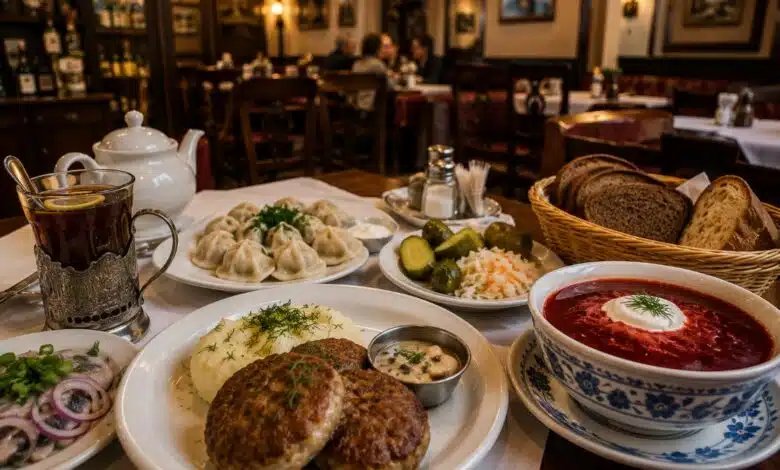
Vesti Food Atlas · Restaurant decision audit
Searching for a Russian restaurant nearby sounds simple until the results mix white-tablecloth dining rooms, banquet venues, neighborhood cafés, Eastern European delis, bakeries, grocery counters and delivery-only kitchens. This guide helps you identify the format before you order, read the menu without guessing and choose dishes that fit lunch, dinner, a family meal or takeout.
A Russian restaurant may be a quiet lunch café, a celebratory banquet hall, a deli with hot trays or a broad Eastern European restaurant using “Russian” as the easiest label for unfamiliar diners. Check the current menu, service style, portion format and event schedule before choosing. For a first meal, build around one soup or cold starter, one main such as kotleti, pelmeni or a braised dish, and one side rather than ordering every famous item at once.
The word “restaurant” hides several very different experiences
The smartest first step is not choosing a dish. It is identifying the kind of place behind the search result. A polished dining room with linen, table service and an evening entertainment schedule behaves differently from a compact café that serves soup, cutlets and buckwheat at lunch. A deli-café may have excellent prepared food but only a few tables. A grocery counter may sell the exact home-style dishes you want without calling itself a restaurant at all.
That distinction controls nearly everything: how long the meal takes, whether reservations matter, whether food comes plated or from a steam table, how portions are priced and whether the room is suitable for conversation. Search pages often place all these formats together because they share cuisine labels. The diner has to separate them.
Neighborhood café
Usually the easiest format for a first visit. Expect familiar soups, dumplings, kotleti, salads, pancakes, tea and straightforward mains. Lunch may be especially strong because the kitchen is built around everyday meals rather than formal celebration.
Full-service restaurant
A broader menu, table service and more composed plates. This is where you may find fish, braised meats, elaborate appetizers, house specialties and a more extensive beverage program. Dinner can be slower and more expensive than lunch.
Banquet or entertainment restaurant
Designed for birthdays, weddings, dancing and large groups. The food may be generous and festive, but the room can become loud, minimums may apply and the evening schedule matters as much as the menu.
Deli, market or prepared-food counter
Often the best route to home-style food. You may buy kotleti, stuffed cabbage, salads, dumplings, baked goods and complete dinners by weight or by piece. Seating may be limited or absent.
A fifth format now appears often: the delivery kitchen. It may list dozens of traditional dishes online but provide no dining room, no visible counter and little information about how food is prepared. That does not automatically make it poor, but it changes how you evaluate it. Packaging, reheating and menu consistency become more important than ambiance.
Search for the meal you want, not only the label “Russian restaurant”
A single near-me phrase can miss useful places. Some businesses identify as Ukrainian, Georgian, Uzbek, Armenian, Jewish, Central Asian, Baltic, Balkan or broadly Eastern European. Others serve several of these traditions under one roof. The public label may reflect neighborhood history, the owner’s preferred description, the language most customers recognize or simply the category available on a map platform.
Use the cuisine name with a format or dish. Searches such as “Russian lunch,” “Eastern European deli,” “pelmeni near me,” “kotleti restaurant,” “borscht takeout,” “Russian bakery” and “prepared foods market” reveal different parts of the local food landscape. If your goal is a broad discovery search rather than one dining room, the guide to finding Russian food through restaurants, delis, markets and bakeries explains why the best result may not use the restaurant label at all.
Location words help too. Add the neighborhood, suburb or nearby city instead of trusting the map radius. Ethnic groceries and banquet restaurants often sit outside tourist centers, in shopping plazas or along suburban commercial roads where rent and parking suit larger kitchens. A result fifteen miles away may be more relevant than a generic restaurant two blocks away.
Do not read cuisine categories as rigid borders. A menu can include Russian-language names while the dishes come from several neighboring traditions. Respect the identity used by the business, then read the dish descriptions closely. The goal is not to police the menu; it is to understand what the kitchen actually serves.
Build the first meal around contrast, not fame
The most satisfying first order usually has contrast: something bright or cold, something warm and comforting, and one main whose texture survives the pace of the meal. Ordering borscht, pelmeni, kotleti, stuffed cabbage, blini and three salads all at once sounds educational but turns dinner into a starch-and-meat marathon. A restaurant is easier to understand when each dish has room to register.
For two people, one cold starter or salad, one soup, and two mains is often enough unless the menu clearly uses tasting portions. Olivier salad is rich and mayonnaise-based; vinaigrette salad is typically lighter and beet-forward; pickled vegetables sharpen fatty foods. Borscht introduces the kitchen’s approach to broth, acidity and beet sweetness. Pelmeni test dough, filling and timing. Kotleti reveal seasoning, moisture and the quality of everyday cooking.
Start with borscht or a clear soup, then chicken kotleti with buckwheat or potatoes. Add pickles or a fresh salad. This gives you warmth, texture and acidity without requiring familiarity with organ meats, aspic or smoked fish.
Choose pelmeni as the center, ask whether sour cream and broth are included, and add one vegetable side. Skip a second heavy entrée unless the portion is clearly small.
Share two small appetizers—perhaps a beet salad and herring preparation—then order one hot main each. Cold dishes are often where family and banquet traditions become visible.
Ask what is made in-house. This is especially useful for dumplings, bread, smoked fish, cakes and fermented products. A restaurant can still serve excellent food made by a specialist supplier, but knowing what the kitchen produces helps you choose its strengths.
Do not treat unfamiliarity as a challenge to order the most extreme item. The first visit is not an exam. Choose dishes that let you judge the kitchen: soup for balance, dumplings for technique, kotleti for everyday comfort, or a braise for patience and sauce work.
Kotleti are a useful test of an everyday kitchen
Kotleti belong near the center of this guide because they sit between restaurant food and home food. They are usually shaped patties made from ground meat, poultry, fish or vegetables, often softened with bread, onion, dairy or another moisture-retaining ingredient. They may be pan-fried, baked, breaded or served with gravy. The exact recipe changes from kitchen to kitchen.
On a menu, confirm three things: the protein, the cooking method and what comes with the plate. “Chicken cutlet” can describe a ground chicken kotleta or a breaded chicken breast. “House cutlets” may use mixed beef and pork. A lunch plate may include two smaller patties and sides, while a dinner menu may list one larger portion à la carte.
A strong kotleta should be fully cooked, moist enough to cut without crumbling and seasoned throughout rather than only on the surface. It need not be pink inside to be juicy. A crisp exterior is welcome, but a thick armor of breading is not universal. Some versions are deliberately soft and lightly browned.
Readers looking specifically for restaurants, delis, prepared-food counters and frozen options can continue with the Vesti atlas for finding Russian kotleti near you. For spelling and menu-name confusion, the separate explanation of kotlet, kotleta, kotlety and kotleti is more useful than forcing every language variation into this restaurant guide.
At the restaurant table, pair kotleti with something that keeps the plate from becoming uniformly soft and brown. Buckwheat adds nuttiness, mashed potatoes emphasize comfort, cabbage gives sweetness and acidity, and pickles bring contrast. Mushroom gravy can be excellent, but request it separately for takeout so the crust does not disappear during the trip.
Lunch and dinner may feel like two different restaurants
Lunch is often the most revealing time to visit a neighborhood Russian restaurant. The room is quieter, combination plates may be available and everyday dishes tend to dominate. Soup-and-main specials, smaller portions and faster service make it easier to sample without committing to a formal evening.
Dinner can introduce a larger menu, slower pacing, shared appetizers and more celebratory dishes. It may also bring live music, private events or banquet seating. A restaurant praised for Friday-night energy may feel completely different at Tuesday lunch. Neither experience is more authentic; they serve different purposes.
Before choosing a time, decide what you want to learn. For broth, dumplings, kotleti and a calm conversation, lunch is usually efficient. For a birthday, a long table, dancing or a broad cold-appetizer spread, dinner may be the point. If you want both food and entertainment, verify when entertainment starts. Arriving at 6:00 p.m. for a quiet dinner in a venue that transforms at 8:30 p.m. can create an awkward surprise in either direction.
Lunch clues
Combination plates, soup specials, smaller menus, office-hour service, quick table turnover, deli-counter crossover and simple desserts.
Dinner clues
Reservations, larger appetizer sections, whole fish or grilled platters, bottle service, minimum spends, live performers, dancing and group menus.
Weekend brunch is less universal than in mainstream American restaurants, but some cafés serve blini, syrniki, eggs, porridge and pastries earlier in the day. Check the actual hours and menu rather than assuming that a breakfast dish is available whenever the restaurant is open.
Live music and banquet restaurants need a different checklist
Banquet restaurants are not simply regular restaurants with a singer in the corner. Their economics, kitchen rhythm and room design may revolve around events. Tables can be arranged for groups, music can be amplified, courses may arrive in waves and certain evenings may require deposits, minimums or set menus.
This format can be wonderful when the occasion matches it. Cold appetizers cover the table, hot dishes arrive later, toasts stretch the evening and dancing is part of the experience. It is less successful when two people expect a quiet, spontaneous dinner and discover a wedding, birthday or ticketed show.
Ask before booking: Is there live music or a private event that night? Is regular à la carte dining available? Is there a cover charge, deposit, minimum spend or fixed menu? Where is the table relative to the speakers or dance floor? How long is the table reserved?
Reviews of banquet venues should be read by occasion. A guest praising “an incredible party” may tell you little about a weekday meal. A complaint about slow pacing may describe a multi-course event where the kitchen intentionally staggered service. Look for reviews that match your intended night and party size.
Food choices also change. Large shared salads and appetizers may offer better value than ordering individual starters. Hot dishes designed for immediate service can suffer if the table is busy dancing. Ask whether mains are plated individually or served family-style, and coordinate the order so food does not arrive while everyone is away from the table.
Family-style dining works best when someone edits the order
Russian and broader Eastern European restaurant menus often encourage sharing, especially among cold appetizers, salads, breads and pickles. But “family-style” does not mean every dish is automatically large. Some salads are personal bowls; others arrive on platters. Some entrées include sides; others need separate orders. The organizer should confirm portion size instead of multiplying everything by the number of guests.
For four to six diners, choose a few contrasting cold dishes rather than six mayonnaise-based salads. Add one soup only if people genuinely want it, because soup slows a shared meal. Select two or three hot mains with different textures: dumplings, kotleti, a braise or grilled item, plus vegetables and starches.
Children may respond well to chicken kotleti, plain pelmeni, mashed potatoes, blini or simple soup, but recipes can include onion, pepper, dill, garlic or mixed meats. Ask rather than assuming “plain” means unseasoned. If allergy risk is serious, confirm ingredients and cross-contact directly with the restaurant.
Large parties should decide whether the meal is exploratory or celebratory. An exploratory meal benefits from smaller, varied orders and conversation with the server. A celebration benefits from advance planning, reliable favorites and clear timing. Trying to conduct a culinary survey during a birthday dinner usually exhausts both the table and the kitchen.
Price makes sense only after you identify the portion format
Russian restaurant prices are difficult to compare from the entrée number alone. A kotleti lunch with soup and two sides may cost less than an à la carte dinner cutlet, yet provide more food. A small bowl of pelmeni may be an appetizer; another restaurant may serve a heavy main portion. A banquet platter may look expensive but feed several people.
Separate price from value. Value includes ingredients, labor, portion, included sides, table service, entertainment, atmosphere and location. Handmade dumplings and layered cakes require labor. Smoked fish and specialty imports can be costly. At the same time, a luxurious room does not guarantee that every traditional dish receives equal attention.
Check inclusions
Soup, bread, garnish, sour cream, sauce and side dishes may be included, optional or separately priced.
Check units
Prepared food can be priced per pound, per 100 grams, per piece, per container or per tray.
Check service charges
Large parties, entertainment nights and banquet menus may add automatic gratuity, cover charges or room fees.
Check the real portion
User photos and direct questions are more useful than guessing from the dish name.
Lunch can be the best value when the goal is tasting the core kitchen. Dinner may be worth the higher total when service, music and a long social evening are part of the plan. Takeout can reduce the bill, but sides, containers and delivery fees sometimes erase the expected savings.
When a menu has no prices online, do not assume deception. Banquet packages, seasonal fish and market-priced items genuinely vary. Still, a diner is entitled to ask for current pricing before confirming a reservation or large order.
Takeout rewards the dishes that were built to rest
Many Russian restaurant dishes travel extremely well. Braises, soups, dumplings, stuffed cabbage, buckwheat, potatoes, kotleti and layered salads can remain satisfying after a short trip. Other items lose quality quickly: crisp potato pancakes soften, fried foods steam in closed containers and delicate blini can stick together.
Request sauces separately when possible. Mushroom gravy over kotleti tastes good at the table but can erase surface texture in transit. Sour cream should remain cold and separate from hot soup or dumplings. Pickles and dressed salads can leak into starches if everything shares one container.
For delivery, check whether the restaurant uses its own drivers or a platform. The same dish may appear at different prices, and the platform menu may not include daily specials. Read packaging reviews, not only flavor reviews. A perfectly cooked soup is still a problem if the lid is unreliable.
Borscht, solyanka, pelmeni packed correctly, stuffed cabbage, kotleti with sauce separate, braised meats, buckwheat and many cakes.
Potato pancakes, breaded cutlets, fried fish, delicate blini, composed salads with crisp garnishes and anything served for its crust.
Reheat gently. Soup should be heated until steaming throughout. Kotleti and stuffed cabbage benefit from covered, moderate heat rather than aggressive microwaving that dries the exterior. Dumplings should not sit boiling for a second full cooking cycle. Follow any restaurant instructions when provided.
The broader takeout guide to dishes that preserve their texture helps compare packaging and reheating across cuisines. For a Russian restaurant specifically, the practical question is whether the kitchen separates wet, cold and crisp components.
Verify the restaurant you found before you drive across town
Local restaurant information changes too quickly to trust one listing. A place can keep an old name after ownership changes, pause lunch service, switch to events only, move to catering or close while delivery pages remain active. Verification is part of choosing well, not an administrative chore.
Start with the restaurant’s own current website or social page, then compare recent map information. Look for a post, menu or reservation slot from the last few weeks. Call when the trip is long, the dish is essential or the evening involves music. Ask one or two precise questions instead of requesting a complete menu reading over the phone.
Confirm today’s opening hours and whether the dining room is open.
Confirm the dish you care about, especially daily soups, kotleti, cakes or fish.
Confirm the evening format: quiet dining, live music, private event or banquet service.
Confirm reservation rules, minimums and parking when the venue is suburban or event-focused.
Read recent reviews for patterns, not isolated emotion. Three recent comments about unavailable menu items matter more than one angry review from years ago. Repeated praise for soup, dumplings or service is useful. Ratings that focus only on décor or nightlife do not answer whether kotleti are good.
Photos should be dated mentally. Seasonal decorations, old menus and former interiors can remain online indefinitely. Recent exterior photos are especially helpful for locating restaurants in plazas, office buildings or banquet complexes where signage may be small.
Five realistic restaurant searches and the choice each one favors
You want a quiet first lunch
Prioritize a neighborhood café or deli-café with a current lunch menu. Order soup, kotleti or pelmeni and a simple side. Avoid a venue whose recent posts focus entirely on late-night entertainment and private events.
You are planning a birthday for twelve
Look for banquet experience, group menus, parking, music details and clear deposit rules. Ask whether appetizers are sized for sharing and whether the table will receive plated mains or family-style platters. A tiny beloved café may have better everyday food but be wrong for the logistics.
You want Russian food but do not need table service
Search delis, markets and prepared-food counters. This is often the fastest path to kotleti, stuffed cabbage, salads, dumplings and baked goods. Buy small portions of several items rather than one enormous tray.
You are introducing skeptical friends
Choose a comfortable full-service restaurant with clear English descriptions and a balanced menu. Start with recognizable textures—dumplings, chicken kotleti, potatoes, pickles—and add one less familiar dish for the table. Do not build the meal around proving bravery.
You want dinner and dancing
Select the entertainment restaurant deliberately. Confirm the performer, start time, volume, cover charge and table location. Eat shared cold appetizers early, then coordinate hot food with the music schedule so the main course is not cooling while everyone is on the dance floor.
These scenarios show why “best Russian restaurant near me” has no single answer. The best match depends on whether you value a fast lunch, a broad menu, home-style takeout, quiet conversation or a full celebratory evening.
Service, room design and review photos need context
Restaurant choice is not only about food. The same menu can feel generous in a warm neighborhood café, formal in a polished dining room or theatrical in a banquet hall. Service expectations change with the room, and misunderstandings often begin when diners apply the rules of one format to another.
In a casual café, service may be direct and efficient. Staff may expect guests to know the menu or ask concise questions. At a formal restaurant, pacing may be slower because appetizers, soup and mains are treated as separate courses. In a banquet venue, servers may coordinate with speeches, performers and large tables rather than one small party’s preferred rhythm.
Reserved does not always mean unfriendly
Some diners interpret minimal small talk as poor hospitality, while others value unobtrusive service. Focus on practical signs: Were questions answered accurately? Did the server explain portion sizes? Did hot food arrive hot? Were allergies taken seriously? Was the bill clear? These measures are more useful than expecting a particular conversational style.
Photos can reveal logistics that ratings miss
Look beyond the plated food. Wide room photos show table spacing, stage placement and whether the venue is dominated by group tables. Exterior images reveal parking, stairs and whether the restaurant sits inside a market or plaza. Menu-board photos help identify counter service. Pictures of large appetizer spreads may come from banquets rather than normal à la carte dinners.
Check the date of the photo and compare several sources. A restaurant may renovate, move or change concepts while old images remain highly visible. If every recent image shows events and none shows ordinary dinner service, call before assuming that walk-in dining works as it once did.
Noise is part of the product
Live music, dancing and large celebrations are not defects when advertised clearly. They become problems only when the diner wanted quiet conversation. Read recent comments for words such as loud, stage, dance floor, wedding, birthday, DJ and private party. Then decide whether those are warnings or exactly what you want.
Seating position matters. A table near the stage can be exciting and exhausting. A corner table may preserve conversation but feel removed from the celebration. Ask when booking, especially if anyone in the group has hearing sensitivity, mobility concerns or young children.
Accessibility and comfort deserve the same attention as the menu
Older restaurants and converted banquet spaces may have stairs, narrow entrances or restrooms located away from the dining room. Confirm step-free access, elevator availability and seating layout when needed. A beautiful menu is not helpful if part of the group cannot comfortably enter or remain at the table.
Temperature and dress expectations also vary. Banquet rooms may feel formal at night; deli-cafés may be entirely casual. Outdoor waiting areas can be uncomfortable in winter or summer. Recent photos usually provide better clothing clues than the restaurant’s category label.
Read reviews by matching the reviewer’s goal to yours
A five-star review for a wedding says little about a ten-minute lunch. A complaint about small portions may come from someone who ordered an appetizer as a main. A review praising nightlife may be irrelevant to a family with toddlers. Sort mentally by occasion, date and specific dish.
Dish-level detail is more valuable than vague praise. “The pelmeni dough was thin and the filling juicy” tells you more than “authentic.” “The kotleti arrived with two patties and buckwheat” clarifies portion format. “The music began at nine and was very loud” provides actionable timing. Build your decision from repeated, concrete observations.
Ultimately, atmosphere should support the purpose of the meal. A restaurant can be excellent and still be the wrong room for tonight.
The right restaurant is the one whose format matches your evening
A useful search ends before the first bite. You know whether the place is a café, dining room, banquet venue or deli; you have checked the current menu; you understand the portion format; and you have chosen a few dishes that show the kitchen rather than burying it under a giant order.
For many first visits, lunch at a focused café is the clearest introduction. Borscht, pelmeni and kotleti reveal broth, dough, seasoning and everyday technique. For celebrations, a banquet restaurant may offer exactly the generosity and energy the occasion needs. For weeknight comfort, a prepared-food counter can be more useful than a formal dining room.
Let the restaurant tell you what it is. Then order accordingly.
Questions diners ask before choosing a Russian restaurant
Menus, schedules and service formats vary by restaurant. These answers cover the practical points worth confirming before a visit.
What should I order at a Russian restaurant for the first time?
<p>A balanced first order could include borscht or another soup, pelmeni or kotleti as the main focus, and a bright side such as pickles, cabbage salad or vinaigrette. Avoid ordering every famous dish at once; two or three contrasting items reveal more about the kitchen.</p>
How can I tell whether a Russian restaurant is actually a banquet hall?
<p>Check recent photos, event posts, reservation language and the evening schedule. Banquet venues often advertise live music, dancing, group menus, deposits, minimum spends or private celebrations. Calling before a quiet dinner is wise.</p>
Are Russian restaurant portions usually large?
<p>Not consistently. Lunch combinations may be generous, while dinner dishes can be à la carte. Dumplings may be a starter or a full bowl, and salads may be personal or shareable. Confirm the number of pieces, included sides and serving size.</p>
What are kotleti on a restaurant menu?
<p>Kotleti are commonly ground-meat, poultry, fish or vegetable patties shaped and cooked like home-style cutlets. Because English menus also use “cutlet” for whole breaded meat, ask whether the item is ground or whole.</p>
Is lunch a better time than dinner to try a Russian restaurant?
<p>Lunch is often calmer and may feature combination plates, soups and everyday dishes at lower prices. Dinner is better when you want a longer meal, a broader menu, live music or a celebratory atmosphere.</p>
Do Russian restaurants usually have live music?
<p>Some banquet-focused restaurants do, especially on weekends, but many neighborhood cafés and delis do not. Entertainment schedules change, so verify the date, start time, cover charge and whether regular dining is available.</p>
What Russian dishes are good for takeout?
<p>Borscht, pelmeni, kotleti, stuffed cabbage, braised meats, buckwheat and many layered cakes generally travel well. Ask for gravy, sour cream and cold garnishes separately. Crisp potato pancakes and fried dishes lose texture faster.</p>
How do I know whether a menu online is current?
<p>Look for a recent update date, compare the restaurant’s official menu with recent social posts and delivery listings, and call when a specific dish or long trip is involved. Old PDFs and third-party menus can remain online after major changes.</p>
Are Russian restaurants suitable for children?
<p>Often, yes. Chicken kotleti, plain pelmeni, mashed potatoes, blini and mild soups can be approachable. Still, ask about onions, herbs, mixed meats, allergens and portion size rather than assuming a dish is plain.</p>
Should I search for Eastern European restaurants too?
<p>Yes. Relevant restaurants, cafés and delis may identify as Ukrainian, Georgian, Uzbek, Jewish, Baltic, Central Asian or broadly Eastern European. Search by the dish and format you want, then respect the identity and menu description used by the business.</p>
