
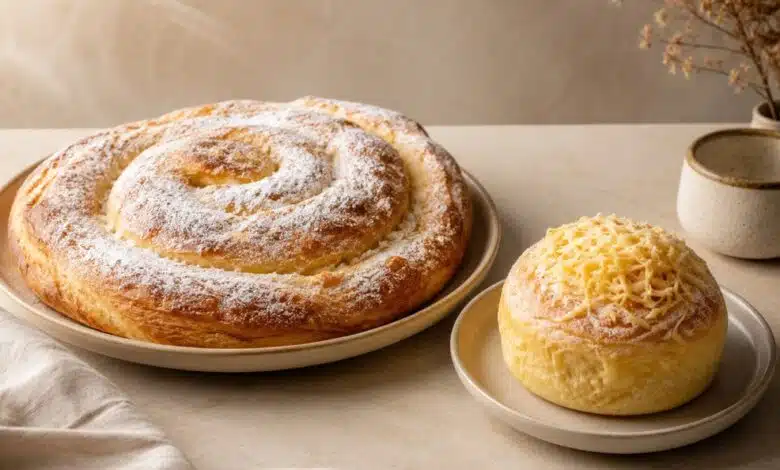
Ensaimada and ensaymada share a name and a historical connection, but they are not simply two spellings for one identical pastry. Mallorcan ensaimada is a stretched, coiled pastry traditionally associated with pork lard, long fermentation, powdered sugar, and a broad spiral form. Filipino ensaymada is usually a softer, richer, more bread-like bun finished with butter or margarine, sugar, and grated cheese. Their relationship is real, but their modern bakery identities, textures, toppings, serving formats, and search intent are different.
The difference is bigger than one letter
If you order ensaimada from a Mallorcan or Spanish bakery, you are usually looking for a wide spiral with an airy, stretched structure and a relatively restrained finish. If you order ensaymada from a Filipino bakery, you are usually expecting a soft individual bun with a buttery, sweet, and often cheesy topping. Neither is a failed version of the other. They belong to connected but distinct food traditions.
They are historically connected, but no longer the same bakery product
The similarity in the names is not accidental. Filipino ensaymada developed from the broader Iberian and Mallorcan pastry tradition introduced during the Spanish colonial period. Over time, Filipino bakers adapted the product to local ingredients, baking practices, tastes, and social occasions. The result is a pastry that still carries the family resemblance of a coiled enriched dough but now behaves differently in the mouth and in the marketplace.
This distinction matters because readers often approach the comparison in one of two misleading ways. Some assume ensaymada is only a misspelling of ensaimada. Others assume the Filipino version is a decorative variation that can be judged by the standards of the Mallorcan original. Both ideas miss the cultural work that adaptation has done. Filipino ensaymada is now a familiar bakery item in its own right, sold in neighborhood bakeries, supermarkets, premium gift boxes, café counters, and holiday assortments.
Mallorcan ensaimada also has a stronger protected-origin context. The name Ensaïmada de Mallorca refers to a geographically protected product made in Mallorca under controlled specifications. That does not mean every spiral pastry outside Mallorca is worthless. It means that a bakery should not present a vaguely similar sweet coil as though it automatically carries the same protected identity.
What is Mallorcan ensaimada?
Ensaimada is an iconic pastry from Mallorca in Spain’s Balearic Islands. Its name is closely tied to saïm, the Catalan word for pork lard. In the protected Mallorcan form, the dough is made with strong flour, water, sugar, eggs, starter dough, and pork lard. The dough is stretched thin, coated with fat, rolled into a long rope, and arranged into a spiral before a long fermentation and baking.
The most recognizable version is broad, low, and coiled, with two or more turns. It is usually finished with powdered sugar rather than a thick frosting. The visual emphasis is on the spiral and the open spacing between coils, not on a tall domed bun. A good piece can be delicate without being brittle, light without being empty, and rich without carrying the buttery density of brioche.
The protected specification recognizes the plain version and the version filled with cabello de ángel, or angel-hair squash preserve. Outside that protected core, bakeries in Mallorca and elsewhere may also sell cream, chocolate, apricot, marzipan, or other contemporary fillings. These can be excellent, but it is useful to distinguish a traditional protected form from a bakery’s broader creative range.
Mallorcan ensaimada may be sold as a small portion, but the culturally familiar format is often a wide pastry packed in a flat round or octagonal box. This makes it suitable for sharing, travel, gifting, breakfast tables, and coffee service. Its identity is as much about shape, method, and fermentation as it is about sweetness.
What is Filipino ensaymada?
Filipino ensaymada is an enriched yeast bread or pastry-bread hybrid that evolved into one of the Philippines’ most familiar bakery foods. It often keeps a coiled or rounded form, but the finished piece is generally taller, softer, and more compact than a broad Mallorcan spiral. Instead of relying mainly on powdered sugar, it is typically brushed or spread with butter or margarine and finished with sugar, grated cheese, or both.
The standard neighborhood bakery version may be simple and affordable: a soft bun, a sweet fat-based coating, granulated sugar, and a light layer of cheese. Premium versions can be much richer, using buttercream, aged Edam-style queso de bola, extra yolks, milk, or elaborate fillings. Modern bakeries also make ube, yema, macapuno, salted egg, chocolate, custard, mango, and seasonal varieties.
Its appeal comes from contrast. The dough is soft and slightly sweet; the topping adds richness; sugar provides sparkle or crunch; and cheese brings salt, dairy aroma, and savory depth. In premium gift-box styles, the topping can be generous enough to become the main sensory event. In more traditional everyday bakery forms, the topping may be lighter and the bread itself more prominent.
Ensaymada is closely associated with merienda, coffee, tea, hot chocolate, family visits, holiday tables, office sharing, and pasalubong. It is not limited to formal pastry shops. It belongs equally to neighborhood bakeries and polished premium brands, which explains why two Filipino ensaymadas can differ dramatically in price, richness, and appearance while still being recognizable members of the same tradition.

How ensaimada and ensaymada look different
Mallorcan ensaimada
- Broad, open spiral
- Lower profile
- Powdered sugar finish
- Visible spacing between coils
- Often sold in a large flat box
- Plain or internally filled
Filipino ensaymada
- Rounded individual bun
- Taller, softer profile
- Butter or margarine coating
- Granulated sugar and cheese
- Often sold by the piece or box
- May have colorful premium flavors
The distinction is not absolute. Some Filipino ensaymada is visibly coiled, while some modern Mallorcan bakery versions are compact. Size can also be misleading. The better visual test is the total system: shape, top finish, crumb, packaging, and bakery context.
A pastry covered in grated cheese and butter is almost certainly being presented in the Filipino tradition, even if the menu spells it “ensaimada.” A wide powdered spiral from a Spanish bakery is more likely to be Mallorcan-style, even if the word appears without the Catalan diaeresis. Product identity is stronger than spelling alone.
Dough and fat create the deepest structural difference
The traditional Mallorcan method depends on stretching the dough very thin, spreading it with pork lard, rolling it, and coiling it loosely enough to preserve the spiral. This technique creates internal layers and a pulled, fibrous quality. The fat is not merely an ingredient for richness; it helps define the dough’s handling, separation, and identity.
Filipino ensaymada often uses butter or margarine in the dough, in the topping, or both. Many formulas include milk and a richer proportion of egg or sugar than a protected Mallorcan formula. The dough is commonly developed toward softness and tenderness rather than dramatic thin-sheet stretching. This produces a bun that may remind people of brioche, milk bread, or a very soft enriched roll, though no single comparison is exact.
These are general tendencies, not universal rules. A modern Spanish bakery may replace lard, and a Filipino artisan may use a laminated or highly layered technique. If the specific fat matters for religious, vegetarian, or allergy reasons, ask the bakery directly. Neither spelling guarantees the answer.

Texture comparison: airy and pulled versus soft and plush
Texture is where the two pastries stop feeling like variations of one item and begin to feel like different experiences. A good Mallorcan ensaimada may have a feather-light impression, a gentle resistance when pulled, and irregular strands or layers created by stretching and rolling. It should not feel like a dense dinner roll. It should also not be judged by croissant standards: the structure is different from a sharply laminated butter pastry with crisp shattering flakes.
Filipino ensaymada is more likely to feel pillowy, tender, and compressible. The crumb may be fine and even or slightly shreddable, depending on the bakery. Premium versions can be exceptionally rich and soft, especially when made with generous egg, milk, butter, and sugar. Neighborhood bakery versions may be lighter and more bread-forward.
What poor texture looks like
A dry Mallorcan ensaimada may feel papery, hollow, or stale rather than delicately light. A bad Filipino ensaymada may be dense, gummy, greasy, or so heavily topped that the bread quality disappears. In both traditions, freshness matters more than the decorative finish. A beautiful spiral or dramatic cheese layer cannot rescue a stale center.
Flavor and sweetness are built differently
Mallorcan ensaimada often presents sweetness with restraint. The dough is sweetened, but the powdered sugar finish is relatively light and dry. The flavor may emphasize fermentation, egg, toasted wheat, and the savory richness of the fat. In a plain version, the pleasure comes from aroma and structure rather than a thick top layer.
Filipino ensaymada usually tastes more overtly rich because sweetness and fat are applied after baking as well as built into the dough. Butter or margarine creates a creamy top note, granulated sugar adds immediate sweetness, and cheese introduces salt. That sweet-salty contrast is central to the appeal.
Filled versions complicate the comparison. A Mallorcan ensaimada filled with sweet cream, chocolate, or angel-hair preserve can be sweeter than a lightly topped Filipino bakery bun. A premium Filipino ensaymada with buttercream and queso de bola can be far richer than an everyday version. It is better to compare specific products than to declare one tradition universally sweeter.
Toppings and fillings tell you which tradition you are seeing
Common Mallorcan presentations
- Plain or llisa
- Powdered sugar
- Cabello de ángel
- Cream
- Chocolate
- Apricot or other bakery variations
The protected PGI forms are more specific than the full modern bakery range. Do not assume every creative filling belongs to the protected specification.
Common Filipino presentations
- Butter or margarine
- Granulated sugar
- Grated cheese
- Queso de bola
- Ube or yema
- Macapuno, salted egg, chocolate, or custard
The top finish can be simple or luxurious, but the butter-sugar-cheese family is the strongest visual clue.
Why cheese makes sense on Filipino ensaymada
Cheese is not a random modern garnish. It provides salt, dairy aroma, and savory balance against sweet bread and sugar. Mild grated cheese creates an everyday bakery profile, while aged queso de bola produces a sharper holiday or premium taste. The best examples use enough cheese to create contrast without turning the top rubbery, stale, or overwhelmingly salty.
Why fillings should not hide stale bread
Ube, yema, chocolate, and cream can make an excellent fresh pastry more expressive. They can also conceal dry crumb. When testing a bakery for the first time, a classic version often reveals more about fermentation and softness than the most elaborate flavor.
Serving size, packaging, and occasions
Mallorcan ensaimada is strongly associated with a sharing format. A large spiral can arrive in a broad flat box and be cut into wedges or torn into portions. This makes it practical for breakfast tables, family visits, workplace sharing, and travel gifts. Smaller individual versions exist, but the wide spiral remains a powerful part of its identity.
Filipino ensaymada is commonly sold as an individual bun, a mini piece, a half-dozen box, or an assorted gift set. Individual portions protect the topping and make it easy to serve at an office or celebration. Premium versions may be boxed separately so the buttercream and cheese do not smear.
Freshness and quality checks are different for each style
A comparison becomes much more useful when it explains not only what each pastry should be, but also how a good example differs from a tired one. Mallorcan ensaimada and Filipino ensaymada age in different ways because their structures and finishes are different.
What to look for in Mallorcan ensaimada
The spiral should still be identifiable, with a surface that looks dry and delicate rather than damp or compressed. Powdered sugar may absorb slightly over time, but a fresh pastry should not appear wet, gummy, or oily. When pulled apart, the interior should reveal strands, pockets, or a light layered structure. The crumb should not collapse into a dense ring.
A stale Mallorcan-style pastry often becomes papery at the edges while the center loses its spring. Excess grease at the base can indicate poor fat balance or storage in a warm box. A very dense interior may point to underproofing, rough shaping, or a recipe that is closer to ordinary sweet bread than to a stretched ensaimada.
What to look for in Filipino ensaymada
The bun should feel soft without being wet or gummy. The topping should look fresh and intentional: butter or margarine should not have separated into an oily film, sugar should not have dissolved completely into moisture, and cheese should smell clean rather than stale. A premium buttercream version should still hold its shape without cracking or sweating excessively.
Cut-open photos are especially useful because generous toppings can hide a dry center. The crumb should look fine, tender, and evenly baked. A collapsed line under the topping may indicate that the bun was compressed while warm. Condensation inside an individual wrapper can accelerate staling and damage the cheese finish.
Dietary and allergen differences require direct questions
Neither name gives a complete dietary answer. The protected Mallorcan tradition is strongly associated with pork lard, while Filipino ensaymada is often made with butter or margarine. However, individual bakeries may substitute fats, use blended shortenings, add milk powder, or prepare pastries on shared equipment.
For vegetarian, halal, kosher, or allergy-sensitive shoppers, ask which fat is used in the dough, which fat is used on top, what cheese is used, and whether the bakery shares equipment with pork, nuts, or other allergens. A staff member saying “it is just bread” is not enough for a serious dietary restriction.
Storage and reheating: one method does not fit both
Plain Mallorcan ensaimada and cheese-topped Filipino ensaymada respond differently to refrigeration and heat. Storage also changes when the pastry contains cream, custard, fresh cheese, macapuno, or other perishable fillings.
Mallorcan ensaimada
A plain or angel-hair version is usually best protected from air in its original box or suitable wrapping for the period recommended by the bakery. Refrigeration can dry the crumb and dull the aroma, so it should not be automatic unless the filling requires it. Gentle oven warming may restore aroma and flexibility, but high heat can toughen the edges. Add a fresh dusting of powdered sugar after warming rather than before.
Filipino ensaymada
Simple cheese-topped versions may keep well for a short time according to the bakery’s instructions, but hot climates and dairy-rich toppings require caution. Refrigeration can firm the bread, so let a chilled bun lose some of its cold before serving. If warming is recommended, use very little heat; too much can melt the butter layer, turn the cheese greasy, and dissolve the sugar.
Filled and premium versions
Cream, custard, yema, fresh dairy, and some coconut fillings may require refrigeration. Follow the seller’s label rather than applying general bread advice. Do not warm a filled pastry unless the bakery specifically recommends it, because the center can become dangerously hot while the exterior still feels cool.
For shipped products, inspect the box immediately. Follow thawing instructions, note whether the product arrived chilled or frozen, and photograph damaged or unusually warm packaging before eating a perishable filling.
How to taste ensaimada and ensaymada side by side
A side-by-side tasting is the clearest way to understand the difference, but the tasting should be organized so that toppings do not overwhelm the comparison. Start with the simplest versions available: a plain or lightly sugared Mallorcan-style ensaimada and a classic Filipino cheese ensaymada.
- Look at the shape before cutting. Notice the width of the spiral, the height of the bun, and whether the top finish is dry, buttery, sugary, or cheesy.
- Smell the pastry at room temperature. Mallorcan ensaimada may emphasize wheat, fermentation, egg, and toasted fat. Filipino ensaymada may present butter, milk, sugar, and cheese more immediately.
- Pull rather than slice the first piece. This reveals whether the crumb separates into stretched strands, soft shreds, or a uniform bread-like interior.
- Taste the crumb without extra topping. On Filipino ensaymada, take a small piece from the side or bottom first. This prevents the cheese and sugar from hiding the dough quality.
- Then taste the full bite. Evaluate how the finish changes the pastry: powdered sugar should support the Mallorcan dough, while butter, sugar, and cheese should create balance rather than heaviness.
- Compare the aftertaste. One may finish lighter and more fermented; the other may leave a richer dairy and sweet-savory impression.
For a second round, add one filled Mallorcan version and one flavored Filipino version. Angel hair versus ube, or cream versus yema, can show how each tradition handles sweetness differently. Avoid comparing six heavily flavored products at once; the basic structural distinction becomes harder to perceive.
Which one is softer?
Filipino ensaymada is usually the softer of the two in the everyday meaning of the word. It is often designed to feel plush, tender, and yielding, with a crumb that compresses easily and springs back gently. Butter, milk, eggs, and enriched-dough methods can heighten that softness.
Mallorcan ensaimada can also be soft, but its ideal qualities are not limited to pillow-like tenderness. It may be airier, more fibrous, more stretched, or slightly more elastic. The sensation is closer to a light coiled pastry with internal pull than to a soft dinner roll.
Freshness can reverse the result. A stale Filipino bun may be firmer than a freshly baked Mallorcan spiral. Therefore, “Which is softer?” is best answered as a style tendency, not a promise about every bakery.
Which is more pastry-like, and which is more bread-like?
Mallorcan ensaimada is generally more pastry-like in its visual structure and eating style. The thin stretching, fat coating, rolling, coiling, powdered finish, and broad shape place attention on artisan pastry technique. Yet it is still yeast-raised and should not be confused with puff pastry or a croissant.
Filipino ensaymada is generally more bread-like, especially in its common neighborhood bakery form. It may be mixed and proofed like an enriched sweet bread, baked in molds, and topped after baking. Premium versions can be so rich that they move toward brioche-like territory, but their identity still comes from Filipino shaping, topping, and serving traditions rather than from French brioche rules.
How to search for the right pastry
Search spelling changes the businesses and images you see. A general query can mix Filipino bakeries, Spanish restaurants, recipe pages, packaged supermarket products, and unrelated sweet rolls. Add the tradition or topping you want.
Do not rely on spelling alone once you open a menu. Check the photo, topping, size, ingredients, and bakery identity. American businesses sometimes use ensaimada for a Filipino-style product, while Spanish-language pages may omit the accent in ensaïmada.
For real bakery examples and a practical buying workflow, use VESTI.LA’s Best Ensaimada Near Me hub. The neighborhood bakery guide can also help you judge freshness, reviews, and ordering systems.
Which one should you choose?
Choose Mallorcan ensaimada if you want:
- A wide, elegant spiral
- Powdered sugar rather than a thick topping
- An airy, stretched, gently layered crumb
- A pastry for sharing
- A plain version that highlights dough quality
- Traditional angel-hair filling
Choose Filipino ensaymada if you want:
- A soft individual bun
- Butter, sugar, and grated cheese
- A richer, more bread-like texture
- Sweet-savory contrast
- Ube, yema, macapuno, or premium flavors
- A gift box with several varieties
Choose both when you can. A side-by-side tasting makes the difference obvious in a way that definitions cannot. Start with a plain Mallorcan-style piece and a classic cheese Filipino ensaymada before moving to filled or premium versions. That gives the dough and structure a fair comparison.
Common misconceptions
Why bakery context matters as much as the name
A product can be technically well made and still disappoint if it does not match the buyer’s expectation. Someone searching after a trip to Mallorca may be looking for a wide spiral, powdered sugar, and the aroma of a traditional bakery box. Someone searching after tasting Filipino ensaymada at a family gathering may expect a soft bun with cheese and butter. The same search word can therefore represent two different memories.
Before ordering, read the bakery description for clues: “Mallorcan,” “saïm,” “cabello de ángel,” and “large spiral” point in one direction; “Filipino,” “cheese,” “ube,” “queso de bola,” and “merienda” point in the other. When the description is vague, the photo, serving size, and topping usually reveal more than the spelling.
This is also why ratings alone are weak comparison tools. A five-star Filipino bakery may make excellent ensaymada but not offer the Mallorcan pastry a traveler remembers. A respected Spanish bakery may produce an elegant ensaimada but not satisfy someone seeking a cheese-topped Filipino bun. The best result is the one that matches the intended tradition, not the one with the highest generic bakery score.
Related pastries, different expectations
Ensaimada and ensaymada are best understood as relatives rather than duplicates. Mallorcan ensaimada emphasizes the spiral, the stretched dough, the fermentation, and a restrained sugar finish. Filipino ensaymada emphasizes softness, enrichment, butter, sugar, cheese, and an enormous range of bakery personalities.
Neither version is universally better. The right choice depends on whether you want airy pastry structure or plush bread-like softness, powdered sugar or cheese, a large sharing spiral or an individual bun. Once you know that distinction, bakery menus, search results, and product photos become much easier to read.
Ready to buy one? Continue to Best Ensaimada Near Me: Bakeries, Filipino Ensaymada, Pickup and Delivery.
Reference points for protected-origin details and the Mallorcan–Filipino relationship: https://www.illesbalearsqualitat.es/iquafront/producte/357?lang=en · https://www.tmdn.org/giview/gi/EUGI00000013622 · https://productesdemallorca.es/ensaimada-mallorca-philippines/?lang=en
Is ensaimada the same as ensaymada?
They are historically related but are now distinct pastry traditions. Mallorcan ensaimada is typically a broad sugar-dusted spiral, while Filipino ensaymada is usually a soft individual bun topped with butter or margarine, sugar, and cheese.
What is the main difference between ensaimada and ensaymada?
The main difference is the complete pastry style: dough structure, fat, topping, texture, serving size, and bakery context. The Mallorcan version emphasizes stretched spiral pastry, while the Filipino version emphasizes soft enriched bread and sweet-savory topping.
Is ensaimada from Spain?
The famous traditional ensaimada comes from Mallorca in Spain’s Balearic Islands. Ensaïmada de Mallorca is a protected geographical indication made under controlled regional specifications.
Is ensaymada Filipino?
Yes. Filipino ensaymada developed from an Iberian pastry influence but evolved into a distinct Filipino bakery tradition with softer dough and common toppings such as butter, sugar, and grated cheese.
Does ensaimada contain pork lard?
Traditional protected Mallorcan ensaimada uses pork lard called saïm. Recipes made outside that protected context can vary, so ask the specific bakery if pork matters to you.
Why does Filipino ensaymada have cheese?
Cheese adds salt and savory dairy flavor that balances the sweet bread, butter, and sugar. Mild grated cheese is common, while premium versions may use sharper queso de bola.
Which is sweeter, ensaimada or ensaymada?
Filipino ensaymada often tastes sweeter and richer because of its butter, sugar, and cheese topping. Filled Mallorcan ensaimada can also be very sweet, so the bakery and flavor matter.
Which one is softer?
Filipino ensaymada is usually softer and more pillow-like. Mallorcan ensaimada may be light and tender, but its characteristic texture is often airier, more stretched, and more fibrous.
How should I search for the right pastry?
Use ensaimada or ensaïmada with Mallorcan or Spanish bakery terms, and use ensaymada with Filipino bakery, cheese, ube, or queso de bola. Then confirm the photo and ingredients because menu spellings vary.
Can I find both pastries in the United States?
Yes, but availability is uneven. Filipino ensaymada is easier to find through Filipino bakeries and chains, while Mallorcan-style ensaimada is more likely at Spanish bakeries, specialty shops, or through shipping.


