
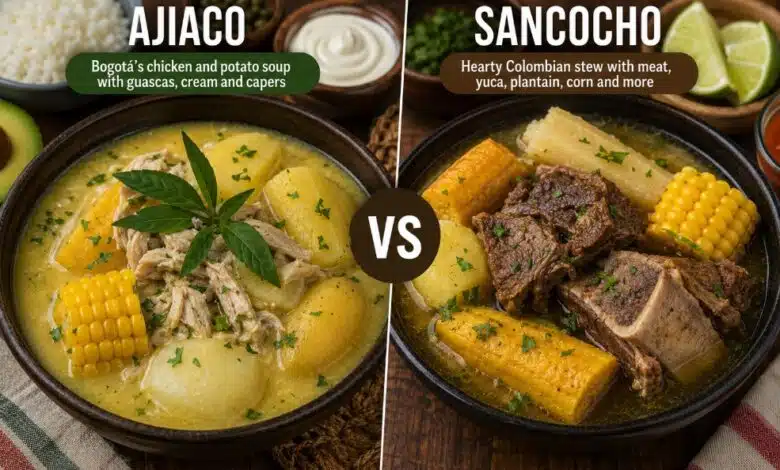
Sancocho and ajiaco often appear on the same Colombian restaurant menu, but they are not two names for the same soup. Ajiaco is most strongly associated with Bogotá and the surrounding Andean region, where chicken, several kinds of potato, corn and guascas create a thick, herb-scented bowl that is commonly served with cream, capers, rice and avocado. Sancocho is a broader family of soups and stews found in many Colombian regions, with versions built around beef, ribs, gallina, chicken, fish, oxtail or mixed meats and frequently containing yuca, green plantain and corn.
The overlap is real. Both dishes can contain chicken, corn and potatoes. Both can arrive with white rice and avocado. Both can be large enough to count as a full lunch. That is why first-time diners sometimes expect them to taste similar. The difference becomes clearer once you look at what actually gives each bowl its identity: potatoes and guascas organize ajiaco, while protein choice, yuca, plantain and regional variation do much more of the organizing work in sancocho.
This guide compares the two as restaurant orders rather than as abstract recipes. It covers the ingredients, broth, texture, regional context, current menu prices, measured restaurant portions, side dishes, weekend availability, takeout, dietary questions and the situations in which one bowl makes more sense than the other. If you already know you want sancocho and are deciding where to find it, Vesti’s guide to best sancocho colombiano near me covers current restaurant examples, prices, portion sizes and local search strategies across several U.S. cities.
The easiest way to separate the two dishes
Ajiaco has a relatively focused center: chicken, potatoes, corn and guascas. Sancocho has a broader center: a chosen protein plus substantial roots and starches that often include yuca and green plantain. That single distinction explains much of what follows.
Most closely associated with Bogotá. The broth becomes naturally thick as potatoes soften, and cream plus capers often let the diner adjust the bowl at the table.
A broad regional family. Beef, ribs, gallina, fish, oxtail and mixed-meat versions can all produce recognizably different restaurant meals.
Neither description should be treated as a rigid national recipe. Colombia’s traditional cooking is regional, and family habits, ingredient availability and restaurant interpretation all matter. Still, these patterns are strong enough to help a diner predict what kind of bowl is likely to arrive.
Sancocho vs ajiaco in one practical comparison
When both appear on the same menu, this is the shortest useful way to think about the choice.
| Difference | Ajiaco | Sancocho |
|---|---|---|
| Main protein | Usually chicken | Beef, ribs, gallina, chicken, fish, oxtail or mixed meats |
| Signature starch | Several kinds of potato | Yuca and green plantain are especially common; potato may also appear |
| Distinctive herb | Guascas | No single herb defines every regional version |
| Corn | Common and important | Also common in many versions |
| Typical texture | Naturally thick from potatoes | Can range from brothy to fairly thick depending on roots and cooking |
| Common table additions | Cream, capers, avocado and rice | Rice, avocado, lime, ají, arepa or salad depending on the restaurant |
| Regional association | Strongly associated with Bogotá and the Colombian Andes | Many regional forms across Colombia |
| Best starting point for | Potato-soup and chicken-soup lovers | Diners who want meat, roots, plantain and wider protein variation |
The shared ingredients explain the confusion. Chicken can appear in both. Corn can appear in both. Potato can appear in both. Rice and avocado can accompany both. The useful distinction is not whether they share one ingredient, but which ingredients control the structure and flavor of the finished bowl.
Bogotá & the Colombian Andes
Ajiaco is a potato-driven chicken soup with a distinctive herbal profile
On an English-language menu, ajiaco may be translated simply as chicken and potato soup. That description is technically understandable but culinary information is lost. Potatoes do more than fill the bowl. Their different textures are part of how the soup works.
Traditional Bogotá-style descriptions emphasize several kinds of potato. Some soften and dissolve more readily, thickening the broth. Others hold their shape longer. That produces a bowl in which potato exists both as visible pieces and as part of the liquid itself.
Guascas supplies the herbal character that makes ajiaco immediately more specific than a generic chicken soup. Corn adds sweetness and a firmer bite. Chicken contributes protein and savory depth without turning the dish into a beef stew.
Build both the substance and much of the natural thickness.
Provides the central protein and a savory foundation.
Gives the soup its recognizable herb profile.
Adds sweetness, aroma and a contrasting firm texture.
Cream and capers are also important to the restaurant experience because they are often served separately. A diner can taste the soup plain, add a small amount of cream for richness, then add a few capers for salty acidity. This is more interesting than emptying every condiment into the bowl before taking the first spoonful.
Avocado is another common companion. It provides cool fat and soft texture beside the hot potato broth. White rice can make the meal considerably heavier, especially when the soup itself is already thick.
Ajiaco therefore has several layers of customization, but the soup should still taste complete before any of them are added. Cream and capers should modify a good broth, not rescue a flat one.
Sancocho gives the restaurant much more freedom to change the protein
Ask what meat is in an ajiaco and chicken will usually be the answer. Ask what meat is in sancocho and the answer can branch immediately.
Beef-centered; the exact cut depends on the kitchen.
Beef rib, often bringing a richer bone-in character to the broth.
Poultry-centered and strongly associated with regional traditions such as those of Valle del Cauca.
Fish changes the aroma and broth dramatically while preserving the broader stew structure.
Oxtail can contribute substantial gelatin and rich slow-cooked beef flavor.
A mixed-meat version; the actual meats should be confirmed with the restaurant.
That protein freedom is one of the major differences between the dishes. Ajiaco teaches you a relatively focused Bogotá soup tradition. Sancocho can become a route through several regions, meats and family styles.
Yuca and green plantain are important clues. Yuca should be tender enough to break easily without a woody center. Green plantain contributes dense starch and restrained sweetness. Corn often appears as a substantial section of cob rather than loose kernels. Potato may join the pot too, but it usually does not dominate the entire broth in the way potatoes do in ajiaco.
Sancocho can also be more variable in thickness. A rib or oxtail version may remain visibly brothy while feeling rich because bone and connective tissue have contributed gelatin. Another version may become thicker because yuca, plantain and potatoes have softened into the liquid.
Potatoes build ajiaco; yuca and plantain often shape sancocho
Looking at the starches is one of the easiest ways to understand the two dishes without reducing the comparison to chicken versus beef.
They are not merely chunks floating in broth. Their breakdown helps create the soup’s body, while firmer pieces provide texture.
Large tender pieces add starch and substance while remaining clearly identifiable.
Dense and savory-starchy, with much less sweetness than a ripe fried plantain.
A strong bridge between the dishes, contributing sweetness and texture in either bowl.
If potatoes are the part of a hearty soup you love most, ajiaco has an obvious advantage. If you would rather work through distinct pieces of yuca, plantain, corn and meat, sancocho provides a more varied bite-to-bite experience.
This also changes how each soup handles rice. Ajiaco is already potato-heavy, so a large side of rice can make the meal extremely starchy. Sancocho may also contain multiple starches, but diners often use rice to absorb broth or balance a particularly meaty version.
The thicker-looking soup is not always the richer one
Ajiaco often looks thick because potatoes dissolve into the liquid. That thickness is primarily starch-driven. It does not necessarily mean the soup contains more fat.
A beef-rib sancocho can look more fluid yet feel richer on the palate because bone, fat and connective tissue have changed the broth. These are two different forms of body.
Starch-driven body
Potatoes thicken the liquid naturally, while cream added at the table can increase richness further.
Meat-and-gelatin richness
Beef rib, bone and connective tissue can make the broth feel fuller even when it appears more brothy.
A gallina sancocho changes the comparison again. Its poultry broth may feel lighter than costilla, while yuca, plantain, corn and potato still make the complete meal substantial.
This is why a visual judgment based on opacity or thickness is unreliable. Neither dish needs to resemble a clarified consommé. Starches, meat proteins and long cooking naturally affect the liquid.
The more useful test is integration. In ajiaco, the chicken, potatoes, corn and guascas should taste as though they belong together. In sancocho, the chosen meat should influence the broth while yuca, plantain and corn remain part of the same coherent pot.
Bogotá explains ajiaco; regional diversity explains sancocho
Ajiaco has a particularly strong geographic shorthand. Bogotá and the surrounding Andean region are central to how the dish is described and understood. U.S. Colombian restaurants often reinforce that identity by using names such as ajiaco bogotano or ajiaco santafereño.
Sancocho does not reduce as neatly to one city or one regional profile. Gallina has especially strong associations with western Colombia and Valle del Cauca. Fish versions make sense in coastal and river regions. Beef and mixed-meat versions belong to other traditions and restaurant interpretations.
This matters in the United States because one Colombian restaurant may place ajiaco, sancocho de costilla, bandeja paisa and coastal fish dishes on the same menu. The menu is bringing several regional traditions together under one roof; it is not claiming they all come from the same part of Colombia.
Current restaurant menus put the two dishes surprisingly close in price
The idea that ajiaco must always be cheaper because it contains chicken and sancocho must always be more expensive because it can contain beef does not hold up consistently on current menus.
| Menu example | Ajiaco | Sancocho | What the comparison shows |
|---|---|---|---|
| Miami, FL | $18.95 | $18.95 costilla | The two soups can carry the same menu price even when one is chicken-and-potato and the other uses beef ribs. |
| Doral, FL | $20.00 | $22.00 costilla | A two-dollar premium for beef-rib sancocho rather than a completely different price category. |
| Colombian restaurant example | $16.99 | $18.99 weekend serving | Ajiaco can be slightly cheaper while both still function as full restaurant meals. |
| Leesburg, VA | $17.00 | $19.00 chicken | Even when both use poultry, the restaurant can price them differently because portion and preparation differ. |
These are current menu examples, not a national average. Prices vary with city, restaurant format, portion size, meat, included sides and ordering channel. The useful lesson is that a one- or two-dollar difference is common enough that diners should choose primarily by the dish they want rather than assuming price alone reflects quality.
Side service can matter as much as the listed soup price. Ajiaco may include rice, avocado, cream and capers. Sancocho may include rice and avocado, rice and salad, or other accompaniments. A lower headline price can stop being cheaper once sides are added separately.
Delivery-platform prices can also differ from direct restaurant prices. For a fair comparison, use the same ordering channel when possible.
Both can be full meals even when the menu files them under “soups”
Ajiaco can arrive as a deep bowl of potato-rich soup with chicken and corn plus rice and avocado on the side. Add cream and capers and it is far removed from the idea of a small starter.
Sancocho can be even more physically imposing because large pieces of meat, yuca, plantain, corn and potato occupy much of the bowl. Some restaurant menus publish exact sizes, which makes the comparison much easier.
One current Houston Colombian menu lists medium ajiaco at 24 oz and large ajiaco at 32 oz, both served with rice and avocado.
Other sancocho listings use 24 oz and 32 oz formats as well, showing that either dish can be a substantial entrée rather than a small soup course.
Twenty-four fluid ounces equals three cups of liquid volume; thirty-two fluid ounces equals four cups. Once meat, potatoes, corn and sides are counted, the actual meal is even larger. That is why one large soup plus a full bandeja paisa can be an unrealistic order for a single diner.
When a menu does not publish ounces, ask whether the serving is a cup, regular bowl, large bowl or full entrée and whether sides are included. The labels “medium” and “large” are restaurant-specific and cannot be compared reliably across different businesses without measurements.
Cream and capers give ajiaco a table ritual that sancocho usually does not have
Ajiaco’s condiments are part of the experience. Cream softens the potato broth and increases richness. Capers add saltiness and acidity. Because they often arrive separately, the diner can change the soup gradually.
A useful sequence is simple: taste the plain broth, add a little cream, taste again, then add a few capers. This preserves the ability to understand the base soup rather than covering it immediately.
Sancocho usually invites different adjustments. Lime can sharpen a heavy broth. Ají can add chile heat and acidity. Rice absorbs broth and increases density. Avocado provides coolness and fat beside a hot meat-and-root stew.
The principle is the same in both cases: condiments should let the diner tune a good bowl, not create flavor that was missing from the kitchen.
If you love potatoes, ajiaco has an obvious advantage
Ajiaco is not simply soup containing potatoes. Potato behavior is part of the dish’s structure. Some soften enough to merge into the liquid while others remain intact, creating several textures from one ingredient family.
For diners whose favorite part of stew is a soft potato absorbing the surrounding broth, ajiaco is difficult to beat. It delivers potatoes as visible food and as part of the soup’s body.
Sancocho can contain potato too, but its starch experience is usually broader. Yuca has a grainier, distinct texture. Green plantain is denser. Corn remains firmer. A spoonful and the next bite can feel very different.
The choice therefore resembles the difference between a soup deeply focused on potatoes and a stew that deliberately gives you several kinds of starch in the same meal.
If the meat is the main attraction, sancocho gives you more routes
Ajiaco’s chicken is essential, but the dish is not normally a menu for choosing among proteins. Sancocho can be exactly that.
A beef-rib lover can search for costilla. Someone interested in poultry can choose gallina. Oxtail fans can look for cola. A mixed-meat diner can order trifásico. Coastal versions may use fish.
Those changes affect more than the protein resting in the bowl. Rib can deepen the broth through bone and connective tissue. Oxtail can add gelatin. Fish creates a different aroma and requires a different cooking logic. Gallina produces a poultry direction that is culturally and texturally distinct from a beef pot.
If the first question you ask at a restaurant is “What meat is in it?”, sancocho is likely to provide the more interesting exploration.
Availability can matter more than preference on the day you visit
Restaurant menus show both dishes in several service patterns. Some kitchens list ajiaco every day. Others reserve it for Saturday. Some keep sancocho as a weekend item. Others serve a beef-rib version daily. There is no universal schedule.
Current menu examples illustrate the point. One Colombian restaurant lists sancocho specifically as weekend-only while keeping ajiaco on the regular menu. Another restaurant marks ajiaco as a Saturday soup. Elsewhere, both dishes appear together on the permanent soup list.
This is especially important for sancocho because the protein can change. “Yes, we have sancocho” does not tell you whether the pot contains gallina, beef ribs, general beef or another style.
If a restaurant is nearby, checking after arrival is low risk. If the trip is thirty or forty minutes specifically for one bowl, same-day confirmation is worth the effort.
Order ajiaco when these details sound better
You want chicken rather than beef, ribs, oxtail or mixed meats.
You love potatoes and want them to shape the texture of the broth.
You want to taste guascas and explore a soup closely associated with Bogotá.
You like the idea of adjusting the bowl with cream and capers.
You want corn and chicken in a thick, potato-driven soup.
You prefer a dish with a relatively recognizable core rather than deciding among several protein styles.
Order sancocho when these details sound better
You want beef ribs, gallina, fish, oxtail or several meats rather than standard chicken.
Yuca and green plantain sound more appealing than a potato-dominated broth.
You want large pieces of roots, corn and meat that eat more like a stew.
You are interested in comparing regional Colombian sancocho traditions.
You want the broth to reflect a specific meat choice such as costilla or cola.
You enjoy adding lime or ají to a hearty soup at the table.
If both lists sound good and two people are eating, the simplest solution is one of each.
For two diners, one ajiaco and one sancocho make an unusually good first order
A side-by-side order demonstrates the diversity of Colombian soup traditions much more clearly than reading two ingredient lists.
Begin with ajiaco plain. Notice the potato body and guascas. Then taste the sancocho broth. If it is costilla, notice the beef and bone character. If it is gallina, compare that poultry broth with ajiaco’s potato-heavy chicken base.
Next compare the starches. Ajiaco gives you potatoes behaving in several ways. Sancocho gives you the firmer contrasts of yuca, plantain and corn. Only after that should cream, capers, rice, lime or ají enter the comparison.
This tasting order is not a formal rule; it is simply a useful way to understand what the restaurant actually cooked before condiments reshape the flavors.
The two soups fail in different ways
Ajiaco should not taste like generic chicken broth with potatoes added
The potatoes should meaningfully affect the body, and guascas should contribute recognizable herbal character.
Sancocho should not taste like meat and roots dropped into unrelated broth
The protein, yuca, plantain, corn and aromatics should feel integrated.
Ajiaco potatoes need more than one role
A completely watery broth with every potato remaining hard misses one of the dish’s central pleasures.
Sancocho yuca needs to be properly tender
A hard or woody center can undermine an otherwise excellent bowl.
Ajiaco cream should enrich rather than erase
If so much dairy is added that chicken, guascas and potato disappear, the bowl loses balance.
Sancocho fat should support rather than dominate
Especially with ribs or oxtail, richness should not become an unpleasant slick of oil.
Neither soup should be judged by broth clarity. Starches, meat proteins and long cooking affect appearance naturally. The question is whether the texture feels intentional and pleasant.
Large ingredients are not a quality guarantee either. A giant piece of yuca that remains hard in the center is less enjoyable than a smaller properly cooked piece. A huge rib can dominate the bowl visually while containing relatively little edible meat.
Is one soup spicier than the other?
Neither dish is defined by aggressive chile heat. Ajiaco is usually savory, herbal and potato-forward. Sancocho can be deeply savory and aromatic without being hot-spicy.
Ají is often served separately with sancocho, allowing each diner to decide how much heat and acidity to add. Ajiaco’s capers contribute acidity and salt rather than chile heat.
Restaurant seasoning varies, so a diner with very low chile tolerance should still ask. But the words ajiaco and sancocho do not automatically indicate a spicy soup.
Neither soup needs another massive entrée beside it
Colombian restaurant menus make over-ordering easy. Empanadas, chorizo, arepas, chicharrón and bandeja paisa may all appear before you reach the soup section, and both ajiaco and sancocho can already be complete meals.
For one diner, pairing a full bowl with a small appetizer usually makes more sense than ordering another entrée. An empanada adds crispness. An arepa can play the role of bread. Pandebono works particularly well at bakery-restaurants.
A large bandeja paisa beside a 24- or 32-ounce soup is better understood as a shared order or a meal that will create leftovers.
Ajiaco and sancocho both travel well when the sides stay separate
Neither dish depends on a fragile crisp crust, so both can survive a drive better than fried foods. The main risks are leakage, over-soaking and loss of control over condiments.
Keep cream, capers and avocado separate whenever possible. Rice also travels better outside the soup.
Use a sturdy container for the heavy broth and roots; keep rice, avocado, lime and ají apart until serving.
Bone-in costilla introduces one extra packaging concern because a large rib can press against the container while it moves in transit. Large 24- or 32-ounce soup containers are also physically heavy, so they should remain upright.
For leftovers, cool the food promptly and follow normal safe food-storage practices. Reheat until the soup is properly hot throughout rather than merely warming the surface.
Dietary questions go beyond the obvious ingredients
The visible ingredient list can create false confidence. Potatoes, corn, yuca and plantain do not contain wheat, but a restaurant may use commercial bouillon, seasoning blends or shared equipment.
Ajiaco also introduces dairy when cream is added. If you avoid dairy, ask whether cream is only a table-side garnish or whether any dairy enters the base soup.
Sancocho requires questions about the stock as well. A chicken-labeled bowl does not prove that the broth contains no beef product. A beef version does not tell you whether the meat is halal or kosher. Fish versions matter for seafood allergies, and shared equipment may matter for serious cross-contact concerns.
When a restriction is medically or religiously important, the restaurant’s staff should answer questions about broth, seasonings, meat sourcing and shared preparation. The menu title alone is not enough.
Is one healthier than the other?
The names alone do not provide enough information for a responsible answer. Ajiaco can contain chicken, several potatoes, corn, cream, avocado and rice. Sancocho can range from a poultry version to a fatty beef-rib or oxtail version, and portion sizes can vary dramatically.
A large serving with rice and multiple sides can contain much more food than a small bowl regardless of which soup is chosen. How much cream you add to ajiaco also changes the meal. The same is true of rice, avocado and fried sides.
If nutrition is important, compare the actual restaurant serving: protein, portion size, sides and condiments. That is more meaningful than assuming one traditional dish name is automatically lighter.
Ajiaco is easier to recognize; sancocho is better for exploring variation
Once you understand the combination of chicken, potatoes, corn and guascas, ajiaco becomes relatively easy to identify on a Colombian menu. Restaurants can vary it, but the dish has a recognizable center.
Sancocho keeps branching. Gallina changes the pot one way. Costilla changes it another. Fish creates another direction. Oxtail changes both broth and price. Trifásico can introduce several meats at once.
That makes the two soups useful for different kinds of food exploration. Ajiaco offers a focused route into Bogotá and Andean Colombian cooking. Sancocho can become an entry point into the country’s regional diversity.
Restaurant menus can hide the real difference in the side dishes
Two soup prices can look almost identical until you read the line underneath them. One restaurant may serve ajiaco with rice and avocado and provide cream and capers automatically. Another may list a lower soup-only price and charge separately for the sides. Sancocho can be packaged just as differently: one bowl may include rice and avocado, another rice and salad, and another may arrive with an arepa or a choice of accompaniments.
This matters because the side dishes are not trivial extras. Rice changes how much broth a diner actually consumes. Avocado adds fat and coolness. Arepa adds another substantial starch. Salad can make a heavy meat-based lunch feel more balanced. A restaurant that includes several of these items is selling a different meal from a restaurant that lists only the soup.
Common with both soups. Add it gradually if you want to preserve the original broth texture.
Works with both dishes, but is especially useful as a cool contrast to a rich sancocho.
Closely associated with ajiaco service; it softens the potato broth and increases richness.
Commonly associated with ajiaco and useful for adding saltiness and acidity in small amounts.
More typical as a sancocho adjustment, sharpening a heavy broth without adding dairy.
Lets the diner add heat and acidity to sancocho without forcing the entire pot to be spicy.
When comparing value, look at the complete plate rather than the menu number beside the soup. A $20 ajiaco with rice, avocado, cream and capers can be a better value for one diner than an $18 bowl that requires two paid sides. The same logic applies to sancocho.
A restaurant that serves both dishes can reveal its regional range
Seeing ajiaco and sancocho on the same menu tells you something useful about the restaurant. It suggests the kitchen is representing more than one Colombian regional tradition rather than building the menu around a single local style.
Ajiaco points strongly toward Bogotá and the central Andes. A gallina sancocho can point toward western Colombian traditions. A fish sancocho can move the menu toward coastal or river cuisines. Add bandeja paisa, arepas, empanadas, coastal seafood or bakery items and the restaurant may be trying to give diners a broad tour of Colombian cooking.
That breadth can be valuable, but it also means one restaurant may prepare some dishes more often than others. Ajiaco might be a regular lunch item while sancocho appears only on weekends. Another restaurant may build its reputation around one particular sancocho and treat ajiaco as the rotating soup. The menu alone does not tell you which dish the kitchen handles most frequently.
Recent dish-specific reviews can help. Search for comments that mention ajiaco, sancocho, costilla, gallina or guascas rather than relying entirely on the overall star rating. A restaurant can have excellent steaks and average soup, or the reverse.
What a first-time diner is most likely to notice in the first five minutes
The first difference is usually visual. Ajiaco often looks more uniform because the potato has changed the broth itself. Chicken and corn may stand out, but the liquid carries much of the dish’s identity. Sancocho often looks more architectural: a piece of corn, a section of yuca, plantain and a substantial piece of meat can remain visually separate inside the bowl.
The second difference is aroma. Guascas gives ajiaco an herbal direction that is difficult to confuse with a beef-rib sancocho. A costilla version may announce beef and slow cooking before the spoon reaches your mouth. A gallina sancocho can smell more like poultry and herbs while remaining distinct from ajiaco because yuca and plantain shape the pot differently.
The third difference is the first spoonful. Ajiaco often gives you broth and potato body immediately. Sancocho may give you a clearer broth first, then a much more varied sequence as you move between meat, yuca, plantain and corn.
The fourth difference appears when the sides arrive. Cream and capers tell you exactly how ajiaco expects to be customized. Lime and ají suggest a different direction with sancocho. Rice and avocado can accompany either, so those two sides alone do not identify the soup.
By the time you have tasted the broth, one piece of potato or yuca, and the main protein, the two dishes should no longer feel interchangeable.
Why ajiaco can feel comforting in a different way from sancocho
Both dishes are substantial, warm and closely connected with home-style cooking, but the comfort comes from different textures. Ajiaco’s softness is cumulative. Potato thickens the broth, shredded chicken is easy to eat, cream can make the soup smoother, and avocado adds another soft element. The bowl can feel almost enveloping.
Sancocho often creates comfort through contrast. A spoon of broth may be followed by fibrous beef, creamy yuca, dense green plantain and sweet corn. The diner works through the bowl rather than experiencing one mostly uniform texture.
Neither approach is better. On a cold day, the thick potato body of ajiaco may be exactly what you want. After a long day when a meat-and-root meal sounds more satisfying, sancocho may feel more substantial even if the broth looks lighter.
This difference is especially useful for diners who say they “do not really like soup.” Someone who dislikes thin broth may enjoy ajiaco because the potatoes create body. Someone who wants a meal with obvious pieces of meat and vegetables may prefer sancocho because it behaves more like a stew.
What to look for when the menu description is only one sentence
Some restaurants provide detailed descriptions. Others simply print “Ajiaco” or “Sancocho” with a price. You can still extract useful information from the surrounding menu.
If ajiaco appears beside cream, capers, avocado or a Bogotá reference elsewhere on the menu, the restaurant is signaling the familiar santafereño direction. If the description mentions three potatoes, corn and guascas, the identity is even clearer.
For sancocho, the word after the dish name matters most. Res points to beef. Costilla identifies rib. Gallina identifies hen or a poultry-centered version. Cola points to oxtail. Pescado identifies fish. Trifásico signals several meats, although the exact combination should be confirmed.
If the menu says only “sancocho,” ask what meat is in today’s pot. This is not a fussy question; it changes the entire character of the dish.
Also check whether the restaurant has separate “consomé” or “small soup” listings. A broth-only or small-format option can cost much less than the full meal and should not be compared directly with a complete serving containing meat, roots and sides.
Price per bowl is less useful than price per complete meal
Restaurant soup prices become misleading when portions and sides are ignored. A twenty-dollar bowl that replaces lunch can be more economical than a sixteen-dollar bowl followed by a separate entrée because the first did not feel substantial enough.
Ajiaco often earns its meal status through potato volume plus rice and avocado. Sancocho may earn it through meat, yuca, plantain, corn and another side. The route is different, but the result can be similar: one order can be enough food for a full meal.
Published ounce measurements make this easier to understand. A 24-ounce serving represents three cups of volume and a 32-ounce serving four cups before the side dishes are counted. Those are not appetizer quantities for most diners.
At restaurants that publish only “small” and “large,” the safest assumption is that those labels are meaningful only within that restaurant. A large at one Colombian café may be the size of a medium elsewhere.
For two people who want to sample several dishes, smaller portions can be more valuable than the lowest price per ounce. A small ajiaco and small sancocho may leave enough room for an empanada, arepa or dessert and provide a broader understanding of the menu.
How to compare ajiaco and sancocho fairly at two different restaurants
If you are comparing restaurants rather than dishes, keep the evaluation grounded in what each soup is supposed to do. Ajiaco should not lose points because it lacks yuca. Sancocho should not lose points because it lacks guascas. Those ingredients belong to different culinary structures.
Focus on potato body, chicken flavor, guascas, corn, balance and the quality of the cream, capers and sides.
Focus on the chosen meat, broth development, tenderness of yuca and plantain, corn, balance of fat and how the sides complement the pot.
Portion size should be compared separately from quality. A larger bowl is useful when you are hungry, but it does not make a watery ajiaco or tough costilla better cooked.
Value also deserves its own category. A smaller but carefully prepared bowl with rice and avocado can represent good value even when another restaurant serves more liquid for the same price.
When ajiaco is the better group order
Ajiaco can be easier for a group when several diners want the same comforting flavor profile. The protein decision is straightforward, and cream and capers allow each person to adjust richness and acidity individually.
It can also work well for a mixed table where some diners want soup while others order grilled meats or bandeja paisa. Ajiaco’s identity is strong enough to stand on its own without requiring a complicated conversation about which meat is in the pot.
The limitation is dietary: a table with diners avoiding chicken or dairy may need more questions. Cream can often be kept separate, but the chicken broth itself is central.
When sancocho is the more interesting group order
Sancocho becomes more interesting when the restaurant offers several versions. A table can order costilla and gallina, or res and trifásico, and compare how much the protein changes the broth.
It is also a natural sharing dish because large portions of roots and meat divide easily. Rice, avocado, lime and ají can be placed in the middle so each diner builds a slightly different plate.
The challenge is availability. A restaurant may have only one sancocho that day, and a weekend batch can sell out. Group plans therefore benefit from a quick confirmation before everyone travels.
What not to use as a shortcut for authenticity
Do not use bowl color alone. Ajiaco can vary in shade depending on potatoes and cooking, and sancocho can range from pale poultry broth to darker beef preparations.
Do not use thickness alone. Ajiaco is often thick because of potato, while a rich costilla sancocho can remain more liquid.
Do not use the size of the meat alone. A dramatic rib can be visually impressive without proving that the broth is well developed.
Do not use one remembered family recipe as the only standard for every Colombian restaurant. Traditional Colombian cooking is regional and local, so meaningful variation is expected.
And do not assume the highest-rated restaurant automatically makes the best version of the specific soup you want. Dish-specific reviews and current menu details are more useful than a general star average.
Choose ajiaco for potatoes and guascas; choose sancocho for roots and protein variety
If you want chicken, a thick potato-driven broth, corn, guascas, cream and capers, ajiaco is the clearer choice. Its identity is strongly connected with Bogotá and remains distinctive even on a long Colombian restaurant menu.
If you want yuca, green plantain, corn and the freedom to choose among beef, ribs, gallina, fish, oxtail or mixed meats, sancocho gives you more directions to explore.
Do not let a small price difference make the decision for you. Current menus often place the two dishes within only a few dollars of each other, and some restaurants charge the same price.
For two curious diners, one of each is difficult to beat. Keep the condiments separate, taste both broths first and compare how potatoes and guascas build one bowl while meat, yuca and plantain shape the other. The contrast tells you far more about Colombian cooking than trying to declare one soup the universal winner.
What is the main difference between sancocho and ajiaco?
Ajiaco is strongly associated with Bogotá and usually centers on chicken, several kinds of potato, corn and guascas. Sancocho is a broader family of Colombian soups and stews that can use beef, ribs, gallina, chicken, fish, oxtail or mixed meats and commonly includes yuca, green plantain and corn.
Is ajiaco the same as sancocho de gallina?
No. Both can contain poultry and corn, but ajiaco is defined much more strongly by potatoes and guascas and is closely associated with Bogotá. Gallina sancocho commonly includes yuca, green plantain and other roots and belongs to a different regional tradition.
Which is thicker, ajiaco or sancocho?
Ajiaco is often naturally thick because some potatoes break down into the broth. Sancocho can range from brothy to thick depending on its roots, meat and cooking. A beef-rib sancocho may feel richer even when it looks more liquid because bone and connective tissue contribute gelatin and fat.
What is guascas and why is it important in ajiaco?
Guascas is the herb closely associated with Bogotá-style ajiaco. It gives the soup a distinctive herbal character that helps separate it from an ordinary chicken-and-potato soup.
What meats can be used in Colombian sancocho?
Restaurant menus may offer beef, beef ribs, gallina, chicken, fish, oxtail or mixed-meat sancocho. Terms such as de res, de costilla, de gallina, de pescado, de cola and trifásico help identify the version.
How much do ajiaco and sancocho cost at Colombian restaurants?
Prices vary by city, restaurant, portion and sides. Current menu examples checked for this guide place many full restaurant servings in the high teens or low twenties, and some restaurants price ajiaco and sancocho identically. These examples are not a national average.
How large are restaurant portions of ajiaco and sancocho?
There is no standard size. Some current Colombian restaurant menus publish 24-ounce medium and 32-ounce large soup portions, while many others use restaurant-specific labels such as regular or large. Rice, avocado and other sides can make the complete meal substantially larger.
What is usually served with ajiaco?
Common accompaniments include cream, capers, avocado and white rice. Cream and capers are often served separately so diners can adjust richness, saltiness and acidity at the table.
What is usually served with sancocho?
Depending on the restaurant and regional style, sancocho may come with white rice, avocado, arepa, salad, lime or ají. Large servings containing meat, yuca, plantain and corn can already function as a complete meal before the sides are added.
Which should I order first, sancocho or ajiaco?
Choose ajiaco if you want chicken, potatoes, corn, guascas and a thick broth that can be finished with cream and capers. Choose sancocho if you want yuca, green plantain and more choice in the protein. For two diners, ordering one of each and sharing is an excellent introduction.


