
What Comes With Colombian Sancocho? Rice, Avocado, Arepa, Ají & Restaurant Sides
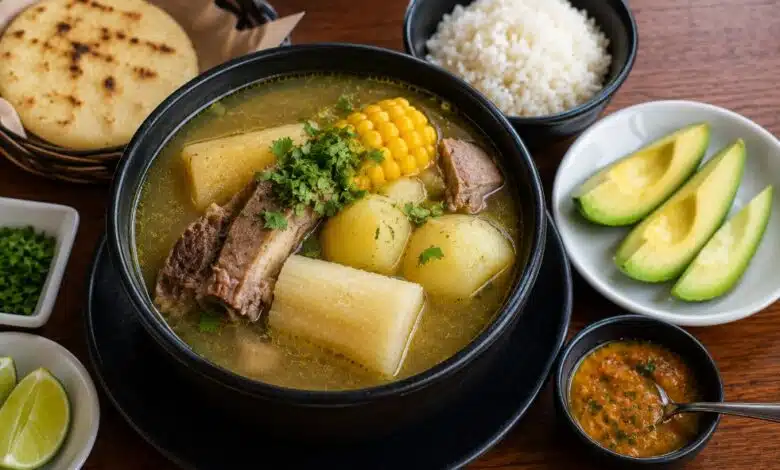
Colombian sancocho rarely arrives as nothing more than a bowl of broth. Depending on the restaurant and regional style, the soup itself may already contain meat, yuca, green plantain, corn and potatoes, while white rice, avocado, arepa, salad, lime or ají can arrive separately. That distinction matters because a menu price may represent either a simple bowl or a complete meal spread across several dishes.
White rice and avocado are among the most recognizable companions to Colombian sancocho, but they are not mandatory at every restaurant. Some kitchens add an arepa. Others serve salad. A weekend sancocho may arrive as a full lunch plate, while a smaller cup can be sold almost like an appetizer with no extra sides at all.
The easiest way to understand the meal is to separate three things: what cooks inside the pot, what the restaurant automatically places beside it, and what the diner adds at the table. Yuca and green plantain usually belong to the first group. Rice and avocado often belong to the second. Lime and ají frequently belong to the third.
This guide explains how those pieces work together, which accompaniments are common rather than universal, how restaurant side choices change portion value, and how to order without accidentally turning one hearty soup into two full meals. If your main goal is finding a restaurant rather than understanding the plate, see our guide to where to find a good Colombian sancocho near you.
The bowl and the side plate are two different parts of the meal
A first-time diner can look at a Colombian restaurant photo and assume that the rice, avocado, corn, plantain and meat are all ingredients of the soup. Some are. Some are not.
Meat or fish, yuca, green plantain, corn, potatoes and aromatics can cook directly in the broth depending on the regional version.
White rice and avocado are especially common restaurant accompaniments. Arepa or salad may also appear.
Lime and ají can sharpen or spice the broth without changing the entire restaurant pot.
This is why two restaurants can both advertise Colombian sancocho and still present noticeably different meals. The soup itself may be similar, while the plate around it changes.
The most familiar companion
White rice is common because it gives the diner control over the broth
Rice is one of the most familiar accompaniments to Colombian sancocho. It can arrive in a separate mound, a small bowl or as part of a side plate with avocado and salad.
Keeping it outside the soup at first is useful. A bowl of sancocho already contains several starches, often including yuca, plantain, potato and corn. Adding a full serving of rice immediately makes the meal much denser and changes the broth from something you sip into something closer to a rice-heavy stew.
There is no need to choose between “rice belongs inside” and “rice must stay outside.” Diners use it in different ways.
This lets the grains absorb flavor while keeping most of the bowl unchanged.
A piece of costilla or gallina can be eaten with rice on the side while the broth stays relatively clear.
After the larger pieces of yuca, corn and meat are gone, rice can absorb the remaining broth.
The third method is particularly useful with a large serving. It prevents the meal from becoming overly heavy during the first few minutes and gives the diner several different textures as the bowl changes.
Rice also affects how you compare two restaurants. A $19 sancocho including rice and avocado is not exactly the same purchase as a $17 bowl that charges separately for both sides. Menu value should be judged from the complete meal rather than the soup line alone.
Cool contrast
Avocado works because sancocho is hot, savory and often very substantial
Avocado provides something the soup itself usually lacks: a cool, creamy texture.
That contrast is particularly effective with beef-rib and oxtail versions. Rich meat broth, hot yuca and a fatty piece of beef can become tiring after several bites. A piece of avocado resets the mouth without adding aggressive acidity or chile heat.
Poultry sancocho benefits too. Gallina, corn and plantain all work naturally with avocado’s mild richness.
Restaurant service varies. Some kitchens give each diner several slices. Others include a small piece on the side plate. Some menu descriptions explicitly say avocado is seasonal or available when in season.
There is also no requirement to mash it into the soup. Many diners simply alternate between a spoonful of broth and a bite of avocado.
That preserves the temperature and texture contrast, which is one of the reasons the pairing works so well.
Restaurant-dependent
Arepa can complete the plate, but it is less universal than rice and avocado
Arepa appears with many Colombian restaurant meals, so it is easy to assume that every sancocho should include one. Actual menus show more variation.
Some restaurants serve sancocho with rice, avocado and arepa. Others provide rice and avocado only. Another kitchen may offer arepa as a paid side rather than part of the soup order.
This is one reason restaurant photos can be misleading. A photographed arepa may belong to an optional side order, a combination platter or a particular regional service rather than every bowl of sancocho sold by that kitchen.
When included, arepa adds another corn-based starch to a meal that may already contain yuca, plantain, potato, corn on the cob and rice.
That can be enjoyable, but it also makes the meal dramatically more filling.
Ask whether the arepa is included with the sancocho or ordered separately.
For a diner who wants to taste several Colombian dishes in one visit, skipping an optional arepa may leave more room for an empanada, pandebono or another specialty.
For someone treating the sancocho as the only meal, an arepa can make the serving feel even more complete.
Table adjustments
Ají and lime change the broth without changing the pot
Sancocho itself does not need to be intensely spicy.
Serving ají separately allows each diner to control chile heat and acidity. Someone who prefers a mild broth can leave it alone. Someone who wants more brightness can add a small spoonful.
Lime performs a related but simpler job. Acidity can make a rich beef or oxtail broth feel less heavy and can brighten poultry and fish versions.
The mistake is adding too much before tasting the soup.
Notice meat, herbs, roots and salt level before changing anything.
See whether acidity makes the flavors feel clearer.
Add only enough to learn what it contributes before making the whole bowl hotter.
This approach is especially useful when comparing restaurants. If every bowl receives a large amount of lime and ají immediately, differences in broth quality become harder to detect.
A lighter counterpoint
Salad appears on some restaurant plates because the soup itself is already heavy
A green salad may seem like an odd companion to a traditional soup until you look at the full meal.
Sancocho can contain beef or chicken, yuca, plantain, potato and corn before rice is added. A small mixed-green salad gives the plate something fresh, crisp and acidic.
Current Colombian restaurant menus show real examples of sancocho served with rice, mixed greens and avocado.
Salad should therefore be understood as one restaurant service style rather than an ingredient defining sancocho itself.
If your bowl is already enormous, the salad can be more useful than another heavy starch. If you are extremely hungry, rice or arepa may feel more satisfying.
Do not count yuca, green plantain and corn as “side dishes” when they are already in the pot
Restaurant descriptions sometimes list ingredients in a way that makes it difficult to know whether they arrive inside the soup or beside it.
In Colombian sancocho, yuca, green plantain, corn and potatoes commonly cook as part of the dish itself.
Dense cassava softens during cooking and contributes starch to the broth.
A savory-starchy ingredient that is very different from sweet fried ripe plantain.
Often served as a substantial section of cob inside the soup.
Common in many versions, though exact varieties and amounts differ by region and kitchen.
This matters when thinking about portion size.
A large container of sancocho is not simply four cups of broth. A meaningful percentage of the volume can be occupied by meat, corn, yuca and plantain.
The bowl can therefore be much more filling than an equally sized container of a smooth or mostly liquid soup.
There is no single side plate that represents every Colombian region
Colombian sancocho changes across the country, and side service changes with it.
Gallina traditions in Valle del Cauca or Nariño do not need to produce exactly the same restaurant plate as a fish sancocho associated with coastal cooking.
What remains useful is the broad pattern: substantial soup in the bowl, often accompanied by rice and avocado, with additional sides determined by regional practice and restaurant format.
This is also why the protein name deserves attention. Gallina, costilla, res, pescado, cola and trifásico can each produce a different meal before the side dishes are even considered.
If those menu names are unfamiliar, our guide to different Colombian sancocho styles explains how the protein changes the broth, richness and texture.
Avoid judging one restaurant as incorrect simply because its side plate differs from another Colombian restaurant hundreds of miles away or from a family recipe connected with another region.
A small cup and a complete sancocho plate should not be compared by price alone
One restaurant may offer a small soup cup for under ten dollars. Another may list a full sancocho entrée close to twenty dollars or more.
Those can be entirely different products.
The smaller order may contain broth and some solids with no extra sides. The larger meal may include a full portion of meat, rice, avocado, salad or arepa.
Restaurant pricing therefore needs context.
Is it a cup, regular bowl, large bowl or published ounce size?
Chicken, gallina, beef rib and oxtail do not have identical ingredient costs.
Rice, avocado, salad and arepa can transform a soup order into a complete meal.
Direct restaurant prices and delivery-platform prices may differ.
Included sides can make a slightly higher menu price the better value
Suppose one restaurant charges a little more for sancocho but includes rice and avocado. Another appears cheaper but treats both as extras.
The lower headline price may disappear once the meal is built.
This is especially relevant for takeout menus, where side modifiers are often hidden until the final ordering screen.
A useful value comparison therefore asks what arrives for the advertised price rather than simply sorting restaurants from cheapest to most expensive.
Portion quality matters too. A large amount of rice does not compensate for very little meat, badly cooked yuca or weak broth.
Quantity and quality should be evaluated separately.
What should you actually do with the side plate?
There is no complicated etiquette.
You can eat the rice separately, mix some into the broth or use it to accompany the meat. Avocado can stay beside the bowl. Arepa can be eaten between spoonfuls or used to pick up meat and vegetables.
The one method that improves understanding is simply not mixing everything immediately.
Taste the broth first. Then try the meat. Try yuca and plantain. After that, experiment with rice, lime, ají and avocado.
That sequence lets you understand the restaurant’s cooking before the side dishes change the balance.
Rice is most useful with the broth; avocado is most useful with the richest bites
Side dishes become more interesting when they are treated as tools rather than decorations.
Rice absorbs broth extremely well. It can also balance a salty spoonful or provide a neutral base beside heavily seasoned meat.
Avocado performs almost the opposite role. Instead of absorbing liquid, it introduces fat and coolness.
With costilla, a bite of avocado after beef can soften the impression of fat. With gallina, it creates a creamy contrast beside leaner poultry. With fish, avocado can add body without making the broth itself heavier.
This difference is why rice and avocado work together rather than merely repeating each other.
Arepa becomes less necessary when the bowl already contains several starches
Sancocho can already contain yuca, plantain, potatoes and corn. Add rice and the meal may contain four or five substantial starch sources before an arepa reaches the table.
There is nothing wrong with that when the diner wants a very large, traditional-style meal.
But a person who plans to order an appetizer or dessert may enjoy the meal more by treating arepa as optional when the restaurant allows it.
This is particularly useful for first-time diners who often underestimate how filling yuca and plantain can be.
Sweet plantain on the side is not the same ingredient experience as green plantain in the soup
Colombian menus frequently use plantain in more than one form.
Green plantain cooked in sancocho is dense, savory and starchy. Ripe sweet plantain served as a side is softer, sweeter and often caramelized through frying or roasting.
A restaurant can therefore theoretically serve plantain inside the soup and another plantain preparation beside it without literally duplicating the same flavor.
Still, sweet plantain is not as standard a sancocho accompaniment as rice and avocado. Treat it as a restaurant-specific addition unless the menu states otherwise.
When salad is included, eat it before it warms beside the soup
This sounds trivial, but takeout makes the issue obvious.
Hot soup and cold salad should not spend a long drive pressed together in the same insulated bag if avoidable. Lettuce wilts quickly, while avocado can darken and soften.
In a restaurant, salad provides a useful fresh interval during a heavy meal.
At home, unpack the cold sides as soon as possible rather than leaving them beside a hot soup container until dinner.
A first-time restaurant order can be much simpler than the menu makes it look
If you have never ordered Colombian sancocho, start by identifying the protein.
Then ask what is included with the bowl.
This identifies gallina, costilla, res, fish, oxtail or mixed meat.
This confirms the two most common companions rather than assuming them.
Useful when the menu photo shows extra sides but the description is unclear.
Prevents accidentally ordering a second huge main beside a large bowl.
These questions are more useful than asking whether the soup is “authentic,” because they tell you exactly what you are about to eat.
The best companion changes with the type of sancocho
Not every version benefits equally from the same side.
Rice and avocado are easy partners. Lime can brighten the poultry broth without overwhelming it.
Avocado and lime are especially useful against beef richness. Rice absorbs the deeper broth well.
Rice remains versatile, while the need for lime depends on how rich the beef cut is.
Lime can feel particularly natural with fish, while rice gives the meal more substance.
Oxtail richness makes avocado and acidity useful counterpoints.
A mixed-meat bowl can already be enormous, so extra arepa may be less necessary than a lighter side.
Sancocho and ajiaco may share rice and avocado, but the bowls themselves are organized differently
Side dishes can create another source of confusion between Colombian soups.
Ajiaco can also arrive with rice and avocado, but its defining structure is different. Bogotá-style ajiaco centers on chicken, potatoes, corn and guascas and is commonly associated with cream and capers.
Sancocho is much broader in protein and often gives yuca and green plantain more important roles.
Therefore seeing rice and avocado beside both soups does not make them versions of the same dish.
If you are choosing between the two on one restaurant menu, our guide lets you compare sancocho with ajiaco by broth, ingredients, texture and regional tradition.
For two diners, sharing the sides can make more sense than duplicating them
Two large bowls plus two full portions of rice, two arepas, two avocados and appetizers can become an enormous amount of food.
If the restaurant allows sharing, one or two side portions can be enough to understand the meal.
This is especially useful when the two diners order different sancocho styles.
One can try gallina while the other tries costilla, then compare both with the same rice, avocado and ají.
Shared sides remove one variable from the comparison and place attention back on the broth and protein.
A sancocho order can be complete even without rice
Rice is common, but the soup itself can already contain enough starch to function as a meal.
Yuca, plantain, potatoes and corn each contribute meaningful carbohydrates and bulk.
Someone who prefers less rice does not need to treat the side as mandatory simply because it arrived.
The same principle applies to arepa.
Traditional service and personal appetite do not need to be identical questions.
What comes with the soup matters more when ordering delivery
Restaurant-table service makes side dishes obvious. Delivery apps can hide them inside modifiers.
A sancocho listing may show one price, then ask you to select rice, salad or another side on the next screen.
Another restaurant may include those components automatically.
Before comparing prices between two apps, open the complete item and check the final configuration.
Otherwise you may compare a bare soup at one restaurant with a full meal at another.
The best takeout packaging keeps hot soup and cold sides apart
Sancocho itself travels fairly well because its meat and roots do not rely on crispness.
The side dishes are more vulnerable.
Keep it outside the broth so it does not absorb all the liquid during the drive.
Separate packaging prevents it from warming and softening unnecessarily.
Keep it away from the hot container to preserve texture.
Small separate containers let the diner season the reheated soup at the end.
Bone-in costilla or oxtail also makes the soup container heavier and more awkward. Keep it upright during transport rather than relying on a thin bag to stabilize it.
Side dishes do not tell you whether the soup is gluten-free, dairy-free or allergen-safe
Rice, avocado, yuca, corn and plantain are naturally free of wheat, but that does not establish the safety of the restaurant meal.
Broth bases, seasoning mixtures, shared equipment and sauces can matter.
Arepa can also vary in preparation and cross-contact risk.
Someone with celiac disease, a serious allergy or another medical restriction should ask about the complete soup and sides rather than making a decision from the visible ingredients.
If the meal already includes four starches, another side is a preference rather than a requirement
A large sancocho can contain yuca, plantain, potatoes and corn before rice reaches the table.
That matters for appetite planning more than for culinary rules.
If you are extremely hungry, rice and arepa may be welcome. If you are sharing appetizers or planning dessert, avocado and a small amount of rice may be enough.
The goal is not to strip a traditional meal down to the smallest possible plate. It is simply to recognize that sancocho can be far more substantial than the English menu category “soup” suggests.
What should you order with sancocho if you want to try more Colombian food?
Choose contrast rather than more of the same.
If the sancocho already contains several roots and starches, another enormous starch-heavy entrée may teach you less about the restaurant.
A single empanada offers crispness. A small arepa introduces another corn preparation. A light salad resets the palate. Sharing a dessert afterward gives a completely different flavor direction.
The exception is when the meal itself is meant to be large and communal. Colombian sancocho has strong associations with family gatherings and shared eating, so abundance can be part of the occasion rather than a mistake.
A restaurant photo can show more food than the advertised order actually includes
This is worth remembering when choosing between local restaurants.
A promotional photograph may place rice, avocado, arepa, salad and condiments around one bowl because the image looks generous.
The current menu description is more reliable than the photo for deciding what you actually receive.
Look for words such as “served with,” “includes,” “choice of side” or “extra.”
When those details are absent, ask before assuming.
The most useful first spoonful contains no rice, lime or ají
This may be the simplest practical advice in the whole guide.
Taste the broth before modifying it.
Good sancocho should have its own identity through the protein, roots, vegetables and aromatics.
Rice can absorb flavor. Lime can sharpen it. Ají can add heat. Avocado can soften it. None of those additions should be necessary to make the soup taste like something.
Once you understand the base, use the side plate however you like.
Rice and avocado are the familiar starting point, but the complete plate depends on the restaurant
Colombian sancocho commonly arrives with white rice and avocado, while arepa, salad, lime and ají may join the meal depending on region and restaurant service.
Yuca, green plantain, corn and potatoes are different: they frequently belong inside the soup itself rather than functioning as optional side dishes.
When comparing restaurants, look at the complete order. Check the protein, soup size, rice, avocado and any additional sides before deciding which menu price represents better value.
And once the bowl arrives, taste the broth before mixing everything together. The sides are there to complement the sancocho, not to hide it.
What is usually served with Colombian sancocho?
White rice and avocado are among the most common accompaniments. Depending on the restaurant and regional style, sancocho may also come with arepa, salad, lime or ají. The exact side plate varies, so the current menu is the best guide to what is included.
Does Colombian sancocho always come with rice?
No. Rice is very common with Colombian sancocho, but it is not guaranteed at every restaurant. Some places include it automatically, some offer it as a side choice, and smaller soup portions may come without rice at all.
Is avocado traditionally served with sancocho?
Avocado is a familiar companion to Colombian sancocho and appears on many restaurant plates. It provides a cool, creamy contrast to the hot broth and works especially well with rich beef, poultry and mixed-meat versions. Availability can still vary by restaurant and season.
Does sancocho come with arepa?
Sometimes. Arepa is served with sancocho at some Colombian restaurants, while others provide rice and avocado instead or offer arepa as an optional side. It should not be assumed to be included unless the menu says so.
Are yuca, plantain and corn sides or part of the soup?
Yuca, green plantain, corn and potatoes are commonly cooked directly in the sancocho rather than served only as separate sides. They help give the soup its hearty structure and can make the bowl much more filling than a mostly liquid soup.
Should I put the rice inside the sancocho?
You can, but you do not have to. Many diners add a little rice to the broth, eat it separately with the meat or save it for the end. Tasting the broth before adding rice makes it easier to appreciate the soup’s original texture and flavor.
What is ají served with sancocho?
Ají is a Colombian chile-based condiment that can add heat and acidity to the soup. It is often served separately so each diner can control how spicy the bowl becomes. A small amount is usually enough to change the flavor noticeably.
Why is lime served with sancocho?
Lime adds acidity and can make a rich broth taste brighter and less heavy. It works particularly well with beef, oxtail, poultry and fish versions, but it is best added after tasting the plain broth first.
How can I tell whether the side dishes are included in the sancocho price?
Check the menu for wording such as served with, includes or choice of side. If the description is unclear, ask whether rice, avocado, arepa or salad are included or charged separately. This makes price comparisons between restaurants much more meaningful.
What should I order with sancocho for a first meal?
A simple first order is sancocho with rice and avocado, then add lime or ají only after tasting the broth. If the serving is already large and contains yuca, plantain, potato and corn, another heavy side such as arepa may be optional rather than necessary.


