
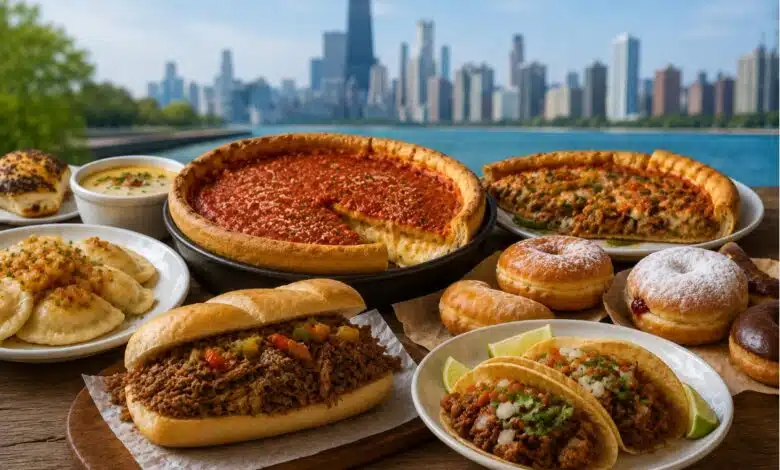
Chicago is often reduced to one dramatic slice of deep-dish pizza, which is a little like describing the lakefront by mentioning one wave. The city’s food makes more sense when you follow neighborhoods: Polish bakeries and delis, Ukrainian lunch counters, Mexican taquerias and panaderías, Italian beef stands, corner hot-dog windows, tavern-style pizza, old-school steakhouses, contemporary tasting menus, and markets where several immigrant stories sit in the same shopping basket.
This guide is built as a practical city map rather than a rigid restaurant ranking. Businesses change, chefs move, and opening hours are less reliable than Chicago weather in March. The useful part is learning what to look for, which neighborhoods reward a focused visit, how to order the classics, and how to plan a day without spending half of it in traffic.
Chicago tastes better when you stop treating it like a checklist
The first mistake visitors make is building a food itinerary from a list of famous names without looking at a map. Chicago is large. A restaurant that sounds “close” may sit across a river branch, beyond a highway, or forty minutes away once traffic, parking and train transfers become involved. A perfect day here is not the day with the most pins. It is the day when the meals, streets and neighborhoods make sense together.
I like to think of Chicago as a collection of food chapters. Downtown and the Loop offer architectural drama, hotel dining rooms, steakhouses and convenient access to well-known classics. The West Loop is polished, ambitious and restaurant-dense. Pilsen and Little Village tell stories through Mexican groceries, taquerias, bakeries, murals and family businesses. Ukrainian Village and surrounding West Town connect old immigrant institutions with newer cafes and bars. Polish food appears across several northwest-side and suburban corridors rather than in one neat tourist district. South Side and West Side food traditions deserve their own attention, especially when the goal is to understand the city rather than collect a few famous photographs.
That means your route should begin with a question: what kind of Chicago day do you want?
Once that is clear, the city becomes easier. A first-time visitor might pair architecture in the Loop with Italian beef, a Chicago-style hot dog and one pizza dinner. Someone returning for a second trip might skip downtown almost entirely and spend the day moving between a neighborhood bakery, a cultural museum, a grocery store and a family-run restaurant. Both are valid. The second often tastes more personal.
The famous dishes are not clichés when you order them well
Chicago’s iconic foods became iconic because they solved real urban problems: feeding workers quickly, making inexpensive cuts satisfying, serving groups in taverns, and turning immigrant cooking traditions into local forms. They are worth eating. The trick is to understand the differences rather than ordering every item as if it were one category called “Chicago food.”
Deep-dish pizza: a planned meal, not an impulse slice
Deep dish is constructed more like a savory pie than a typical thin pizza. The crust rises along the pan, cheese and toppings sit beneath the tomato sauce, and the whole thing needs time in the oven. It is rich, slow and theatrical. That is exactly why it works best as a deliberate dinner.
Order a smaller size than your appetite suggests. Add a salad. Ask about the baking time when you arrive, because a deep-dish meal rarely behaves like fast food. A sausage version gives the most classic Chicago experience, but spinach, mushrooms and other vegetable combinations can make the richness easier to handle.
What I would not do: eat deep dish at noon and schedule a steakhouse dinner at six. That itinerary looks heroic in a spreadsheet and feels disastrous in real life.
Tavern-style pizza: the local counterpoint
Thin, crisp and commonly cut into squares, tavern-style pizza has a completely different personality. It is easier to share, easier to eat with a drink and far more connected to neighborhood routines. The tiny corner pieces and cheese-heavy center squares produce a table argument that is practically part of the dish.
If deep dish is the visitor’s photograph, tavern-style is often the neighborhood habit. Try both before declaring a winner. They are not competing versions of the same idea; they are built for different moods.
Choose deep dish when…
You want one substantial destination meal, have time to wait, and enjoy thick crust, abundant cheese and a dramatic tomato-forward presentation.
Choose tavern-style when…
You want crisp edges, square pieces, easier sharing, neighborhood atmosphere and room in the day for another food stop.
Italian beef: learn the vocabulary before the sandwich arrives
An Italian beef sandwich is thinly sliced seasoned beef piled into a roll and served with varying amounts of its cooking juices. Sweet peppers or hot giardiniera can be added. The texture depends heavily on how wet you order it.
The bread is not decorative. It must absorb liquid without instantly dissolving. Eat the sandwich while it is hot. Italian beef is not improved by a long photo session.
The Chicago-style hot dog: details matter
A classic Chicago-style hot dog is usually an all-beef dog in a poppy-seed bun with yellow mustard, chopped onion, bright relish, tomato, pickle spear, sport peppers and celery salt. The exact arrangement can vary, but the pleasure comes from the contrast: salty, sharp, juicy, crisp and spicy in one bite.
The famous no-ketchup rule is partly tradition and partly theater. You do not need to perform anxiety at the counter. Order the standard version first, taste why the toppings work together, and then make your own decisions later.
Jibarito: a Chicago-born sandwich with Puerto Rican roots
The jibarito replaces bread with flattened fried green plantains. Inside, you may find steak, chicken or another filling with lettuce, tomato, cheese, mayonnaise and garlicky seasoning. It is crisp, savory and unmistakably tied to Chicago’s Puerto Rican food story.
This is one of the city’s most important dishes for anyone trying to move beyond the usual pizza-and-hot-dog circuit. It shows how Chicago’s identity keeps expanding through the communities that cook here.
Other dishes that belong on the radar
Chicken Vesuvio
Roasted chicken with potatoes, garlic, herbs and a bright pan sauce. It feels old-school, generous and ideal for a table that wants something recognizably Chicago without ordering another sandwich.
Shrimp de Jonghe
A rich baked shrimp dish with garlicky breadcrumbs and butter, associated with Chicago dining history. It is not an everyday lunch. It is exactly the sort of dish to order when the room has white tablecloths and you have stopped counting butter.
Garrett-style popcorn mix
Caramel popcorn and cheese popcorn together sound chaotic until the salty-sweet balance makes sense. Buy a small bag unless you possess unusual self-control.
Rainbow cone
Layers of several ice-cream flavors create a colorful Chicago dessert that feels nostalgic rather than minimalist. It is especially satisfying after a hot summer afternoon.
Polish Chicago is a route of bakeries, delis and family tables
Chicago’s Polish food story cannot be reduced to one restaurant district. Polish communities have shifted and expanded over generations, leaving churches, social institutions, grocery stores, bakeries, banquet halls and restaurants across the northwest side and beyond the city limits. For a visitor, that means the best Polish food day may involve more movement than a compact downtown crawl—but it also feels more like discovery.
Start with the deli counter. This is where a large part of the culture becomes visible: smoked sausages, fresh sausages, ham, pâtés, head cheese, pickled vegetables, prepared salads and breads. Ask what is made in-house and what is especially fresh that day. A good counter conversation is often more useful than an online ranking.
What to taste at a Polish deli or restaurant
A Polish bakery is often the more approachable first stop for travelers who do not want a full sit-down meal. Buy one fruit-filled pastry, one cheese-based item and something involving poppy seeds. This produces a better tasting comparison than buying three variations of the same doughnut.
For a deeper guide to finding Eastern European dishes, delis and markets beyond a single neighborhood, the site’s practical Ukrainian food search guide offers a useful method that also applies to Chicago’s Polish and Slavic grocery landscape.
Ukrainian Village rewards the visitor who looks beyond one lunch
Ukrainian Village is not a themed attraction. It is a living neighborhood with churches, museums, community organizations, long-established businesses, newer arrivals and changing commercial streets. Food is part of that fabric, but the best visit respects the cultural context.
A useful route combines a cultural stop with a meal and a grocery visit. The neighborhood’s churches and museums help explain why Ukrainian identity remains visible here. Then lunch gives the history flavor: borshch, varenyky, holubtsi, potato pancakes, sausages, cutlets and baked goods. A market visit shows what people actually cook at home.
A comfortable first Ukrainian meal
Begin with borshch if it is available. Good versions vary: some are intensely beet-forward, some more cabbage-heavy, some meaty, some light and vegetable-driven. Sour cream and dill soften and brighten the bowl, but the soup should still have enough structure to taste complete without them.
Then choose varenyky with a filling you do not usually order. Potato is classic and friendly; farmer’s cheese can be savory or gently tangy; cabbage and mushroom bring more complexity. If the menu offers a mixed plate, that is often the smartest choice for a first visit.
Holubtsi, or stuffed cabbage rolls, reveal the kitchen’s patience. The cabbage should be tender enough to cut easily, the filling moist, and the sauce balanced rather than sugary. Kotleti—seasoned ground-meat patties—are another deeply home-style choice. They rarely look theatrical, which is precisely the point.
At the restaurant
Ask what is made that day, which dumplings are handmade, and whether the soup changes. Daily specials may be more revealing than the permanent menu.
At the grocery store
Look for dark rye bread, smoked fish, pickles, buckwheat, frozen varenyky, farmer’s cheese, candies and cakes. Check labels and refrigeration instructions before building an ambitious hotel-room picnic.
Chicago’s Ukrainian food scene also helps travelers understand a larger truth: “Eastern European food” is not one cuisine. Ukrainian, Polish, Georgian, Balkan, Baltic and other traditions overlap in ingredients yet differ in technique, seasoning and cultural meaning. Treat every menu as its own language.
Pilsen and Little Village deserve more than a rushed taco stop
Chicago’s Mexican food is one of the strongest reasons to plan by neighborhood. Pilsen and Little Village offer restaurants, taquerias, street vendors, panaderías, carnicerías, grocery stores, murals, cultural institutions and everyday family businesses. A visitor who arrives only for one famous taco misses the rhythm of the area.
Pilsen is often easier to combine with art and a walk. Little Village’s 26th Street corridor delivers a dense commercial experience with bakeries, restaurants, shops and markets. Each area has its own energy, and neither should be treated as a backdrop for food photography.
Build the day around one specialty
Choose one anchor dish, then let the rest of the day stay lighter. Carnitas, birria and barbacoa can each become a full meal. Tacos al pastor are easier to sample across multiple stops. Tamales work well for breakfast or an early snack. Seafood dishes are refreshing in warmer months. A bakery visit can happen at the end, when the sugar display no longer has to compete with common sense.
At a taqueria, observe what other customers order and how the counter works. Some places specialize narrowly, and that focus is a gift. A short menu is not a limitation when the kitchen has spent years perfecting one meat, one broth or one griddle method.
The bakery strategy that saves the afternoon
Take a tray, but choose by texture: one soft bread, one crisp cookie, one filled pastry and one item you cannot identify. Ask. The conversation is part of the visit, and the answer may lead to the best bite in the bag.
Bring cash as a backup, especially for smaller shops and street vendors. Check current payment options rather than assuming. And remember that a line of local customers usually tells you more than an overly polished dining-room photograph.
Markets and bakeries show the city between meals
A restaurant gives you a composed plate. A market reveals ingredients, routines, cravings and family habits. Chicago’s grocery stores, indoor markets, specialty shops and bakeries are where the city’s food cultures become easiest to compare.
Walk through produce first. Then notice the bread, prepared-food counter, freezer section, spice shelves and sweets. In an Eastern European market, frozen dumplings and smoked fish may occupy the space that another store gives to tortillas and fresh salsa. In a Mexican supermarket, the carnicería, bakery and hot-food counter can turn grocery shopping into lunch. Asian markets may offer live seafood, prepared barbecue, noodle counters and entire aisles of condiments unfamiliar to a first-time visitor.
What makes a market stop useful
Bakeries deserve their own route because Chicago’s bread and pastry traditions are extraordinarily diverse. Polish pączki, Mexican pan dulce, Ukrainian tortes, Jewish rye, Italian cookies, Filipino pastries, Scandinavian cardamom buns and contemporary laminated dough can all fit into one weekend if you pace yourself and carry a sensible box.
The best bakery order is rarely the most photogenic item. Ask what came out recently, what locals reserve for holidays, and which product sells out first. Freshness beats decoration.
Italian Chicago lives in more than one sandwich
Italian beef may be the headline, but Chicago’s Italian American food story also includes red-sauce restaurants, neighborhood bakeries, sub shops, pizza traditions, pasta, sausages, chicken Vesuvio and old-school dining rooms where the portions assume you have brought relatives.
For a classic dinner, look for a menu that understands pacing: antipasto, pasta or a substantial main, vegetables or potatoes, and dessert. You do not need all of them. Chicago’s old-school Italian restaurants can make moderation feel socially suspicious, but it remains legal.
Italian bakery and deli shopping list
Giardiniera deserves particular attention. Chicago versions are typically chopped pickled vegetables packed with peppers and oil, ranging from mild to aggressively hot. It appears on Italian beef, sausages, pizza and sandwiches because acidity and heat cut through richness. Buy a jar only after checking how much luggage space you are willing to sacrifice to oil-based condiments.
The West Loop is polished, but it is not the whole food city
The West Loop and Fulton Market contain a dense concentration of acclaimed restaurants, fashionable dining rooms, cocktail bars and tasting menus. It is convenient for a high-energy evening because several appealing options sit within walking distance. Reservations can matter, prices can rise quickly, and the social scene may be as noticeable as the food.
This is the right area when you want a planned dinner, contemporary cooking and the ability to move to another bar or dessert stop afterward. It is not the right area if your goal is to understand Chicago solely through legacy immigrant food businesses. That story lives across a much wider map.
I would use the West Loop as one chapter in a weekend: perhaps a bakery or market morning elsewhere, a neighborhood lunch, a long break, and then a dressed-up dinner here. That contrast feels very Chicago.
Three itineraries that respect geography and appetite
These plans are intentionally broad. Restaurant hours, transit service and business locations can change, so verify the details shortly before your trip. The structure matters more than any single address.
One day: first-time Chicago without food exhaustion
One day: Ukrainian Village and Polish comfort food
One day: Pilsen and Little Village
A weekend rhythm that works
| Time | Saturday | Sunday |
|---|---|---|
| Morning | Downtown walk and light breakfast | Neighborhood bakery and market |
| Lunch | Italian beef or hot dog | Ukrainian, Polish or Mexican sit-down meal |
| Afternoon | Architecture, museum or lakefront | Grocery browsing and cultural stop |
| Dinner | Reserved West Loop or downtown dinner | Tavern-style pizza or casual neighborhood favorite |
| Dessert | Ice cream or plated dessert | Bakery box already waiting |
How to order without turning lunch into a logistics problem
Share strategically
Chicago’s best-known foods are unusually shareable. A small deep-dish pizza, one Italian beef cut in half, a plate of pierogi and a bakery box allow more discovery than four separate heavy meals. Ask whether a shop can cut a sandwich before wrapping it. Some will; some will look at you as if you have proposed zoning reform.
Do not overbook the day
One reservation is structure. Three reservations are a hostage situation. Leave enough room for transit delays, weather, unexpected lines and the possibility that lunch was larger than advertised.
Use trains for corridors, rideshares for awkward jumps
Public transit can be excellent for many routes, but not every restaurant sits conveniently beside a station. Check the entire trip, including the final walk, before committing. At night or in severe weather, a direct ride may be worth the cost.
Parking changes the mood
Driving offers flexibility in farther neighborhoods and suburban food corridors, yet parking can consume time and patience. Read signs carefully, account for permit zones, and never assume a busy commercial street will produce a space exactly when your reservation begins.
Check the day of the week
Some independent restaurants close one or two days weekly. Bakeries may sell out early. Markets can have different prepared-food schedules. Verify hours directly before leaving, especially for a place that anchors the entire route.
Ask focused questions
“What is best?” can produce a generic answer. Better questions are: What was made today? What sells out first? Which sausage is smoked here? Which dumplings are handmade? Is the giardiniera very hot? Which pastry is most traditional? Specific questions invite useful answers.
A few mistakes I would quietly prevent for a friend
What makes a Chicago meal feel truly local
It is not necessarily the age of the restaurant, the number of newspaper clippings on the wall or the difficulty of obtaining a reservation. A local-feeling meal usually has a clear relationship to its surroundings. The menu reflects a community. The room has regulars. The food solves a real appetite rather than performing an abstract idea of the city.
Sometimes that meal is deep dish under a red-checkered tablecloth. Sometimes it is a bowl of borshch after visiting a Ukrainian museum. Sometimes it is tacos eaten near a busy commercial street, pierogi from a deli counter, a jibarito wrapped tightly in paper, or a polished tasting menu built from Midwestern ingredients.
Chicago’s food identity is strongest when these experiences are allowed to coexist. The city is not asking you to choose between immigrant comfort food and ambitious contemporary dining. It is asking whether you planned enough days.
Season, weather and timing can completely change the route
Chicago food planning is partly a weather exercise. Summer encourages walking, patio meals, frozen desserts and long neighborhood afternoons. Winter rewards compact routes, hot soup, bakeries, markets and restaurants where you can stay awhile. Spring and fall can deliver either mood within the same day, sometimes within the same hour.
In warm weather, build in water and shade. A heavy lunch followed by a long exposed walk near the lake can feel less romantic than the itinerary suggested. In colder months, choose clusters with short transfers and warm indoor stops. A grocery store, museum or bakery can become a useful pause between meals rather than filler.
Summer strategy
Start earlier, especially for popular bakeries and neighborhood markets. Use the hottest part of the afternoon for a museum, indoor market or café. Save pizza, Italian beef and rich dinners for later unless you genuinely enjoy carrying several pounds of melted cheese through humid streets.
Mexican fruit cups, aguas frescas, paletas and seafood dishes can create a better warm-weather rhythm than repeating heavy classics. Chicago’s food identity is broad enough that “iconic” does not have to mean hot, fried and covered in cheese at every meal.
Winter strategy
Winter is excellent for soups, dumplings, stews and old-school dining rooms. Polish żurek, Ukrainian borshch, bowls of noodles, tamales and a hot Italian beef sandwich all make more emotional sense when the wind has been personally insulting you.
Check transit delays and restaurant hours before leaving. Keep one backup within the same area so a closure does not force a cross-city rescue mission. A flexible neighborhood plan is far more useful than a perfect list with no alternatives.
Festival and holiday weeks
Food festivals, cultural celebrations and holiday weekends can add special menus, street vendors and community events, but they also change parking, traffic and wait times. Polish, Ukrainian, Mexican and other cultural calendars may shape bakery offerings and restaurant specials. Pączki season, Easter breads, Christmas pastries, Independence celebrations and neighborhood festivals can all make a familiar shop feel completely different.
When visiting during a major event, decide whether the event itself is the goal. If it is, accept crowds and simplify the rest of the day. If it is not, choose a nearby neighborhood on another day and let residents have their festival without your itinerary trying to conquer every line.
Budgeting the food day without making it joyless
Chicago can support a wide range of budgets. The city’s famous handheld foods, deli counters, bakeries, taquerias and markets make it possible to eat memorably without reserving every meal at a high-end restaurant. The most satisfying plan often mixes price levels rather than choosing one.
Lower-cost day
Bakery breakfast, one sandwich or taco-focused lunch, market snacks and tavern-style pizza shared at dinner. Spend more on transport if it helps reach a strong neighborhood cluster.
Mid-range day
Café breakfast, sit-down immigrant-cuisine lunch, a bakery or dessert stop, then a polished but not tasting-menu dinner.
Splurge day
Keep breakfast and lunch light, reserve one serious dinner, and allow time to enjoy it. A tasting menu after deep dish is not luxury; it is poor scheduling in expensive clothing.
Family day
Choose places with flexible ordering, shareable dishes and nearby activities. Markets, pizza and bakeries usually reduce negotiation at the table.
Remember the less visible costs: parking, rideshares, taxes, tips and the bakery box you absolutely did not plan to buy. A neighborhood route can reduce transportation costs while improving the experience.
Frequently Asked Questions
What food is Chicago most famous for?
Chicago is best known for deep-dish pizza, Italian beef sandwiches and Chicago-style hot dogs. Tavern-style pizza, jibaritos, chicken Vesuvio, shrimp de Jonghe, caramel-and-cheese popcorn mix and rainbow cone ice cream are also important local specialties.
Is deep-dish pizza the pizza Chicagoans eat most often?
Not necessarily. Many locals regularly eat thin, crisp tavern-style pizza cut into squares. Deep dish remains an authentic Chicago tradition, but it is usually a heavier destination meal rather than an everyday slice.
Which Chicago neighborhood is best for Mexican food?
Pilsen and Little Village are excellent starting points. Pilsen combines food with murals and cultural stops, while Little Village offers a dense commercial corridor with taquerias, bakeries, markets and specialty shops. The best choice depends on whether you want a walkable cultural afternoon or a deeper market-and-restaurant crawl.
Can I visit Ukrainian Village and Polish restaurants on the same day?
Yes, with planning. Ukrainian Village is relatively compact, while Polish restaurants, delis and bakeries are spread across several northwest-side and suburban corridors. Choose one Polish area instead of trying to cover every historic enclave.
How should I order an Italian beef sandwich?
For a first sandwich, order it wet with hot giardiniera or sweet peppers. Dry is easier to handle, while dipped gives the softest and messiest experience because the entire sandwich is placed in the cooking juices.
How many food neighborhoods can I realistically visit in one day?
Two nearby areas is comfortable; three is possible when the stops are light and transit is simple. Crossing between distant neighborhoods for every meal usually creates more travel than pleasure. Build the day around one main neighborhood and one complementary stop.
Do I need restaurant reservations in Chicago?
Reservations are helpful for popular fine-dining restaurants, fashionable West Loop dining rooms and weekend dinners. Casual taquerias, delis, bakeries, hot-dog stands and many neighborhood restaurants generally work better as flexible stops, though current hours should always be checked.
What is the best Chicago food itinerary for a first visit?
Start with a light breakfast and downtown sightseeing, have Italian beef or a Chicago-style hot dog for lunch, visit one neighborhood bakery or market in the afternoon, and share pizza for dinner. This covers the classics without turning the day into a competitive eating event.
Are Chicago food markets worth visiting if I am not cooking?
Absolutely. Markets are useful for prepared foods, pastries, deli items, regional snacks and small tastings. They also reveal more about the city’s immigrant food traditions than a restaurant menu alone.
What should a vegetarian eat in Chicago?
Vegetarians can enjoy cheese or vegetable deep dish, tavern-style pizza, meat-free pierogi, potato pancakes, vegetable borshch, Mexican dishes built around beans, squash, mushrooms or nopales, bakery foods and many contemporary restaurant options. Ask whether broths, beans and sauces contain meat, because the dish name may not make that clear.


