
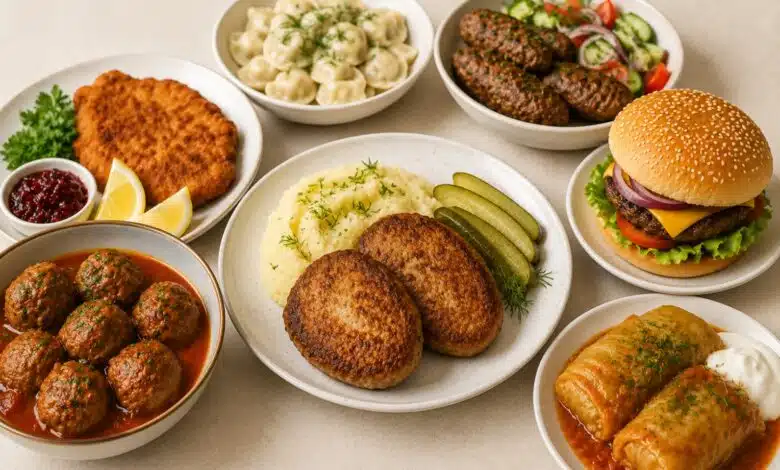
There is a particular kind of restaurant confusion that arrives before the food does. You recognize the dish in the photograph, but the name is unfamiliar. Or you recognize the name, order confidently, and receive something that looks nothing like the version you know.
That is not always a translation mistake. Food names are shaped by grammar, migration, family speech, regional pride, old borders, new customers and the limited patience of a delivery app. A dish can cross one border and gain a new ending. Cross another and it may acquire an English description. After two generations abroad, the family may use one name at home and another when ordering in public.
The interesting part is not deciding which name is “correct.” It is learning what each name is trying to tell us.
The same dish can have different names across countries because languages organize words differently, migration changes pronunciation and ingredients, transliteration creates several spellings, and restaurants adapt unfamiliar names for local diners. Sometimes the names describe close relatives; sometimes they hide major differences in structure, filling or cooking method.
A food name is a clue, not a complete recipe
A dish name may point to a shape, ingredient, cooking method, region, person, occasion or simply the word a family has always used. It does not always contain enough information to predict the exact plate.
English speakers are often trained to expect food names to behave like fixed labels. A cheeseburger is a cheeseburger. A croissant is a croissant. But many traditional dishes are named with ordinary nouns that change according to grammar, number and context. The same root word can appear with several endings. A diminutive may sound affectionate rather than merely small. A restaurant may list the plural even when the price covers one portion.
Then there is the problem of broad categories. “Cutlet” sounds precise until you travel. It may mean a thin whole piece of meat, a breaded pork chop, a ground-meat patty, a fish cake or a vegetable preparation. “Dumpling” covers an entire world of dough shapes, fillings and cooking methods. “Pancake” can be thin, thick, flour-based, potato-based or made primarily from cheese.
The translated category helps a first-time diner orient themselves. It rarely tells the whole story.
What the name can tell you
It may identify the country, region, main ingredient, shape, family tradition or serving occasion. A word such as mielony can signal that meat is minced. A geographic name can point to a recognized regional preparation.
What the name may leave out
It may not reveal whether the meat is ground or whole, whether the dish is fried or baked, whether the filling contains pork, or whether the menu uses a simplified English category.
Read the name, then look for four additional facts: the main ingredient, the structure, the cooking method and the serving style. Those four details usually explain more than the title alone.
Sometimes the “different dish” is only grammar changing clothes
Singular, plural, case endings and diminutives can make one food word look like several unrelated names to someone who does not speak the language.
English usually forms a plural by adding “s.” Other languages may alter the ending more noticeably. That is why a person can encounter kotlet, kotleta, kotlety, kotleti and kotletki and reasonably wonder whether they have stumbled into five separate dishes.
Sometimes the difference is grammatical. Sometimes it is linguistic: one form belongs to Polish usage, another appears in Russian or Ukrainian transliteration, and another reflects the spelling habits of an immigrant community. Sometimes the ending also changes the tone. A diminutive may suggest a smaller size, a home-style version or simply affection.
Food words are especially resistant to standardization because they are learned at the family table. A child hears the name long before seeing it written. Years later, that person may open a café and spell the word the way the family pronounced it. Another owner may follow a formal transliteration system. Both menus can refer to the same kind of food.
One listing can use the plural as a general category, while another uses the singular for one ordered portion.
A smaller or affectionate form can sound more homemade without describing a fundamentally new recipe.
Once a dish name enters another language, speakers may give it new plurals or pronunciation patterns.
Owners, translators, delivery platforms and customers may each use a different form.
The kotlet family is a perfect example. Our detailed explanation of how kotlet, kotleta, kotlety and kotleti differ shows why grammar and cooking style have to be read together. A spelling is useful evidence, but it is not a complete verdict.
Migration does not freeze a dish; it gives the dish a second life
When families move, recipes meet new ingredients, new kitchens and new audiences. The name often changes at the same time.
A family may preserve the original word at home while using an English explanation in public. The children learn to say one thing to grandparents and another to classmates. A restaurant menu may combine both: “syrniki — cottage cheese pancakes,” “pelmeni — Siberian meat dumplings,” “kotleti — homemade meat patties.”
These phrases can sound redundant to a linguist. To a diner, they are helpful. The traditional name protects identity; the English category lowers the risk of ordering blind.
Ingredients travel less perfectly than memories
A cheese pancake made after migration may change because the local farmer’s cheese is wetter. A dumpling wrapper may become thicker because the available flour behaves differently. A meat patty may contain another cut of meat because the butcher uses local terminology.
The family can still consider the result the same dish. The texture may tell a different story.
The next generation often creates hybrid wording
“Pierogi dumplings” and “syrniki pancakes” repeat the category, but they are understandable bilingual shortcuts. They also help search engines and delivery customers who know the English word but not the traditional one.
Over time, the explanatory phrase may become the everyday public name, while the original survives in the family.
Migration can narrow or broaden a name
In the original language, a word may cover several related dishes. Abroad, one community version can become so dominant that local diners think the term means only that preparation.
That is how food language becomes a map of movement. The dish remembers where it came from, but the name also records where it landed.
Transliteration explains why one sound can appear in several spellings
Translation replaces meaning. Transliteration carries letters or sounds from one alphabet into another. The second process is far less uniform than diners usually expect.
When a food name moves from Cyrillic, Greek, Arabic, Georgian or another script into the Latin alphabet, different systems may represent the same sound differently. One country follows an academic standard. A restaurant uses the spelling customers already recognize. A family writes the word phonetically. A delivery app removes accents or special characters.
The result is not one correct spelling surrounded by mistakes. It is often several reasonable spellings serving different audiences.
The original word
The dish begins in its own alphabet and grammatical system, where speakers understand the endings naturally.
The formal transliteration
A published standard converts the letters according to consistent rules. This version may look unfamiliar to the community that cooks the food.
The restaurant spelling
The owner chooses a form that customers can pronounce, recognize or type into a search box.
The platform version
Menus, maps and delivery systems may simplify punctuation, accents or letters that their software handles poorly.
For local food searches, this means one query is rarely enough. Someone looking for Russian-style patties may need to try kotleti, kotlety, kotlet, katleti, Russian cutlets and meat patties. The goal is not to win a spelling contest. The goal is to discover the wording used by the actual business.
The same translated word can conceal completely different structures
“Cutlet” is the classic trap. In one place it means a thin whole piece of meat, often breaded. In another it means a ground mixture shaped into a patty. A fish cutlet may be closer to a fish cake. A vegetable cutlet may contain no meat at all.
Ground patty
Russian-style kotleti and Polish kotlety mielone are made from minced meat mixtures. Bread, onion, egg or vegetables may be added for tenderness and flavor.
Whole-meat cutlet
A schnitzel or kotlet schabowy is made from a whole thin piece of meat. Breading and pounding shape the texture, not grinding.
Fish preparation
Fish kotleti can be delicate patties, sometimes breaded. Their closest English category may be fish cake, but the seasoning and cultural context differ.
Vegetable version
Potato, cabbage, carrot, beet or zucchini can be shaped into cutlets. The word describes the form more than the protein.
“Dumpling” is even broader. Pelmeni, vareniki, pierogi, manti and khinkali all fit the English category, yet their dough, fillings, size, shape and serving traditions are distinct. Calling each one a dumpling is useful at the first level of explanation. Stopping there is not.
“Pancake” performs the same trick. Blini, syrniki, potato pancakes and thick breakfast pancakes share a broad visual family. Their centers, batters and cultural roles are dramatically different.
A broad English category should open the door, not close the conversation.
It helps a diner recognize the form. The traditional name and description explain what makes the dish itself.
Different names can also describe close culinary cousins
The opposite situation is just as common. Foods with different names can share a strikingly similar structure because neighboring regions exchange ingredients, techniques and family habits.
A Romanian chiftea, a Polish kotlet mielony and a Russian kotleta may all begin with seasoned ground meat formed into patties. The similarities are real. So are the differences in seasoning, meat blend, breading, size and serving style.
This is where food writing can become careless. The easiest sentence is “They are all basically the same.” It is also the least interesting. A better comparison names the shared structure and then explains what each tradition does with it.
The same principle applies to stuffed cabbage, dumplings, grilled meats and layered salads. Borders move. Families marry. Recipes borrow. A dish can belong deeply to several communities without becoming culturally anonymous.
How to find the right dish when every menu seems to call it something else
The best search method is not one perfect phrase. It is a small sequence that follows the dish from traditional name to plain-English description.
Begin with the name you know
Search the traditional term with the city or neighborhood. This often uncovers specialist restaurants, community delis and family-run markets.
Translate the structure
Add a plain-English description such as ground chicken patties, farmer’s cheese pancakes, filled meat dumplings or layered herring salad.
Try alternate spellings
Small businesses may appear under one transliteration only. Search variants rather than assuming the first spelling is universal.
Add the business type
Restaurant, deli, bakery, market, prepared-food counter and takeout kitchen lead to different results.
For kotleti specifically, the Vesti guide to finding Russian kotleti at restaurants and delis explains how the same dish appears in dine-in, takeout, frozen and prepared-food formats.
For a broader search, the Russian food guide for restaurants, markets and delivery shows why a “near me” result can be a bakery, grocery store or deli rather than a formal restaurant.
Read photographs carefully
A photo can confirm shape and presentation, but it cannot always reveal whether the meat is ground, whether pork is present or whether a crisp exterior comes from breading.
What to ask when the menu description is too charmingly vague
Some menu descriptions are beautifully written and almost useless. “Grandmother’s special cutlets” sounds irresistible. It does not tell you whether the cutlets are chicken, pork, fish or vegetables.
This separates a minced patty from a schnitzel-style cutlet immediately.
“Meat” can mean beef, pork or a mixture. Ask directly when avoiding pork.
Fried, baked, grilled and sauce-finished versions travel and reheat differently.
A price may cover one patty only or a complete plate with potatoes, grains and salad.
Delis and holiday menus often rotate dishes even when older photographs remain online.
Comparison is useful; cultural flattening is not
It is perfectly reasonable to compare similar foods from different countries. Comparison helps diners understand shape, texture and flavor. The problem begins when every related dish is renamed under the cuisine with the strongest recognition.
A Romanian chiftea should not become a “Russian meatball” simply because that phrase seems easier. A Ukrainian dish should not be categorized as Russian solely because the menu is written in Russian. A Polish kotlet mielony deserves its Polish name even when the diner recognizes the form from another table.
The respectful approach is specific without becoming territorial. Name the dish as the cook or business identifies it. Explain the shared family of techniques. Describe the differences that matter on the plate.
Food history is full of migration, empire, trade, mixed households and moving borders. A dish can have more than one honest story. Precision does not require pretending the history is simple.
The names that survive are usually the ones people can use
A formal transliteration can be linguistically elegant and commercially invisible. A simplified menu phrase can be easy to order and culturally thin. The names that last often balance both needs.
That balance may look like a traditional title followed by a clear explanation. It may look like a bilingual menu. It may look like a family spelling that is not academically perfect but has been used for forty years.
Food language is practical. People choose words that help them cook, remember, sell, search and share. The result will never be perfectly standardized.
And perhaps it should not be. The slight disorder tells us where the dish has traveled.
Six questions that decode almost any unfamiliar dish name
Meat, fish, cheese, potato, grain, dough or vegetables?
Ground, whole, filled, layered, wrapped, folded or shaped?
Boiled, fried, baked, grilled, braised or served cold?
The same English category can hide several traditions.
With bread, in broth, with potatoes, inside a bun, with sauce or as part of a holiday table?
Those are three different operations, and each can change what the name appears to mean.
Why cities create their own menu vocabulary
A dish can have one name in its country of origin and a second life in a city abroad. New York, Toronto, London, Berlin, Miami and Los Angeles are full of food words that have been reshaped by neighborhood history. A deli may use the language of the first immigrant generation. A younger café may prefer a cleaner English description. A delivery kitchen may choose whichever phrase customers type most often.
That means the same preparation can be listed differently only a few miles apart. One menu says “kotleti.” Another says “homemade meat patties.” A third says “Russian cutlets,” even though the cook’s family may be Ukrainian, Jewish, Georgian or from a mixed Soviet-era background. The local city vocabulary can become so familiar that diners stop noticing how much translation is happening.
Neighborhoods also develop shorthand. Regular customers know that a certain bakery’s “cheese pancakes” are syrniki, or that a market’s “meat pies” are pirozhki. The wording works locally because everyone has learned the code. A visitor, however, may imagine a completely different dish.
Community shorthand
A name can become perfectly clear inside one neighborhood even if it would confuse diners elsewhere. Local familiarity acts like an unwritten glossary.
Platform shorthand
Apps push restaurants toward broad categories because customers filter by familiar terms. A traditional dish may be placed under burgers, pancakes or dumplings simply to remain visible.
For readers, the lesson is simple: local naming is evidence, but not proof. Look at the restaurant’s own description, photos, ingredients and cultural identity before deciding what the dish “really” is.
Family names can be older than the restaurant language around them
Some food words survive because families repeat them long after official terminology changes. A grandmother may use the name she learned before borders moved, before spelling reforms or before migration. Her grandchildren may understand the dish perfectly but have no idea how to write the word.
This creates affectionate, inconsistent and very human spellings. The recipe card may contain one version, the restaurant menu another and the delivery app a third. None of them necessarily signals a different dish.
Family names can also preserve lost distinctions. A household may use separate words for weekday and holiday versions, for small and large shapes, or for a meat filling versus a potato filling. A commercial menu may collapse all of those into one easy category.
When a family recipe enters public circulation, the private vocabulary can become part of the dish’s identity. That is why it is worth asking cooks what they call the food at home. The answer often reveals more history than the polished menu description.
If two family recipes use different names, compare the actual ingredients and method before assuming they are unrelated. Conversely, identical names can hide meaningful differences in texture, seasoning and occasion.
When restaurant translation becomes too elegant for its own good
Some menus translate so aggressively that the dish loses all recognizable identity. A modest home-style patty becomes “artisan hand-formed poultry medallions.” A simple cheese pancake becomes “pan-seared curd cakes.” The language sounds refined, but the diner cannot connect it to the traditional food.
Elegant wording is not automatically bad. A modern restaurant may genuinely reinterpret the dish. The problem is opacity. If the description avoids both the traditional name and the familiar structure, the guest is forced to guess.
The opposite problem is bluntness. “Meat thing,” “cheese pancake” or “Russian salad” may be understandable, but these labels erase useful distinctions. Good menu writing sits between poetry and clarity.
Too vague
“House specialty” tells the diner almost nothing about ingredients, structure or portion.
Too polished
“Seared heritage poultry medallions” may disguise what is essentially a familiar chicken kotleta.
Too broad
“Dumplings” can describe many unrelated shapes and fillings.
Balanced
“Pelmeni — thin dough dumplings filled with beef and pork, served with sour cream” gives identity and clarity.
Three mini-scenes that explain the naming problem better than a dictionary
The deli counter
You point to a browned oval patty and ask whether it is a cutlet. The server says yes. You ask whether the meat is chicken. The answer is “chicken and pork.” The sign says “home cutlet.” The food itself is closer to Russian-style kotleti than to the breaded chicken cutlet you imagined.
The bakery case
A tray is labeled “cheese pancakes.” You expect a stack of breakfast pancakes. Instead, you receive three compact golden rounds made mostly from farmer’s cheese. The English phrase was not false, but it was broad enough to create the wrong mental picture.
The delivery app
You search for dumplings and find pelmeni, vareniki and pierogi under the same category. One is filled with meat, another with potato and cheese, another with cabbage. The platform grouped them by shape, not by tradition or exact method.
These small misunderstandings are why strong food descriptions matter. Names guide the first impression. Structure and ingredients confirm the reality.
How food names change when a dish becomes fashionable
Popularity can transform vocabulary. Once a dish becomes fashionable, restaurants often keep the traditional name because recognition has grown. Years earlier, the same item might have needed a full English explanation.
Consider how words such as ramen, tapas, gnocchi and bao entered mainstream restaurant language. At first, menus explained them carefully. Later, the names themselves became selling points. The same process happens on a smaller scale with regional dishes.
Fashion also encourages overuse. A trendy word can be attached to dishes that only loosely resemble the original. A café may call any filled bun “bao,” any thin pancake “crepe” or any grain bowl “bibimbap-inspired.” This can attract attention while blurring meaning.
The best food writing resists both extremes. It does not hide unfamiliar names, and it does not use fashionable names carelessly. It explains enough for the reader to understand the dish without stripping away its context.
Why ingredient substitutions can change the name—or leave it untouched
Sometimes a dish keeps its name even after the recipe changes significantly. Migration may replace one cheese with another, one cut of meat with a local equivalent or one herb with what is available. The family still recognizes the dish through shape, method and memory.
In other cases, a small change creates a new local name. A filling, sauce or cooking method becomes distinctive enough that the variation develops its own identity.
This is not inconsistency so much as cultural logic. Food categories are held together by different features in different places. One community may define a dish by its dough. Another by the filling. Another by the serving ritual.
The dish is considered the same because the main ingredient remains unchanged.
The cooking technique matters more than the exact ingredient list.
The food keeps its name because it appears at the same holiday or family event.
The name survives because the dish still feels like the one the family knows.
What reviewers reveal when menus do not
Reviews can be useful for decoding food names, especially when diners describe what arrived. A review might explain that “chicken cutlets” were ground patties, that “cheese cakes” were syrniki or that “dumplings” were filled with potato rather than meat.
But reviews need interpretation. One diner may call a dish by the closest English category they know. Another may use a family term. A third may confidently misidentify it.
The most reliable clues are concrete: photographs, ingredient mentions, texture descriptions and serving style. “Two oval patties with mashed potatoes and mushroom gravy” tells you more than “great authentic cutlets.”
Recent reviews matter more than old ones because menus change. A restaurant may revise its English wording, replace a dish or move it to a weekend menu while older photos remain online.
Look for several independent descriptions that agree on the structure. Treat one confident label as a clue, not final proof.
Why one family can use three names for the same dinner
Inside multilingual families, food vocabulary often changes with the person speaking. A grandparent may use the original regional name. A parent may use a shortened household version. A child may describe the dish in English to school friends and switch back at home.
All three names can be sincere. They belong to different social settings rather than different recipes. This is especially common when a dish is easy to recognize visually but difficult to translate neatly.
The public name may also change over time. A family that once said “meat patties” for convenience may later restore the traditional word when local diners become more familiar with the cuisine. The recipe stayed stable while the audience changed.
This explains why arguments about the one “real” name often miss the point. The same dish can carry a domestic name, a restaurant name and a search-friendly English description at once.
At home
The name is brief, emotional and understood without explanation.
On the menu
The wording has to help a stranger imagine ingredients, texture and portion.
A dish name can describe identity, not only ingredients
Some names survive because they connect the food to a place, family or memory. Changing the wording may make the menu clearer, but it can also remove the history that gives the dish meaning.
That is why the most helpful explanation does not replace the original term. It keeps the name, then adds enough detail for the diner to understand the filling, texture, cooking method and serving style.
Clarity and cultural specificity do not have to compete. A good menu can offer both.
The best food translations leave a little of the original world intact
A useful translation tells the diner enough to order. A memorable one also preserves the dish’s own name, texture and context.
That is why I prefer menus that say “syrniki — farmer’s cheese pancakes” rather than hiding the traditional word. I want the explanation, but I also want to learn what the dish is called by the people who cook it.
The same dish can carry different names without one side being fraudulent. Language changes as people move. Recipes adapt. Restaurants translate. Families keep private words alive.
The name is not the whole plate. It is the first invitation to look more closely.
Questions about food names, translation and menus
The FAQ block below answers the most practical questions diners ask when one dish appears under several names.
Why does the same dish have different names in different countries?
Different languages use different words and grammatical endings. Migration, regional speech, transliteration and restaurant menu adaptation can also change how a dish is written or described. Sometimes the dishes remain very close; sometimes one translated category hides major differences.
What is the difference between translation and transliteration?
Translation replaces a word with its meaning in another language. Transliteration represents the original letters or sounds in a new alphabet. That is why one dish may appear under several spellings even when the intended meaning is the same.
Can one translated word describe several different dishes?
Yes. “Cutlet” may mean a whole breaded piece of meat, a ground-meat patty, a fish patty or a vegetable preparation. “Dumpling” and “pancake” are similarly broad categories. The ingredients and cooking method provide the real distinction.
Why do restaurants replace traditional food names with English descriptions?
They usually want first-time diners to understand what they are ordering. A phrase such as “cottage cheese pancakes” is easier to imagine than an unfamiliar traditional word. The clearest menus use both: the original name and a concise explanation.
Are kotlet, kotleta, kotlety and kotleti separate dishes?
Not necessarily. Some forms reflect singular and plural grammar, language differences or alternate transliteration. The full phrase matters because words such as mielony or schabowy can identify genuinely different preparations.
How do I search for a dish if I am unsure of the spelling?
Try several common spellings and a plain-English description. Add the city, neighborhood, protein or business type. For example, search both “chicken kotleti” and “Russian chicken patties,” then add deli, restaurant or market.
Why does my family call a dish something different from a restaurant menu?
Family language often preserves regional, affectionate or older forms, while restaurants adapt names for local customers and delivery platforms. Both can refer to the same food tradition.
Does a similar-looking dish from another country have the same history?
Not automatically. Similar foods can develop through neighboring traditions, migration or shared techniques. Compare ingredients and structure, but keep the cultural name used by the cook or business.
How can I avoid ordering the wrong version of a dish?
Check whether the main ingredient is ground or whole, ask which protein is used, note the cooking method and confirm what sides are included. Photographs help, but the written description or a direct question is more reliable.
Is it disrespectful to compare foods from different countries?
No. Comparison is useful when it is specific. Explain the shared structure and the differences in ingredients, seasoning and service. The problem is not comparison; it is erasing the identity of each dish by calling them all the same thing.


