
Georgian Pkhali Near Me: Restaurants, Varieties and How to Order
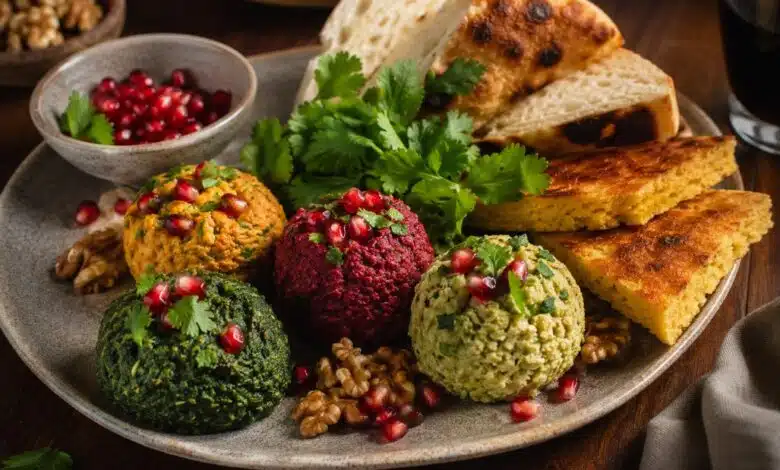
Find Georgian pkhali without mistaking every walnut appetizer or vegetable spread for the same dish
Pkhali is a family of chilled Georgian vegetable and walnut preparations that may be made with spinach, beetroot, cabbage, beans, leeks, wild greens or several vegetables on one plate.
Georgian pkhali near you is most likely to appear at a Georgian restaurant, bakery, wine bar or prepared-food counter under names such as pkhali, assorted pkhali, pkhali trio, spinach pkhali, beet pkhali or Georgian vegetable pâté. The defining combination usually includes cooked or softened vegetables, ground walnuts, garlic, herbs, spices and acidity from vinegar or another sour element.
Pkhali is normally served cold or at cool room temperature. Restaurants may shape it into small rounds, quenelles, rolls or compact mounds and garnish it with pomegranate seeds, herbs or walnut pieces. Other kitchens serve it as a spread beside bread or mchadi, the Georgian cornmeal bread.
This hub helps you find confirmed restaurant versions, understand menu wording, distinguish pkhali from eggplant rolls and other Georgian walnut dishes, check dietary concerns and choose the right portion for dine-in, pickup or a shared Georgian meal.
How do you find Georgian pkhali near you?
The most reliable method is to search both the dish name and the vegetable variety. A restaurant may not use the broad phrase “assorted pkhali” even when spinach or beet pkhali appears elsewhere on its menu.
Open the restaurant’s own website or ordering system and search for “pkhali,” “phali,” “spinach,” “beet,” “walnut” and “cold appetizers.” Some menus place pkhali under chilled plates, starters, vegetable dishes or Georgian appetizer boards rather than using a dedicated pkhali section.
Places where pkhali is most likely to appear
- Georgian restaurants with a full cold-appetizer menu
- Georgian bakeries that also sell prepared salads and spreads
- Georgian wine bars serving shareable plates
- Caucasian restaurants with clearly identified Georgian dishes
- Georgian grocery stores with refrigerated prepared food
- Restaurants offering supra-style platters or appetizer assortments
A broad search for “vegetable pâté” is less reliable because it may return French terrines, vegan spreads or unrelated Eastern European dishes. The words Georgian, walnut, spinach, beet and pkhali narrow the results more effectively.
What is Georgian pkhali?
Pkhali is a Georgian preparation in which cooked vegetables or greens are finely chopped or ground and combined with walnuts, garlic, herbs, spices and acidity. It is usually served as a chilled starter or shared vegetable plate.
The word does not identify one fixed vegetable. It describes a method and family of dishes. Spinach pkhali and beet pkhali may look completely different but remain recognizably related because both use the Georgian walnut-herb seasoning structure.
The vegetable provides color, moisture and the main earthy or sweet flavor. Walnuts give richness and body. Garlic and herbs add freshness, while vinegar or another sour element prevents the mixture from tasting flat or heavy.
Many restaurants form pkhali into small decorative portions. This presentation is common, but the dish can also be served more loosely as a spread. Shape alone does not determine quality or tradition.
Vegetable base
Spinach, beetroot, cabbage, beans, leeks, bell pepper, eggplant, beet leaves or wild greens may be used.
Walnut mixture
Ground walnuts commonly provide richness, structure and the distinctive nutty finish associated with the dish.
Aromatics
Garlic, coriander, cilantro and other herbs may appear according to the vegetable and restaurant recipe.
Acidity
Vinegar or another sour component helps balance the walnuts and cooked vegetables.
Pkhali makes more sense within the larger Georgian table, where herbs, walnuts, vegetables, breads, cheeses, dumplings and tart sauces are served together. The VESTI.LA guide to Georgian food and the shared Georgian table provides the broader context.
Which U.S. restaurants currently list Georgian pkhali?
The restaurants below had pkhali confirmed through an official restaurant website or active ordering page when this guide was researched. Menu items, prices and availability can change, so check the current menu before making a special trip.
Where can you find pkhali in New York City?
New York currently offers the strongest concentration of confirmed options, including sit-down Georgian restaurants, wine-focused dining rooms and a Staten Island bakery-market format.
Saperavi — East Village, Upper East Side and Upper West Side
Official menu confirmedSaperavi lists pkhali as Georgian vegetable rolls made with walnuts and Georgian spices and served with house-made cornbread. The restaurant currently operates several Manhattan locations, making it one of the easier options for diners searching in central New York City.
Official website and ordering menu checked July 2026.
The History Georgian Fusion Restaurant — Midtown Manhattan
Official ordering page confirmedThe History lists a broad Georgian pkhali palette with spinach, beet, eggplant and leek preparations blended with walnuts, garlic and coriander. The plate is served with nadughi and mchadi, giving diners both the vegetable spreads and traditional accompaniments.
Official ordering page checked July 2026.
Chama Mama — Multiple New York City locations
Official menu confirmedChama Mama offers several pkhali styles rather than treating the dish as one fixed spinach spread. Current official ordering pages have included beet, spinach, eggplant, lobio, ekala and ramson versions, with some offered individually and others arranged as a selection.
Official ordering menu checked July 2026.
Georgian Bread House — Staten Island
Official menu confirmedGeorgian Bread House offers pkhali in a bakery and prepared-food setting. The current menu includes beet pkhali, spinach pkhali and an assorted trio combining vegetable pâtés with an eggplant roll. Some portions are sold by weight, which is useful for takeout or a larger home meal.
Official website and current ordering menu checked July 2026.
Where can you find pkhali in Washington, D.C.?
Supra in the Shaw neighborhood currently offers one of the clearest menu descriptions of pkhali and its dietary details.
Supra — Shaw
Official ordering page confirmedSupra lists pkhali as twin vegetable pâtés made with beet and collard greens, walnuts, fresh herbs and sunflower. It is served with house-made shotis puri. The menu specifically identifies the dish as vegetarian and nut-containing and notes that it is gluten-free without the bread.
Official ordering menu checked July 2026.
Where can you find pkhali in the Chicago area?
Stumara in Wheeling serves a multi-vegetable pkhali plate with Georgian cornbread.
Stumara — Wheeling, Illinois
Official menu confirmedStumara’s official menu describes its pkhali plate as Georgian vegetable preparations made with spinach, beet leaves, leek leaves, walnuts and aromatic Georgian herbs. The plate is served with warm mchadi.
Official website and ordering menu checked July 2026.
Where can you find pkhali in Texas?
Nikala in Round Rock provides a confirmed option for the Austin metropolitan area.
Nikala — Round Rock
Official menu confirmedNikala lists pkhali as a Georgian appetizer made with spinach, beets and bell peppers seasoned with walnuts, garlic, fresh greens and vinegar. This version is especially useful for first-time diners because the menu identifies both the vegetable assortment and the walnut-herb seasoning.
Official website and ordering menu checked July 2026.
What varieties of pkhali can you order?
Pkhali changes with the vegetable used, so an assortment is often the best first order. The walnut, garlic, herb and vinegar structure may remain similar while the color, moisture, sweetness and texture change significantly.
| Variety | Typical flavor | Typical texture | Common appearance |
|---|---|---|---|
| Spinach pkhali | Green, herbaceous and mildly earthy | Soft and finely chopped | Deep green |
| Beet pkhali | Earthy, slightly sweet and tangy | Dense and moist | Pink, burgundy or purple-red |
| Cabbage pkhali | Mild, savory and walnut-forward | Fine but slightly fibrous | Pale green or beige-green |
| Bean pkhali | Earthy, rich and substantial | Thicker and more paste-like | Tan, brown or muted green |
| Leek pkhali | Sweet onion character with herbs and walnut | Soft with light vegetable fibers | Light green |
| Bell pepper pkhali | Sweet, vegetal and gently tangy | Moist and soft | Red, orange or mixed |
| Ekala pkhali | Green, herbal and distinctly wild-plant-like | Fine and compact | Dark green |
| Mixed pkhali plate | Several contrasting vegetables and seasoning balances | Varied | Multicolored assortment |
The menu may use a familiar English vegetable name or retain a Georgian plant name such as ekala. When the name is unfamiliar, ask whether the variety is leafy, sweet, earthy or bean-based.
What does pkhali taste like?
Pkhali usually tastes nutty, garlicky, herbal and tangy, with the featured vegetable shaping the final sweetness or earthiness. It should not taste like plain boiled vegetables or an undiluted walnut paste.
Walnuts create richness, but vinegar and herbs keep the mixture from becoming heavy. Garlic may be noticeable, especially in spinach and beet versions. Coriander and cilantro can add freshness, while Georgian spices may create warm, slightly floral or earthy notes.
What texture should pkhali have?
Pkhali should be fine enough to hold together but not completely smooth like hummus or commercial dip. Small vegetable and walnut particles are normal. A good portion feels cohesive and moist without leaking water or oil.
Is pkhali the same as Georgian eggplant rolls?
No. Pkhali is a vegetable mixture combined with walnuts, while Georgian eggplant rolls usually use slices of cooked eggplant wrapped around a walnut-garlic filling.
| Feature | Pkhali | Eggplant rolls with walnuts |
|---|---|---|
| Vegetable role | Finely chopped into the walnut mixture | Eggplant forms the outer wrapper |
| Shape | Round, mound, quenelle, roll or loose spread | Distinct folded or rolled eggplant slices |
| Texture | Uniform vegetable-walnut mixture | Soft eggplant surrounding denser walnut filling |
| Menu wording | Pkhali, phali or vegetable pâté | Eggplant rolls, badrijani nigvzit or eggplant with walnuts |
| Common garnish | Pomegranate, herbs or walnut pieces | Pomegranate and herbs |
Restaurants sometimes place both dishes on the same appetizer platter, which can make the distinction less obvious. The menu description should identify whether the eggplant is blended into the pkhali or used as a wrapper.
Is pkhali vegan, gluten-free and vegetarian?
The basic pkhali mixture is commonly vegetarian and often vegan and gluten-free, but the complete restaurant plate must be checked. Bread, dairy accompaniments and kitchen cross-contact can change the answer.
Is pkhali vegan?
Vegetables, walnuts, garlic, herbs, spices and vinegar are plant-based. Some restaurants therefore mark pkhali vegan. Others serve it with cheese, nadughi, yogurt sauce or another dairy accompaniment.
Ask whether dairy is mixed into the pkhali or served separately. Do not judge from the white garnish alone because it may be cheese, yogurt or a non-dairy sauce.
Is pkhali gluten-free?
The vegetable and walnut mixture generally does not require wheat. However, shotis puri and most Georgian wheat breads contain gluten. Mchadi is made from cornmeal, but restaurant preparation and added ingredients still need confirmation.
Supra specifically marks its pkhali gluten-free without the bread, illustrating why the accompaniment matters as much as the spread itself.
Does pkhali contain nuts?
Yes, traditional restaurant pkhali commonly contains walnuts. Walnuts are not an optional decorative garnish; they are usually a central ingredient that contributes structure and flavor.
Does pkhali contain dairy?
The core mixture often contains no dairy, but a mixed restaurant plate may include cheese, nadughi, matsoni or another dairy sauce. Ask about the entire plate rather than only the vegetable portions.
Does pkhali contain sesame?
Sesame is not a defining pkhali ingredient, but bread, sauces and shared preparation may introduce it. Diners with serious allergies should ask the restaurant directly.
Does pkhali travel well for pickup and delivery?
Pkhali generally travels well because it is served chilled and does not depend on a crisp crust, hot broth or melting cheese. It is one of the more practical Georgian dishes for a cold appetizer order.
The main delivery risks are moisture separation, crushed garnishes and bread softening in the same container. A restaurant that packs bread separately usually preserves both components better.
What to check before ordering takeout
- Whether the listing is one variety, a trio or a larger shared plate
- Whether bread, mchadi or cheese is included
- Whether the portion is sold by weight
- Whether pomegranate garnish is packed separately
- Whether the plate includes eggplant rolls or other walnut appetizers
- Whether delivery availability depends on your ZIP code
Prepared-food counters may sell half-pound or one-pound portions rather than restaurant appetizer plates. That format can be more useful for a party, picnic or larger Georgian meal at home.
What should you order with pkhali?
Pkhali works best as part of a shared Georgian table with bread, cheese, salads, dumplings, beans or grilled dishes. Its walnut richness and acidity make it especially useful beside warm bread and richer cheese dishes.
Khachapuri
Khachapuri adds warm bread and cheese to the chilled vegetable plate. A round Imeretian or Megrelian style is easier to divide among several diners, while Adjarian khachapuri creates a richer meal centered on melted cheese, egg and butter.
The VESTI.LA guide to Georgian khachapuri styles explains the differences between Adjarian, Imeretian, Megrelian and other forms.
Mchadi
Mchadi is Georgian cornmeal bread. Its simple flavor and firm texture work well with walnut-based vegetable spreads. Restaurants may serve it warm beside a pkhali plate.
Georgian salad
A cucumber and tomato salad provides fresh moisture and acidity. A walnut-dressed Georgian salad creates a more walnut-forward table, so consider the balance if pkhali is already a large part of the order.
Lobio
Georgian bean stew adds warmth and substance. Together, lobio, pkhali and bread can form a satisfying vegetable-centered meal, but confirm butter and other additions when ordering vegan.
Khinkali
Khinkali add a hot, juicy dumpling course after the chilled appetizer. Pkhali is easier to share while waiting for dumplings to arrive and provides a vegetable contrast to meat or cheese fillings.
A balanced first Georgian order
For two to four people, consider one assorted pkhali plate, one Georgian salad, one khachapuri style and one order of khinkali. This creates a useful contrast of chilled vegetables, fresh salad, warm bread, cheese and dumplings without ordering several similar walnut appetizers.
How can you recognize good pkhali?
Good pkhali should taste clearly of its vegetable while maintaining a balanced walnut, herb, garlic and acidic finish. It should not be watery, oily, dry or dominated by raw garlic.
| Quality issue | What you may notice | Possible cause |
|---|---|---|
| Watery pkhali | Liquid collects around the portion | Vegetables were not drained sufficiently |
| Dry, crumbly texture | The mixture does not hold together | Too little vegetable moisture or overly coarse walnuts |
| Heavy walnut paste | The featured vegetable becomes difficult to taste | Walnut proportion is too dominant |
| Harsh garlic | Raw garlic overwhelms herbs and vegetables | Poor balance or insufficient resting time |
| Flat flavor | The mixture tastes rich but dull | Too little acidity, salt or fresh herb character |
| Stale walnut flavor | Bitter, dusty or rancid finish | Old or poorly stored walnuts |
| Mushy presentation | No vegetable texture remains | Excess processing or moisture |
| Crushed delivery plate | Varieties blend together in the container | Loose packaging or stacked garnishes |
Different pkhali varieties do not need identical consistency. Beet pkhali may naturally feel denser and moister than spinach pkhali. The important question is whether each portion feels intentional and balanced.
What should you ask before visiting a restaurant?
Ask which pkhali varieties are available that day and whether the listing is an individual portion, trio or full appetizer platter.
- Which vegetables are included in the pkhali plate?
- Is the menu item one variety or an assortment?
- Does the pkhali contain walnuts?
- Is any dairy mixed into the pkhali?
- Does the plate include cheese, matsoni or nadughi?
- Is it served with wheat bread or mchadi?
- Can the bread be packed separately?
- Is the portion intended for one person or for sharing?
- Can pkhali be ordered by weight or in a catering tray?
- How does the kitchen handle cross-contact for the relevant allergen?
The most useful first question is: “Which pkhali varieties are on the plate today, and what is served with them?” That single question clarifies the vegetables, portion format and possible bread or dairy accompaniments.
Build a fuller Georgian meal
Read the VESTI.LA guide to Georgian food for a broader introduction to walnut dishes, sauces, breads, dumplings, grilled meats and the shared-table structure of a Georgian meal.
For the cheese-bread course, compare the major regional forms in the guide to khachapuri styles.
What should you remember when searching for pkhali?
Pkhali is not one fixed spinach spread. It is a Georgian family of vegetable and walnut preparations that can feature beetroot, spinach, cabbage, beans, leeks, peppers or wild greens.
Search by both the dish name and the vegetable, then confirm whether the restaurant serves one variety, an assortment or a larger platter. Walnuts are normally central, while bread, dairy sauces and cheese may be separate additions that change the dietary details of the complete order.
Where can I find Georgian pkhali near me?
Search Georgian restaurants, bakeries, wine bars and prepared-food markets for pkhali, phali, assorted pkhali, spinach pkhali or beet pkhali. Check the official menu because it may appear under chilled appetizers or vegetable plates.
What is Georgian pkhali?
Pkhali is a chilled Georgian preparation made by combining cooked vegetables or greens with ground walnuts, garlic, herbs, spices and acidity.
What vegetables are used in pkhali?
Common varieties include spinach, beetroot, cabbage, beans, leeks, bell peppers, beet leaves and wild greens such as ekala.
Is pkhali vegan?
The core vegetable and walnut mixture is often vegan, but restaurant plates may include cheese, yogurt, matsoni or nadughi. Confirm the complete serving.
Is pkhali gluten-free?
The pkhali mixture often contains no wheat, but it may be served with Georgian wheat bread. Ask about bread, preparation and cross-contact.
Does pkhali contain nuts?
Yes. Traditional pkhali commonly contains ground walnuts as a central ingredient, not merely as a garnish.
Is pkhali the same as Georgian eggplant rolls?
No. Pkhali blends the vegetable into the walnut mixture, while Georgian eggplant rolls wrap slices of cooked eggplant around walnut filling.
What does pkhali taste like?
Pkhali usually tastes nutty, garlicky, herbal and tangy. Spinach versions are greener and more herbaceous, while beet versions are sweeter and earthier.
Can pkhali be ordered for takeout?
Yes. Pkhali generally travels well because it is served chilled. Ask for bread and delicate garnishes to be packed separately.
What should I order with pkhali?
Pkhali pairs well with mchadi, Georgian salad, khachapuri, lobio, khinkali and other shared Georgian appetizers.


