
Best Hallaca Near Me: Where to Find Venezuelan Hallacas, Prices, Types & Holiday Ordering
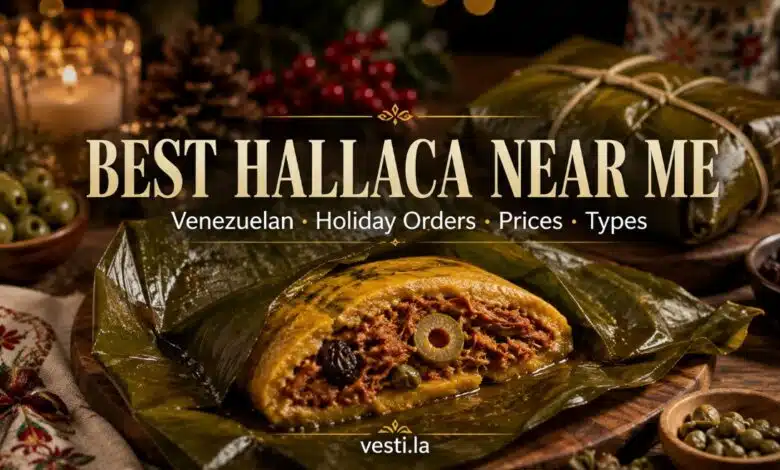
Finding the best hallaca near you is different from searching for arepas, empanadas or most other Venezuelan dishes. Hallacas are strongly tied to the Christmas season, take significant time to assemble, and are often produced in batches rather than cooked one at a time to order. A Venezuelan restaurant may serve arepas every day of the year but offer hallacas only from November through early January, by preorder, frozen, or as part of a holiday plate.
A traditional Venezuelan hallaca begins with seasoned corn dough spread over a plantain or banana leaf. The center contains a savory guiso, commonly built around meats such as beef, pork and chicken, with ingredients that may include olives, capers, raisins, peppers, onions and other garnishes. The parcel is folded, tied and cooked in its leaf wrapping. Family recipes and regional traditions can change the filling considerably, so two excellent hallacas do not need to be identical.
That variation makes the search more interesting, but it also makes generic “hallaca near me” results difficult to judge. A restaurant may sell an individual hot hallaca, a refrigerated or frozen package, a six-pack for the holidays, a vegetarian version, or a complete Venezuelan Christmas plate with hallaca, pernil, pan de jamón and ensalada de gallina. Those are not equivalent purchases.
This guide is designed to help you find the right one. It covers where hallacas are most likely to appear in the United States, current restaurant price examples, what to inspect before ordering, how traditional and regional styles differ, how frozen hallacas work, what to ask before making a long trip, and how to tell whether a cheaper or more expensive listing actually offers better value.
Hallaca is a seasonal search, so “near me” can mean three different things
When someone searches for tacos or pizza, the main question is usually distance. With hallaca, availability matters just as much.
A restaurant or bakery has cooked hallacas available for immediate pickup, dining in or delivery.
The kitchen is taking orders for a specific pickup date, often around Christmas Eve, Christmas Day or New Year’s celebrations.
A bakery, specialty shop or restaurant sells prepared hallacas cold or frozen so you can store and reheat them later.
The nearest restaurant with Venezuelan food therefore is not automatically the nearest place that can sell you a hallaca today. A five-mile-away restaurant may have none until December, while a Venezuelan bakery fifteen miles away may keep frozen hallacas available for much longer.
The dish itself
What exactly is a Venezuelan hallaca?
The easiest description for a first-time diner is a leaf-wrapped Venezuelan corn dough parcel filled with a highly seasoned guiso and garnishes. Comparing it with a tamale can help someone understand the basic format, but the comparison becomes less useful once you begin looking at the actual filling and holiday tradition.
The dough is generally made from cornmeal and is commonly colored and flavored with annatto or onoto. It forms a relatively thin layer around the filling rather than functioning simply as a thick block of masa.
Inside is the guiso. A traditional mixed-meat preparation may contain beef, pork and chicken, although family and regional recipes vary. Restaurant versions can use fewer meats, different cuts, vegetarian fillings or other adaptations.
Olives, capers and raisins are among the ingredients most strongly associated with the classic visual appearance of a hallaca once it is opened. Bell pepper and onion may also appear as carefully positioned garnishes rather than disappearing completely into the stew.
Finally, the hallaca is wrapped in plantain or banana leaves, folded into a rectangular parcel and tied. The leaf is part of the cooking process and aroma, but it is not eaten.
Local search strategy
Where are you most likely to find hallacas near you?
Start with Venezuelan businesses rather than generic Latin American restaurants. A broad Latin restaurant can certainly sell hallacas, but a Venezuelan bakery, café, restaurant or specialty food shop is more likely to understand their seasonal role and offer them when demand rises.
The most productive searches are not always identical throughout the year.
Best when the product is already indexed as a menu item.
The plural can reveal bulk orders and holiday packages that the singular misses.
Useful when hallaca pages are seasonal or temporarily removed from the menu.
Particularly useful for refrigerated, frozen and preorder products.
Often useful during November and December when holiday menus appear.
Useful outside the peak restaurant season or when buying several at once.
You can also begin with Vesti.la’s broader food-near-you guides when you are exploring a city rather than searching for only one dish.
Once you find a Venezuelan restaurant, search its current menu for both hallaca and hallacas. Then check sections labeled holiday, Navidad, seasonal specials, frozen foods, catering and family packs.
A hallaca can disappear from the ordinary entrée section while remaining available through a holiday preorder page.
Menu snapshot
Current U.S. listings show why price and format must be compared together
Current online menus provide useful examples of what a hallaca search can return in different U.S. markets. These examples are a snapshot, not a national ranking, and seasonal availability can change even while a menu page remains online.
Individual Venezuelan hallaca sold by the unit on the restaurant’s seasonal menu.
Current menu description identifies corn dough filled with a beef, pork and chicken stew and garnished with raisins, capers and olives.
Venezuelan tamal-style hallaca described with a thin corn-dough layer and a beef, pork and chicken filling wrapped in plantain leaf.
A restaurant interpretation offered in traditional and vegan forms. The listed traditional version uses pork with chickpea, potato, raisin and olive.
Four prices cannot define what a hallaca “should” cost everywhere in the United States. They do, however, show a useful current restaurant range: approximately $9.50 to $15 for an individual hallaca in this small verified sample.
That range should be treated as orientation rather than a promise. Homemade preorder businesses, premium restaurants, bakeries, frozen packs and holiday bundles can fall outside it.
A cheaper hallaca is not automatically better value
Price comparisons become meaningful only after you know what is being sold.
The cleanest format for comparing restaurant prices, provided the size and filling are reasonably similar.
Hallaca may be accompanied by pernil, pan de jamón, ensalada de gallina or additional sides. The price cannot be compared directly with one wrapped hallaca.
The headline price may look high because you are buying several hallacas at once.
Restaurant service, presentation and unusual fillings can raise the price above a bakery or bulk-order product.
If quantity is listed, divide the total package price by the number of hallacas. A $60 six-pack, for example, works out to $10 each before delivery or service fees. That is much more useful than comparing the $60 package headline with a $14 individual restaurant listing.
Also check whether the online price is direct from the restaurant or displayed through a delivery marketplace. Fees, markups and minimum-order requirements can change the final cost materially.
The busiest hallaca season usually starts before Christmas week
Waiting until December 24 to begin searching is one of the easiest ways to reduce your options.
Hallacas are labor-intensive. The guiso requires preparation. Leaves need to be cleaned and portioned. Masa has to be mixed. Each parcel is assembled, decorated, folded, tied and cooked. A family or small commercial kitchen producing dozens or hundreds therefore has a practical production limit.
Restaurants can respond by opening preorders weeks before the holiday, limiting quantities, selling frozen packs, or assigning specific pickup windows.
If hallacas are important to your Christmas Eve dinner, begin checking Venezuelan restaurants and bakeries in November rather than treating them as a last-minute takeout item.
Before you buy
A good hallaca should balance masa, guiso, garnish and leaf aroma
“Authentic” is too vague to be a useful quality test by itself. Family recipes differ. Regional recipes differ. What you can judge more consistently is whether the parts work together.
The masa should support the filling rather than bury it
A hallaca needs enough masa to create a coherent parcel, but a very thick layer can dominate the guiso. When cut open, you should still be able to understand that the filling is the center of the dish.
The guiso should taste developed
Meat should not taste as though it was cooked separately and dropped into corn dough without seasoning. A well-made filling has its own aromatic identity.
Sweet and briny ingredients should create contrast
Raisins, olives and capers can sound strange together to someone who has never eaten hallaca. Their purpose becomes clearer in context: sweetness, salt, acidity and rich meat are layered into the same parcel.
The leaf should contribute aroma without contaminating the food
Plantain or banana leaf is functional packaging and part of the cooking experience. The leaf can be darkened and softened after cooking without meaning the food is spoiled.
The parcel should hold together
A hallaca is not supposed to explode into the cooking water. Secure folding and tying matter because the wrapper protects the masa and filling during cooking and reheating.
Understanding the layers makes restaurant descriptions easier to read
Plantain or banana leaf surrounds the parcel during cooking and contributes aroma. It is removed before eating.
Corn-based dough, commonly seasoned and colored with annatto or onoto.
The savory central filling. Classic versions frequently use a combination of meats, but recipes vary.
Garnishes can include olives, capers, raisins, peppers, onions and other family- or region-specific additions.
This structure is useful when comparing menu photos. One hallaca may show more visible garnishes, another may have a darker guiso, and another may contain a thinner masa. The question is not which photograph most closely matches one universal template; the question is whether the restaurant clearly explains the style it is selling.
Venezuela is not one recipe
Regional hallacas can differ without losing their identity
Hallaca is deeply associated with Venezuelan national Christmas tradition, but that national identity contains regional cooking traditions rather than replacing them.
A Caracas-style hallaca does not have to be identical to an Andean hallaca. Eastern Venezuela can introduce different ingredients. Zulia has its own approaches. Family customs create another layer of variation inside those regional patterns.
Current Venezuelan cultural material specifically notes that eastern versions may incorporate fish or seafood, while Andean traditions can include grains. Other documented regional descriptions mention chickpeas in Andean hallacas and additional variations in sweetness, potatoes, egg, plantain or garnish.
For the diner, this changes the right question.
Ask: “What style of hallaca do you make, and what is in your version?”
That invites the restaurant or seller to explain its recipe rather than forcing every Venezuelan family tradition into one checklist.
Hallaca and tamale are related ideas, but ordering one as if it were a generic tamale misses the point
English-language restaurant menus sometimes call hallaca a “Venezuelan tamale.” That is a useful bridge for someone who has never seen one: corn dough, filling and a leaf wrapper are familiar tamale concepts.
But “tamale” covers an enormous family of foods across Latin America, so the word does not explain the flavor of a Venezuelan hallaca.
Hallaca is especially recognizable through the combination of seasoned corn dough, complex guiso, decorative sweet and briny ingredients, plantain-leaf wrapping and its central place in Venezuelan Christmas meals.
Someone expecting the flavor profile of a Mexican pork tamal, a Colombian tamal tolimense or a Puerto Rican pastel should therefore approach hallaca as a different dish rather than asking which one is the “correct” version of the other.
Raisins in hallaca make more sense once you taste them with olives and meat
Raisins are one of the most debated ingredients among first-time diners because the sweetness is visually obvious before the first bite.
In context, the raisin is not meant to turn the hallaca into dessert. It creates a small sweet contrast against seasoned meat, salty olives, capers and savory masa.
The distribution matters. Several isolated sweet bites are very different from a filling overwhelmed by sugar.
If you strongly dislike raisins, ask whether the seller uses them rather than assuming you need to avoid all hallacas. Family recipes vary, and some sellers may offer versions without them.
Olives and capers are not decorative afterthoughts
Their salt and acidity provide another counterweight to meat and corn.
A hallaca filled only with rich stew and thick masa can taste heavy. Briny ingredients break up that richness and make individual bites more complex.
This is also why removing every olive, caper and raisin before tasting can significantly change the intended balance of a traditional mixed filling.
First-time diners do not need to love every garnish, but trying at least one complete bite explains the dish better than tasting each ingredient separately.
United States
Which U.S. cities give you the strongest chance of finding hallacas?
Hallacas can appear anywhere a Venezuelan family, bakery or restaurant makes them, so no city list is complete. Still, some metropolitan areas give a searcher more options because they support larger networks of Venezuelan restaurants and specialty businesses.
Miami, Hialeah and South Florida
South Florida is one of the easiest U.S. markets for beginning a hallaca search. Current menus include individual hallacas at established bakeries, holiday packages from Venezuelan restaurants and specialty businesses selling Venezuelan foods.
Search beyond Miami proper. Hialeah, Doral, Kendall, Coral Way, Hallandale, Broward County and other nearby areas can all produce relevant results.
The advantage of South Florida is not merely restaurant count. You may encounter several buying formats: single hot hallacas, holiday plates, six-packs, frozen products and catering.
Orlando and Central Florida
Orlando has a substantial Venezuelan restaurant scene, but the same seasonality rule applies. Current ordering systems can show hallaca pack pages or holiday products even when an ordinary daily menu focuses on arepas, grilled meats and other dishes.
Search specifically for holiday ordering rather than assuming every Venezuelan restaurant currently has hallacas in its hot-food case.
Houston
Houston’s large and diverse Latin American food landscape includes Venezuelan businesses, and current restaurant ordering pages show hallaca listings in the area.
Because metropolitan Houston covers a huge geographic area, search by neighborhood and suburb as well as simply “Houston.” A seller twenty miles away may still be the most relevant hallaca source if it offers advance holiday orders or frozen packages.
New York City
New York offers a different pattern: hallaca may appear not only in traditional Venezuelan cafés but also in chef-driven restaurants and modern interpretations.
A current Brooklyn/New York listing, for example, offers both a traditional-style hallaca and a vegan alternative. This is a reminder to read the actual filling description rather than assuming every $15 hallaca represents the same recipe.
Austin and Cedar Park
Current menus in the Austin-area market also show traditional mixed-meat Venezuelan hallaca. Cedar Park is especially useful evidence that the search should extend beyond the center of a major city.
Smaller U.S. markets
Do not give up because Google shows no permanent “hallaca restaurant.” In smaller markets, hallacas may be sold seasonally by Venezuelan caterers, food trucks, bakeries or community-based preorder businesses.
When evaluating unfamiliar sellers, prioritize clear ingredient information, reliable ordering instructions, safe refrigerated or frozen handling, and consistent recent customer feedback.
The restaurant nearest to you may not be the best place to buy a dozen
An individual hallaca and a family holiday order create different buying decisions.
For one person trying hallaca for the first time, a restaurant that sells a single unit is ideal. You can taste the filling without committing to a freezer full of food.
For Christmas dinner with six or ten people, a bakery or specialty seller with package pricing can be more practical.
Compare minimum order, pickup date, frozen versus cooked status, reheating instructions and per-unit price before placing a large order.
Buying ahead
Frozen hallacas are not automatically a compromise
Hallacas are unusually well suited to advance preparation because their leaf wrapping protects a compact cooked parcel.
Families commonly prepare large batches, and restaurant or specialty-shop sellers may intentionally sell them frozen so customers can store them for the holiday period.
The important distinction is whether the product is already fully cooked and simply needs reheating or whether the seller expects additional cooking from frozen.
Published hallaca recipes and commercial instructions illustrate that variation. Some cooked hallacas can be reheated from chilled in simmering water in roughly 10–20 minutes, while frozen products may require roughly 25–30 minutes or much longer depending on whether they are being reheated or fully cooked.
Therefore, “boil for X minutes” is not a safe universal rule for every frozen hallaca. Ask the seller what state the product is in and follow the directions for that specific batch.
Do not unwrap the leaf before reheating unless the seller specifically tells you to
The tied leaf parcel helps protect the hallaca in hot water and reduces direct moisture contact with the masa.
Remove any external plastic packaging that the seller instructs you to remove, but the traditional plantain-leaf wrapping generally remains around the hallaca during water reheating.
Once hot, place the parcel on a plate, cut or untie the string carefully, open the leaf and eat the hallaca from the plate rather than attempting to eat the wrapper.
Steam and hot liquid can collect inside the folds, so opening it immediately with bare fingers can be uncomfortable.
Christmas ordering
The complete Venezuelan holiday plate explains why hallaca is often sold with other dishes
Hallaca is one part of a larger Venezuelan Christmas table.
Restaurant holiday menus frequently group it with dishes such as pan de jamón, pernil and ensalada de gallina. A “plato navideño” can therefore cost substantially more than an individual hallaca because it is a complete holiday meal rather than one parcel.
When comparing Christmas packages, write down what each one includes.
One per person is a useful starting assumption for a full holiday plate, but appetite and other food matter.
Check whether the pork portion is individual, family-size or sold by weight.
Determine whether you receive slices, half a loaf or a whole loaf.
Compare actual container size rather than treating “side” as a standardized portion.
A lower-priced package can contain significantly less food. The most useful comparison is the full package, not the hallaca price hidden inside it.
How many hallacas should you order?
For a first tasting, one hallaca per person is generally enough to learn the dish, especially if you are also ordering arepas, tequeños, cachapas or another main.
For a Venezuelan-style Christmas plate with pernil, salad and pan de jamón, one hallaca per person can already produce a substantial dinner.
If hallacas are the main food with very few sides, some diners may want more than one.
Bulk ordering should also account for leftovers. Frozen or properly stored hallacas can make advance buying practical, but storage space becomes relevant surprisingly quickly when each parcel is individually wrapped.
Buying ten from an unknown seller is riskier than tasting one first
Holiday preorder businesses often work in large minimum quantities because batch cooking is efficient.
If you have never tried that seller before, a small early order is valuable when possible.
Taste the masa thickness, salt level, guiso, meat tenderness and sweet-to-briny balance. Then decide whether you want ten or twenty for the holiday.
This matters because hallaca preferences are personal. One family prefers sweeter guiso. Another uses more capers. Another makes thinner masa. Another prefers a heavier filling.
Fresh, refrigerated and frozen listings should not be treated as the same product state
“Fresh” can mean recently prepared, not necessarily hot.
A refrigerated hallaca may be fully cooked and ready to reheat. A frozen one may also be fully cooked. Another product can require a longer final cooking step.
Ask three separate questions:
Then ask how it should be stored and exactly how the seller recommends reheating it.
That is more useful than assuming every frozen hallaca follows the same preparation method.
A hallaca that looks small can still be dense
Size comparisons based only on length and width can be misleading.
A thin parcel with a generous guiso can contain more filling than a visibly larger hallaca dominated by masa. Leaf folds also make the outside dimensions look larger than the edible portion.
When ordering a package for a group, actual weight would be more useful than visual dimensions, but many restaurant menus do not publish either.
If no size information is provided, ask whether one hallaca is intended as a full entrée portion or part of a larger holiday plate.
Delivery makes sense for hallacas, but distance still matters
Hallaca travels better than fries or crisp fried food because it does not depend on a fragile crunchy texture.
The leaf wrapping also gives it physical protection.
The problems are temperature, delay and order format.
A hot single hallaca should arrive hot enough to enjoy safely. A frozen bulk order needs to remain properly cold. A holiday package may contain hot pernil beside cold salad, which creates a more complicated delivery job than one wrapped parcel.
For large Christmas orders, direct pickup can provide more control than waiting for a third-party courier during a busy holiday dinner period.
Direct ordering can reveal options that delivery apps hide
Delivery platforms are useful discovery tools, but restaurant websites, phone orders and direct holiday pages can offer different package sizes or pickup dates.
Some businesses use separate seasonal ordering systems. Others require preorder by phone or social media even when their standard restaurant menu is available through an app.
If a restaurant has a strong Venezuelan menu but no hallaca listed, it is reasonable to ask whether holiday preorders have opened.
Do not interpret a missing August menu item as proof that the restaurant will not sell hallacas in December.
Dietary questions
Traditional hallaca is not automatically vegetarian, vegan, halal or allergen-safe
Traditional mixed-meat versions commonly use pork in addition to beef and chicken, so anyone avoiding pork should ask specifically about the guiso.
Beef-only or chicken-only assumptions are risky because meat combinations are part of many recipes.
Vegan hallacas do exist. Current U.S. restaurant menus include plant-based versions, and specialty businesses also sell vegetarian alternatives.
That does not mean a standard hallaca can be made vegan simply by removing a visible meat garnish. Broth, fat and guiso preparation all matter.
Corn dough also does not by itself prove that a hallaca is safe for someone with celiac disease. Broth, sauces, seasoning products, Worcestershire-style ingredients and kitchen cross-contact should be checked when medically important.
Nuts may appear in some family or regional recipes as garnish. Someone with a serious allergy should therefore ask for an actual ingredient list rather than relying on a generic description of hallaca.
Can you find a hallaca without pork?
Yes, but do not assume.
Restaurant and family variations make pork-free versions possible, including chicken, beef, seafood, vegetarian and vegan interpretations.
The word hallaca does not identify the meat automatically.
Ask whether pork is present in the guiso, broth or added fat. That is particularly important for religious dietary requirements, where simply removing a piece of pork after cooking would not solve the issue.
Vegan hallaca can still preserve the structure of the dish
A plant-based version can retain corn masa, leaf wrapping, olives, capers, raisins, peppers and the basic folded-parcel format while replacing the meat guiso.
This makes more culinary sense than treating vegan hallaca as an unrelated corn patty.
The quality question becomes whether the filling still has enough savory depth and moisture to balance the masa.
Current restaurant examples show that vegan hallaca is not merely theoretical; it is a real menu format in the U.S. market.
What should a first-time diner order with hallaca?
If the goal is specifically to understand hallaca, do not overwhelm the first tasting with five heavy entrées.
One hallaca can be shared or eaten individually depending on size. A few tequeños or an arepa can introduce another Venezuelan texture without completely masking the dish.
During Christmas season, however, ordering the complete plato navideño gives important cultural context because hallaca is experienced beside the foods with which it is traditionally celebrated.
Both approaches are valid; they answer different questions.
If the menu says “plato navideño,” read past the word hallaca
A Christmas plate can contain several substantial components.
Hallaca may be joined by roasted pork, chicken or potato salad and pan de jamón. Portions vary widely.
That means a $25–$35 holiday plate and a $10–$15 individual hallaca should not be described as competing hallaca prices.
They represent different amounts of food and different dining experiences.
How to tell whether a menu listing is actually current
Search engines can preserve seasonal item pages long after the holiday rush.
A hallaca page being indexed does not necessarily mean you can walk into the restaurant today and buy one.
Look for an active ordering button, current restaurant hours, a selectable pickup time and recent seasonal announcements.
Even then, calling before a long trip is sensible because a batch can sell out.
Reviews are most useful when they describe the hallaca itself
A five-star review of an arepa tells you very little about a restaurant’s seasonal hallaca.
Search within reviews for hallaca, hallacas, Navidad, Christmas, guiso, masa and pan de jamón.
Useful comments describe filling quantity, masa thickness, seasoning, freshness, pickup reliability and whether holiday orders were ready on time.
Comments that simply call the whole restaurant “authentic” provide much less practical information.
Photos can help, but an opened hallaca is more informative than a tied leaf parcel
An unopened hallaca mainly shows wrapping skill.
A cross-section reveals the relationship between masa and guiso, the visible garnishes and how densely the parcel is filled.
When comparing customer photos, look for several examples rather than one unusually generous or unusually poor serving.
Seasonal batches can vary, especially with small producers.
The best hallaca for you may not be the most traditional-looking one online
Some diners prefer a strong sweet-and-savory contrast with obvious raisins. Others prefer a saltier, meatier filling. Some like very thin masa. Others grew up with thicker family versions.
Regional background also shapes expectations.
A restaurant that clearly identifies its style gives you more useful information than one that simply claims to make “the only authentic hallaca.”
Seven questions worth asking before a large holiday order
Especially important for pork restrictions or when comparing mixed-meat recipes.
Useful for strong preferences and certain dietary restrictions.
Determines whether you are reheating or completing a cooking process.
Important for storage and pickup planning.
Get instructions for that exact product rather than guessing.
Seasonal home businesses and catering kitchens may require several units.
Holiday pickup logistics matter when production is limited.
For your first hallaca
Start with one traditional version before buying a freezer pack
If you have never eaten hallaca, the easiest introduction is an individual restaurant or bakery portion with a clearly described filling.
Open the leaf and look at the masa-to-filling ratio. Taste a piece containing meat, masa and at least one garnish together.
Then decide what you liked.
Look for a seller whose photos show a thinner layer and more visible guiso.
Ask whether another version uses fewer raisins or a less sweet guiso.
A recipe with more olives and capers may suit you.
Look for chicken, beef, seafood, vegetarian or regional alternatives.
Hallaca is exactly the kind of food where tasting one version teaches you how to search for the second.
What if there are no hallacas near you right now?
First, check the calendar.
If it is spring or summer, weak local availability may simply reflect the dish’s holiday seasonality rather than a lack of Venezuelan food in your area.
Search Venezuelan restaurants now, save the strongest candidates, and check their holiday menus again beginning in November.
Next, search frozen Venezuelan specialty foods. A packaged hallaca that ships or can be picked up frozen may be easier to find year-round than a freshly cooked restaurant portion.
Finally, broaden the radius. Hallaca is worth treating as a destination food when the alternative is buying an unrelated generic tamale simply because it is closer.
What else should you try at a Venezuelan restaurant?
Hallaca is especially important during the holidays, but it is only one part of Venezuelan cooking.
Arepas, cachapas, tequeños, pabellón criollo, asado negro, hervido, empanadas and regional dishes can help you understand the restaurant beyond its December menu.
If you are building a broader list of foods to explore, browse Vesti.la’s dish guides rather than treating one seasonal item as the entire cuisine.
When is the best time of year to search for hallacas?
November and December generally provide the strongest combination of restaurant availability, family production, catering offers and holiday packages.
Early January can still produce leftovers, frozen inventory or New Year’s availability.
Outside that window, specialized Venezuelan bakeries, food stores and restaurants with frozen inventory become more important.
A year-round listing is valuable, but always verify that it is currently orderable rather than merely an old seasonal menu page.
Is $15 expensive for one hallaca?
It is toward the upper end of the small current individual-price sample used in this guide, but price alone cannot answer whether it is expensive.
A chef-driven restaurant in New York has a different cost structure from a bakery selling high-volume holiday packs in Florida or Texas.
Filling quality, portion, labor, location and service format all matter.
For bulk buying, calculate the unit price. For a first restaurant experience, evaluate the complete dish.
Is $9–$10 a realistic hallaca price?
Yes. Current restaurant and bulk examples show that this level exists in the U.S. market.
But a low price is not evidence that the product is homemade, traditional or good, just as a high price is not proof of better quality.
Ask about the filling and portion. If buying several, calculate the real per-unit cost after fees.
Hallaca is one of the foods where labor matters as much as ingredient cost
Looking only at cornmeal, meat and leaves understates what is being purchased.
The cook makes guiso, prepares masa, cleans and portions leaves, arranges fillings, folds each parcel, ties it and cooks a batch.
Family production often becomes an assembly line because several people can divide those tasks.
Commercial kitchens have to reproduce the same labor at scale.
That helps explain why handmade hallacas can cost considerably more than a simple corn-based snack even when the outside dimensions look similar.
A good local hallaca search ends with verification, not with the map result
Search engines are excellent for finding candidates. They are weaker at confirming whether a highly seasonal dish is actually in stock at this moment.
Once you have two or three plausible businesses, check the current direct menu. Look for individual versus package pricing. Check whether the item is frozen. Search recent restaurant posts if necessary. Then call when the trip is significant or the order is for a holiday.
That short verification step solves the most common hallaca problem: driving to a Venezuelan restaurant that absolutely knows how to make hallacas but is not making them this week.
The best hallaca near you is the one that matches the season, style and order you actually need
For a first taste, look for an individual Venezuelan hallaca with a clearly described filling. For Christmas dinner, compare preorder deadlines, package quantities and complete holiday plates. Outside the holiday season, frozen hallacas and specialty Venezuelan food shops often become more useful than ordinary restaurant menus.
Do not reduce quality to one rigid ingredient checklist. Venezuela has regional hallaca traditions, and families have their own recipes. Instead, judge the balance of masa and guiso, the seasoning, the meat, the wrapping, the sweet and briny contrasts, and whether the seller clearly explains what is inside.
Current U.S. menu examples show individual hallacas around the $9.50–$15 range in several markets, but that small sample is a reference point rather than a national average. Package size, city, filling and restaurant format can all move the price.
Most importantly, confirm availability before traveling. Hallaca is one of Venezuela’s defining Christmas foods, and that seasonality is exactly why finding a great one can require a little more planning than typing “near me” and choosing the first result.
Where can I find hallacas near me?
Start with Venezuelan restaurants, bakeries, cafés and specialty food shops. Hallacas are strongly seasonal, so also check holiday menus, catering pages, frozen-food sections and preorder listings, especially from November through early January.
How much does a hallaca usually cost in the United States?
Current restaurant examples can fall around roughly $9.50 to $15 for one individual hallaca, but that is only a small current sample rather than a national average. City, filling, size, restaurant format and whether the item is sold individually or in a holiday package can change the price significantly.
What is inside a traditional Venezuelan hallaca?
A traditional hallaca generally has seasoned corn dough wrapped around a savory guiso, often made with a combination of beef, pork and chicken. Olives, capers, raisins, peppers and other garnishes may be added, but family and regional recipes vary considerably.
Are hallacas only available at Christmas?
Hallacas are especially associated with the Venezuelan Christmas season, and many restaurants sell them mainly from November through early January. Some Venezuelan bakeries, specialty shops and restaurants also keep frozen hallacas available outside the holiday period.
What is the difference between a hallaca and a tamale?
Both use corn-based dough and a leaf wrapper, but hallaca has its own Venezuelan identity, filling style and Christmas tradition. Hallacas commonly use a complex guiso with meats and contrasting ingredients such as olives, capers and raisins, while tamales vary widely across Latin America.
Can I buy frozen hallacas?
Yes. Frozen hallacas are commonly sold by Venezuelan restaurants, bakeries and specialty food businesses, especially for holiday orders. Ask whether the product is fully cooked and follow the seller’s specific storage and reheating instructions rather than assuming every frozen hallaca needs the same cooking time.
How do I reheat a hallaca?
The correct method depends on whether the hallaca is refrigerated, frozen and fully cooked. Many cooked hallacas are reheated while still wrapped in their plantain leaf, often in hot or gently boiling water, but exact times vary. Follow the instructions provided by the restaurant or seller.
Can I find hallacas without pork?
Yes, but you should verify the filling before ordering. Traditional mixed-meat hallacas often contain pork along with beef and chicken, while some sellers make beef-only, chicken, seafood, vegetarian or vegan versions. The word hallaca alone does not identify the protein.
Are vegan hallacas available?
Yes. Vegan hallacas can keep the corn dough, plantain-leaf wrapping, olives, capers, raisins and traditional parcel structure while replacing the meat guiso with a plant-based filling. Availability depends on the restaurant or specialty seller.
How many hallacas should I order per person?
One hallaca per person is often a practical starting point when it is served as part of a full Venezuelan Christmas plate with pernil, pan de jamón and ensalada de gallina. If hallacas are the main food with few sides, some diners may want more than one.
What should I ask before ordering hallacas for Christmas?
Confirm the meat or filling, whether the hallacas are fully cooked, whether they are sold hot, refrigerated or frozen, the minimum order, reheating instructions, final price and exact holiday pickup date and time.
What cities are good for finding Venezuelan hallacas in the U.S.?
Large Venezuelan food markets such as Miami and South Florida, Orlando, Houston, New York and parts of the Austin area can offer multiple hallaca options, especially during the holidays. Smaller cities may still have seasonal caterers, bakeries or Venezuelan preorder businesses.


