
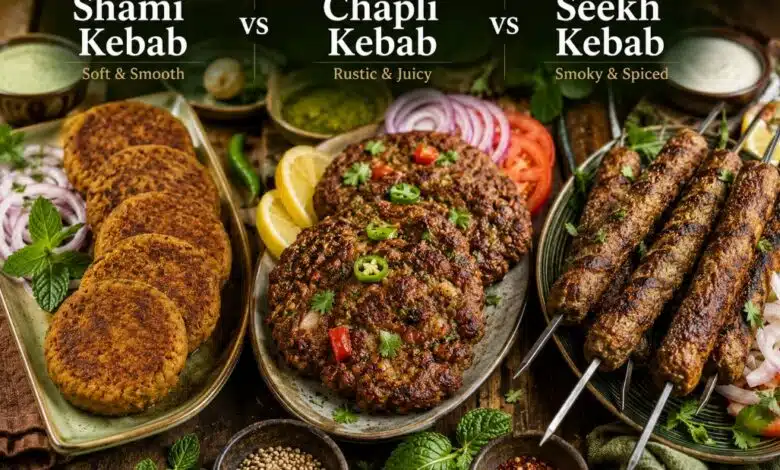
Shami kebab, chapli kebab and seekh kebab are often grouped together by delivery apps, map listings and restaurant menus, but they are not three versions of the same food. They differ in structure, texture, seasoning, shape, cooking method and the kind of meal they create. Knowing those differences is especially useful when a local search returns a screen full of “kebab” results and only a few of them actually match the soft meat-and-lentil patty you were looking for.
The confusion is understandable. All three dishes can contain ground or finely processed meat. All three belong to broad South Asian kebab traditions. Beef, chicken or mutton may be used, and all three can be served with chutney, onion, lemon, bread or rice. Yet the similarities end quickly once the mixture is prepared. Shami is built around cooked meat and pulses that are processed together. Chapli emphasizes a coarse, highly seasoned minced-meat mixture pressed into a broad patty. Seekh is shaped around a skewer and cooked for direct grilled flavor.
The distinction that matters most
Shami kebab is usually the finest and softest of the three, chapli kebab is the broadest and most visibly textured, and seekh kebab is the long skewer-shaped option. That single distinction helps, but shape alone is not enough. A closer look at the mixture, surface, cooking method and menu wording gives a much more reliable answer.
Three dishes, three different identities
Shami kebab
A compact, soft patty made from meat cooked with chana dal or another split pulse, then processed, shaped and browned in a pan. Its identity comes from its fine, cohesive interior.
Chapli kebab
A broad, rustic minced-meat patty with visible herbs, spices and often pieces of onion, tomato or chile. It is usually fried on a flat surface and keeps a coarser meat texture.
Seekh kebab
A seasoned ground-meat mixture pressed around a skewer into a long cylinder, then grilled, roasted or cooked in a tandoor. Smoke and char are central to its appeal.
These identities are not rigid recipes. Regional traditions, family preferences and commercial production create many variations. A chicken shami may be firmer than a delicate beef version. A chapli kebab may be extremely large or only moderately wider than a burger. A seekh kebab may be cooked over charcoal, in a tandoor, under a broiler or on a restaurant griddle. Even so, the basic structures remain different enough that the dishes should not be treated as interchangeable.
The differences also affect how the food behaves. Shami can be fragile before frying because its mixture is already cooked and finely processed. Chapli begins with raw mince and develops its structure during frying. Seekh must cling securely to a skewer and therefore needs a mixture that can hold a long shape without falling apart. Those functional demands shape everything from moisture level to grinding style.
That difference in construction changes the dining experience. Shami can feel almost delicate, especially when served hot with chutney. Chapli offers a more rugged bite and a pronounced fried-meat character. Seekh delivers a firm, juicy chew and the aroma of direct heat. A person who loves one may enjoy the others, but ordering them as substitutes often leads to disappointment because the textures are so different.
Shami kebab vs chapli kebab vs seekh kebab at a glance
| Feature | Shami kebab | Chapli kebab | Seekh kebab |
|---|---|---|---|
| Main structure | Cooked meat and split pulses processed together | Raw minced meat with seasonings and visible additions | Raw seasoned ground meat shaped around a skewer |
| Typical shape | Small, flat, round or oval patty | Wide, thin, irregular patty | Long cylinder or ridged log |
| Interior texture | Fine, soft and cohesive | Coarse, juicy and visibly meaty | Firm, springy and finely ground |
| Cooking method | Pan-fried or shallow-fried | Fried on a griddle or flat pan | Grilled, roasted or tandoor-cooked |
| Role of pulses | Usually essential to the classic structure | Not a defining ingredient | Not a defining ingredient |
| Surface | Evenly browned, relatively smooth | Craggy, rough and deeply browned | Charred or roasted, often ridged |
| Flavor emphasis | Integrated warm spice, meat and pulse richness | Bold spice, chile, herbs and fried meat flavor | Meat, smoke, char and aromatic seasoning |
| Common serving use | Snack, appetizer, bun, roll, rice or catering tray | Main plate, naan meal, street-food portion | Grill platter, roll, wrap, rice plate or mixed kebab meal |
The table is useful for orientation, but real restaurant food can blur a few boundaries. A commercial frozen shami may be firmer than expected. A thin seekh kebab may be cut into short pieces and look less obviously skewer-shaped after plating. A small chapli may resemble a rough burger. That is why several clues should be considered together rather than relying on one photograph.
Menu context also matters. A Pakistani snack menu offering bun kebab, chutney and tea is more likely to use shami-style patties. A restaurant emphasizing Peshawari specialties may be pointing toward chapli. A mixed grill or tandoor section strongly favors seekh. The section heading can sometimes be as revealing as the item name itself.
What makes shami kebab different?
Shami kebab begins with a cooking stage that the other two normally do not share. Meat, chana dal or another split pulse, aromatics and spices are simmered until tender. The liquid is reduced, the mixture is cooled, and the cooked components are processed into a fine mass. Fresh herbs, chile or onion may be added afterward. The mixture is then shaped into small patties and browned.
Because the meat is already cooked before shaping, the final frying stage is not primarily about cooking raw meat through. Its purpose is to warm the patty, set the surface and create color. This helps explain why a well-made shami kebab can have a delicate center and a relatively thin browned exterior.
The pulse is not simply filler. It changes the body of the mixture, softens the meat-forward texture and helps create the fine, cohesive bite associated with the dish. A patty made only from raw ground meat may be delicious, but it moves toward burger, kofta or chapli territory rather than classic shami structure.
The separate guide to what shami kebab is and how it is made explores the dish in greater depth, including meat options, mixture texture, serving forms and fresh-versus-frozen differences.
Shami is also the most adaptable in serving format. The same patty can appear alone with chutney, inside a bun, wrapped in paratha, arranged on a rice plate or frozen for later use. That flexibility is one reason local search results may hide it under a serving name rather than under the exact phrase “shami kebab.”
What makes chapli kebab different?
Chapli kebab is built to celebrate minced meat rather than transform it into a smooth pulse-bound mixture. The mince remains recognizably coarse. Seasonings and fresh ingredients are mixed through it, and the portion is flattened into a broad patty. Depending on the recipe, visible pieces of onion, tomato, chile, herbs or crushed spices may remain inside and on the surface.
Its broad shape creates a large area of contact with the hot griddle or pan. This allows extensive browning and produces the crisp, irregular edges many diners associate with the dish. The interior can remain juicy while the outside develops darker fried flavor.
Chapli kebab often feels more forceful than shami. Its texture is rougher, its seasoning can be more immediate, and its shape dominates the plate. It is usually eaten as a substantial meat item with naan, chutney, salad and sometimes rice rather than as a delicate tea-time patty.
The name itself may not be enough on a modern menu. Some restaurants describe chapli as a “Peshawari beef patty” or place it in a grilled-meat section even when it is pan-fried. Read the ingredient and texture language before assuming a flat kebab is shami.
What makes seekh kebab different?
Seekh kebab is designed around the skewer. Ground meat is mixed with seasonings, aromatics and sometimes herbs, then pressed along a metal or wooden skewer. The mixture must be cohesive enough to stay attached while cooking, but it should not become dense or rubbery.
Cooking over charcoal or strong direct heat creates a flavor profile that neither pan-fried shami nor griddle-fried chapli can exactly reproduce. The exterior develops charred points and roasted aromas. Fat renders along the length of the kebab, and the ridges created by shaping increase the surface exposed to heat.
Seekh kebab may be served whole, slid off the skewer, cut into pieces, wrapped in bread or placed on a mixed grill platter. Once removed from the skewer, short pieces can confuse image-based search systems, but the cylindrical shape and grilled surface usually remain visible.
Restaurants sometimes list seekh by meat rather than by style, such as beef seekh, chicken seekh or lamb seekh. Mixed platters may include several seekh pieces without repeating the word kebab in every item description. The skewer reference remains the strongest clue.
The mixtures are built for different jobs
A kebab mixture is not only a list of ingredients; it is a structure designed to survive a particular cooking method. Shami must be moldable after its components have already been cooked. Chapli must stay broad and flat while raw mince firms on a hot surface. Seekh must grip a skewer while heat reaches it from every side.
Shami needs controlled moisture
Too much retained cooking liquid makes the mixture sticky and fragile. Too little creates cracked, dry patties. The pulse and meat must be processed finely enough to hold together without becoming gluey.
Chapli needs a workable mince
The mixture must remain loose enough for a tender coarse bite but firm enough to flatten and turn. Large wet additions can cause breakage if the balance is poor.
Seekh needs skewer adhesion
The mince must bind to itself and the skewer. Excess water or large vegetable pieces can make the kebab slip, while overmixing can make the cooked texture tight.
Grinding changes identity
Fine processing supports shami and seekh in different ways. Shami becomes soft and integrated; seekh becomes cohesive enough to shape. Chapli usually benefits from a visibly coarser grind.
This structural view explains why substitutions can have larger effects than expected. Removing pulses from shami does not merely change nutrition; it changes the patty’s identity. Processing chapli until completely smooth removes much of its rustic character. Adding too many wet ingredients to seekh can make the mixture fail before it reaches the grill.
Binders also play different roles. Egg may stabilize a soft shami mixture. Chapli may rely on the natural stickiness of mince, flour, cornmeal or another small addition depending on the recipe. Seekh often depends on careful mincing, chilling and mixing rather than a heavy breadcrumb binder. A large amount of bread can make any of the three taste more like a generic processed patty.
The first bite tells you almost everything
Texture is often the fastest way to identify these kebabs once they are on the plate. Shami yields easily under a fork and should feel fine and tender. Chapli has a more obvious minced-meat bite with crisp edges and visible inclusions. Seekh has a springier, grilled structure and a longer grain created by shaping along the skewer.
| Texture clue | Most likely dish | Reason |
|---|---|---|
| Very fine center that cuts cleanly with a fork | Shami kebab | Cooked meat and pulses were processed into a cohesive mixture |
| Rough, juicy center with visible onion, chile or herbs | Chapli kebab | Coarse raw mince and visible additions remain part of the bite |
| Firm cylindrical piece with charred exterior | Seekh kebab | The mixture was shaped on a skewer and cooked over direct heat |
| Dry, bread-like interior | Poor execution or commercial variation | Excess binder, overcooking or an imbalanced recipe can distort any style |
Frozen products may soften these distinctions. Commercial shami is often made firmer for packaging. Frozen seekh may lose some char if reheated in a microwave. A mass-produced chapli may be more regular in shape than a restaurant version. The ingredient statement and cooking instructions therefore matter when visual clues are weak.
Temperature changes perception as well. A hot shami can feel tender and aromatic, while the same patty may seem denser after cooling. Chapli loses some crispness in a closed delivery box. Seekh can become dry when held too long after grilling. Judge the intended texture as soon as practical rather than after the food has sat for an hour.
Why shape reveals more than appearance
Shape reflects cooking logic. Shami is small and moderately thin so a delicate pre-cooked mixture can brown quickly without drying. Chapli spreads wide to maximize contact with the frying surface. Seekh stretches along a skewer so direct heat can cook the meat evenly while smoke reaches a large exterior area.
A restaurant may modify portion size, but the underlying geometry usually remains. A bun kebab requires a shami patty wide enough to sit inside bread. Catering shami may be miniature. Chapli may be made smaller for a mixed platter, yet it normally remains broad and rough. Seekh may be cut after cooking, but each piece retains part of the original cylinder.
Plating can hide the original shape. A seekh wrapped in naan may appear only as a line of meat inside bread. A shami rice bowl may show a cut patty under sauce. A chapli burger may be partially hidden by the bun. When the full item is not visible, look for descriptive words and ask the restaurant directly.
Pan, griddle or grill: the heat source changes the dish
Shami kebab is usually pan-fried or shallow-fried. Since the interior mixture has already been cooked, a short browning stage is enough. The pan creates an even crust while protecting the soft center.
Chapli kebab is traditionally suited to a flat hot surface with enough fat to brown its broad underside. The wide patty allows edges to become crisp and irregular. Turning must be handled carefully because the raw mince is spread thinner than a thick burger.
Seekh kebab benefits from heat surrounding the meat rather than touching only one flat side. Charcoal grills, tandoors and strong ovens encourage browning along the ridges. A restaurant may cook seekh on a griddle when equipment is limited, but the classic expectation remains grilled or roasted flavor.
Alternative home methods can work, but they do not erase the distinctions. Shami reheats well in a skillet or air fryer. Chapli can be cooked on a cast-iron pan. Seekh can be broiled on a rack. The method may change the intensity of browning, yet the mixture and shape still identify the dish.
Deep-frying is not the defining method for any of the three. Some cooks may use more oil, and commercial kitchens may adapt equipment, but a heavily battered deep-fried patty is moving away from the most recognizable presentation. The surface should support the kebab’s identity rather than conceal it.
The flavor profiles overlap, but the emphasis changes
All three kebabs may include cumin, coriander, chile, ginger, garlic, black pepper or garam masala. Shared spices do not make them taste the same because ingredient form and cooking method change how those spices are experienced.
Shami tastes integrated
Meat, pulse and spices have been cooked together before processing. The flavor feels blended throughout the patty. Fresh herbs and green chile added later can brighten the otherwise deep, warm base.
Chapli tastes immediate and bold
Crushed spices, chile, herbs and fresh additions remain more visible. The wide fried surface contributes powerful browned-meat flavor. Some bites may contain more chile, onion or herb than others, which is part of the rustic appeal.
Seekh highlights smoke and meat
Aromatic seasoning supports the ground meat, but char and rendered fat often lead the experience. Even a mildly spiced seekh can taste intense because direct heat concentrates roasted aromas.
Heat level varies independently from style. A mild chapli and a spicy shami are both possible. Diners should not assume that the broadest patty will always be hottest or that a fine-textured shami will always be gentle.
Accompaniments change the balance. Mint chutney sharpens shami, fresh tomato and onion lighten chapli, and lemon or raita can soften the smoky richness of seekh. A sauce-heavy presentation can blur the differences, so tasting one bite without sauce is useful when comparing them.
Beef, chicken and mutton behave differently in each style
Beef is common across all three forms because it offers enough flavor and structure for patties and skewers. In shami, beef contributes depth while the pulse softens the texture. In chapli, its fat and coarse mince support a juicy broad patty. In seekh, it can hold well on the skewer when the mixture is balanced.
Chicken creates lighter versions but demands more attention to moisture. Chicken shami can become dry when very lean meat is paired with too much pulse or overcooked during reheating. Chicken chapli may need fat or careful frying to avoid toughness. Chicken seekh can be tender but may feel springy if overmixed.
Mutton or goat brings a stronger aroma and richer savory character. It suits shami’s warm spice profile, gives chapli a robust identity and creates deeply flavored seekh kebab. Menu terminology varies by country and business, so “mutton” may not always refer to the same animal in every context.
The dish name alone does not identify the meat. A menu that says only “shami kabab,” “chapli kabab” or “seekh kabab” leaves an important question unanswered. Ask directly when dietary preference, flavor or halal sourcing matters.
Fat content is equally important. Very lean meat can make chapli and seekh dry, while too much fat may cause excessive shrinkage or flare-ups. Shami gains moisture from the cooked pulse mixture but still benefits from meat that is not excessively lean. Commercial products may use added oil or binders to compensate.
Why delivery apps and map results mix them together
Delivery platforms organize food for speed and discovery. A restaurant may place shami, chapli and seekh under one “Kebabs” category, while the platform’s search system may retrieve every item containing kabab, patty, grill or halal. That broad matching fills the results page but weakens precision.
Business names create another problem. A restaurant called “Kabab House” may serve Afghan skewers but no shami. A grocery product page may use a broad kebab category while selling only seekh. An image carousel may show multiple kebabs without labeling each one. The user must therefore verify the exact item rather than assume the search engine has done the culinary distinction correctly.
This issue is central to the broader Kebabs Shami Near Me guide, which explains how to filter restaurant, market, frozen and delivery results when the search phrase produces mixed intent.
Delivery photos may also be shared across branches or reused for category pages. A photograph of seekh does not prove that every location serves shami, and an old shami image does not confirm current availability. The item title, description and direct confirmation carry more weight.
Which kebab should you order?
Choose shami when you want a soft, compact patty that works as a snack, appetizer, sandwich filling or part of a home-style meal. It is especially appealing when you enjoy tender textures, integrated spice and chutney-based accompaniments.
Choose chapli when you want a larger, more rugged meat experience. It suits diners who appreciate crisp edges, visible herbs and chile, a coarse juicy center and a plate built around naan or salad.
Choose seekh when grilled flavor matters most. It works well in a mixed grill, roll, wrap or rice plate and usually feels more meat-forward than shami because no pulse is required to define its structure.
For a tender snack
Order shami kebab with chutney, onion and lemon.
For a bold main plate
Order chapli kebab with naan, salad and raita.
For grilled aroma
Order seekh kebab in a platter, wrap or mixed grill.
A tasting order can be more useful than choosing only one. When a restaurant offers all three, order a small portion of each and compare the interior, browning and serving style side by side. That experience makes future menu searches much easier.
For children or diners who prefer mild flavors, ask about chile level rather than choosing by kebab type alone. A restaurant may prepare a mild seekh and a very spicy shami. Texture preference is a more reliable reason to choose among the three than assumptions about heat.
Serving styles reveal how each kebab is meant to be eaten
Shami is highly adaptable. Two patties can be served with tea, placed in a bun, wrapped in paratha, added to rice or arranged on a catering tray. Its compact shape makes portioning easy.
Chapli often functions as the center of the meal. One large patty may occupy most of a plate and be torn apart with naan. Fresh onion, tomato, lemon, chutney and yogurt-based sauces balance the fried richness.
Seekh naturally suits platters and wraps. A long kebab can be slid into naan, divided into pieces or combined with grilled chicken and other meats. Its shape makes it easy to serve in counted portions.
Best bread pairings
Paratha and buns are especially natural for shami. Naan supports the broad weight of chapli. Seekh fits easily into naan, roti or a thin wrap.
Best fresh contrasts
Chutney, onion, lemon, tomato, herbs and raita work across all three, but chapli and seekh often benefit from larger fresh salads alongside the meat.
For catering, shami is often the easiest to portion because each patty is compact and can be reheated in batches. Seekh works well when service includes a grill station or wrap assembly. Chapli can be impressive on a buffet, but its broad crisp surface softens more quickly when stacked or covered.
How to judge whether each kebab is well made
Good shami kebab
The patty holds together but cuts easily. The center is fine and tender, not wet, gummy or dry. The surface is browned without becoming hard. Meat, pulse and spices taste integrated.
Good chapli kebab
The edges are browned and crisp while the middle remains juicy. The patty tastes seasoned throughout, visible ingredients feel intentional, and the mince is coarse without becoming tough.
Good seekh kebab
The kebab remains attached during cooking, then releases cleanly from the skewer. It is juicy rather than rubbery, evenly seasoned and marked by roasted or smoky flavor without a burnt exterior.
Price alone is not a quality measure. Shami may be inexpensive because pulses extend the mixture, yet it can still require careful cooking and shaping. Chapli can be large but not necessarily well seasoned. Seekh may look impressive from grill marks while being dry inside. Evaluate the dish in the way its own structure demands.
How to search for the right kebab without wasting a trip
Begin with the full dish name rather than the word kebab alone. Add the cuisine, neighborhood and purchase format when results remain broad. A restaurant menu search and a grocery search also need different wording.
Use natural menu spellings
Try shami kebab, shami kabab and shammi kabab. For the other dishes, search chapli kebab and seekh kabab separately.
Add the cuisine or region
Pakistani shami kebab, Peshawari chapli kebab and Pakistani seekh kebab reduce unrelated Mediterranean or generic grill results.
Add the format
Use restaurant, delivery, frozen, grocery, catering, bun, roll or platter depending on what you actually need.
Read the description, not only the title
Lentils suggest shami, a broad coarse patty suggests chapli, and skewer or tandoor language suggests seekh.
Call when the menu is vague
Ask for the exact dish and meat. A thirty-second confirmation is better than assuming every kebab listing is interchangeable.
Readers who prefer to prepare or serve shami at home can use the Shami Kebab Essentials guide for chana dal, spice, cookware, chutney and freezer-storage choices.
Search phrasing should match the goal. “Shami kebab near me” is appropriate for a restaurant search. “Frozen shami kebab near me” is better for grocery pickup. “Chapli kebab restaurant” and “seekh kebab delivery” should remain separate so a broad platform does not merge them again.
A final practical point is that these names carry cultural and regional meaning, not merely product-category differences. Families may prepare softer or firmer versions, restaurants may adjust spice and portion size, and frozen manufacturers may simplify the original structure for transport. Those variations do not erase the core identities. The most respectful and useful approach is to recognize the traditional pattern, allow for reasonable variation and avoid collapsing every South Asian meat patty or skewer into one generic kebab label. That precision improves ordering, helps restaurants communicate their menus more clearly and gives diners a better chance of receiving the dish they actually wanted.
Frequently asked questions
Is shami kebab the same as chapli kebab?
No. Shami is usually made from cooked meat and pulses processed into a fine mixture. Chapli is generally made from raw coarse mince shaped into a broad patty with visible seasonings and fresh ingredients.
Is shami kebab the same as seekh kebab?
No. Shami is a small flat patty that is usually pan-fried. Seekh kebab is shaped around a skewer and grilled or roasted, giving it a firmer texture and more pronounced char.
Which kebab contains lentils?
Shami kebab traditionally includes chana dal or another split pulse. Lentils are not defining ingredients in chapli or seekh kebab.
Which kebab is the softest?
Shami is usually the softest and finest-textured. Chapli is coarser and seekh is firmer because it must hold its skewer shape.
Which kebab is grilled?
Seekh kebab is the clearest grilled style of the three. Shami is generally pan-fried, while chapli is usually cooked on a griddle or flat pan.
Which kebab is best for a sandwich?
Shami works especially well in bun kebab because its compact flat shape fits bread easily. Seekh also works well in wraps, while chapli can be served in bread when the portion is sized appropriately.
Why does chapli kebab look like a burger?
Both are broad ground-meat patties, but chapli is usually thinner, more irregular and more visibly seasoned. Its regional spice profile and griddle-fried surface distinguish it from a standard burger.
Can chicken be used for all three kebabs?
Yes. Chicken shami, chicken chapli and chicken seekh all exist, although recipes must manage moisture carefully because lean chicken can dry out.
Which kebab is best for a mixed grill?
Seekh kebab is the most natural fit because it shares the grilled cooking method with many other mixed-grill items. Chapli and shami may appear on combination plates, but they are not usually grilled in the same way.
How can I tell them apart in a restaurant photo?
Look for a smooth small patty for shami, a broad rough patty with visible ingredients for chapli, and a long ridged or cylindrical grilled piece for seekh. A cut edge often provides the strongest clue.
Why do search results show the wrong kebab?
Search platforms group dishes through broad words such as kebab, halal, grilled meat and patty. Restaurant names containing Kabab can also appear even when the exact dish is absent.
Which spelling should I use when searching?
Use both kebab and kabab. For shami, also try shammi. Combining the spelling with the cuisine, neighborhood and desired format usually produces more precise results.


