
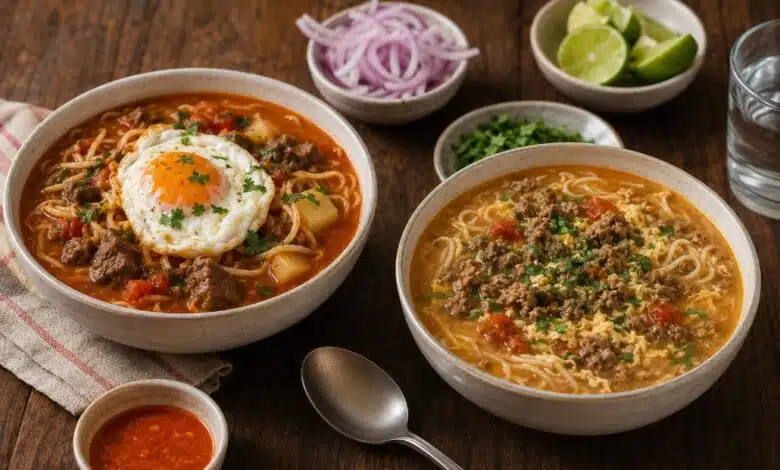
Sopa criolla and sopa a la minuta can look so similar that a diner may assume they are two names for the same bowl. That conclusion is sometimes correct in practice, but not reliably enough to use as a universal rule. Peruvian recipes, households and restaurants overlap heavily in their use of beef, noodles, tomato, ají panca, milk, oregano and egg, yet some kitchens still prepare and list the two soups separately.
Sopa criolla and sopa a la minuta are closely related Peruvian beef-and-noodle soups rather than two dishes separated by one fixed ingredient. Sopa a la minuta is commonly associated with speed, ground beef and a straightforward home-style preparation. Sopa criolla is often presented with a more pronounced criollo aderezo, chopped beef, a mounted or poached egg, fried bread and a more composed restaurant-style finish. These patterns are useful, but the recipe and menu description of the individual kitchen remain more reliable than the name alone.
The practical distinction is a pattern, not a law
The safest comparison is not “sopa criolla contains one ingredient and sopa a la minuta does not.” Real recipes refuse to cooperate with such a tidy rule. Both soups may contain ground beef, chopped beef, ají panca, tomato, angel-hair noodles, milk, oregano and egg. Both can be fast. Both can be served as an inexpensive family meal. Both may appear creamy or relatively clear.
The more useful distinction concerns emphasis. The phrase a la minuta points toward something prepared quickly, almost to the minute. Recipes using this name often feature ground beef because it browns fast, fine noodles because they cook in minutes and beaten egg because it can be streamed directly into the pot. Milk is commonly added at the end.
Sopa criolla is more likely to be described through the identity of its criollo base. Tomato, onion, garlic, ají panca and oregano are developed into an aderezo before broth and noodles are added. Chopped or diced beef appears frequently. The egg may be poached or fried and mounted over the bowl, and fried bread may arrive as a deliberate accompaniment.
That does not mean ground beef makes a soup a la minuta or fried egg automatically makes it criolla. It means those details help establish a probability. The kitchen’s own method has the final word.
Sopa criolla
A visibly developed red-brown aderezo, chopped beef, beef stock, fine noodles, milk, oregano, a poached or fried egg and fried bread create the version many restaurants present as sopa criolla.
The bowl may feel more composed, with separate elements that the diner mixes while eating.
Sopa a la minuta
Ground beef, a quickly cooked onion-and-tomato base, hot water or broth, angel-hair noodles, beaten egg, oregano and evaporated milk create the fast household version frequently associated with the name.
The ingredients may feel more fully dispersed through the pot rather than arranged individually.
Readers searching for a categorical verdict are therefore better served by a two-part answer. The soups belong to the same close family, and individual versions can be nearly indistinguishable. At the same time, Peruvian cooks and restaurants may distinguish them through speed, meat preparation, the strength of the aderezo, the form of the egg, bread and presentation.
The words “criolla” and “a la minuta” point in different directions
The names provide context even when they do not create a strict ingredient boundary. Criolla places the soup within Peru’s broad comida criolla tradition. It draws attention to the seasoned cooked base, the cultural repertoire around the dish and its identity as a Peruvian preparation.
A la minuta emphasizes time. The expression suggests food prepared quickly after it is ordered or assembled in a matter of minutes. In practical terms, ingredients that cook fast become especially logical: ground beef, fine noodles, a small amount of tomato, beaten egg and milk added at the end.
These names describe different aspects of a dish. One points toward culinary tradition; the other points toward speed. A soup can therefore be criolla in flavor and prepared a la minuta in technique. That conceptual overlap is one reason the names have not produced a universally enforced border.
A useful way to remember the distinction: “criolla” tells you more about the soup’s Peruvian culinary identity, while “a la minuta” tells you more about its quick everyday preparation. Neither phrase alone guarantees a particular meat cut, egg style or amount of milk.
Why literal English translations can make things worse
Sopa criolla may appear as “Creole soup,” but that wording can lead American diners toward Louisiana or Caribbean expectations. Sopa a la minuta may be translated awkwardly as “minute soup,” which sounds like an instant product rather than a fresh beef-and-noodle dish.
The clearest menu strategy is to retain the Spanish name and add a plain description. “Sopa criolla — Peruvian beef noodle soup with tomato, ají panca, milk and egg” communicates more than “Creole soup.” “Sopa a la minuta — quick Peruvian beef soup with angel hair and egg” conveys the practical meaning of the second title.
Why published recipes do not settle the question
A recipe comparison might seem like the easiest way to create a definitive chart. In reality, published recipes demonstrate the overlap. One sopa a la minuta recipe may contain ground beef, evaporated milk, onion, garlic, ají panca, tomato, two eggs, angel hair and oregano. A sopa criolla recipe may contain nearly the same ingredients, with chopped steak replacing ground beef and an egg poached rather than streamed into the pot.
Another sopa criolla recipe may add potato and omit visible bread. A restaurant version may thicken the broth slightly with yellow potato and top it with fried egg. Meanwhile, another cook may describe a light soup as a la minuta even though it includes milk and the same red criollo aderezo.
This variation is not evidence that the names are meaningless. It shows that culinary identity is structured through clusters of features rather than a single mandatory formula. Similarity can coexist with meaningful differences in technique, timing and presentation.
Beef, milk, fine noodles, egg, tomato, ají panca and oregano appear in recipes under both names.
Ground beef is strongly associated with quick minuta recipes, yet it also appears in dishes called sopa criolla.
Beaten egg in the broth feels different from a fried or poached egg mounted over the serving, although both are still egg.
A composed bowl with chopped meat, fried bread and mounted egg is easier to identify as criolla than a communal pot of quickly cooked ground-beef soup.
A household may preserve the name it learned even when its method resembles another published category.
A responsible comparison therefore explains the strongest recurring patterns without pretending that every Peruvian kitchen follows them. The goal is to help the reader order and understand the soup, not to invalidate family recipes.
The aderezo may be the most meaningful difference in practice
Both soups can begin with onion, garlic, tomato and ají panca, but the intensity and cooking time of that base may differ. A more developed criollo aderezo creates deeper color, sweetness and cohesion. The aromatics are cooked until they lose rawness, the tomato concentrates and the chile paste mellows in oil.
A very fast sopa a la minuta can use a lighter version of the same logic. Onion and garlic are sautéed, tomato is added, ground beef cooks quickly and hot water or broth follows. The result may be excellent, but the emphasis is speed and practicality rather than a long reduction.
Time alone is not the complete answer. A skilled cook can produce a concentrated aderezo efficiently, while a rushed cook can spend longer without developing flavor. Pan size, heat, ingredient quantity and the water content of tomato all affect the process.
| Aderezo question | Common sopa criolla tendency | Common sopa a la minuta tendency |
|---|---|---|
| Overall emphasis | A clearly defined criollo flavor base | A fast base supporting quick preparation |
| Tomato character | Often more concentrated and visibly red | May be lighter and more directly broth-like |
| Ají panca | Frequently emphasized as part of identity | Common, but sometimes simplified or replaced with paprika |
| Cooking approach | May prioritize browning and layered development | Usually prioritizes getting a satisfying soup ready quickly |
| Final effect | Deeper, more composed and restaurant-friendly | Immediate, home-style and efficient |
The broth matters as well. House-made beef stock can give sopa criolla more body and length. A la minuta versions may use water, bouillon or leftover broth because the browned ground beef and aderezo supply flavor quickly. This is a tendency, not a restriction.
When reading a menu, descriptions such as “beef broth with ají panca, tomato, oregano and cream” suggest a restaurant has considered the broth as a central component. A brief description such as “ground beef soup with noodles and milk” points more strongly toward the quick minuta model.
Ground beef and chopped beef create different soups even when everything else matches
Meat format is one of the most useful clues because it changes cooking speed, texture and the distribution of flavor. Ground beef cooks quickly and releases browned fat throughout the pot. Chopped steak takes more preparation and remains visually distinct in the final bowl.
Ground beef
Ground beef fits the a la minuta concept naturally. It browns in minutes, requires no long tenderizing and places small pieces of meat in almost every spoonful.
It also produces a homestyle texture and can make the broth feel more uniformly meaty.
Finely chopped steak
Small pieces of steak create clearer bites and a more composed visual presentation. The broth may remain cleaner around the meat.
This format appears frequently in restaurant-style sopa criolla.
Shredded cooked beef
Shredded meat can turn leftover beef and broth into a practical soup. It is not the most recognizable stereotype of either dish, yet it appears in home cooking.
Ground beef is not automatically cheaper in every location, and chopped beef is not automatically superior. Quality depends on fat balance, browning and tenderness. Dry ground beef can be less pleasant than carefully cooked chopped meat, while chewy steak can interrupt an otherwise excellent bowl.
The format also affects delivery. Ground beef remains distributed even if the container is shaken. Chopped meat may settle at the bottom. Neither travels badly, but ground beef produces a more consistent spoonful after transport.
When both soups appear on a restaurant menu, asking “Is one made with ground beef and the other with chopped beef?” is one of the most efficient ways to discover the kitchen’s distinction.
Milk does not provide a dependable dividing line
Milk is sometimes presented online as the defining difference between the soups. Published Peruvian recipes make that rule unreliable. Evaporated milk appears frequently in sopa a la minuta, and it also appears frequently in sopa criolla.
The amount and timing may still differ. A light minuta recipe can use a modest splash added after the noodles and egg. A restaurant-style sopa criolla may use more evaporated milk or cream to create a visibly rounded broth. Another criolla version may use very little dairy and remain predominantly red-brown.
Dairy changes the soup by softening tomato acidity, reducing the perceived heat of ají panca and making beef broth feel smoother. It does not have to create a thick cream soup. A small amount may be difficult to identify as a separate flavor.
Can one soup be milk-free?
Either soup can be prepared without milk. Household preferences, dairy availability and dietary needs produce milk-free variations. A menu that does not mention milk cannot be assumed to be dairy-free because short descriptions often omit secondary ingredients.
Does cream point toward sopa criolla?
Cream is more likely to appear in a richer restaurant interpretation than in a simple household minuta, but it remains a kitchen choice. Cream changes weight and mouthfeel more than identity. The soup should still preserve beef, tomato, chile and oregano beneath the dairy.
Dietary rule: never select between the two names as a way to avoid dairy. Ask whether the specific soup contains milk, evaporated milk, cream, butter or a dairy-containing prepared broth.
The form of the egg may reveal more than the presence of egg
Egg is common in both soups. The difference often appears in how the egg reaches the bowl. A quick minuta recipe may beat eggs and pour them into the simmering broth in a thin stream. Soft strands or curds distribute through the entire pot and cook almost immediately.
Sopa criolla is frequently pictured with a whole egg. It may be poached in the broth, prepared separately or fried and placed on top. The mounted egg creates a more composed appearance and allows the diner to decide when the yolk enters the liquid.
| Egg style | Effect on the soup | Which name it may suggest | How reliable is the clue? |
|---|---|---|---|
| Beaten and streamed into broth | Creates fine egg strands throughout the pot | Often suggests sopa a la minuta | Useful pattern, not a fixed rule |
| Whole egg poached in soup | Keeps the yolk concentrated and visually distinct | Often suggests sopa criolla | Moderately useful clue |
| Fried egg mounted on top | Adds visible richness and possible crisp edges | Strong restaurant-style criolla signal | Still dependent on the kitchen |
| Hard-cooked egg | Provides firm pieces without changing the broth much | Can appear in either soup | Weak clue |
| No egg | Leaves a lighter beef-and-noodle soup | Possible variation of either | Does not resolve the name |
The egg also changes the eating experience. A beaten egg integrates immediately. A poached or fried egg creates stages: the diner tastes the original broth, breaks the yolk and then experiences a richer second half of the bowl.
For delivery, the distinction becomes less predictable. Residual heat firms a soft yolk, and a fried egg may lose crispness. A soup that looks carefully composed in the restaurant can arrive more blended after a long trip.
Angel hair is common to both because speed and texture favor it
Fine noodles are one of the strongest shared features. Angel-hair pasta cooks within minutes, which makes it ideal for sopa a la minuta. The same delicacy also suits sopa criolla because the noodles absorb the seasoned broth without overwhelming chopped beef and egg.
Spaghetti, linguine and fettuccine appear in restaurant and household versions. Wider noodles make the soup heavier, reduce the apparent intensity of seasoning and absorb more liquid during storage. Their presence does not reliably identify either name.
Does the noodle quantity differ?
A quick family minuta may use enough noodles to stretch a modest amount of beef into several servings. A restaurant sopa criolla may use fewer noodles to preserve a more broth-centered presentation. The opposite can also occur, especially when a restaurant serves a very large bowl as a full meal.
Why noodle texture complicates comparisons
Two recipes can taste different simply because one is eaten immediately and the other sits for twenty minutes. Fine pasta continues absorbing broth. A soup that begins light can become dense, making it seem more like a different recipe even when the ingredients match.
Dine-in comparisons are therefore more useful than comparing a fresh restaurant bowl with reheated leftovers. Timing can influence texture as much as the recipe name.
Fried bread, potato and rice often make sopa criolla feel more composed
Fried bread is one of the strongest visual associations with restaurant-style sopa criolla. A crisp slice may rest along the rim or arrive separately. It gives the diner a contrasting texture and gradually absorbs the red, seasoned broth.
Sopa a la minuta is more often presented as a self-contained pot of soup that requires no additional assembly. This tendency fits its quick, practical identity. Bread can certainly accompany it, but fried bread is less central to the standard image.
Potato
Yellow potato may appear in sopa criolla, adding softness and mild thickening. It can make the broth creamier without requiring more dairy. Potato also appears in some minuta versions, so it remains a supporting clue rather than a rule.
Rice
Some restaurants serve rice beside sopa criolla, especially when presenting the bowl as a complete meal. Rice is less strongly associated with the quick household definition of sopa a la minuta, though family meals do not follow restaurant presentation conventions.
Yuca and other starches
Published soup traditions may incorporate yuca, bread or leftover ingredients in ways that blur neat categories. These versions demonstrate how practical household cooking adapts a familiar structure to what is available.
Do sopa criolla and sopa a la minuta taste different?
They can taste almost identical when their recipes overlap. Both may be savory, beefy, tomato-rich, mildly warm from ají panca, aromatic with oregano and softened by evaporated milk. Noodles and egg create a comforting texture in either bowl.
Differences become clearer when preparation choices move apart. A soup with chopped steak, concentrated beef stock, a deeply cooked aderezo, poached egg and fried bread will taste more layered and composed. A fast ground-beef soup with water, fine noodles, beaten egg and a small splash of milk may taste lighter, more immediate and more homestyle.
| Sensory point | Possible sopa criolla expression | Possible sopa a la minuta expression |
|---|---|---|
| Beef flavor | Distinct pieces of beef in a concentrated stock | Ground meat flavor dispersed through the broth |
| Tomato and chile | Deeper, more developed aderezo | Brighter, faster and sometimes lighter |
| Egg | Whole yolk enriches the broth after being broken | Beaten egg creates immediate richness throughout |
| Texture | More composed, with distinct beef, egg and bread | More integrated and consistent from spoon to spoon |
| Overall impression | A full criollo restaurant bowl | A fast and comforting household soup |
These descriptions should not be interpreted as a quality hierarchy. Fast does not mean careless. An expertly prepared sopa a la minuta can have excellent browning, a balanced aderezo and tender noodles. A complicated sopa criolla can still be greasy, oversalted or poorly timed.
The strongest flavor comparison comes from tasting two versions prepared by the same kitchen. When a restaurant lists both soups, the distinction reflects an intentional house decision rather than differences between unrelated recipes.
Which soup should you order?
Choose according to the version described by the restaurant rather than the title you believe should be better. The most satisfying choice depends on meat texture, egg style, broth richness and portion size.
When both are available and the portions are manageable, sharing one of each is the most informative approach. Taste the broth before adding lime or rocoto. Compare the meat, egg and noodle texture. Notice whether one aderezo is darker or more aromatic.
This side-by-side method also reveals how the restaurant defines its own food. The comparison may differ from another restaurant without either kitchen being careless or dishonest.
Which soup is easier to cook at home?
Sopa a la minuta is designed around speed and is usually the easier weeknight choice. Ground beef requires little knife work, angel hair cooks quickly and beaten egg can be incorporated without managing individual poached eggs. A satisfying pot can be made from pantry ingredients and a modest amount of meat.
Sopa criolla is not necessarily difficult, but a more elaborate version rewards extra attention. Chopped beef should be cut evenly. The aderezo benefits from patient cooking. Whole eggs require timing, and fried bread adds another pan or cooking step.
A practical weeknight minuta method
Cook onion and garlic until softened. Add ají panca and tomato, allowing them to lose their raw flavor. Brown ground beef in the base, pour in hot water or broth and season. Add broken angel-hair noodles. When they are nearly ready, stream in beaten egg, add oregano and finish with evaporated milk off strong heat.
A more composed criolla method
Brown small pieces of beef and reserve them if necessary. Develop onion, garlic, tomato and ají panca in the same pot. Add beef stock and return the meat. Cook noodles separately or in the broth according to the intended serving time. Finish with milk and oregano, then add a poached or fried egg and serve with fried bread.
Both methods can be simplified or expanded. The distinction lies in the cooking experience as much as the final list of ingredients.
Are the soups equally suitable for takeout and delivery?
Both soups can travel, but noodle and egg styles affect the result. A fully integrated ground-beef minuta is easy to portion and remains consistent after the container moves. Beaten egg does not require careful positioning.
A composed sopa criolla with fried egg and bread is more vulnerable. The egg continues cooking, bread loses crispness and separate pieces may shift. Good packaging can reduce these problems. Bread should be wrapped separately, and noodles may be packed apart when the restaurant permits.
Angel hair is the greatest delivery risk in either soup. It absorbs liquid quickly and can transform a brothy serving into a dense container of noodles. A nearby restaurant with a shorter trip may provide a better experience than a more celebrated kitchen located far away.
Reheat gently. Dairy can separate under a fierce boil, while egg becomes rubbery and noodles deteriorate further. Add a small amount of water or unsalted broth if the soup has thickened.
Dietary questions cannot be answered by the title
Both soups commonly contain beef, wheat noodles, dairy and egg. Neither should be presumed vegetarian, vegan, gluten-free or dairy-free. Ingredient omissions in short menu descriptions are common.
Gluten
Angel hair, spaghetti, linguine and fettuccine are normally wheat-based. Stock concentrates may add another gluten source. Shared pots and utensils also matter for diners with celiac disease or severe wheat allergy.
Dairy
Evaporated milk appears in recipes under both names. Even when a restaurant offers to omit visible milk, the prepared broth may already contain dairy. Ask whether the soup base is made in batches.
Egg
Egg can be mounted visibly or dispersed through the broth. Removing a fried egg does not address egg beaten into the pot. Ask how the kitchen handles it.
Halal requirements
Beef does not establish halal preparation. Verify the meat source, broth, cooking fat and shared equipment directly. The soup name provides no information about certification.
Vegetarian adaptations
Plant-based cooks may recreate the seasoning profile with soy meat, mushrooms, vegetable stock, plant milk and egg alternatives. These are purposeful adaptations, not the conventional preparation. A restaurant should identify them clearly.
The most common comparison mistakes
The most damaging mistake is turning a flexible culinary boundary into an accusation. A family recipe does not become invalid because another source assigns the name differently. A useful food guide describes recurring patterns, identifies uncertainty and helps the reader navigate real menus.
A decision rule that works in restaurants, recipes and search
Begin with the name, but never stop there. Search both terms. Read the ingredients. Identify the meat format, egg style, dairy and accompaniments. Ask the kitchen when both items appear. Choose according to the bowl you actually want.
A restaurant may use only one title for the flavor profile you remember.
Ground beef suggests a quick integrated soup; chopped beef suggests more distinct bites.
Beaten egg, poached egg and fried egg create meaningfully different textures.
Fried bread, potato and rice can turn a bowl into a much heavier meal.
Soup listings can change, and a kitchen may prepare one version only on selected days.
This method avoids two opposite errors. It prevents readers from treating different names as completely unrelated dishes, and it prevents them from assuming that every bowl under either title will be identical.
The difference matters most when it changes the bowl you receive
The terminology becomes useful when it predicts an experience. A diner expecting chopped beef, poached egg and fried bread may be disappointed by ground beef and egg ribbons, even if the broth tastes excellent. Another diner may prefer the integrated texture and speed of the minuta style.
That is why descriptive menus are more valuable than rigid definitions. The ideal listing tells the customer the meat, noodle, dairy, egg and accompaniments. The diner can then understand the restaurant’s interpretation without demanding that every kitchen use the same label.
Sopa criolla and sopa a la minuta should therefore be understood as very close relatives with a large shared center. They can be nearly identical, but they do not have to be. The strongest recurring distinction is between a composed criollo presentation and a quick household preparation, not between milk and no milk or egg and no egg.
Once that relationship is clear, both names become easier to search, order and appreciate.
Questions about sopa criolla and sopa a la minuta
The two names overlap enough to cause confusion, but a few practical questions make restaurant menus and recipes much easier to interpret.
Are sopa criolla and sopa a la minuta the same soup?
They are closely related Peruvian beef-and-noodle soups and can be nearly identical in some homes and restaurants. Both may contain tomato, ají panca, milk, oregano, noodles and egg. Other kitchens distinguish them through preparation speed, meat format, egg style, the strength of the aderezo, fried bread or presentation.
What is the main difference between sopa criolla and sopa a la minuta?
The most useful general distinction is emphasis rather than one mandatory ingredient. Sopa a la minuta is commonly associated with quick preparation, ground beef, fine noodles and egg incorporated into the pot. Sopa criolla often emphasizes a fuller criollo aderezo, chopped beef, a whole egg and a more composed serving. Individual recipes vary.
Which soup contains milk?
Either soup may contain milk or evaporated milk. Dairy is common in published recipes for both sopa criolla and sopa a la minuta, so milk does not create a dependable dividing line. Diners with dairy allergies should ask about the specific restaurant preparation.
Is sopa a la minuta always made with ground beef?
Ground beef is strongly associated with sopa a la minuta because it cooks quickly and distributes through the broth, but it is not mandatory. Some recipes use chopped or shredded beef, and ground-beef soups may also be called sopa criolla.
How is the egg different in the two soups?
Sopa a la minuta often uses beaten egg poured into the broth, creating soft strands throughout the pot. Restaurant-style sopa criolla is more likely to feature a whole poached or fried egg. This is a recurring pattern rather than a universal rule.
Do sopa criolla and sopa a la minuta taste different?
They may taste almost identical when the ingredients overlap. A composed sopa criolla can taste deeper and more layered because of concentrated beef stock, chopped meat and a developed aderezo. A quick minuta may feel lighter, more integrated and more home-style, especially when made with ground beef and beaten egg.
Which soup should I order at a Peruvian restaurant?
Read the ingredient description instead of choosing by name alone. Ask whether the meat is ground or chopped, whether the egg is beaten, poached or fried, whether milk is used and whether the bowl includes bread, potato or rice. Choose the version whose texture and portion match your preference.
Which soup is easier to make at home?
Sopa a la minuta is usually the faster weeknight option because ground beef, angel-hair noodles and beaten egg cook quickly in one pot. A composed sopa criolla with chopped beef, poached egg and fried bread may require more preparation and timing.
Where can I find sopa criolla near me?
Search full-service Peruvian restaurants and check menus under both sopa criolla and sopa a la minuta. Current U.S. restaurant listings exist in several states, but availability can change. Read the current menu and call before making a long trip.


