
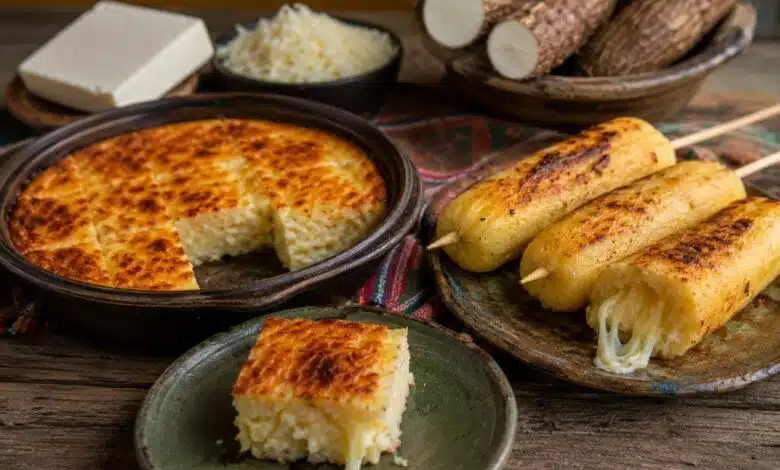
Sonso de yuca is a traditional Bolivian dish made by combining fully cooked yuca with cheese and then baking, browning or grilling the mixture until it is warm, cohesive and lightly golden. It is especially associated with Santa Cruz and the tropical lowlands of eastern Bolivia, where yuca is an everyday ingredient rather than an occasional substitute for potatoes.
At first glance, sonso can be difficult to classify. A baked portion may resemble a soft casserole. A skillet version can look like a thick patty. Sonso al palo is shaped around a wooden stick and grilled until toasted on the outside. Despite those differences, all of them share the same basic idea: the yuca is cooked, softened and mixed with cheese before the final cooking stage.
That detail matters because many foods described as “yuca and cheese” are not sonso. Boiled yuca served beside cheese is not the same dish. Fried yuca covered with melted cheese is not sonso either. Cassava-flour breads such as cuñapé and pão de queijo belong to a different family because they begin with processed starch rather than a mash of cooked cassava root.
If you are trying to order the dish rather than identify it, visit our guide to the best sonso de yuca near me for Bolivian restaurants worth calling, alternate menu names and practical ways to search outside permanent online menus.
What exactly is sonso de yuca?
Sonso de yuca is a savory cassava-and-cheese preparation from Bolivia. The yuca is peeled, cooked until completely tender and then mashed or crushed while warm. Cheese is mixed through the softened root, often with butter, milk, salt or another small adjustment depending on the cook.
The finished mixture can be placed in a baking dish, shaped into individual portions, cooked on a griddle or formed around a stick for grilling. Sonso is therefore better understood as a family of closely related preparations than as one shape that must always look the same.
The defining features are straightforward:
- The base is cooked yuca rather than raw cassava flour.
- The yuca is softened and mashed before the final cooking stage.
- Cheese is incorporated into the yuca rather than served only on top or beside it.
- The mixture is cooked again so the exterior can set, brown or toast.
- The center remains soft, dense and clearly different from bread.
Calling sonso a cassava cake can help someone imagine its shape, but the description is incomplete. It is not necessarily sweet, and it may not be baked in a pan. Calling it cassava cheese bread is also misleading because sonso does not usually have the airy or elastic crumb expected from bread.
Where does sonso de yuca come from?
Sonso is strongly associated with the eastern lowlands of Bolivia, particularly Santa Cruz. It is also connected with other warm, cassava-growing parts of the country, including Beni and Pando.
This regional identity is important because Bolivia has many distinct food traditions shaped by climate, agriculture, altitude and local history. Foods commonly associated with La Paz or the Andean highlands may rely more heavily on potatoes, chuño, grains or slow-cooked meats. In the eastern lowlands, yuca plays a much more visible role.
Santa Cruz is often the first place mentioned when people talk about sonso. The dish appears in homes, cafés, roadside food settings, outdoor grills and regional food celebrations. It belongs comfortably beside other eastern Bolivian foods made with cassava, corn and local cheese.
The dish does not need an elaborate restaurant presentation to feel authentic. A freshly grilled cylinder held by a wooden stick can be as recognizable as a neatly cut square from a baking dish. In many cases, the cooking method reflects where and when the food is being served.
Why yuca matters in eastern Bolivia
Yuca grows well in warm climates and produces a starchy root that can be boiled, fried, mashed, dried or processed into starch. Its mild taste makes it useful in both simple daily meals and more distinctive regional dishes.
In sonso, yuca is not merely a neutral filler. Its dense but tender texture gives the dish its character. Potato mash would produce something softer and more familiar, while cassava starch would create a more elastic bread-like result. Cooked yuca provides the middle ground that makes sonso recognizable.
A dish connected with place rather than one formal recipe
Traditional foods often develop through household practice rather than one published formula. Families adjust the cheese, butter, moisture and cooking method according to what is available. That is why two Bolivian cooks may produce visibly different versions while still recognizing both as sonso.
The regional connection comes from the ingredients, technique and eating tradition—not from forcing every portion into an identical size or shape.
Why is it called sonso?
The name most commonly appears as sonso de yuca, although shorter and regional forms are also used. In English-language menus, the spelling may vary because restaurants adapt Spanish words for customers who are unfamiliar with the dish.
You may encounter:
- Sonso — the shortened everyday name.
- Sonso de yuca — the clearest full name.
- Sonzo de yuca — an alternate spelling found in some references.
- Sonso camba — a name emphasizing its eastern Bolivian identity.
- Sonso cruceño — a name connecting it specifically with Santa Cruz.
- Sonso al palo — sonso shaped around a stick and grilled.
- Sonso al horno — a baked version.
- Yuca con queso — a broad description that may or may not refer to true sonso.
The word camba is often associated with people and culture from Bolivia’s eastern lowlands. When a menu uses the phrase sonso camba, it usually signals the regional style rather than a completely separate recipe.
Cruceño refers to Santa Cruz. A restaurant using the name sonso cruceño is emphasizing the dish’s connection with that department or its culinary traditions.
What is sonso de yuca made from?
The shortest traditional ingredient list contains only a few elements, but each one affects the result.
Cooked yuca
Yuca, cassava and manioc are different names used for the same starchy root. For sonso, the root must be peeled and cooked until completely tender. It is then drained, stripped of its firm central fibers and mashed while warm.
The yuca provides the body of the dish. It creates a denser texture than potato and a less bread-like texture than tapioca or cassava starch.
Cheese
Cheese gives sonso its salt, richness and much of its aroma. It also helps the mashed yuca hold together. Depending on the cheese, the center may be creamy, stretchy, crumbly or somewhere between those textures.
Traditional local cheese is not always easy to duplicate outside Bolivia. For that reason, home cooks and restaurants may combine a fresh crumbly cheese with a mild melting cheese.
Butter or another fat
Butter softens the yuca mixture and prevents it from feeling dry. It also encourages browning and adds a familiar dairy flavor that blends naturally with the cheese.
Milk
Milk may be added when the cooked yuca is dry or difficult to mix. It is not always required. Too much can make the mixture loose and prevent shaped sonso from holding together.
Salt
The amount depends heavily on the cheese. A salty cheese may require almost no additional seasoning, while a mild fresh cheese may need more.
Eggs
Some recipes include eggs to improve binding or enrich the mixture. Other versions contain no eggs at all. Egg should therefore be treated as a possible variation rather than a universal requirement.
Optional additions
Household adaptations may include pepper, green onion, mild chile or another small seasoning. These additions can be enjoyable, but the central flavor should still come from yuca and cheese.
How is sonso de yuca made?
The exact cooking time and proportions vary, but the traditional process follows a recognizable sequence.
- The yuca is peeled. Fresh cassava has a thick outer skin and a pale layer underneath. Both must be removed before cooking.
- The root is boiled until fully tender. The pieces should split slightly and allow a fork to pass easily through the center.
- The central fibers are removed. Cooked yuca commonly contains a tough string-like core that should not remain in the finished dish.
- The yuca is mashed while warm. Warm cassava is easier to break down and combine with dairy ingredients.
- Cheese and fat are mixed through the yuca. The ingredients become one cohesive preparation rather than separate layers.
- The moisture is adjusted. Milk or another small amount of liquid may be added only when the mixture is too dry.
- The sonso is shaped or placed in a dish. It may become a tray, patty, oval portion or cylinder around a stick.
- The exterior is browned. Baking, skillet cooking or grilling adds toasted flavor and helps the mixture hold its shape.
- The sonso is served warm. Its texture and cheese flavor are usually best before the center cools and firms.
The second cooking stage is not simply decorative. It changes the contrast between the outside and the center. Without that browning or setting, the mixture would remain closer to cheesy mashed yuca.
The main ways sonso is cooked
Sonso al palo
The yuca-and-cheese mixture is pressed around a wooden stick and cooked over moderate heat. Rotating the stick exposes different sides to the heat and creates toasted patches around the exterior.
Baked sonso
The mixture is spread in a greased dish and baked until the top and edges become golden. It may be served by the spoonful or cut into squares after a short rest.
Skillet sonso
The mixture is shaped into thick portions and browned on a griddle or frying pan. This method provides crisp edges without requiring an outdoor grill.
Large shared sonso
For gatherings, the mixture may be prepared as one large baked portion. The result stays soft inside and is easy to divide for several people.
Is sonso al palo more authentic?
Sonso al palo is one of the most recognizable presentations, especially because the cylindrical shape and grilled surface immediately distinguish it from a casserole. However, a properly prepared baked sonso is not automatically less authentic.
Cooking traditions adapt to homes, cafés, ovens, griddles and outdoor fires. The key is the preparation of the yuca-and-cheese mixture, not the idea that only one heat source is acceptable.
Why restaurants may prefer baked sonso
A baking dish makes portioning and advance preparation easier. A café can prepare one batch, keep it warm and cut servings as needed. The method also reduces the risk that a soft mixture will fall from a skewer.
Why grilled sonso has a different flavor
Direct heat produces more toasted surface and may add a light smoky aroma. Because a cylindrical piece is browned on several sides, it can have a stronger contrast between the outside and the soft center.
What does sonso de yuca taste like?
Sonso has a mild, savory and dairy-rich flavor. Cooked yuca contributes a gentle natural sweetness and a restrained earthy or nutty quality. Cheese adds salt, tang and richness, while butter rounds out the mixture.
The final cooking method changes the aroma:
- Baked sonso develops warm toasted-cheese notes.
- Skillet sonso may taste more buttery around the browned edges.
- Sonso al palo can carry a faint smoky character from the grill.
- A heavily browned portion may taste nuttier than a pale one.
Is sonso sweet or savory?
Sonso is generally treated as a savory food, but yuca has a subtle sweetness that becomes more noticeable next to salty cheese. That contrast does not turn it into a dessert.
People unfamiliar with cassava may describe the flavor as somewhere between a mild root vegetable, a dense cheese bread and a soft grilled starch. None of those comparisons is exact, but together they help explain why sonso feels familiar and unusual at the same time.
Does it taste strongly of cheese?
That depends on the proportion and type of cheese. A fresh mild cheese produces a gentler result. A stronger aged cheese can dominate the yuca and create more salt or oil.
Good sonso should still taste like cassava. If the yuca disappears completely behind the cheese, the balance has shifted away from the character of the traditional dish.
How to recognize authentic sonso de yuca
Shape alone is not enough. A square may be sonso, but it could also be potato casserole, corn cake or another baked starch. The structure and preparation provide better clues.
The yuca and cheese are combined
When the portion is cut open, the interior should look like one cohesive mixture. The cheese may form visible pockets or strands, but it should not appear only as a separate topping.
The center is dense rather than airy
Sonso does not usually have the hollow or springy crumb associated with cassava-starch cheese breads. The cooked root gives it a heavier, more substantial interior.
The exterior is browned but not heavily breaded
A golden crust may form naturally from contact with the oven, grill or skillet. Breadcrumb coating is not a defining part of sonso.
The yuca texture is smooth but not gluey
Properly cooked and hand-mashed yuca creates a soft, slightly elastic mixture. Processing it too aggressively can produce a sticky, gummy texture.
There should be no hard central fibers
A tough string inside the portion usually means the yuca core was not removed completely. It is a preparation problem rather than a characteristic of the dish.
Foods that are often confused with sonso
Cheesy yuca fries
Yuca fries are cut pieces of cassava that are boiled, fried or both. Adding cheese afterward does not transform them into sonso because the pieces remain separate.
Boiled yuca with cheese
This may use the same two principal ingredients, but it lacks the mixing and final shaping that define sonso.
Yuca con mojo
Yuca con mojo normally consists of boiled cassava served with a garlic, citrus or onion-based sauce. It belongs to a different culinary tradition and contains no required cheese mixture.
Cassava croquettes
Croquettes may begin with mashed yuca, but they are often filled, breaded and deep-fried. Sonso does not require breading or a separate filling.
Potato casserole
A baked sonso can resemble potato casserole from a distance. The denser cassava texture and regional identity distinguish it once tasted.
Sweet cassava cake
Many cuisines prepare sweet cakes from grated cassava, coconut, sugar or condensed milk. Sonso is generally savory and centered on cheese.
Sonso de yuca and cuñapé are not the same
Both foods are closely associated with eastern Bolivia, and both combine cassava with cheese. The crucial difference is the form of cassava used.
| Feature | Sonso de yuca | Cuñapé |
|---|---|---|
| Cassava form | Cooked whole yuca that is mashed | Processed cassava or yuca starch |
| Texture | Dense, soft and substantial | More bread-like, elastic and often airy |
| Common shape | Square, patty or cylinder on a stick | Small roll, bun or rounded bread |
| Cooking method | Baked, pan-cooked or grilled | Usually baked |
| Main impression | Mashed cassava and cheese preparation | Cassava-starch cheese bread |
Because cuñapé is easier to display in bakery cases and often appears on permanent menus, customers searching for sonso may be offered cuñapé instead. It is worth trying, but it does not replace the same texture or cooking experience.
How sonso compares with other cassava-and-cheese foods
Pão de queijo
Brazilian pão de queijo is made with cassava starch and cheese. It is typically small, rounded and elastic, often with a partly hollow interior. Sonso is denser because it uses cooked root.
Pan de bono
Colombian pan de bono also belongs to the cassava-starch bread family. Its ingredients, technique and national identity are different from Bolivian sonso.
Enyucado
Colombian enyucado is commonly a sweet baked cassava cake made with ingredients such as coconut, sugar and cheese. Its dessert-like profile separates it from savory sonso.
Carimañolas
Carimañolas are shaped cassava preparations filled with meat, cheese or another filling and then fried. Sonso incorporates cheese throughout the yuca rather than hiding a separate filling inside.
Yuca rellena
Stuffed yuca preparations may resemble thick sonso portions, but the internal structure is different. Sonso does not require a central filling.
These similarities explain why broad searches for “cassava and cheese” produce many unrelated dishes. The Bolivian name and the cooked-yuca mixing method are the best ways to narrow the search.
When is sonso de yuca eaten?
Sonso fits several parts of the day. It may be served as breakfast, a midmorning bite, an afternoon snack, a side dish or part of a larger table.
Breakfast
A warm portion with coffee is one of the most natural ways to experience sonso. The combination is substantial without requiring a full plate of meat or eggs.
Afternoon snack
A smaller piece works well with tea, coffee or hot chocolate. Its dense texture means a modest serving can be filling.
Side dish
Sonso can replace bread, rice or potatoes beside grilled meat, roast chicken or vegetables. Its cheese content makes it richer than plain boiled yuca.
Shared family food
A baked tray is easy to place in the center of the table. Diners can cut squares or spoon softer portions onto their plates.
Outdoor and festival food
Sonso al palo is practical for outdoor cooking and immediately recognizable when grilled. The stick also makes it easier to hold without a plate.
What is served with sonso?
Commonly suitable pairings include:
- coffee or tea;
- hot chocolate;
- fresh tomato and onion salad;
- grilled meat or chicken;
- fresh fruit at breakfast;
- other Bolivian baked foods in smaller portions;
- a mild fresh salsa.
Heavy sauces are not necessary. Properly prepared sonso should already be moist and flavorful inside.
Why cheese is essential to sonso
Cheese does more than add flavor. It changes how the mashed yuca behaves during shaping and cooking.
It seasons the yuca
Cassava has a mild taste. Salt and acidity from cheese keep the mixture from feeling flat.
It adds moisture
A fresh cheese softens the dense starch and helps the center remain tender after baking or grilling.
It helps the mixture hold together
Melting cheese can bind small pieces of mashed yuca into a cohesive portion. This is particularly useful for skillet sonso and sonso al palo.
It encourages browning
Cheese exposed near the surface develops golden toasted patches under heat. Those browned areas add aroma and contrast.
What cheese is traditionally used?
The answer varies by region and availability. Local fresh cheeses are natural choices in Bolivia, but recipes outside the country often use substitutes.
A practical substitute combines:
- a fresh crumbly cheese for flavor;
- a mild low-moisture melting cheese for cohesion;
- only a small amount of stronger salty cheese if more intensity is wanted.
Using only very wet cheese can make the mixture loose. Using only aged cheese can make it oily and overly salty.
Why sonso recipes vary from one household to another
Traditional household food rarely follows one universal ratio. The cook responds to the moisture of the yuca, the saltiness of the cheese, the available equipment and the number of people being served.
Some versions contain more cheese
A cheese-heavy sonso may be softer and more visibly stretchy. A yuca-forward version feels denser and allows the natural cassava flavor to stand out.
Some recipes use eggs
Egg can help bind a soft mixture, especially in baked versions. Other cooks rely entirely on the starch and cheese.
Some add milk
Milk is useful when the cooked yuca is dry. Very moist yuca may need none.
Some cook over fire
Outdoor grilling creates a toasted surface and smoky aroma that an oven cannot reproduce exactly.
Some prepare one large dish
A large baked sonso is convenient for families and gatherings. Individual skewers require more shaping and attention during cooking.
Some versions are smoother than others
Finely mashed yuca produces a uniform interior. Coarser hand-mashing leaves small pieces that make the cassava more visible.
These variations should not automatically be treated as errors. A version becomes less recognizably sonso when it abandons the cooked-yuca base or leaves the cheese completely separate.
What should you expect when ordering sonso at a restaurant?
A restaurant portion may differ from a home version because professional kitchens must consider preparation time, holding temperature, delivery packaging and portion control.
The portion may be pre-baked
A café may bake a tray in the morning and warm individual squares when ordered. This is practical, although the surface may be softer than a portion served immediately after baking.
It may be available only at certain times
Sonso may appear for breakfast, on weekends or until the day’s batch sells out. Its absence from an evening delivery menu does not always mean the kitchen never makes it.
The menu description may be brief
A menu may list only “sonso,” especially when most customers already know the dish. English descriptions may use phrases such as cassava with cheese, Bolivian yuca cake or grilled yuca cheese stick.
One order can mean different things
It may be:
- one grilled skewer;
- one baked square;
- two small patties;
- a large slice;
- a family-size tray;
- a side portion served with another dish.
Ask about size before ordering several portions. Sonso is dense, and a large baked square can be more filling than its appearance suggests.
Takeout changes the texture
Steam trapped in a sealed container can soften browned surfaces. The flavor remains, but the contrast between the crust and center may be reduced.
Is sonso vegetarian, gluten-free or vegan?
Is sonso vegetarian?
A basic sonso made from yuca, cheese, butter and milk may be suitable for many vegetarians. However, individual recipes can include lard, meat drippings or cheese made with animal-derived enzymes.
Is sonso vegan?
Traditional sonso is not vegan because cheese is a defining ingredient. Butter and milk may also be present.
Is sonso gluten-free?
Yuca naturally contains no gluten, and the traditional concept does not require wheat flour. A restaurant version may still include flour, seasoning blends or cross-contact from shared equipment.
Does sonso contain eggs?
Some versions do and some do not. Eggs are not universal, so the current recipe should be checked.
Does it contain dairy?
Yes, traditional sonso contains cheese, and it may also contain butter or milk.
Does it contain nuts?
Nuts are not a defining ingredient. Cross-contact may still be possible in kitchens that prepare peanut soup, desserts or other nut-containing foods.
What makes a good sonso de yuca?
| Feature | A good result | A possible problem |
|---|---|---|
| Yuca | Fully tender and evenly mashed | Hard, chalky or fibrous pieces |
| Cheese | Distributed throughout the portion | Present only as a topping |
| Center | Soft, warm and cohesive | Watery, cold, gluey or extremely dry |
| Exterior | Golden with deliberate toasted patches | Burned, raw-looking or soggy |
| Flavor | Balanced yuca, cheese and light browning | Overwhelming salt or stale oil |
| Structure | Holds together while remaining tender | Falls apart immediately or feels rubbery |
Should the cheese stretch?
It can, but it does not have to. Stretch depends on the cheese. A version made mainly with fresh crumbly cheese may have a soft dairy-rich center without long cheese pulls.
Should the outside be crispy?
Light crispness or browning is desirable, particularly for skillet and grilled versions. The dish does not need a hard fried shell.
Should sonso feel heavy?
It is naturally dense and filling. Heavy does not have to mean dry or compacted. The center should still feel tender.
Can you make sonso de yuca at home?
Yes. The ingredients are straightforward, and frozen peeled yuca makes the process easier for cooks who do not regularly prepare fresh cassava.
The most important points are:
- cook the yuca until completely tender;
- remove every firm central fiber;
- mash while the yuca is still warm;
- use enough cheese to flavor and bind the mixture;
- add milk gradually rather than all at once;
- avoid blending the yuca into a gluey paste;
- brown the exterior without drying the center.
The baked method is usually the easiest starting point because the mixture does not need to support its own weight while cooking. Once you understand the proper consistency, the same base can be shaped into skillet portions or pressed around sticks.
Why sonso deserves more attention outside Bolivia
Sonso uses familiar ingredients in a form that many diners have never encountered. Cassava is widely eaten across Latin America, the Caribbean, Africa and parts of Asia, while cheese is one of the most recognizable comfort-food ingredients in the United States. Bringing them together in sonso creates an accessible introduction to eastern Bolivian cooking.
The dish also challenges the idea that all cassava-and-cheese foods are interchangeable. Sonso, cuñapé, pão de queijo, pan de bono and cassava croquettes each use the root differently. Learning the distinction reveals how one ingredient changes when boiled, mashed, dried, fermented, grated or processed into starch.
Sonso is especially memorable because it can move between settings. It can be rustic food cooked over a fire, a neat café square, a breakfast beside coffee or a tray shared at home. Its identity remains clear as long as the cooked yuca and cheese form the center of the preparation.
Frequently asked questions about sonso de yuca
What is sonso de yuca?
Sonso de yuca is a Bolivian dish made by mixing fully cooked and mashed yuca with cheese before baking, pan-cooking or grilling the mixture.
Where does sonso de yuca come from?
It is closely associated with eastern Bolivia, particularly Santa Cruz, and is also connected with other cassava-growing lowland areas such as Beni and Pando.
Is sonso de yuca a bread?
No. Sonso is based on cooked mashed yuca rather than a flour or starch dough. Its interior is usually denser and softer than bread.
Is sonso the same as cuñapé?
No. Sonso uses cooked whole yuca, while cuñapé is a Bolivian cheese bread made primarily with cassava or yuca starch.
Is sonso always cooked on a stick?
No. Sonso al palo is grilled around a wooden stick, but baked and skillet-cooked versions are also common.
What does sonso de yuca taste like?
It tastes savory, cheesy and mildly sweet from the cassava, with toasted or lightly smoky notes depending on how it is cooked.
Is sonso de yuca vegetarian?
A basic version may be vegetarian, but individual recipes should be checked for lard, meat drippings and the type of cheese used.
Is sonso de yuca gluten-free?
Traditional sonso can be gluten-free because yuca contains no gluten and wheat flour is not required. Restaurant recipes and shared equipment should still be checked.
Can sonso be made with cassava flour?
Cassava flour does not produce the same traditional texture. Sonso depends on fully cooked yuca that is mashed before being mixed with cheese.
When is sonso usually eaten?
Sonso may be eaten for breakfast, as an afternoon snack, as a side dish or as shared food at family and community gatherings.
Sonso is simple, but it is not just yuca with cheese
The character of sonso comes from the way its two main ingredients are handled. The yuca must be cooked until tender, freed from its tough fibers and mashed while warm. The cheese must be mixed through the root so the two ingredients form one cohesive preparation.
From there, the cook can choose the form: a golden baked tray, thick skillet portions or sonso al palo slowly turned over heat. Each method changes the surface and aroma, but the soft cassava-and-cheese center remains the feature that connects them.
That combination of regional identity, modest ingredients and flexible preparation is why sonso continues to stand out among Bolivia’s traditional foods.


