
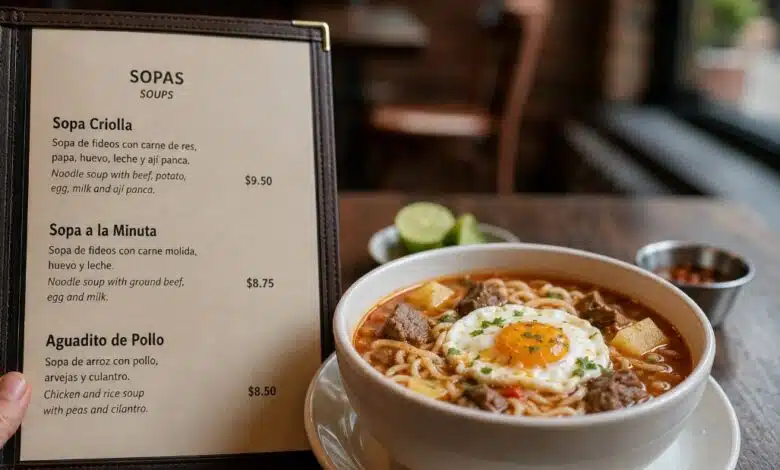
Ordering sopa criolla should be simple: find the soup on the menu, ask for a bowl and enjoy it. In practice, the same dish can appear under several names, descriptions may omit milk or egg, portion sizes range from starter bowls to full meals, and some restaurants distinguish sopa criolla from sopa a la minuta while others use the names almost interchangeably.
To order sopa criolla successfully, confirm four things: whether the soup is available today, how the restaurant distinguishes it from sopa a la minuta, whether it contains milk and egg, and whether the portion is a starter or a full meal. Ask how the beef is prepared, whether the egg is poached, fried or mixed into the broth, and whether noodles can be packed separately for takeout. These questions reveal more than the dish name alone.
The simplest way to order sopa criolla
When the soup is clearly listed and you have no dietary restrictions, the order can be direct: “I’d like the sopa criolla, please.” The extra questions become useful when the menu is abbreviated, the restaurant lists both sopa criolla and sopa a la minuta, or you are deciding between a small soup and a larger entrée.
A complete but natural order
“I’d like the sopa criolla. Is it a full-size bowl, and does your version come with milk and a whole egg?”
This one sentence confirms portion size and two ingredients that vary in how they are described. It does not make the order feel like an interrogation.
When the server says the restaurant has sopa a la minuta rather than sopa criolla, do not assume the answer is irrelevant. Ask how it is prepared. The bowl may contain exactly the beef, noodles, tomato, milk and egg combination you were seeking under the related name.
Likewise, a translated menu may list “Peruvian beef noodle soup” without the Spanish title. Look for supporting ingredients such as ají panca, tomato, oregano, evaporated milk, egg or angel-hair noodles.
Order in English
“May I have the sopa criolla? Is the egg poached or fried, and is the bowl large enough for a meal?”
Order in Spanish
“Quisiera una sopa criolla. ¿El huevo viene pochado o frito? ¿Es una porción grande?”
Pronunciation does not need to be perfect. “Sopa” is straightforward, while “criolla” is commonly pronounced approximately as cree-OH-yah. Pointing to the menu item is completely acceptable when the dining room is noisy or the written description is clearer than spoken communication.
Confirming availability matters more than confirming popularity
A restaurant can be highly rated for Peruvian food and still not serve sopa criolla. Another may offer it only as a lunch special, during colder months or on selected weekdays. Dish-specific evidence matters more than the restaurant’s general reputation.
When the restaurant is nearby, checking the current online ordering menu may be enough. When the trip is long, call. Ask whether the soup is available now rather than whether the restaurant “usually” makes it.
Search the site and direct ordering page for sopa criolla, minuta and soup of the day.
A current lunch-special post may be more reliable than an old permanent menu.
Confirm that it is accepting orders rather than merely visible in an archived category.
Ask whether the soup is available during the exact service period you plan to visit.
Multi-location restaurants may carry different menus at different addresses.
A useful phone question
“Hi, do you have sopa criolla available today for dinner, or is it only served at lunch?” This question establishes the dish, day and service period in one sentence.
When an employee says “we have soup”
Ask which one. Peruvian restaurants may serve aguadito, caldo de gallina, parihuela, chupe, menestrón or another rotating soup. “Beef soup with noodles, tomato, milk and egg” is a useful clarifying description.
When the app says unavailable
The item may be unavailable only for delivery, outside a scheduled time or beyond the entered address. Switch the order mode to pickup and check again. A dish hidden from delivery can still be served in the dining room.
The questions worth asking—and the ones that usually are not
A good restaurant question should change your decision. Asking about every traditional variation is unnecessary when you have no dietary concern and are open to the kitchen’s version. Focus on availability, portion, allergens and major texture choices.
Questions that can be simplified
Instead of asking whether the soup is “authentic,” ask what is in it. Authenticity is too broad to produce a practical answer. A server can tell you whether the kitchen uses ground beef, evaporated milk, poached egg and fried bread. Those details allow you to understand the version without asking the employee to defend it.
Instead of asking whether it is “good,” ask whether it is popular, prepared daily or recommended as a full meal. “Good” invites a polite yes. A concrete question produces useful information.
Sopa criolla may be a starter, lunch or the largest item on the table
Portion size varies dramatically. One restaurant serves a modest cup before the main course. Another presents a wide bowl with chopped beef, abundant noodles, potato, egg, fried bread and rice. The category name on the menu does not always reveal the actual amount of food.
| Serving style | Likely role | What may be included | Ordering advice |
|---|---|---|---|
| Small cup or bowl | Starter | Broth, noodles and modest beef | Pair with an entrée |
| Medium bowl with one egg | Light meal | Beef, noodles, egg and dairy | Add bread or a small side |
| Large bowl with potato | Complete lunch | Beef, noodles, egg, milk and potato | Order another dish only when sharing |
| Bowl with rice and fried bread | Very substantial meal | Multiple starches plus beef and egg | Avoid ordering a heavy entrée for one person |
| Included in menú del día | First course | Smaller serving before a set main dish | Ask whether the soup can be ordered separately |
How to ask about size without discussing ounces
Say, “Is the sopa criolla usually enough for lunch by itself?” Servers answer this more naturally than questions about exact volume. Another useful question is, “Would you recommend an entrée after it for one person?”
Sharing a bowl
A large bowl can be shared as a first course. Ask for an extra small bowl and spoon. Sharing also lets two diners compare the soup with another Peruvian dish without over-ordering.
Children and lighter eaters
A child may find the noodles and mild chile approachable, but the broth can be hot, salty and richer than expected. Ask whether a smaller serving is available and request hot sauce separately. Egg doneness may also matter.
Ground beef and chopped beef create different eating experiences
Ground beef disperses through the broth and appears in nearly every spoonful. It produces a home-style texture and is frequently associated with quick sopa a la minuta preparations. Chopped beef remains in distinct pieces and can make the bowl feel more composed.
Neither is automatically better. Ground beef can be juicy, deeply browned and satisfying. Chopped steak can be tender and flavorful or disappointingly chewy. The restaurant’s technique matters more than the prestige of the cut.
A restaurant listing both sopa criolla and sopa a la minuta may use meat format as the primary distinction. The quickest question is: “Is one made with ground beef and the other with chopped beef?”
The egg can be hidden in the broth or become the center of the bowl
Egg appears in several forms. A whole egg may be poached directly in the soup, fried separately and placed on top, fully cooked, or left with a soft yolk. Beaten egg may be streamed through the broth, creating fine ribbons.
Soft-poached egg
This style allows the yolk to enrich the soup after you break it. The first spoonfuls remain broth-forward; later spoonfuls become silkier. Ask for the yolk fully cooked when you do not enjoy runny egg.
Fried egg
A fried egg gives the bowl visual drama and possibly crisp edges. It may continue cooking during delivery, so a yolk that begins soft can arrive firm.
Egg ribbons
Beaten egg dispersed through the broth creates a more integrated soup. You cannot remove it after cooking, which matters for allergies and diners who simply dislike egg texture.
No egg
Some restaurants may omit it on request when eggs are added individually. A soup made in a shared batch with egg already incorporated cannot be modified easily.
Useful question: “Is the egg cooked separately for each bowl, or is it already mixed into the soup?” That one answer tells you whether doneness and omission are realistic requests.
A reddish broth can still contain dairy
Evaporated milk is common in sopa criolla, but the quantity may be small enough that the soup does not look white or obviously creamy. Some restaurants use fresh milk or cream. Others prepare a milk-free version.
Do not rely on a photograph. Lighting, tomato concentration and ají panca can keep the broth strongly red even after dairy is added. The menu may also omit milk from a short description.
For dairy intolerance
Ask whether milk can be omitted from an individual serving. The answer depends on when it enters the process. A restaurant that adds evaporated milk while finishing each bowl may have flexibility. A kitchen that prepares a large finished batch does not.
For dairy allergy
Ask about the entire preparation, not only the final splash. Beef stock, butter, cream, prepared seasoning and shared utensils can matter. “No milk on top” is not sufficient confirmation.
For a lighter preference
You can ask whether the kitchen offers the soup with less milk. Avoid insisting that a traditional dish must be changed when the batch is already prepared. Choosing another broth-based Peruvian soup may be more practical.
Never confuse evaporated milk with condensed milk
Evaporated milk is unsweetened. Sweetened condensed milk would create an entirely different flavor and is not the expected ingredient in this soup.
Sopa criolla is usually flavorful before it is hot
Ají panca gives the broth a deep red color and warm chile character, but it is generally used for flavor more than intense heat. A bowl can look fiery while tasting mild. Hotter peppers or rocoto sauce create a sharper level of spice.
Lime makes chile feel brighter, while milk and egg reduce the perception of heat. The same broth can taste hotter before the yolk is broken and softer afterward.
Why “mild” is not an allergy statement
A server describing the soup as mild is discussing heat, not ingredient safety. Pepper sensitivity, chile allergy and general dislike of spicy food are different concerns and should be explained specifically.
Dine-in is the best format for a first bowl
Sopa criolla is sensitive to time. Fine noodles continue absorbing broth, whole eggs keep cooking and fried bread loses crispness. Eating at the restaurant lets you experience the texture closest to the kitchen’s intention.
Taste before adjusting
Begin with the broth. Notice beef, tomato, ají panca and oregano. Then taste it with noodles and meat. Break the egg afterward when the yolk is soft. Add lime and rocoto only after you understand the original balance.
Ask for condiments on the side
Lime, rocoto and extra oregano can transform the soup. Keeping them separate lets you adjust one spoonful at a time rather than committing the entire bowl.
Do not wait too long before eating
Angel hair changes quickly. Photographs are understandable, but the soup should not sit through a long photo session or the arrival of several other dishes.
Request an extra plate for fried bread
Keeping bread out of the broth preserves crispness until you choose to dip it. When it arrives already submerged, eat that portion first.
Communicate egg preference when ordering
Asking after the bowl arrives may be too late. Say “fully cooked egg, please” or “soft yolk, if possible” when the order is placed.
Pickup gives more control than long-distance delivery
Pickup works well when you can arrive at the promised time and transport the soup upright. The main enemy is not the car ride itself but the minutes the completed noodles spend inside hot broth.
Can the egg be packed separately?
A fried egg can usually be placed in a separate container, though it may cool faster. A poached egg cooked inside the soup is harder to separate without breaking. Ask rather than assume.
Inspect the lid before leaving
Confirm that the container is sealed and upright. Soup can escape through small gaps that are harmless for dry food. Place the container on a level surface rather than a sloped seat.
Reheat gently
Transfer the soup to a saucepan when possible. Add a small amount of water or unsalted stock if the noodles absorbed too much liquid. Warm without prolonged hard boiling.
For delivery, distance can matter more than restaurant fame
A nearby restaurant with a short estimated delivery may produce a better final bowl than a celebrated kitchen located across the city. Soup quality changes during transit even when the courier handles the order perfectly.
Check the estimated time before ordering
A fifteen-minute journey is different from a fifty-minute route involving multiple stops. Fine noodles and eggs do not pause while the order travels.
Read the modification options
Some apps allow separate noodles, fully cooked egg, no milk or sauce on the side. Other kitchens do not accept modifications through the platform. Call when the request involves an allergy or a major preparation change.
Choose pickup mode to see the full menu
A restaurant may hide soup from delivery because of distance or packaging concerns while offering it for pickup. Switching modes can reveal the item.
Expect the broth level to look lower
Noodles absorb liquid in transit. The restaurant may have packed a properly brothy soup that arrives thicker. This is not necessarily evidence that the kitchen served too little broth.
Rate transport and cooking separately
Overly soft noodles after a long journey may reflect delivery time rather than the restaurant’s in-house execution. A leaking container, however, is a packaging problem worth reporting accurately.
What to order with sopa criolla
The right pairing depends on bowl size. A large serving already combines beef, broth, noodles, egg and often potato, milk or bread. Pairing it with another large starch-heavy entrée can overwhelm one diner.
For a first-time tasting
Order the soup alone with bread, lime and rocoto on the side. This keeps attention on the broth and avoids masking the dish with several other rich flavors.
For sharing
Share one bowl and one contrasting entrée. Anticuchos offer grilled texture. Ceviche introduces acidity and freshness. A modest salad can balance a creamy bowl.
With lomo saltado
The combination is satisfying but substantial. Share the lomo saltado or order a small soup when possible. Both dishes feature beef, so the meal may feel less varied than pairing the soup with seafood or chicken.
With ceviche
Hot beef soup and cold acidic seafood create strong contrast. Eat the ceviche promptly and avoid adding excessive lime to the soup before comparing the flavors.
With pollo a la brasa
A shared portion of chicken can work for a group. For one diner, a large soup plus a full chicken plate is usually too much food.
With bread
Fried bread, toast or a crusty roll provides texture and absorbs broth. Ask whether bread is included before ordering an extra side.
What to drink
Water is the simplest choice. Chicha morada provides fruitiness and sweetness, while a tart drink may make tomato and lime feel sharper. A warm herbal tea after the meal can suit a cold-weather lunch.
Dietary restrictions require ingredient-level confirmation
The standard restaurant profile commonly includes beef, wheat noodles, dairy and egg. The dish should not be presumed vegetarian, vegan, gluten-free or dairy-free.
Gluten-free
Angel hair and other common noodles are wheat-based. Broth concentrate, seasoning and shared equipment may add further concerns. Replacing noodles does not automatically make the entire dish safe for someone with celiac disease.
Dairy-free
Ask whether evaporated milk or cream is already mixed into the batch. A restaurant may be able to finish one bowl without milk only when the dairy is added individually.
Egg-free
A whole fried or poached egg may be removable from the order. Egg ribbons cooked into a shared pot cannot. Cross-contact and shared utensils remain relevant for serious allergies.
Vegetarian or vegan
Traditional sopa criolla is beef-based. A restaurant offering a vegetable-broth adaptation should identify it separately. Omitting visible meat does not remove beef stock.
Halal
Confirm the source of the beef, broth ingredients, cooking fat and shared equipment. A statement that the soup contains no pork does not establish halal preparation.
Low sodium
Batch-prepared soup is difficult to alter after the stock and seasoning are combined. Ask whether the restaurant makes the broth in-house and whether a smaller portion would be more appropriate. “No added salt” at service does not remove sodium already present.
Lactose intolerance versus milk allergy
These are not interchangeable. Someone managing lactose may make a personal decision based on quantity and medication. A milk allergy requires direct confirmation of ingredients and cross-contact.
For serious allergies: contact the restaurant directly. Delivery-app checkboxes and short descriptions are not substitutes for a conversation about the broth, batch preparation and shared equipment.
How to avoid the most common disappointing orders
When the restaurant’s version differs from a photograph
Photography shows one preparation at one moment. Restaurants change garnishes, egg style, noodle shape and presentation. Judge whether the delivered or served item matches the written description and maintains the recognizable soup structure.
When the menu description is wrong
Politely ask for clarification. Third-party platforms can contain old descriptions. The restaurant may have changed its recipe or the platform may have copied information incorrectly. Avoid assuming intentional deception before checking.
When the soup is sold out
Ask whether it returns the next day or on a particular weekday. Also ask about sopa a la minuta. When neither is available, choose another Peruvian soup deliberately rather than selecting the first option at random.
What to order when sopa criolla is unavailable
The best alternative depends on which part of sopa criolla you wanted most: beef, noodles, egg, creaminess, chile or general warmth.
| Alternative soup | Choose it when you want | Main difference |
|---|---|---|
| Sopa a la minuta | The closest beef-and-noodle relative | The kitchen may use ground beef, egg ribbons or a quicker preparation |
| Caldo de gallina | Noodles, potato and egg in a substantial broth | Poultry replaces the red beef-and-tomato profile |
| Aguadito de pollo | A bright herbal soup with chicken and rice | Cilantro and green color replace oregano and ají panca |
| Menestrón | Vegetables, pasta, beans and green herb flavor | More vegetable-driven and pesto-like |
| Chupe de camarones | A rich dairy-enriched soup | Shrimp and a more elaborate seafood profile |
| Parihuela | An intense fish-and-shellfish broth | Briny and marine rather than beefy and creamy |
When the exact soup is important, ask when it returns instead of accepting a substitute that does not match the craving. A green chicken-and-rice soup may be excellent but cannot reproduce beef, tomato, noodles, milk and egg.
A complete order for four common dining situations
Solo lunch
Order one medium or large sopa criolla and confirm whether bread or rice is included. Add lime and rocoto on the side. Skip another entrée unless the serving is small.
First visit to a Peruvian restaurant
Share one sopa criolla as a starter, then choose one contrasting entrée. Ask for the egg preparation and taste the broth before condiments. This lets you explore more than one dish without losing focus.
Family dinner
Order one or two bowls for sharing, depending on size, plus a varied selection of entrées. Request extra small bowls and spoons. Keep hot sauce separate for children and heat-sensitive diners.
Cold-weather takeout
Choose the nearest well-reviewed restaurant with a confirmed current listing. Request separate bread, lime and rocoto. Ask whether noodles can be separated when the drive is long.
Lunch special
Confirm whether the soup is a small first course and what main dish follows. A set menu can be excellent value, but the soup portion may not represent the restaurant’s full à la carte serving.
How to interpret reviews without letting them decide for you
Reviews can reveal recurring information about portion, spice, noodle texture and availability. They are less reliable for establishing the one correct form of the dish. Different reviewers may expect different family versions.
Useful review details
Look for recent mentions of serving size, egg style, whether the soup sells out, how it travels and whether the restaurant distinguishes criolla from minuta. Photographs can confirm presentation when they are recent and clearly labeled.
Less useful review claims
Statements that a bowl is “not authentic” without explaining ingredients or technique offer little guidance. A detailed note such as “the restaurant uses ground beef and egg ribbons rather than chopped steak and a poached egg” is much more useful.
Check the review date
Restaurants change chefs, recipes, suppliers and menus. A current official listing should outweigh a review from several years earlier when deciding whether the dish is presently available.
Separate delivery texture from restaurant texture
A complaint about soft noodles after a long delivery does not necessarily describe dine-in quality. Look for context before drawing conclusions.
The best order is based on the kitchen’s real version
The dish name begins the conversation, but the restaurant’s actual preparation completes it. Sopa criolla can be light or creamy, ground-beef or steak-based, topped with fried egg or finished with egg cooked directly in the broth. Potato, rice and bread can turn it from a starter into a full meal.
The diner does not need to memorize every variation. Confirm the few details that affect the decision: today’s availability, portion size, dairy, egg and meat texture. For takeout, add one logistics question about separate noodles.
This approach respects the kitchen while protecting the diner from avoidable surprises. It also works when the restaurant uses the name sopa a la minuta for a closely related bowl.
Still looking for a restaurant that serves it?
The Best Sopa Criolla Near Me hub identifies U.S. restaurants with public menu evidence and explains how to compare locations, availability, ingredients, pickup and delivery before choosing where to order.
Questions about ordering sopa criolla
These answers summarize the decisions most likely to affect restaurant choice, portion, ingredients and takeout quality.
How do I order sopa criolla at a Peruvian restaurant?
Ask for sopa criolla by name and confirm whether it is available today. When the menu is unclear, ask whether the bowl contains beef, noodles, tomato or ají panca, milk and egg. Also confirm whether the portion is intended as a starter or a complete meal.
Can sopa criolla appear under another menu name?
Yes. A closely related bowl may be listed as sopa a la minuta, Peruvian beef noodle soup, creole beef soup or soup of the day. The names are not always interchangeable, so read the ingredient description and ask how the restaurant prepares its version.
Is sopa criolla a starter or a main course?
It can be either. A small bowl may precede an entrée, while a large serving with beef, noodles, egg, potato, bread or rice can function as a complete meal. Ask whether the restaurant considers its portion large enough for lunch.
Does restaurant sopa criolla contain milk?
Many versions contain evaporated milk, fresh milk or cream, but some are milk-free. A red broth can still contain dairy, and short menu descriptions may omit it. Diners with allergies should ask whether dairy is already incorporated into the batch.
How is the egg served in sopa criolla?
The egg may be poached in the broth, fried and placed on top, fully cooked or left with a soft yolk. Some versions contain beaten egg ribbons. Ask how the restaurant prepares it and request a fully cooked egg when preferred.
Is sopa criolla spicy?
It is usually mild to moderately seasoned. Ají panca provides red color and warm chile flavor without extreme heat. Some kitchens add hotter peppers or serve rocoto sauce separately. Request hot sauce on the side when trying the soup for the first time.
Is sopa criolla good for takeout?
The broth travels reasonably well, but thin noodles continue absorbing liquid and the egg continues cooking. Pickup is best when the drive is short. Ask whether noodles, fried bread and a fried egg can be packed separately for a longer journey.
What should I do if the restaurant has sopa a la minuta instead?
Ask how it differs from the restaurant’s sopa criolla. Sopa a la minuta may provide a very similar beef, noodle, tomato, milk and egg profile. Ground beef, egg ribbons or a faster preparation are common distinctions, but each kitchen uses the names differently.
What allergens are common in sopa criolla?
Common allergens include wheat from the noodles, dairy from milk or cream and egg. Prepared stock and shared equipment may create additional concerns. People with serious allergies should contact the restaurant directly rather than relying only on an online description.
Where can I find a restaurant serving sopa criolla?
Search full-service Peruvian restaurants and check current soup menus under sopa criolla, sopa a la minuta and Peruvian beef noodle soup. Public U.S. listings exist in several states, but availability can change, so confirm before making a long trip.


