
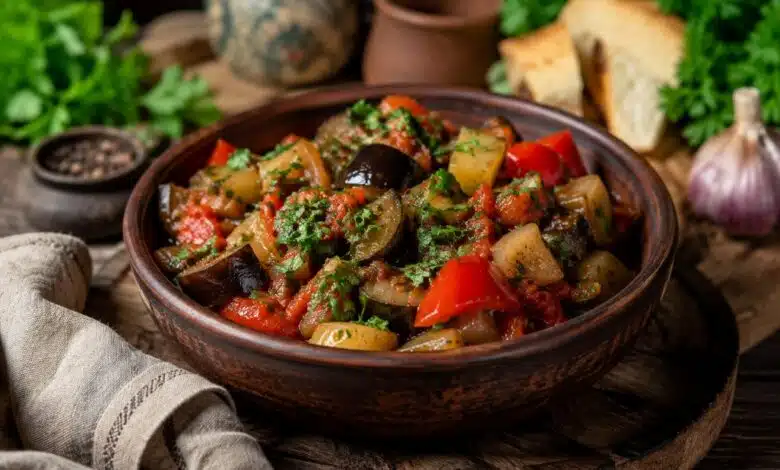
Ajapsandali and ratatouille are vegetable dishes built around eggplant, tomatoes, peppers and onions, but they are not interchangeable names for the same recipe. Ajapsandali belongs to Georgian and wider Caucasus cooking, while ratatouille comes from the culinary tradition of Provence in southern France. Their shared vegetables make the comparison easy, but their herbs, seasoning, cooking styles and place at the table create distinct results.
Ajapsandali often emphasizes eggplant, garlic, fresh cilantro, parsley, basil, coriander and sometimes chile or adjika. Potatoes may make it more substantial. Ratatouille commonly combines eggplant with zucchini, tomatoes, peppers, onions, olive oil and Mediterranean herbs such as thyme and basil.
The greatest difference is not one individual ingredient. It is the overall flavor direction. Ajapsandali tends to feel more garlicky, herbaceous and connected to the shared Georgian table. Ratatouille usually leans toward olive oil, ripe vegetables and Provençal herbs, with less emphasis on coriander, cilantro or Georgian chile seasoning.
Both dishes can be chunky or soft. Both may be prepared in one pot or by cooking vegetables separately. Both can be served warm or at room temperature. These overlaps explain why ajapsandali is sometimes introduced as “Georgian ratatouille,” but that phrase should be treated as a helpful comparison rather than a literal definition.
For restaurant locations and current menu leads, see our guide to ajapsandali near me.
Ajapsandali vs ratatouille at a glance
| Feature | Ajapsandali | Ratatouille |
|---|---|---|
| Culinary tradition | Georgian and wider Caucasus cooking | Provençal cooking from southern France |
| Central vegetable | Usually eggplant | Eggplant, zucchini, tomatoes and peppers share the focus |
| Common herbs | Cilantro, parsley and basil | Thyme, basil, parsley and other Mediterranean herbs |
| Common spices | Coriander, black pepper, red pepper and optional adjika | Usually lightly spiced, with herbs taking the main role |
| Potatoes | Common in some versions | Not normally a defining ingredient |
| Zucchini | Optional | Common and strongly associated with the dish |
| Garlic | Often prominent | Common but usually integrated with olive oil and herbs |
| Typical cooking fat | Vegetable oil, sunflower oil or another neutral oil | Olive oil |
| Heat level | Mild or spicy depending on chile and adjika | Usually mild |
| Serving temperature | Hot, warm, room temperature or chilled | Hot, warm or room temperature |
| Common role | Starter, side, vegetable plate or light main | Side dish, main vegetable dish or accompaniment |
| Meal context | Served with Georgian bread, pkhali, lobio, khachapuri and grilled foods | Served with bread, fish, meat, eggs, rice or other French and Mediterranean foods |
What is the main difference between ajapsandali and ratatouille?
The main difference is their culinary identity. Ajapsandali is shaped by Georgian ingredients and Georgian ways of building a shared meal. Ratatouille belongs to Provençal cooking and reflects the produce, olive oil and herbs associated with southern France.
Looking only at a bowl of cooked eggplant, tomatoes and peppers may not reveal the distinction immediately. The difference becomes clearer after tasting the seasoning.
Ajapsandali may contain generous cilantro, parsley, basil and garlic. Ground coriander, black pepper, chile or adjika may add warmth and depth. The dish can be distinctly aromatic even when it is not spicy.
Ratatouille is often seasoned with garlic, thyme, basil, parsley or other herbs associated with Provence. Olive oil contributes a recognizable fruitiness and richness. The dish is normally not defined by cilantro, coriander seed or adjika.
Potatoes also create a major practical difference. They are common in many ajapsandali recipes and restaurant versions, although not universal. They make the dish more filling and give it a thicker, starchier character. Classic descriptions of ratatouille focus on eggplant, zucchini, tomatoes and peppers rather than potatoes.
Zucchini creates the opposite contrast. It may appear in ajapsandali, but it is much more strongly associated with ratatouille. A zucchini-rich bowl with thyme and olive oil will usually feel more like ratatouille, while an eggplant-dominant bowl with cilantro, coriander and potato will feel more like ajapsandali.
Neither dish has only one correct texture. A restaurant chef may preserve clean vegetable pieces, while a home cook may simmer everything until soft. Origin and seasoning remain more useful identifiers than chunk size.
Where do ajapsandali and ratatouille come from?
Ajapsandali
Ajapsandali is associated with Georgia and is also prepared in Armenia, Azerbaijan and other parts of the Caucasus. Georgian versions are closely connected with summer eggplant, tomatoes, peppers, garlic and fresh herbs.
The dish fits naturally into Georgian meals built around shared plates. It may be served with bread, bean dishes, walnut-based vegetable preparations, cheese breads, salads, pickles and grilled meat.
Although ajapsandali is less internationally famous than khachapuri or khinkali, it is a classic expression of Georgian vegetable cooking. It shows that Georgian cuisine is not defined only by cheese, dough and meat.
Our separate guide to what ajapsandali is explores its ingredients, spellings, regional context and serving traditions in greater detail.
Ratatouille
Ratatouille is associated with Provence and especially with Nice in southern France. It belongs to a Mediterranean tradition of cooking ripe summer vegetables with olive oil, garlic and herbs.
The word commonly refers to a mixture of eggplant, zucchini, tomatoes and peppers cooked in olive oil. Onions and garlic are also common, while herbs bring fragrance and connect the dish to its Provençal setting.
Like ajapsandali, ratatouille began as practical vegetable cooking rather than a rigid fine-dining formula. Home cooks, restaurants and chefs may use different proportions and techniques.
Why the dishes developed similar structures
Both cuisines had access to warm-season vegetables that cook well together. Eggplant absorbs fat and seasoning. Tomatoes provide moisture and acidity. Peppers contribute sweetness. Onions and garlic build a savory base.
When similar produce is cooked in neighboring or comparable climates, related dish structures can develop without becoming identical. The seasoning traditions surrounding those vegetables are what make the final dishes culturally distinct.
How do ajapsandali and ratatouille use eggplant?
Eggplant is important in both dishes, but it is often more dominant in ajapsandali.
Eggplant in ajapsandali
Ajapsandali may contain enough eggplant for it to form the main body of the stew. The pieces absorb tomato, garlic, coriander and herb flavors, becoming soft and deeply seasoned.
Depending on the recipe, eggplant may be fried, roasted, grilled or simmered. Fried eggplant creates rich silkiness. Roasting controls oil and creates browned edges. Grilling introduces smoke.
The skin may be left on to preserve structure, removed for softness or peeled in stripes as a compromise.
Eggplant in ratatouille
Eggplant is one of several central vegetables. It shares attention with zucchini, peppers, tomatoes and onions rather than always dominating the final mixture.
It may be sautéed separately so that it browns before joining wetter vegetables. It may also be simmered with the rest of the ingredients in a more rustic method.
What proper eggplant texture looks like
In both dishes, eggplant should be fully tender. Raw, squeaky or spongy eggplant usually means it has not cooked long enough.
Soft does not have to mean shapeless. The skin can hold a piece together while the interior becomes creamy. A long-cooked version may collapse more fully into the sauce.
Which dish tastes more like eggplant?
Ajapsandali often does, especially when the recipe contains no zucchini and only a moderate amount of potato. Ratatouille may distribute attention more evenly across several vegetables.
Which vegetables are used in each dish?
| Vegetable | Ajapsandali | Ratatouille |
|---|---|---|
| Eggplant | Central and usually essential | Central and normally included |
| Tomatoes | Essential or nearly universal | Essential or nearly universal |
| Bell peppers | Very common | Very common |
| Onions | Very common | Very common |
| Garlic | Often prominent | Common |
| Potatoes | Common in many versions | Not usually included |
| Zucchini | Optional | Common and characteristic |
| Carrots | Possible but not universal | Occasional but not defining |
| Fresh chile | Optional | Uncommon as a defining element |
The overlap is large enough that ingredients alone do not always provide a complete answer. A dish containing eggplant, tomatoes, peppers, onion and zucchini could move in either direction until the herbs, spices, fat and context are considered.
A restaurant may also adapt either dish to available produce. That flexibility does not remove the need for a recognizable core, but it makes strict ingredient policing less useful than understanding the overall balance.
Why, but it makes strict ingredient policing less useful than understanding the overall balance.
Why are potatoes common in ajapsandali but not ratatouille?
Potatoes make ajapsandali heartier and more suitable as a family meal or light main course. They absorb tomato juices, garlic and spices while contributing starch and a mild flavor.
Not every ajapsandali contains them. Some Georgian cooks prefer a lighter dish dominated by eggplant and peppers. Others consider potatoes part of the familiar household version.
Ratatouille is generally defined around eggplant, zucchini, tomatoes and peppers. Adding potatoes would not automatically make a dish inedible or inauthentic home cooking, but it would move away from the most recognizable ratatouille structure.
What potatoes change
- They make ajapsandali more filling.
- They absorb seasoning and tomato sauce.
- They thicken the surrounding liquid slightly.
- They create a firmer contrast to soft eggplant.
- They make refrigerated leftovers more substantial.
Can potato-free ajapsandali resemble ratatouille?
Yes, visually and texturally. The distinction then depends more heavily on cilantro, coriander, garlic, chile, oil and the rest of the meal.
Why is zucchini more closely associated with ratatouille?
Zucchini is one of the vegetables most people expect in ratatouille. It provides a mild, fresh flavor and a tender but recognizable texture.
Because zucchini releases a large amount of moisture, it can make the dish watery when crowded in a pan. Many cooks sauté or roast it separately to control that liquid.
Ajapsandali can include zucchini, especially in broad summer-vegetable versions, but it is not always expected. Eggplant remains more important to the dish’s identity.
What happens when zucchini is added to ajapsandali?
The dish becomes lighter, wetter and more varied in color. It may resemble ratatouille more closely, particularly when potatoes are absent.
Georgian herbs and spices can still make the final result distinctly ajapsandali. A bowl with zucchini, cilantro, coriander, garlic and adjika will taste different from a thyme-and-olive-oil ratatouille.
How do the herbs differ?
Herbs provide one of the clearest distinctions.
Ajapsandali herbs
Ajapsandali may use cilantro, parsley and basil together. These herbs can be added during cooking and again near the end.
Cilantro is especially important because it gives the dish a fresh, citrus-like aroma associated with many Georgian preparations. Parsley adds a cleaner green flavor, while basil provides sweetness and fragrance.
Some cooks use purple basil, which can have a stronger clove-like or peppery aroma than common sweet basil.
Ratatouille herbs
Ratatouille commonly uses thyme, basil, parsley or a broader Provençal herb profile. Bay leaf may simmer in the tomato base and be removed before serving.
Thyme produces an earthy, dry fragrance that feels different from fresh cilantro. Olive oil carries these aromas through the vegetables.
Can the same basil be used in both?
Yes. Basil appears in both culinary traditions. Its presence alone does not identify the dish.
Which dish is more herb-forward?
Either can be aromatic, but ajapsandali often displays fresh herbs more visibly and may use several at once. Ratatouille may depend more on thyme and herbs infused into olive oil during cooking.
How do the spices and heat levels compare?
Ajapsandali often uses a broader spice profile. Ground coriander, black pepper, red pepper and adjika may be added alongside fresh herbs.
Ratatouille is typically mild. Its complexity usually comes from vegetable browning, olive oil, garlic and herbs rather than concentrated chile seasoning.
Ground coriander
Ground coriander seed gives ajapsandali a warm, lightly citrus-like flavor. It supports fresh cilantro without tasting exactly the same.
Adjika
Adjika can contain chile, garlic, herbs, salt and spices. A small amount deepens the stew, while a larger amount creates noticeable heat.
Black pepper
Both dishes may contain black pepper, but it is only one part of ajapsandali’s possible seasoning profile.
Does ajapsandali have to be spicy?
No. Many versions are mild. Georgian seasoning is not automatically hot, and strong garlic or coriander should not be confused with chile heat.
Can ratatouille be spicy?
A cook can add chile, but strong heat is not a defining feature of the classic dish.
What cooking fats are commonly used?
Ajapsandali
Ajapsandali may be cooked with sunflower oil, another neutral vegetable oil or the oil commonly used by the household or restaurant.
A neutral oil allows garlic, coriander and fresh herbs to remain prominent. Eggplant still absorbs fat readily, so quantity must be controlled.
Ratatouille
Olive oil is closely associated with Provençal cooking and contributes its own flavor. It coats the vegetables and carries garlic and herb aromas.
Does the oil change the identity?
Yes, although it is not the only factor. Olive oil gives ratatouille a recognizably Mediterranean direction. Neutral oil leaves more space for Georgian herbs and spices.
Which dish is oilier?
Either can become oily if the eggplant is fried carelessly. The amount depends more on technique than the dish name.
Roasting reduces the amount of oil required. Separate frying can produce richer flavor but must be managed carefully.
Are the cooking methods different?
Both dishes can be prepared through one-pot simmering, separate sautéing or oven roasting. The techniques overlap considerably.
One-pot cooking
Vegetables are added in stages or layers and cooked until tender. This method produces a soft, integrated result.
Ajapsandali may use the vegetables’ own released moisture with little added water. Ratatouille similarly benefits from avoiding unnecessary liquid.
Cooking vegetables separately
Eggplant, zucchini, peppers and onions can be cooked independently, then combined with tomatoes and seasoning.
This gives better control because each vegetable softens at a different speed. It also prevents zucchini from releasing water before eggplant has browned.
Oven roasting
Roasting concentrates flavor and creates caramelized surfaces. It is useful for both dishes, especially when preparing a large batch.
Grilling
Grilled eggplant and peppers can produce smoky ajapsandali. Grilling can also be used for a modern ratatouille, although it is not required.
Layered presentation
Some modern ratatouille presentations arrange thin vegetable slices in repeating patterns. This is visually striking but should not be confused with every traditional home-style version.
Ajapsandali is more commonly presented as a mixed stew or vegetable ragout rather than carefully arranged slices.
Which method is more authentic?
No single method has exclusive ownership of authenticity. Both dishes have rustic and refined versions. The important issue is whether the technique supports the expected flavor and texture.
How do their textures compare?
Ajapsandali texture
Ajapsandali may be very soft and spoonable. Eggplant often forms much of the body, while potatoes can remain in firmer pieces.
A roasted version may preserve large chunks. A long-simmered version may blend tomato, onion and eggplant more completely.
Ratatouille texture
Ratatouille often aims to keep eggplant, zucchini and peppers recognizable. Separate cooking makes this easier.
Rustic one-pot ratatouille can also become soft and integrated, especially after reheating.
Which dish is chunkier?
There is no reliable universal answer. Restaurant ratatouille is sometimes more structured because chefs want each vegetable visible, while household versions of either dish may be soft.
Which dish is thicker?
Ajapsandali with potatoes can feel thicker and starchier. Ratatouille with a large amount of zucchini may release more liquid unless reduced carefully.
Which dish is more likely to become creamy?
Eggplant-heavy ajapsandali can become especially creamy because the softened eggplant absorbs the sauce and partly breaks down.
What do ajapsandali and ratatouille taste like?
Ajapsandali flavor
Ajapsandali often begins with the earthy softness of eggplant and builds upward through tomato acidity, sweet peppers, garlic and fresh herbs.
Ground coriander adds warmth. Cilantro creates brightness. Adjika or chile may add heat. Potatoes soften and absorb those stronger flavors.
Ratatouille flavor
Ratatouille tastes of ripe vegetables cooked in olive oil. Tomato acidity, sweet peppers, mild zucchini and creamy eggplant are supported by garlic and Provençal herbs.
The best versions taste concentrated without becoming tomato sauce. Each vegetable contributes to the whole.
Which is sweeter?
Either can be naturally sweet from onions, tomatoes and peppers. Ratatouille may feel sweeter when red peppers and zucchini are prominent. Ajapsandali may feel more savory when garlic, coriander and chile are stronger.
Which is more acidic?
The answer depends on tomato ripeness and quantity. Chilled ajapsandali may seem sharper because cold temperature reduces perceived sweetness.
Which has stronger garlic?
Ajapsandali often does, especially when garlic is added near the end or the dish is served cold.
Are ajapsandali and ratatouille served hot or cold?
Ajapsandali
Ajapsandali may be served hot as a stew, warm as a side, at room temperature among shared plates or chilled as a vegetable appetizer.
Cold service makes garlic and acidity more noticeable. Potato and eggplant become firmer after refrigeration.
Ratatouille
Ratatouille is commonly served hot, warm or at room temperature. It can be eaten chilled, but cold service is usually less central to its identity than it is for some ajapsandali presentations.
Which temperature shows flavor best?
Warm or room-temperature service often reveals the greatest aromatic detail in both dishes. Extremely hot food can hide subtle herbs, while refrigerator-cold food can mute sweetness.
Do leftovers need to be reheated?
No. Both dishes can taste good after resting. Ajapsandali is particularly comfortable in a cold-appetizer role, while ratatouille leftovers can be used with eggs, bread, pasta or grains.
How does each dish fit into a meal?
Ajapsandali on a Georgian table
Ajapsandali may sit beside pkhali, eggplant rolls, Georgian salad, lobio, bread, khachapuri, dumplings and grilled meat.
Its role is often to add cooked vegetables and tomato acidity to a table that may otherwise contain substantial bread, cheese, beans or meat.
It can be served as a small shared bowl rather than a large individual entrée.
Ratatouille in a French or Mediterranean meal
Ratatouille may accompany roasted or grilled meat, fish, eggs, rice, couscous, potatoes or bread. A generous portion can also serve as a vegetable main.
It can become part of another dish, such as an omelet filling, tart topping or accompaniment to pasta and grains.
Which is more likely to be a cold appetizer?
Ajapsandali, especially on Georgian restaurant menus that group it with vegetable starters.
Which is more likely to accompany fish?
Ratatouille fits naturally with Mediterranean-style fish, although ajapsandali can also be served with fish when the herbs and spices suit the preparation.
Which works better with cheese bread?
Ajapsandali. Its garlic, tomato and herbs make it a natural counterpoint to rich khachapuri.
Are ajapsandali and ratatouille vegan and gluten-free?
Both dishes can naturally be vegan and gluten-free, but restaurant recipes require confirmation.
Ajapsandali concerns
- butter may be used for onions or potatoes;
- cheese may be added as a topping;
- meat broth could appear in a nontraditional restaurant version;
- bread may be served on the same plate;
- cross-contact may occur in kitchens using flour and walnuts.
Ratatouille concerns
- the vegetable base is usually vegan;
- a restaurant may add cheese, butter or meat as part of the final plate;
- bread, pastry or another accompaniment may contain gluten;
- shared kitchen equipment may matter for celiac disease.
Which is lower in carbohydrates?
A potato-free ajapsandali and a standard ratatouille are both relatively vegetable-focused. Ajapsandali with a large amount of potato contains more starch.
Which is lower in fat?
Either can be light or rich. Fried eggplant absorbs oil in both recipes. Oven roasting allows more control.
Which provides more protein?
Neither is naturally high in protein. Serve them with beans, lentils, eggs, cheese, meat or fish when a more protein-rich meal is needed.
How do restaurant versions differ?
Restaurant ajapsandali
A Georgian restaurant may serve ajapsandali in a small ceramic bowl, as a molded cold starter or beside cheese and herbs.
The menu may describe it as Georgian vegetable stew, eggplant ragout or Georgian ratatouille. Potatoes, zucchini and cheese vary by restaurant.
Some kitchens emphasize smoke by roasting eggplant over flame. Others prepare a soft tomato-heavy stew suitable for sharing.
Restaurant ratatouille
A French restaurant may serve a rustic scoop of mixed vegetables or a carefully arranged presentation with distinct slices and herb oil.
It can appear as a side for meat or fish, as a vegetarian entrée or as part of a composed plate.
Why menu descriptions can be misleading
Restaurants often use familiar comparison terms to help customers. Calling ajapsandali “Georgian ratatouille” does not mean the kitchen is following a Provençal recipe.
Similarly, a dish marketed as ratatouille may be a modern interpretation rather than a rustic mixed stew.
What should you ask?
- Does the ajapsandali contain potatoes?
- Is cilantro used?
- Is it served hot or chilled?
- Is cheese added?
- Is the ratatouille made with zucchini?
- Are the vegetables cooked separately?
- Is either dish spicy?
- Can the dish be prepared without dairy?
How can you tell whether a dish is ajapsandali or ratatouille?
Appearance alone may not be enough. Use several clues together.
| Clue | More likely ajapsandali | More likely ratatouille |
|---|---|---|
| Potatoes | Common clue | Less typical |
| Zucchini | Possible | Strong clue |
| Cilantro | Strong clue | Unusual |
| Thyme | Possible but not central | Strong clue |
| Ground coriander | Strong clue | Unusual |
| Adjika | Strong Georgian clue | Not typical |
| Olive-oil flavor | Possible | Strong Provençal clue |
| Cheese topping | Possible restaurant presentation | Possible modern presentation |
| Served with khachapuri | Strong context clue | Very unlikely |
| Served with Provençal fish | Possible adaptation | Strong context clue |
The name used by the cook also matters. Culinary identity is not determined by an outsider counting vegetables while ignoring the recipe’s cultural setting.
Can ajapsandali substitute for ratatouille?
Yes, in some meals, but the flavor will change.
As a side for grilled meat
Ajapsandali can replace ratatouille successfully. Its garlic and herbs may create a stronger flavor, while potato can make the side heavier.
With fish
A mild, potato-free ajapsandali may work. Strong cilantro, adjika or coriander can change the intended French flavor of the plate.
With pasta
Ratatouille is the more natural match, but ajapsandali can be used as a vegetable sauce when the Georgian seasoning is welcome.
With bread
Both work well. Ajapsandali pairs naturally with Georgian bread, while ratatouille works with crusty French or Mediterranean bread.
As a cold appetizer
Ajapsandali may be the better substitute because chilled service is common and its garlic-herb profile remains strong.
In a formal French recipe
Substitution changes the dish’s identity. Use the correct name rather than presenting Georgian-seasoned vegetables as classic ratatouille.
Should you choose ajapsandali or ratatouille?
Choose ajapsandali when you want
- eggplant as the main focus;
- cilantro and fresh herbs;
- stronger garlic;
- coriander or adjika;
- optional potato;
- a Georgian shared-meal experience;
- a dish that may be served chilled.
Choose ratatouille when you want
- zucchini alongside eggplant;
- olive oil as a central flavor;
- thyme and Provençal herbs;
- a mild Mediterranean vegetable side;
- an accompaniment for fish or roasted meat;
- a vegetable base for eggs, rice or pasta;
- a recognizably French flavor direction.
For a richer meal
Ajapsandali with potatoes, bread and cheese can feel more substantial.
For a lighter vegetable side
Ratatouille made with moderate olive oil and no starch may feel lighter.
For spice lovers
Ajapsandali provides more natural room for chile and adjika.
For herb lovers
Both work, but the preferred herb family matters. Choose ajapsandali for cilantro and coriander; choose ratatouille for thyme and Mediterranean basil.
Which dish is easier to make at home?
Both are approachable, but both require attention to moisture and cooking times.
Ajapsandali challenges
- cooking eggplant until tender without excessive oil;
- softening potatoes before peppers collapse;
- balancing garlic and fresh herbs;
- using tomato without making the dish watery;
- adding adjika without overpowering the vegetables.
Ratatouille challenges
- preventing zucchini from releasing too much water;
- browning eggplant properly;
- preserving recognizable vegetable pieces;
- reducing tomato liquid;
- avoiding a flat or oily result.
The fastest method
A rustic one-pot version is fastest for either dish. Add vegetables according to their cooking time and use only enough liquid to prevent sticking.
The most controlled method
Cook the vegetables separately and combine them near the end. This produces better texture but takes more time and uses more pans.
The easiest large-batch method
Roast the vegetables on sheet pans, then combine them with a reduced tomato and herb base.
Which is more forgiving?
Ajapsandali can tolerate a softer, more integrated texture, making it forgiving when the vegetables cook unevenly. Ratatouille is also flexible, but many diners expect zucchini, eggplant and peppers to remain individually recognizable.
Which dish makes better leftovers?
Both often taste better after resting because the vegetables absorb garlic, herbs, oil and tomato.
Ajapsandali leftovers
Ajapsandali can be eaten chilled, at room temperature or reheated gently. Potatoes absorb more sauce overnight, while eggplant becomes softer.
Fresh cilantro or parsley can restore brightness before serving.
Ratatouille leftovers
Ratatouille works well reheated or repurposed. It can accompany eggs, fill an omelet, top toast, mix with rice or become a pasta sauce.
Which freezes better?
Neither retains perfect vegetable structure after freezing. Eggplant and zucchini become softer, while potatoes may change texture.
A smooth, stew-like ajapsandali may tolerate freezing better than a ratatouille whose appeal depends on distinct vegetable pieces.
How should they be reheated?
Use moderate heat in a saucepan or covered skillet. Stir gently and allow excess liquid to evaporate before serving.
Can they be served directly from the refrigerator?
Ajapsandali commonly can. Ratatouille is usually more aromatic after losing some of the refrigerator chill.
Common misconceptions about ajapsandali and ratatouille
“Ajapsandali is simply ratatouille with potatoes”
Potatoes are only one possible difference. Georgian herbs, coriander, garlic, adjika and meal context are equally important.
“Ratatouille must be arranged in perfect circles”
Decorative sliced presentations are only one style. Rustic ratatouille is often a mixed vegetable dish.
“Ajapsandali always contains potatoes”
Many versions do, but potato-free ajapsandali is also recognized.
“Ratatouille always contains zucchini”
Zucchini is strongly associated with the dish, but household proportions and local variations can differ.
“Both dishes are always vegan”
The basic vegetable preparations can be vegan, but restaurants may add butter, cheese, broth or non-vegan accompaniments.
“Ajapsandali must be spicy”
It may be mild. Georgian spices can be aromatic without creating strong chile heat.
“Ratatouille has no garlic”
Garlic is common, but it usually works with olive oil and Mediterranean herbs rather than Georgian coriander and cilantro.
“One is more authentic if the vegetables stay separate”
Both dishes have chunky and soft versions. Texture reflects method and household preference.
“They taste the same because they use the same vegetables”
Herbs, spices, oil and serving context create clearly different results.
Frequently asked questions
Is ajapsandali the same as ratatouille?
No. They share eggplant, tomatoes, peppers and onions, but ajapsandali belongs to Georgian cooking and commonly uses cilantro, coriander, garlic and sometimes potatoes or adjika.
What is the biggest difference between ajapsandali and ratatouille?
The biggest difference is their seasoning and culinary tradition. Ajapsandali has a Georgian herb-and-spice profile, while ratatouille is associated with Provence, olive oil and Mediterranean herbs.
Does ajapsandali contain zucchini?
It can, but zucchini is optional. It is more strongly associated with ratatouille.
Does ratatouille contain potatoes?
Potatoes are not normally a defining ingredient in ratatouille. They are more common in some ajapsandali recipes.
Which dish is spicier?
Ajapsandali is more likely to contain chile or adjika, but it can also be completely mild. Ratatouille is generally mild.
Which dish uses cilantro?
Cilantro is strongly associated with ajapsandali and other Georgian dishes. It is not a typical defining herb in ratatouille.
Can ajapsandali be served cold?
Yes. Ajapsandali may be served hot, warm, at room temperature or chilled.
Can ratatouille be served cold?
It can be eaten cold, but it is more commonly served hot, warm or at room temperature.
Are ajapsandali and ratatouille vegan?
Both can be vegan when made with vegetables, herbs, spices and plant-based oil. Restaurant additions such as butter, cheese or broth should be checked.
Which dish is better with grilled meat?
Both pair well with grilled meat. Ajapsandali adds Georgian herbs and possible spice, while ratatouille brings olive oil and Provençal flavors.
Similar vegetables do not make ajapsandali and ratatouille the same dish
Ajapsandali and ratatouille begin with a remarkably similar group of vegetables. Eggplant, tomatoes, peppers, onions and garlic can appear in both, and either dish may be cooked until chunky or soft.
Their identities become clear through everything surrounding those vegetables. Ajapsandali belongs to Georgian and Caucasus cooking, where cilantro, parsley, basil, coriander, chile, adjika and optional potatoes shape the final bowl.
Ratatouille belongs to Provence, where zucchini, olive oil, thyme, basil and Mediterranean vegetable cooking define the familiar flavor.
Calling ajapsandali “Georgian ratatouille” can help a first-time diner understand the general category, but it should not erase the dish’s name or Georgian identity. The two dishes are culinary relatives rather than duplicates.
Choose ajapsandali for stronger garlic, Georgian herbs, optional heat and a natural place beside bread, pkhali, lobio, khachapuri and grilled meat. Choose ratatouille for olive oil, zucchini, Provençal herbs and a classic Mediterranean vegetable accompaniment.


