
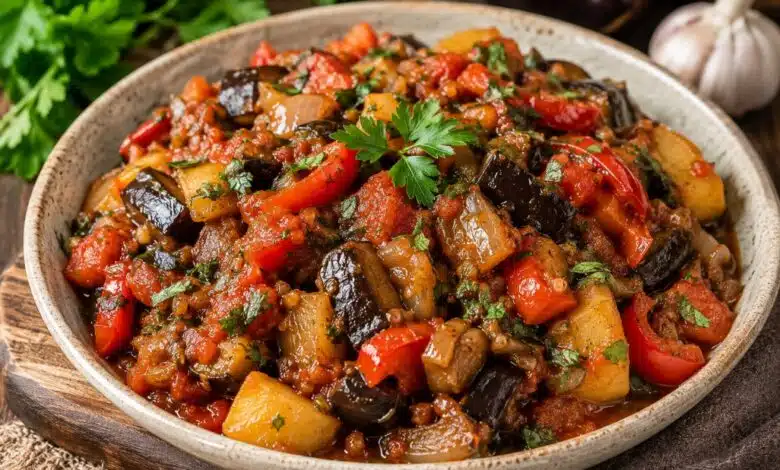
Ajapsandali is a Georgian vegetable dish built around tender eggplant, tomatoes, peppers, onions, garlic and fresh herbs. It can be roasted, fried, simmered or prepared through a combination of methods, then served warm, at room temperature or chilled. Some versions include potatoes, carrots or zucchini, while others keep the focus firmly on eggplant, tomatoes and peppers.
The dish is frequently introduced to English-speaking diners as Georgian ratatouille. That comparison is useful because both dishes combine summer vegetables into a soft, aromatic preparation. It is not a complete definition, however. Ajapsandali belongs to the culinary traditions of Georgia and the wider Caucasus, and its character is shaped by garlic, cilantro, parsley, basil, coriander and, in some kitchens, chile or adjika.
Ajapsandali may arrive as a small starter, a vegetable side, part of a cold-appetizer selection or a substantial bowl served with bread. A potato-rich version can be filling enough for a light main course. A concentrated roasted version may function more like a shared vegetable plate beside khachapuri, grilled meat, lobio or pkhali.
There is no single restaurant formula that defines every legitimate bowl. One family may insist that potatoes are essential, while another may consider them optional. One cook may fry each vegetable separately; another may layer everything in one pot. Some versions are distinctly chunky, while others become soft and spoonable after longer cooking.
Looking for a restaurant version rather than a general explanation? See our guide to ajapsandali near me for current menu leads, city-specific guidance and questions to ask before visiting.
What is ajapsandali in simple terms?
Ajapsandali is a vegetable stew or cooked vegetable dish in which eggplant is normally the central ingredient. Tomatoes, peppers, onions, garlic, herbs and oil support the eggplant and create a mixture that can range from chunky to very soft.
Calling it a stew is usually accurate, but the word can create the wrong expectation for some diners. Ajapsandali does not always contain a large amount of broth or thin liquid. Many versions are cooked until the tomato juices reduce and coat the vegetables. The result may be moist and spoonable without being soupy.
It can also be described as an eggplant ragout, vegetable sauté or cooked vegetable appetizer. The correct description depends on the method and serving style.
Ajapsandali can be a family meal, a restaurant starter, a side for grilled meat or part of a larger Georgian spread. Its flexibility helps explain why recipes differ so widely without losing the basic identity of the dish.
The vegetables are ordinary and widely available. The distinctive character comes from how they are cooked and seasoned. Eggplant must become tender enough to absorb the flavors around it. Tomatoes need enough time to lose their raw edge. Garlic and herbs should remain noticeable rather than disappearing under heavy sauce.
How is ajapsandali spelled and pronounced?
The Georgian name is written as აჯაფსანდალი. English-language menus commonly use ajapsandali, but you may also see ajapsandal, adjapsandali, ajabsandali or another transliteration.
These spellings usually refer to the same broad dish rather than separate recipes. Transliteration from Georgian, Armenian, Azerbaijani, Russian and other regional languages can produce several English forms.
Common menu spellings
- ajapsandali;
- ajapsandal;
- adjapsandali;
- ajabsandali;
- Georgian eggplant stew;
- Georgian vegetable stew;
- Georgian ratatouille;
- eggplant and pepper ragout.
Pronunciation varies slightly with language and transliteration. English speakers often say something close to “ah-jap-san-DAH-lee.” A restaurant staff member may pronounce it differently depending on Georgian or another regional language.
When searching menus, use more than one spelling. A restaurant may serve the dish but use ajapsandal, while a delivery platform may label it Georgian vegetable stew.
Does the name describe one exact recipe?
No. The name identifies a family of related preparations. It tells you to expect cooked vegetables, especially eggplant, with tomato, peppers, garlic and herbs. It does not guarantee potatoes, zucchini, a particular level of spice or one specific cooking method.
Where does ajapsandali come from?
Ajapsandali is strongly associated with Georgian cuisine and is also prepared in Armenia, Azerbaijan and other parts of the Caucasus. Related versions appear under different spellings and may use somewhat different ingredients or techniques.
The dish reflects the summer produce of the region: eggplant, tomatoes, peppers and fresh herbs. These ingredients can be cooked in large batches, served at different temperatures and eaten with bread or other dishes.
It is difficult to reduce a shared regional dish to one rigid national formula. Culinary traditions move across borders through trade, migration, family relationships and neighboring agricultural practices. Georgian ajapsandali nevertheless has a recognizable identity through its use of herbs, garlic, coriander and the broader structure of the Georgian table.
Why is ajapsandali associated with summer?
Eggplant, ripe tomatoes, peppers and herbs reach their strongest natural flavor during warm months. When the produce is ripe, the dish needs less correction from sugar, tomato paste or heavy seasoning.
A tomato picked at peak ripeness contributes sweetness and acidity. Fresh peppers provide aroma and color. Eggplant becomes creamy while maintaining enough structure to hold the sauce. Basil, parsley and cilantro add a freshness that dried herbs cannot fully reproduce.
Restaurants may serve ajapsandali throughout the year, but the connection with summer vegetables remains central to its identity.
Is ajapsandali traditional Georgian food?
Yes. It is recognized as a classic Georgian vegetable dish and appears in Georgian culinary guides, family cooking and restaurant menus. It may be less internationally famous than khachapuri or khinkali, but it is not a recent restaurant invention.
Georgia’s official tourism materials describe it as a classic dish made with eggplant, tomatoes, peppers and herbs, with variations that may also contain carrots or potatoes.
How does ajapsandali fit into a Georgian meal?
Georgian meals are often organized around several shared dishes rather than one entrée with two fixed sides. Bread, vegetable plates, cheese, beans, meat, sauces and herbs can all arrive together or in stages.
Ajapsandali contributes cooked vegetables, tomato acidity and herbal depth. It balances richer foods without feeling like a plain side salad.
With bread
Shotis puri, tonis puri or another Georgian bread can absorb the tomato-rich juices. Bread also turns a modest bowl of vegetables into a more substantial snack or light meal.
With khachapuri
Khachapuri is rich with cheese, dough and sometimes butter or egg. Ajapsandali provides acidity, garlic and vegetables, creating a more balanced combination.
With grilled meat
Mtsvadi, kebabs and grilled chicken benefit from a soft vegetable accompaniment. A smoky roasted ajapsandali can echo the char of grilled meat, while tomato and herbs prevent the plate from feeling dry.
With pkhali
Pkhali combines vegetables with walnuts, garlic, herbs and spices. It is denser and nuttier than ajapsandali. Serving both creates different expressions of Georgian vegetable cooking.
With lobio
Lobio contributes beans, earthiness and protein. Ajapsandali adds eggplant, tomato and peppers. Together with bread, the two can form a filling meatless meal.
With pickles and fresh salad
Because ajapsandali is soft, crisp pickles or Georgian cucumber-and-tomato salad provide useful contrast. A good shared table often needs something fresh or sharp alongside cooked vegetables.
To understand how these dishes fit together, see our broader guide to Georgian food.
What ingredients are essential in ajapsandali?
Recipes vary, but several ingredients appear consistently enough to define the dish.
| Ingredient | Role in the dish | What good preparation achieves |
|---|---|---|
| Eggplant | Main body and absorbing texture | Tender and silky without remaining raw or becoming excessively oily |
| Tomatoes | Acidity, sweetness and moisture | Cooked enough to form a sauce without dominating every other vegetable |
| Bell peppers | Sweetness, aroma and color | Softened while still contributing a recognizable pepper flavor |
| Onions | Savory foundation | Sweetened through cooking without burning |
| Garlic | Sharpness, warmth and depth | Clearly present but balanced with herbs and tomato |
| Fresh herbs | Brightness and Georgian character | Added in enough quantity to remain noticeable |
| Oil | Cooking medium and richness | Enough to soften vegetables without leaving an oily pool |
| Salt | Brings the vegetables together | Seasoning reaches the eggplant rather than only the sauce |
Eggplant
Eggplant is normally the most important vegetable. It can be cut into cubes, thick strips, rounds or irregular chunks. Smaller pieces cook faster and blend more fully into the sauce. Larger pieces preserve a more distinct texture.
The skin may be left on, removed completely or peeled in stripes. Keeping some skin helps the pieces hold their shape. Removing it creates a softer, more uniform result.
Eggplant can absorb a large amount of oil. Roasting reduces that tendency, while frying creates deeper richness. A skilled cook balances tenderness with enough structure to keep the dish from becoming greasy paste.
Tomatoes
Fresh ripe tomatoes provide the most natural balance of acidity and sweetness. Some recipes peel them, while others leave the skins on. Tomato purée or paste may be added when fresh tomatoes are pale or watery.
The quantity determines whether the dish feels like vegetables coated in sauce or a tomato stew containing vegetables. Neither style is automatically wrong, but the eggplant should remain important.
Bell peppers
Red peppers add sweetness and bright color. Green peppers provide a more vegetal, slightly bitter quality. Many cooks combine colors.
Peppers may be fried with onions, roasted separately or simmered directly with tomato. Roasting gives them stronger sweetness and smoky notes.
Onions and garlic
Onions build the savory base. Garlic provides one of the dish’s clearest identifying flavors. Some cooks add garlic early so it becomes mellow. Others add part of it near the end for sharper aroma.
Too little garlic can make the dish taste like generic vegetable stew. Too much raw garlic can overwhelm the eggplant and herbs. Balance matters more than an exact clove count.
Which ajapsandali ingredients are optional?
Several ingredients appear often enough to be familiar but not consistently enough to be required in every version.
Potatoes
Potatoes add body, starch and a more filling texture. They absorb tomato and seasoning while making the dish suitable as a main course.
Some cooks consider potatoes traditional and essential. Others prefer a lighter version centered on eggplant, tomatoes and peppers. Restaurant menus may list potatoes clearly because their presence significantly changes the dish.
Zucchini
Zucchini broadens the summer-vegetable profile and adds moisture. It is more common in expanded restaurant versions or household recipes using available produce.
Because zucchini releases water easily, it must be browned or cooked with enough evaporation. Otherwise, the stew can become thin.
Carrots
Carrots add sweetness and a firmer bite. Georgia’s official tourism description includes them among possible ingredients, but they are not universal.
Fresh chile
Chile can provide mild warmth or significant heat. Many versions remain mild and depend on black pepper, coriander and garlic rather than chile.
Adjika
Adjika is a concentrated seasoning associated with Georgia and neighboring regions. Depending on the type, it may contain chile, garlic, herbs, salt and spices. A small amount can deepen the stew without turning it into a hot dish.
Bay leaves
Some recipes simmer bay leaves with the vegetables and remove them before serving. They provide background aroma rather than a dominant flavor.
Tomato paste
Tomato paste adds concentration, color and body when fresh tomatoes are weak. Too much can make the dish taste processed or overly sweet.
Cheese
Cheese is not required in the vegetable base, but some restaurants serve ajapsandali with a slice, crumble or garnish of Georgian cheese. This creates a richer vegetarian plate but removes the possibility of calling it vegan.
Meat
Standard Georgian ajapsandali is understood as a vegetable dish. Related regional preparations may include meat, but a diner ordering ajapsandali at a Georgian restaurant should normally expect a meatless base unless the menu says otherwise.
Which herbs and spices give ajapsandali its Georgian character?
Fresh herbs are not a decorative afterthought. They are part of the flavor structure.
Cilantro
Cilantro contributes citrus-like freshness and a recognizably Georgian aroma. It may be added during cooking, at the end or both.
Parsley
Parsley adds clean herbal flavor without the strong personality of cilantro. Combining the two creates greater depth.
Basil
Basil brings sweetness and fragrance. Georgian cooks may use green or purple basil, depending on availability and tradition.
Ground coriander
Ground coriander seed provides warm, lightly citrus-like spice. It supports the fresh cilantro without tasting identical to it.
Black pepper
Black pepper adds gentle heat and depth. It is especially useful in versions without chile.
Red pepper
Ground red pepper or fresh chile can produce mild warmth or a sharper finish. The dish does not need to be hot to be authentic.
Fenugreek and Georgian spice blends
Some cooks use blue fenugreek or a Georgian spice blend, but these are not mandatory in every recipe. The combination should support the vegetables rather than make the stew taste like one dominant spice.
How is ajapsandali traditionally cooked?
There is no single universal method. The major approaches differ mainly in how they control moisture, oil absorption and vegetable texture.
One-pot simmering
The vegetables cook together or in layers. This creates an integrated, home-style stew with soft textures and fewer dishes to wash.
Separate frying
Eggplant, peppers, onions and potatoes may be fried separately before being combined. This gives strong flavor and precise texture but can use more oil.
Oven roasting
Roasting concentrates the vegetables, reduces water and creates browned edges. It is practical for home cooks who want less stovetop attention.
Grilling and simmering
Eggplant and peppers may be charred before joining the tomato base. This produces a smokier restaurant-style result.
One-pot layered method
A cook may place onions, potatoes, peppers, eggplant and tomatoes into a pot in stages. The vegetables release their own juices and cook over low heat.
This method can require little or no added water. Adding too much water risks turning the dish into soup and diluting the vegetable flavor.
The order matters. Potatoes need more time than tomatoes. Eggplant needs enough heat to become tender. Herbs added too early may lose freshness.
Separate-pan method
Each vegetable is cooked until nearly ready, then combined with tomato, garlic, herbs and spices. This gives the cook control over texture.
Eggplant can become fully tender without forcing peppers to collapse. Potatoes can brown rather than dissolve. Tomatoes can reduce separately before coating the vegetables.
The drawback is additional oil and labor. Eggplant fried in an unrestricted amount of oil can make the final dish heavy.
Roasted method
Eggplant, peppers, onions and potatoes can be spread across baking sheets and roasted. Tomatoes and seasoning may be added later or roasted in a separate pan.
This produces caramelization and reduces excess moisture. The finished dish may be less saucy and more structured than a traditional one-pot version.
Grilled method
Grilling eggplant and peppers introduces smoke. The charred skins may be removed before the vegetables are chopped and combined with tomato, onions, garlic and herbs.
This method creates a strong flavor but can move the dish closer to a roasted eggplant salad if too little tomato or moisture is used.
Why some recipes use no water
Eggplant, tomatoes, peppers and onions release substantial moisture. Low heat and a covered pot can create enough steam and juice to cook the vegetables without added water.
Water may be useful when the pot is drying before the vegetables become tender, but it should be added cautiously.
What texture should ajapsandali have?
Good ajapsandali should contain fully cooked eggplant. That is the clearest requirement. Beyond that, acceptable texture ranges from distinct vegetable pieces to a very soft stew.
Eggplant
Eggplant should feel creamy or silky inside. It should not squeak, resist the fork or remain dry and spongy.
It can hold its shape around the skin while becoming soft within. A long-cooked version may collapse into the tomato base.
Peppers
Peppers may remain slightly firmer than the eggplant. This contrast can keep the dish from feeling monotonous.
Potatoes
Potatoes should be tender but not dissolved. Their starch may thicken the surrounding juices.
Tomato sauce
The liquid should coat the vegetables. A little juice at the bottom is normal, especially in a warm one-pot version. A large amount of thin water suggests insufficient reduction or overcrowding.
Oil
A glossy surface is expected. A deep layer of separated oil is less desirable unless it reflects a deliberately rich fried style.
Chunky versus soft
A restaurant may prefer large, camera-friendly pieces with visible colors. A family recipe may be cooked until the flavors merge and the vegetables lose sharp edges.
Neither form alone proves authenticity. The important questions are whether the eggplant is tender, the vegetables are seasoned and the texture feels intentional.
What does ajapsandali taste like?
Ajapsandali tastes savory, vegetal, garlicky and herbal, with natural sweetness from tomatoes, onions and peppers. Eggplant contributes a mild earthy quality and absorbs the stronger flavors around it.
The exact taste depends on the cooking method and serving temperature.
Roasted ajapsandali
Roasted vegetables taste sweeter and more concentrated. Browned eggplant and peppers may provide caramelized edges and mild bitterness.
Grilled ajapsandali
Char creates a smoky aroma. This version can pair especially well with grilled meat or warm bread.
Simmered ajapsandali
A simmered version tastes integrated and comforting. Tomato, onion and eggplant blend into one another.
Spicy ajapsandali
Adjika or chile adds heat, but the dish should still taste of vegetables and herbs. Strong spice should not erase the eggplant.
Chilled ajapsandali
Cold temperature reduces the perception of sweetness and makes garlic, acidity and salt feel more prominent. The texture also becomes firmer.
Is ajapsandali bitter?
It should not be strongly bitter. Eggplant skin, green peppers, excessive charring or burned garlic may introduce bitterness. A slight vegetal bitterness can be pleasant when balanced by tomato sweetness and salt.
Is it sour?
Tomatoes bring acidity, but ajapsandali is not normally a pickled or sharply sour dish. Unripe tomatoes may make it too acidic.
Is it spicy?
It can be completely mild. Georgian food uses aromatic spices as well as chile, and the presence of garlic or coriander does not automatically mean heat.
Is ajapsandali served hot or cold?
Ajapsandali can be served hot, warm, at room temperature or chilled. The best temperature depends on the recipe and its role in the meal.
Hot
Hot ajapsandali feels most like a vegetable stew. The aroma of garlic, tomato and herbs rises immediately, and the eggplant feels especially soft.
A potato-rich version is often satisfying hot because the starch and tomato create a comforting, substantial texture.
Warm
Warm or slightly cooled ajapsandali may offer the best balance. The vegetables remain tender, but the seasoning becomes easier to distinguish than when the dish is steaming.
Room temperature
At room temperature, ajapsandali fits naturally among shared starters and vegetable plates. The oil remains fluid, and the herbs and garlic are noticeable.
Chilled
Cold ajapsandali becomes firmer and may taste more acidic or garlicky. It works well as a make-ahead appetizer, especially in warm weather.
Which temperature is traditional?
There is no single mandatory temperature. Sources and restaurants describe both warm and cold service. Household preference and cooking method matter.
Before ordering at a restaurant, ask how the kitchen serves it. Someone expecting hot stew may be surprised by a chilled appetizer, even when the dish is properly prepared.
Does traditional ajapsandali contain potatoes?
Potatoes are common but not universal. This is one of the most debated variables in ajapsandali recipes.
Several Georgian recipes and restaurant menus include them. Other descriptions focus on eggplant, tomato, peppers, onions and herbs, treating potatoes as an optional addition.
What potatoes contribute
- additional body;
- a more filling portion;
- starch that absorbs tomato juices;
- a mild contrast to garlic and herbs;
- greater stability after cooling.
Why some cooks leave them out
- to keep eggplant dominant;
- to produce a lighter summer dish;
- to reduce cooking time;
- to avoid starch thickening the tomato juices;
- to emphasize peppers, herbs and smoke.
How potatoes affect restaurant portions
A potato-heavy bowl may feel more like a side or vegetarian main. A potato-free version may be smaller, more concentrated and more appropriate as a starter.
Neither approach should be dismissed automatically. Ask whether potatoes are included when their presence matters to your expectations or dietary plan.
Is ajapsandali the Georgian version of ratatouille?
Ajapsandali is often called Georgian ratatouille because the comparison gives unfamiliar diners an immediate reference point. Both dishes combine eggplant, tomatoes, peppers, onions and other summer vegetables.
They are not the same dish. Their cultural setting, herb profile, seasoning and typical ingredient balance differ.
| Feature | Ajapsandali | Ratatouille |
|---|---|---|
| Culinary tradition | Georgian and Caucasus | French Provençal |
| Main focus | Often eggplant with tomatoes and peppers | Balanced mixture of eggplant, zucchini, tomatoes and peppers |
| Fresh herbs | Cilantro, parsley and basil | Thyme, basil and Provençal herbs |
| Spices | Coriander, black pepper and optional adjika | Usually herb-forward with less spice |
| Potatoes | Common in some versions | Not normally part of classic ratatouille |
| Serving | Hot, room temperature or chilled | Hot or room temperature |
| Georgian meal context | Served with bread, pkhali, lobio, khachapuri or grilled foods | Served as a side, main or accompaniment in French cooking |
Using the phrase Georgian ratatouille is acceptable as a quick explanation, but the name ajapsandali should not be replaced. The dish has its own identity and should be understood within Georgian food rather than only through a French comparison.
How is ajapsandali different from caponata?
Caponata is a Sicilian eggplant dish. Like ajapsandali, it combines cooked eggplant with tomatoes and other vegetables, and it may be served at room temperature.
The flavor direction is different. Caponata is known for agrodolce balance: sweet and sour notes created through vinegar and often sugar. Olives, capers and celery are common.
Ajapsandali generally depends on garlic, peppers, onions, herbs and Georgian spices rather than vinegar, capers and olives.
| Feature | Ajapsandali | Caponata |
|---|---|---|
| Origin | Georgia and the Caucasus | Sicily |
| Dominant flavor | Garlicky, herbal and tomato-rich | Sweet, sour and savory |
| Common accents | Cilantro, basil, coriander and peppers | Vinegar, capers, olives and celery |
| Potatoes | Sometimes included | Not normally central |
| Serving role | Stew, side, starter or light main | Appetizer, condiment or side |
A diner who enjoys one may enjoy the other, but they should not expect identical acidity or seasoning.
How is ajapsandali different from imam bayildi?
Imam bayildi is a Turkish dish of whole or halved eggplant filled with onions, tomatoes, garlic and olive oil. It is often served cool or at room temperature.
Ajapsandali usually cuts the eggplant into pieces and combines it with other vegetables in a stew or ragout. Imam bayildi preserves the eggplant as a distinct stuffed vessel.
Both dishes can be meatless, rich with olive or vegetable oil and strongly flavored with tomato and garlic. Ajapsandali normally shows a more mixed vegetable texture and a Georgian herb profile.
Is ajapsandali vegan, vegetarian or gluten-free?
The basic dish can naturally fit all three categories, but restaurant preparation should be verified.
Vegetarian
Ajapsandali normally contains no meat. A restaurant may add cheese or butter and still label it vegetarian.
Vegan
A version made with vegetables, herbs, spices and vegetable oil is vegan. Possible exceptions include:
- butter used to cook potatoes or onions;
- cheese served on top;
- meat broth added for flavor;
- a dairy-based garnish;
- non-vegan accompaniments on the same plate.
Gluten-free
Eggplant, tomatoes, peppers, onions, potatoes, herbs and spices do not naturally require gluten. Possible concerns include:
- bread placed on the same plate;
- a sauce containing an unexpected thickener;
- shared preparation surfaces;
- cross-contact in a kitchen handling flour and bread dough.
Nut-free
The stew itself does not normally require nuts. Georgian kitchens frequently use walnuts for pkhali, badrijani nigvzit and sauces, so serious allergies still require a conversation with the restaurant.
Dairy-free
Traditional vegetable versions can be dairy-free. Cheese-topped restaurant presentations and butter-based cooking are the main exceptions.
Low-carb
A potato-free version is lower in carbohydrates than one containing a large quantity of potatoes. Eggplant, tomatoes and onions still contribute carbohydrates, so the dish is not carbohydrate-free.
Is ajapsandali healthy?
It contains several vegetables and can be part of a balanced meal. Its calorie density depends heavily on oil, potatoes, cheese and portion size.
Fried eggplant can absorb substantial oil. A roasted version may be lighter, while a restaurant version with cheese and bread becomes more substantial.
How do restaurant versions of ajapsandali vary?
Restaurant ajapsandali is shaped by kitchen style, service format and customer expectations.
Cold appetizer version
This version is prepared ahead, chilled and served in a small bowl or molded portion. It may be more concentrated, garlicky and herb-forward.
Warm side-dish version
A warm version may accompany grilled meat or arrive as one part of a shared table. It is often softer and saucier.
Cheese-topped version
Some restaurants add Georgian cheese for richness and visual contrast. This should be considered a restaurant presentation rather than an essential defining ingredient.
Fire-roasted version
Fire-roasted eggplant introduces smoke and may reduce the need for long simmering. Peppers can also be charred.
Potato-rich version
More potato makes the dish filling and stable. It may be served as a larger portion.
Zucchini-rich version
Zucchini produces a broader summer stew. The cook must reduce the released moisture carefully.
Fine-dining version
A chef may arrange the vegetables separately, use smoked purée, add herb oil or plate the stew with cheese. The presentation can be modern while the underlying flavors remain recognizable.
Takeout version
Ajapsandali travels relatively well because it does not depend on crispness. Vegetables may soften further in a sealed container, and chilled versions may warm during transport.
How can you recognize well-prepared ajapsandali?
The eggplant is fully tender
Raw, squeaky or spongy eggplant has not cooked enough. Tenderness is more important than perfect visual shape.
The vegetables taste seasoned internally
The tomato sauce should not be the only flavorful part. Eggplant and potatoes need enough salt and cooking time to absorb seasoning.
The oil is controlled
The dish may be glossy and rich, but it should not leave the vegetables swimming in grease.
The tomato is balanced
Tomato should provide moisture, sweetness and acidity. It should not taste like canned pasta sauce poured over vegetables.
The herbs remain identifiable
Cilantro, parsley or basil should provide freshness. Overcooking every herb can leave the dish dull.
The garlic is noticeable but not harsh
Garlic should deepen the flavor. Large pieces of raw, burning garlic may dominate a chilled version.
The texture is intentional
Chunky or soft can both work. The problem is inconsistency: some eggplant raw, some potatoes dissolved and some peppers burned.
The vegetables are not watery
A little juice is expected. Thin liquid separating from the vegetables suggests insufficient evaporation or excess water.
The serving temperature makes sense
A chilled version should taste bright and properly seasoned. A hot version should be aromatic and fully warmed through.
What do you eat with ajapsandali?
Georgian bread
Warm bread absorbs the tomato and herb juices and makes the vegetables more filling.
Khachapuri
Ajapsandali cuts through the richness of cheese-filled bread with tomato acidity and herbs.
Mtsvadi
Soft vegetables and garlic complement smoky skewered meat.
Lobio
Beans and eggplant create a substantial vegetarian meal with bread or mchadi.
Pkhali
Walnut-based vegetable spreads add dense, nutty flavor beside the softer tomato stew.
Georgian salad
Fresh cucumber, tomato, onion and herbs bring crispness to a table of cooked dishes.
Pickles
Sharp, crunchy pickles balance the soft vegetables and oil.
Grilled chicken or kebab
Ajapsandali functions as both sauce and vegetable side for grilled food.
Can ajapsandali be served as a main dish?
Yes. Serve a generous portion with bread, beans, cheese or salad. A version containing potatoes is particularly suitable.
Does it need sauce?
No. Tomatoes and vegetable juices create their own sauce. Tkemali or adjika can be served separately, but they are optional.
What drink goes with it?
Water, mineral water, tea and Georgian wine can all work. Wine selection depends on the acidity, spice and other dishes in the meal.
Is ajapsandali difficult to make at home?
It is more approachable than many Georgian dishes involving dough, filling or specialized shaping. The challenge is managing several vegetables with different cooking times.
The main technical problems
- eggplant absorbing too much oil;
- potatoes remaining firm;
- tomatoes releasing too much liquid;
- zucchini making the mixture watery;
- peppers overcooking before potatoes soften;
- herbs losing freshness;
- garlic becoming burned or harsh.
A practical cooking order
- Prepare the eggplant and decide whether to roast, fry or salt it.
- Begin potatoes early when using them.
- Soften onions and peppers.
- Cook tomatoes until their raw flavor disappears.
- Combine the vegetables gently.
- Add garlic, spices and part of the herbs.
- Cook only until the flavors combine.
- Finish with additional fresh herbs.
- Rest before adjusting salt and acidity.
Should eggplant be salted first?
Salting can remove some moisture, season the interior and help with browning. Modern eggplants are not always very bitter, so salting is a technique rather than an absolute requirement.
Should eggplant be peeled?
Leaving some skin helps the pieces remain intact. Fully peeled eggplant creates a softer stew. Striped peeling offers a balance.
Can frozen eggplant be used?
Frozen eggplant can work, but it may become softer and release more liquid. Fresh eggplant gives better control over texture.
Can canned tomatoes be used?
Yes. Good canned tomatoes are often preferable to pale fresh tomatoes outside the growing season. Drain or reduce them if they are very watery.
Can the dish be made without potatoes?
Yes. Increase the relative amount of eggplant and peppers and reduce the cooking time accordingly.
Can it be made in the oven?
Yes. Roasting the vegetables is an effective way to reduce water and control oil. The roasted pieces can be mixed with a cooked tomato base and fresh herbs.
Does ajapsandali taste better the next day?
It often does. Resting allows garlic, herbs, tomato and spices to penetrate the eggplant and potatoes more evenly.
The texture will change. Eggplant becomes softer, potatoes absorb more sauce and the herbs lose some fresh aroma.
Refrigeration
Cool the dish promptly and store it in a covered container. Keep bread, cheese and other accompaniments separate.
Reheating
Use a saucepan or covered skillet over moderate heat. Stir gently to avoid crushing the eggplant.
A microwave can work for a small portion, but repeated strong heating may turn the vegetables into paste.
Serving leftovers cold
Ajapsandali can be served directly from the refrigerator, but allowing it to lose the deepest chill can improve aroma and texture.
Freezing
Freezing is possible, although eggplant, potatoes and zucchini may become softer after thawing. A chunky version may lose some structure.
How to refresh leftovers
Add chopped fresh herbs, a small amount of garlic, black pepper or a touch of acidity after reheating. Avoid adding large amounts before tasting, because the seasoning may already have intensified overnight.
Common misconceptions about ajapsandali
“It is just ratatouille with another name”
The dishes share vegetables but belong to different culinary traditions and use different seasoning patterns.
“It must contain potatoes”
Potatoes are common, but not every recognized version uses them.
“It must be served cold”
Cold service is common, but warm and room-temperature versions are also normal.
“It is always vegan”
The base can be vegan, but butter, cheese or broth may appear in restaurant preparations.
“It should be spicy”
Ajapsandali can be mild. Garlic, herbs and coriander create flavor without strong chile heat.
“The vegetables must remain perfectly separate”
Some versions are deliberately soft and integrated. Tenderness and flavor matter more than visual separation.
“More oil always makes the eggplant better”
Eggplant needs enough fat for richness, but uncontrolled frying can make the dish greasy.
“It is only a side dish”
A generous potato-rich portion with bread can be a complete light meal.
“Restaurant versions should all taste the same”
Ajapsandali is a flexible home-style dish. Cooking technique, vegetables, herbs and temperature create meaningful variation.
Frequently asked questions about ajapsandali
What is ajapsandali made of?
Ajapsandali is usually made with eggplant, tomatoes, peppers, onions, garlic, fresh herbs, oil and seasoning. Some versions also contain potatoes, zucchini, carrots or chile.
What country is ajapsandali from?
Ajapsandali is strongly associated with Georgian cuisine and is also prepared in Armenia, Azerbaijan and other parts of the Caucasus.
Is ajapsandali the same as ratatouille?
No. The dishes share several summer vegetables, but ajapsandali uses Georgian herbs and seasonings and belongs to a different culinary tradition.
Is ajapsandali served hot or cold?
It can be served hot, warm, at room temperature or chilled. The temperature varies by recipe and restaurant.
Does ajapsandali always contain potatoes?
No. Potatoes are common and make the dish more filling, but many versions focus on eggplant, tomatoes and peppers without them.
Is ajapsandali vegan?
It can be vegan when made with vegetables, herbs, spices and vegetable oil. Restaurant versions may include butter, cheese or broth.
Is ajapsandali gluten-free?
The basic vegetable dish can be gluten-free, but bread, garnishes and kitchen cross-contact should be checked when strict avoidance is necessary.
Is ajapsandali spicy?
It may be mild or spicy. Chile and adjika are optional, while garlic, coriander and black pepper provide flavor without necessarily creating strong heat.
What does ajapsandali taste like?
It tastes savory, garlicky, herbal and tomato-rich, with natural sweetness from onions and peppers and a soft earthy quality from eggplant.
Can ajapsandali be a main dish?
Yes. A generous portion served with bread, beans, salad or cheese can make a satisfying vegetarian meal.
Ajapsandali is defined by flavor and technique, not one rigid formula
Ajapsandali begins with eggplant, tomatoes, peppers, onions, garlic and herbs, but the final result depends on the cook. It may be roasted and smoky, slowly simmered and soft, potato-rich and filling or chilled and intensely herbal.
What connects the variations is the treatment of the vegetables. The eggplant should become tender, the tomato should coat rather than drown it, and the garlic and herbs should give the dish a distinctly Georgian character.
Potatoes, zucchini, carrots, chile and cheese may appear without defining every version. The dish can be vegan or vegetarian, warm or cold, a starter or a full meal.
That flexibility is not a weakness. It is one reason ajapsandali works so naturally in homes, restaurants and shared Georgian meals. Each version reflects the produce, technique and preferences of the cook while preserving the familiar combination of soft eggplant, tomato, peppers, garlic and herbs.


