
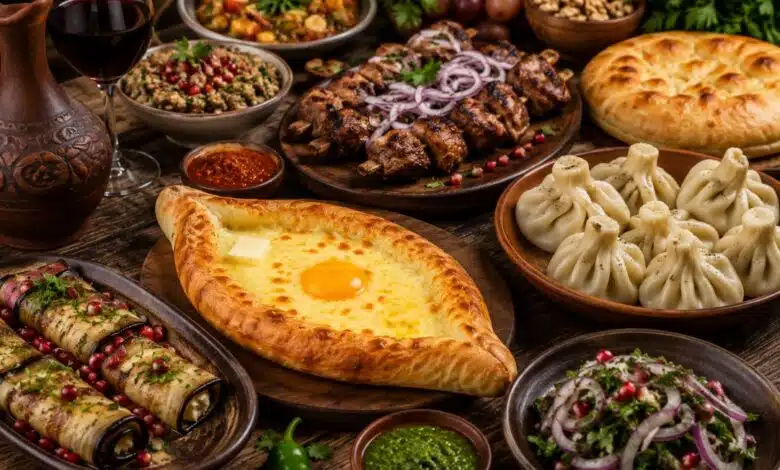
Georgian food makes the most sense when you stop thinking in courses and start thinking in conversations. A Georgian table rarely feels like a neat parade of appetizer, entrée and dessert. It arrives in waves, overlaps itself, and keeps changing character as bread is torn, sauces are passed, khinkali steam on a platter and someone decides that one more plate of grilled meat is clearly necessary.
That is why the best first meal is not built around one famous dish. Khachapuri and khinkali deserve their fame, but Georgian cooking becomes memorable when they sit beside walnut sauces, herbs, pickles, beans, grilled meats, fresh cheese, sharp plum sauce and a bottle of amber or red wine meant for sharing.
Georgia sits at a crossroads between the Black Sea, the Caucasus and routes that connected Europe with western Asia. Its food reflects geography more than any tidy category. Western regions lean toward cornmeal, softer cheeses, walnuts and subtropical produce. Eastern traditions often feel more wheat-based, meat-centered and closely tied to wine country. Mountain dishes are built for cold weather and appetite. Coastal food can be greener, brighter and looser around the edges.
I think of Georgian cuisine as generous rather than heavy. Yes, there is cheese. Yes, there is butter. Yes, a table can become gloriously excessive. But the best meals keep moving between richness and acidity: a piece of khachapuri followed by tkemali, grilled pork beside onions and herbs, beans sharpened with pickles, eggplant softened with walnut paste and pomegranate.
Order several dishes for the center, not one private entrée per person. Georgian food rewards comparison: hot bread against cool salad, meat against sour sauce, soft cheese against herbs and wine.
Choose one bread, one dumpling or meat dish, one vegetable or bean dish and at least one sauce. That already feels like a real table rather than a list of famous names.
The table begins before the “main dish”
A Georgian meal often starts with a spread that would be enough dinner in another cuisine. You may see fresh vegetables, cheeses, pickles, herbs, walnut-based vegetable dishes, beans, bread and small plates placed down before the hot food arrives. These are not filler. They teach you the logic of the meal.
The herb plate matters. Parsley, cilantro, tarragon, basil and green onion may arrive in generous bunches rather than chopped into a decorative sprinkle. You eat them with cheese, bread and meat. The effect is clean, peppery and fragrant. A bite of fatty pork suddenly feels brighter. A piece of bread with fresh cheese becomes more complete.
Pkhali: vegetables dressed like celebration food
Pkhali is a family of vegetable preparations usually bound with walnuts, garlic, herbs and spices. Spinach, beet, cabbage and other vegetables can all become pkhali. The texture is soft but not smooth, the flavor is savory and aromatic, and the plates are often finished with pomegranate seeds.
Do not read “vegetable appetizer” and expect something timid. Walnut paste gives pkhali body. Garlic and herbs give it attitude. The dish works beautifully with warm bread and is one of the smartest choices for a table that already includes cheese-heavy khachapuri.
Badrijani nigvzit: eggplant with walnut filling
Thin slices of eggplant are fried or cooked until supple, then rolled around or layered with seasoned walnut paste. This is one of the easiest Georgian dishes to love immediately. It is creamy without dairy, earthy without feeling dull, and usually sharpened by garlic, herbs and pomegranate.
When a restaurant does it well, the eggplant is tender rather than oily and the filling tastes fresh rather than pasty. Order it early. It holds the table together while richer dishes arrive.
Lobio and the comfort of beans in clay
Lobio refers broadly to bean dishes, but restaurant menus often mean slow-cooked red beans served in a clay pot with onions, herbs and spices. Some versions are rustic and loose; others are thick enough to scoop with bread. Pickles or mchadi may arrive beside it.
Khachapuri is a family, not one recipe
Khachapuri is often translated simply as Georgian cheese bread, which is accurate but incomplete. The name covers multiple regional forms. The dough changes. The shape changes. The cheese can sit inside, on top or in a molten center. Some versions are easy to share. Others demand immediate attention while the egg yolk is still glossy.
The most famous version outside Georgia is Adjarian khachapuri, the open boat with cheese, butter and egg. It is theatrical, rich and best eaten hot. The pointed ends of the bread are torn off and stirred through the center. It feels less like pizza and more like a bread bowl built around molten cheese.
Imeretian khachapuri is round and filled with cheese inside. It is calmer, more portable and often the best first choice for a group because every slice gives you bread and cheese in balance. Megrelian khachapuri adds extra cheese on top, making it the bolder, more indulgent cousin.
Our separate guide to khachapuri styles explains Adjarian, Imeretian, Megrelian, Gurian, Achma, Penovani and other versions in more detail. At a Georgian table, the practical decision is simpler: choose one style based on how you want to eat.
One mistake first-time diners make is ordering several cheese breads plus multiple rich meat dishes. The table becomes impressive but one-dimensional. One khachapuri is usually enough for two or three people when you also order khinkali, vegetables and meat.
Khinkali are eaten with your hands for a reason
Khinkali are pleated Georgian dumplings traditionally associated with mountain regions. The classic meat filling releases broth as it cooks, creating a dumpling that is both food and small engineering project. The top knot is a handle. You lift the dumpling, bite a small opening, sip the broth and then eat the rest.
The first bite is where beginners lose the broth. Hold the khinkali by the stem, tilt it slightly and bite from the side. Sip before taking a larger bite. A fork can puncture the pouch too early, which is why hands are not bad manners here; they are the sensible tool.
Traditional fillings often combine beef and pork, though lamb, beef-only, cheese, mushroom and potato versions appear on modern menus. Herbs may vary. Some are peppery and clean; others are heavily aromatic. The broth should taste integrated with the meat rather than like liquid trapped by accident.
Khinkali are usually ordered by number, sometimes with a minimum quantity per filling. Five dumplings can be a meal for one person. Three per person can work at a shared table with several other dishes. Ten per person is not unheard of, but that is a different kind of evening.
Khinkali belong to the broad world of filled dough, but their broth, pleated shape and hand-eating ritual make them distinct. Readers comparing dumpling traditions may also enjoy our global dumpling atlas.
Grilled meat is where the table becomes smoky
Mtsvadi is Georgian grilled meat, often pork, cooked over coals and served simply with onions, herbs and sometimes sauce. The point is not a complicated marinade. Good meat, smoke and proper browning do most of the work.
Pork is especially common and can be wonderfully juicy when cut into substantial pieces. Chicken and lamb appear too. Some restaurants serve skewers; others slide the meat off before it reaches the table. The best pieces have charred edges, tender centers and enough salt to stand without sauce.
Kebabi, often listed as Georgian kebab or lula-style kebab, is minced meat shaped around a skewer and grilled. It may arrive wrapped in thin bread with onions, sumac or sauce. Compared with mtsvadi, it is softer, more seasoned and often easier to share in smaller bites.
Chakapuli is a very different expression of meat. This springtime stew combines lamb or veal with tarragon, herbs, sour green plums or plum sauce and white wine. It tastes green, tart and aromatic. If grilled meat shows Georgian food at its smoky edge, chakapuli shows its herb garden.
Chicken dishes move between garlic, walnut and tomato
Shkmeruli is chicken in a powerful garlic-milk or cream sauce, associated with the mountain region of Racha. It is rich but not shy. The sauce is the dish, and bread is essential for collecting it.
Satsivi is poultry served with walnut sauce, often associated with holidays and cold service. The sauce is dense, spiced and deeply savory. Chakhokhbili, by contrast, is a tomato-and-herb chicken stew that feels lighter and more familiar to diners who want a comforting entry point.
Sauces are not optional decoration
Georgian sauces change the direction of a bite. Tkemali, made from sour plums, can be green or red depending on the fruit and season. It is tart, herbal and especially good with grilled meat, potatoes and fried food.
Satsebeli is a broader category and restaurant versions vary, but it often appears as a tomato-based sauce with garlic, herbs and spice. Adjika is sharper: a concentrated chili and herb condiment that may be red or green. It can be salty, hot and intensely aromatic, so start with less than you think you need.
Bazhe is a walnut sauce, thinner than some pkhali mixtures and used with poultry, fish or vegetables. Garlic, coriander and vinegar or another sour element give it balance. Walnut is not just a garnish in Georgian cooking; it is a structural ingredient.
| Sauce | Main character | Best first pairing |
|---|---|---|
| Tkemali | Sour plum, herbs, lively acidity | Mtsvadi or roasted potatoes |
| Satsebeli | Tomato, garlic, herbs and mild heat | Kebab or grilled chicken |
| Adjika | Chili, salt, herbs and concentrated spice | Use sparingly with meat or beans |
| Bazhe | Walnut, garlic and gentle tang | Chicken, fish or vegetables |
Western and eastern Georgia do not eat exactly alike
Talking about “Georgian food” as one uniform cuisine hides the regional personality that makes the table interesting. Imereti, Samegrelo, Adjara, Kakheti, Svaneti, Racha, Guria and other regions contribute different breads, cheeses, spice levels, grains and techniques.
Western Georgian food often uses more cornmeal and walnuts. Mchadi, a compact cornbread, commonly accompanies beans or cheese. Elarji stretches cornmeal together with cheese into a rich, elastic dish. Gebzhalia wraps or rolls cheese with minty sauce and is associated with Samegrelo, where flavors can be assertive and spicy.
Megrelian cooking has a reputation for heat, often through adjika and spice blends. Svan cuisine contributes Svan salt, an aromatic mixture of salt, garlic and spices. Racha is known for smoked pork and lobiani styles. Adjara gives the world the famous boat-shaped khachapuri but also reflects its Black Sea setting and regional dairy traditions.
Eastern Georgia, especially Kakheti, is deeply connected to wine, wheat bread and meat cooked over fire. A meal in a Kakhetian style may feel direct and elemental: bread, cheese, mtsvadi, herbs, wine and strong toasts.
Bread is part utensil, part comfort, part identity
Beyond khachapuri, Georgian bread appears in several forms. Shotis puri is a long, canoe-shaped bread baked against the wall of a tone, the traditional clay oven. The surface blisters, the edges become crisp and the inside stays chewy.
Tonis puri is a broad name for bread from the tone oven. When it reaches the table warm, tear it rather than slicing it into perfect pieces. Georgian bread is designed for scooping beans, wiping garlic sauce, carrying cheese and slowing down strong bites of meat.
Lobiani is bean-filled bread and can be round, layered or associated with regional styles. It deserves more attention from first-time diners. Compared with khachapuri, it is earthy and savory rather than dairy-rich, and it works beautifully with pickles.
Kubdari, from Svaneti, is a filled bread with seasoned meat. It is substantial enough to be a meal and often carries garlic, onion and mountain spices. Think of it as bread that has absorbed the role of both pastry and meat dish.
Vegetables are not a polite side note
Georgian cooking takes vegetables seriously, especially when walnuts, garlic, herbs, beans and eggplant are involved. Even a simple tomato-and-cucumber salad can become distinctive through fresh herbs, onions and walnut dressing.
Ajapsandali is a vegetable stew or sauté usually built around eggplant, tomatoes, peppers, onions and herbs. It can be served warm or at room temperature. The texture varies from chunky to soft and spoonable. It is one of the best dishes to order when the table needs a break from cheese and meat.
Pickles often arrive as a mixed plate: cucumbers, tomatoes, peppers, cabbage or jonjoli, the pickled sprouts of a local shrub. Jonjoli has a tangy, caper-like personality and is worth trying when available.
A vegetable-first order
Pkhali, badrijani nigvzit, lobio, ajapsandali, mchadi and a fresh salad can create a complete table without feeling like a compromise.
A balance-first order
One khachapuri, one vegetable plate, one bean dish and one grilled meat gives contrast without turning dinner into a cheese endurance test.
Wine is part of the dining language
Georgia has one of the world’s oldest continuous wine traditions, and wine at the table is more than a beverage pairing. It can shape the pace of the meal, the mood of the gathering and the sequence of toasts.
Traditional qvevri wine is fermented or aged in large clay vessels buried underground. Some white wines are made with extended skin contact, producing amber color, tannin and a structure that can surprise people expecting a light white. Georgian menus may call these amber wines rather than orange wines.
Saperavi is the best-known Georgian red grape internationally. It produces deeply colored wines with dark fruit, acidity and structure. Kindzmarauli and Mukuzani are names you may encounter, though they refer to specific styles or appellations rather than simply grape varieties.
Rkatsiteli is a widely planted white grape used in both conventional and qvevri styles. Mtsvane, Kisi, Chinuri and Tsolikouri may also appear. You do not need to memorize the list. Ask whether the wine is dry or semi-sweet, qvevri or European-style, light or structured.
How to order Georgian wine without pretending to be an expert
A dry amber wine can be excellent with walnut dishes and cheese because its tannin handles richness. Saperavi suits grilled meat, kebab and stews. Lighter whites can work with vegetables, herbs and fish. Semi-sweet reds are traditional and popular, but they are not the only Georgian style.
The supra is more than “a big dinner”
Supra is the Georgian feast tradition, guided by a tamada, or toastmaster. The tamada leads toasts that may honor peace, family, ancestors, children, friendship, love, the dead and the living. The structure can be formal or relaxed, but the core idea is communal attention.
A toast is not just “cheers.” It can be a short speech, a story, a memory or a reflection. Guests may respond or add to the theme. Wine is central, but the dignity of the toast matters more than speed or quantity.
Visitors sometimes imagine a supra as competitive drinking. That misses the point. Hospitality, speech, memory and collective rhythm are the center. At a restaurant outside Georgia, you may not experience a full formal supra, but the shared-table habit still carries that cultural logic.
When invited to a Georgian meal, listen before trying to perform. Follow the host. Raise your glass when others do. A sincere sentence is better than a dramatic speech copied from the internet.
How to read a Georgian restaurant menu
Start by identifying the menu’s structure. Some restaurants organize by cold starters, hot starters, dough dishes, khinkali, grilled meats, stews and sides. Others mix regional categories. The famous names may appear in English transliteration with inconsistent spelling.
Khachapuri can appear as adjaruli, acharuli, adjarian, imeruli, imeretian, megruli or megrelian. Khinkali fillings may be labeled city-style, mountain-style, beef and pork, lamb, mushroom or cheese. “Kebab” may mean minced meat rather than chunks on a skewer. “Barbecue” may mean mtsvadi.
Ask about portion size before ordering. A khachapuri can be personal or large enough for four. Khinkali may require a minimum order. Whole chicken dishes may be listed as one portion but feed multiple people. Salads can be larger than expected.
| Menu situation | What to ask | Why it matters |
|---|---|---|
| Khachapuri | How large is it and is it sliced? | One may replace several appetizers. |
| Khinkali | Price per piece and minimum quantity? | Menus often list one unit but require several. |
| Mtsvadi | Which meat and what weight? | Pork, lamb and chicken portions differ greatly. |
| Wine | Dryness, grape and qvevri style? | Color alone does not predict flavor. |
Three ways to build a first Georgian meal
For two people who want the classics
Order one Imeretian khachapuri, six khinkali, one tomato-cucumber salad with walnuts and one sauce. Add wine by the glass. This gives cheese, dumplings, freshness and enough food without turning the table into a dare.
For four people who want the table to feel abundant
Choose pkhali, badrijani nigvzit, one khachapuri, eight to twelve khinkali, one grilled meat, one bean or vegetable dish, bread and two sauces. Add a bottle of wine only after deciding whether the group prefers dry white, amber or red.
For a vegetarian table
Pkhali, eggplant with walnuts, lobio, mchadi, ajapsandali, salad and Imeretian khachapuri create a serious meal. Ask whether animal rennet is used in cheese and whether beans or bread contain meat fat if that matters to you.
What to notice when the food arrives
Good Georgian food has contrast. Khachapuri should not taste only salty; the bread should have structure and the cheese should feel alive rather than rubbery. Khinkali dough should hold broth without becoming leathery. Grilled meat should taste of smoke and meat, not only marinade.
Walnut sauces should be aromatic, not stale. Herbs should taste fresh. Tkemali should cut through richness. Beans should feel seasoned all the way through. Bread should arrive warm when possible.
Not every restaurant will reproduce a village table, and not every menu needs to. Some are modern, some regional, some adapted to local ingredients. The important question is whether the dishes still have balance and identity.
A Georgian table is built for memory
Khachapuri gets photographed. Khinkali gets demonstrated. Wine gets discussed. But what stays with many diners is the arrangement of everything together: torn bread beside herbs, the sudden sourness of plum sauce, the first cautious sip of dumpling broth, a plate that keeps circulating because no one has claimed it as private property.
This cuisine is social by design. Even when you eat it in a small restaurant far from Tbilisi, the structure invites you to reach, pass, taste and compare. The table becomes active.
For a first visit, do not chase every famous dish. Order enough variety to understand the grammar: bread, dumplings, vegetables, smoke, sauce and wine. The rest can wait for the next dinner. Georgian food is generous enough to reward return visits.
Breakfast, sweets and the quieter side of the cuisine
Georgian food is often introduced through its loudest dishes: molten cheese, giant dumplings, grilled meat and overflowing feast tables. That is understandable, but it leaves out the quieter foods that make the cuisine feel lived-in rather than staged. Breakfasts, bakery snacks, sweets and simple dairy dishes reveal another rhythm.
Matsoni, a cultured dairy product, can appear with bread, fruit, honey or savory dishes. It is tart, cooling and useful after a rich meal. Fresh cheeses vary by region and season, from mild and milky to salty and elastic. Sulguni is one of the names diners encounter most often, especially in khachapuri and hot cheese dishes, but the exact texture and salt level can change depending on age and preparation.
Churchkhela is one of Georgia’s most recognizable sweets. Nuts are threaded and repeatedly dipped in thickened grape must until a firm, chewy coating forms. It looks dramatic, but the flavor is restrained compared with frosted desserts: nutty, fruity and dense. Pelamushi uses grape juice thickened into a soft pudding-like sweet, sometimes finished with walnuts.
Gozinaki, made from walnuts and honey, is associated with New Year celebrations. It is crisp, sticky and best eaten in small pieces. Georgian sweets often rely on grapes, nuts, honey and fruit rather than heavy cream. After a table of meat, cheese and bread, that restraint feels exactly right.
What to look for in a Georgian bakery
A bakery may sell far more than khachapuri. Look for lobiani, bean-filled breads, meat-filled kubdari, penovani made with flaky pastry, sweet buns, breads baked in the tone and small savory pies. Ask what has just come out of the oven. Freshness changes these foods more than elegant packaging ever could.
For takeout, closed breads travel better than Adjarian khachapuri. Imeretian khachapuri, lobiani and kubdari can be reheated in a dry skillet or oven. Steam makes crusts soft, so a microwave is best reserved for speed rather than texture.
How the table changes for lunch, dinner and celebration
A weekday Georgian lunch can be modest: lobio with bread, khinkali, a plate of salad, or one pastry from a bakery. Dinner expands more easily because the cuisine is naturally shareable. Celebration dining is where quantity, toasts and repetition become part of the experience.
At lunch, choose one anchor dish and one contrast. Khinkali plus salad works. Lobio plus mchadi and pickles works. A slice of khachapuri with matsoni or a vegetable plate works. You do not need a ceremonial spread every time you eat Georgian food.
At dinner, the best tables are edited rather than merely large. One bread, one dumpling order, one vegetable dish, one meat or bean dish and two sauces usually create more pleasure than six famous dishes fighting for attention. Add wine after the food plan is clear.
For a celebration, the table can grow in stages. Start with cold plates and bread. Add khachapuri while it is hot. Bring khinkali in a separate wave so everyone can focus on eating them properly. Grilled meats and stews can follow, with fresh herbs, salad and sauces refreshed as needed. Fruit, sweets and tea make a calmer ending than another heavy course.
Common first-time mistakes, and easy ways around them
The first mistake is ordering by fame alone. Khachapuri plus khinkali plus kebab may sound like the essential trio, but without vegetables, herbs or sour sauce the meal quickly becomes dense. Add pkhali, salad, pickles or tkemali.
The second mistake is treating every dish as a private entrée. Georgian portions often make more sense in the center. Sharing also lets you understand the cuisine through contrast rather than committing to one large plate.
The third mistake is assuming all khachapuri are interchangeable. An Adjarian boat is immediate and personal. An Imeretian round is practical for sharing. A Megrelian version is richer. The form tells you how the dish wants to be eaten.
The fourth mistake is ignoring sauces until the plate feels too rich. Georgian sauces are not emergency condiments. They are part of the intended balance. Taste them early.
The fifth mistake is ordering wine by color alone. Amber wine may be dry and tannic. Red wine may be semi-sweet. Ask a simple question about style before choosing.
And finally, do not rush khinkali. The first dumpling teaches you how hot the broth is, how thick the dough feels and where to bite. Speed improves only after technique.
Questions and Answers
What should I order first at a Georgian restaurant?
A balanced first order is one khachapuri, a small order of khinkali, one vegetable or walnut dish and one grilled meat or bean dish. This shows the main contrasts of Georgian cooking without overloading the table with cheese and dough.
Is Georgian food very spicy?
Usually not in the way hot-sauce cuisines are, but some regional dishes and adjika can have real heat. Megrelian food is often spicier than dishes from other regions. Ask for adjika on the side if you are sensitive to chili.
How many khinkali should one person order?
Three to five khinkali per person is reasonable when several other dishes are being shared. Five to eight can be a full meal, depending on their size and your appetite. Restaurants may require a minimum order for each filling.
Do I eat khinkali with a fork?
Hands are traditional and practical. Hold the dumpling by its top knot, bite a small opening, sip the hot broth and then eat the rest. A fork can puncture the dumpling before you are ready.
What is the difference between Adjarian and Imeretian khachapuri?
Adjarian khachapuri is boat-shaped and open, with molten cheese, butter and usually an egg in the center. Imeretian khachapuri is round and closed, with the cheese sealed inside the bread. Adjarian is more dramatic and richer; Imeretian is easier to slice and share.
Can vegetarians eat well at a Georgian restaurant?
Very well. Pkhali, badrijani nigvzit, lobio, ajapsandali, mchadi, salads and cheese breads can make a complete meal. Strict vegetarians should still ask about meat stock, animal fat and rennet.
What Georgian sauce goes best with grilled meat?
Tkemali is the classic first choice. Its sour plum flavor cuts through pork, lamb and chicken beautifully. Satsebeli is a softer tomato-based option, while adjika adds concentrated heat and salt.
Is Georgian amber wine sweet?
Not necessarily. Many amber wines are dry and tannic because white grapes ferment with their skins. Ask whether the bottle is dry, semi-sweet, qvevri-made and full-bodied before ordering.
What does supra mean?
Supra is the Georgian feast tradition centered on shared food, wine and structured toasts led by a tamada. It is not simply a large dinner. Hospitality, memory, conversation and the order of toasts are central to the experience.
Is Georgian food similar to Russian food?
They share some regional history and ingredients, but Georgian cuisine has its own language of herbs, walnuts, sour plum sauces, cheese breads, khinkali, grilled meats and wine traditions. It should not be treated as a branch of Russian cuisine.


