
A Georgian menu decoder
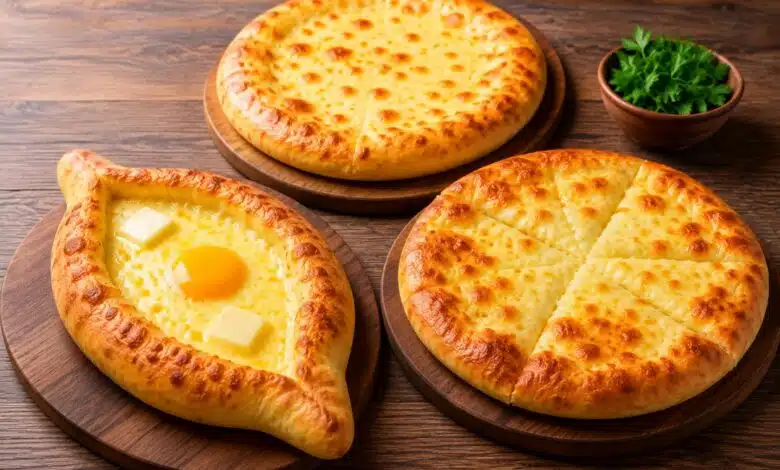
Khachapuri is often translated as Georgian cheese bread, which is accurate in the same way that calling every coat “outerwear” is accurate. It tells you the category and almost nothing about the personality. One version arrives as a round, sealed bread with melted cheese hidden inside. Another is covered with extra cheese. One looks like a boat with a glossy egg in the center. Others are layered, folded, skewered, rolled, baked thin or made with regional cheeses that change the whole mood of the dish.
That variety is why a Georgian menu can feel surprisingly complicated on a first visit. You may know that you want khachapuri, then discover six names, three spellings and no useful description beyond “traditional cheese bread.” The temptation is to order the famous boat-shaped one because it is dramatic and photographs beautifully. Sometimes that is exactly the right choice. Sometimes you really wanted something easier to share, less rich or more bread-like.
This is not a recipe disguised as a glossary. It is a tasting guide for reading real menus, choosing the style that fits your table and understanding why two dishes carrying the same word can feel completely different. I will move from shape to texture, then from the most common regional names to the smaller styles you may meet in Georgian restaurants, bakeries and home kitchens.
Start with the silhouette, not the spelling
When a server sets khachapuri on the table, the shape usually tells you more than the English translation. A round bread is likely designed for slicing and sharing. A boat is more personal, more theatrical and more dependent on timing. A flat layered square or envelope-like pastry often points toward a different regional technique and a crisper or flakier experience.
Think of khachapuri as a family organized by construction. Some members hide the cheese. Some display it. Some use an egg as part of the finishing ritual. Some rely on a thin dough and a broad cheese layer; others feel closer to a substantial bread with a molten center. Once you notice construction, the menu stops looking like a wall of unfamiliar regional names.
For the softest, richest first impression
Choose Adjarian. The open center makes the cheese, butter and egg the main event, and the torn bread edges become the utensil.
For easy sharing
Choose Imeretian or Megrelian. Both can be cut like a pie, passed around and eaten without a mixing ceremony.
The visual method also helps when transliteration changes. You may see Adjaruli, Acharuli or “Adjara-style.” You may see Imeruli instead of Imeretian, and Megruli instead of Megrelian. The spelling shifts, but the silhouette remains reassuringly honest.
What the word khachapuri does—and does not—promise
The name is commonly understood as a combination connected with curd or cheese and bread. In everyday menu language, it signals a Georgian bread-and-cheese tradition rather than one single standardized dish. That distinction matters because a diner who expects the same filling, shape and texture everywhere will be confused quickly.
Regional identity is not decorative branding here. The names usually point toward a recognized local style: Adjara along the Black Sea coast, Imereti in western Georgia, Samegrelo in the west, Guria, Racha, Svaneti and other regions with their own food traditions. Restaurants outside Georgia sometimes simplify those distinctions, adapt cheeses to local availability or use the most familiar name for a close variation. That does not make every adaptation meaningless, but it means the menu description deserves your attention.
Khachapuri also does not automatically mean vegetarian in the strictest sense. Cheese and egg are obvious, but some kitchens brush dough with butter, use cheeses made with animal rennet or offer meat-enriched regional versions nearby. A person with specific dietary rules should ask rather than relying on the category name.
Adjarian khachapuri is dinner with choreography
Adjarian khachapuri—often listed as Adjaruli, Acharuli or Adjara-style—is the one shaped like a boat. The bread edges rise around an open center filled with melted cheese. Near the end of baking, an egg is usually added so the white sets while the yolk remains soft. Butter may be placed on top just before serving.
The drama is functional. You are meant to mix the egg, cheese and butter into a creamy center while the dish is hot, then tear pieces from the bread rim and dip them into the mixture. It is participatory food. Wait too long and the egg firms, the cheese cools and the center loses part of its silky texture.
The size varies enormously. Some restaurants serve a restrained individual boat. Others serve something that looks capable of crossing the Black Sea with passengers. Ask about dimensions before ordering for one. The words “individual” and “small” are more useful than assuming the photograph is to scale.
A good Adjarian khachapuri balances bread and filling. The rim should be substantial enough to tear and dip, but not so heavy that the center feels like sauce trapped inside a bread bowl. The cheese should taste salty and tangy, not merely oily. The egg should enrich rather than drown the cheese.
My practical rule: order Adjarian when you can eat it immediately. It is not the style I choose for a long car ride, a delayed delivery or a buffet where it may sit untouched for twenty minutes.
Imeretian khachapuri is the quiet benchmark
Imeretian khachapuri, often called Imeruli, is a round bread with cheese enclosed inside. It may look less spectacular than the Adjarian boat, but it is one of the clearest ways to understand the relationship between dough and cheese. Cut it into wedges and the filling appears as a soft, savory layer rather than an open pool.
This style is easier to share, easier to transport and usually easier to reheat. It belongs naturally in the middle of a table. The outside can be lightly browned and tender rather than aggressively crisp. Inside, the cheese should be distributed well enough that every wedge receives filling.
Why first-time diners like it
It behaves like a familiar stuffed flatbread or cheese-filled pie while still tasting distinctly Georgian. There is no egg-mixing ritual and no race against cooling butter.
What reveals quality
Even filling, properly seasoned cheese and dough that stays tender without becoming gummy. A thick dry rim with a tiny pocket of cheese in the middle misses the point.
Imeretian khachapuri is also a useful baseline for comparing regional versions. Once you understand the closed round construction, Megrelian becomes easy to recognize as the more extravagant cousin with additional cheese on top. Other variations make sense as changes in dough, folding, shape or filling.
On a mixed Georgian menu, Imeretian is often the safest choice for a table already ordering rich meat dishes, walnut sauces or dumplings. It contributes warm bread and cheese without demanding the entire spotlight.
Megrelian khachapuri turns the cheese volume up
Megrelian khachapuri, usually listed as Megruli, begins with a concept similar to Imeretian: round dough with cheese inside. Then it adds more cheese on the surface before baking. The result is visibly more bronzed, more aromatic and usually richer.
That top layer changes more than appearance. Exposed cheese can brown, blister and develop concentrated savory notes that enclosed filling cannot. The interior remains soft while the surface adds a roasted dairy flavor. It is the style for someone who hears “cheese bread” and thinks the correct amount of cheese is more cheese.
The extra topping can also make mediocre versions feel greasy. Good Megrelian khachapuri should still have structure. The dough should support the filling, the top should brown rather than merely leak oil and the salt level should invite another bite instead of ending the conversation.
If you are comparing only two styles, Imeretian and Megrelian make an excellent side-by-side pair. They share a basic silhouette, so the top cheese becomes the obvious variable. That makes the tasting more instructive than ordering two completely unrelated shapes.
The regional family is much larger than the famous three
Menus outside Georgia often stop after Adjarian, Imeretian and Megrelian because those names are already a lot for newcomers. A deeper Georgian bakery or regional restaurant may offer several more. The exact definitions and execution can vary by kitchen, but the following names are useful to recognize.
Achma deserves special attention because it can surprise diners who expect every khachapuri to be handheld. Its layers create a soft, buttery, almost custard-like cheese structure. Penovani moves in the opposite direction: crisp edges, flaky layers and a bakery-friendly format that travels well.
Khabizgina is useful for anyone who enjoys potato-filled pierogi, varenyky or stuffed breads. It does not taste the same, but the potato-and-cheese combination offers a familiar bridge. Readers exploring filled-dough traditions can also compare the broader logic with our global dumpling atlas, where construction changes flavor as much as filling does.
The cheese is a regional language, not a mozzarella default
Traditional Georgian khachapuri may use regional cheeses such as Imeretian cheese and sulguni, alone or in combination. Outside Georgia, restaurants adapt according to availability. You may encounter blends involving mozzarella, feta, farmer cheese, brined cheese or other local substitutes designed to reproduce stretch, salt and tang.
No single substitute captures everything. Mozzarella stretches beautifully but can taste mild. Feta supplies salt and acidity but does not melt into the same elastic texture. Farmer cheese adds body and freshness. A thoughtful blend tries to create balance rather than imitate appearance alone.
What good cheese should do
It should melt or soften appropriately, retain savory character and remain interesting after the first hot bite. Stretch is delightful, but stretch without flavor is a visual effect.
What to ask on the menu
“Which cheeses do you use?” is a normal question. It helps with salt preference, dietary restrictions and expectations about texture.
The cheese blend also affects reheating. A soft mixed filling may recover gently in the oven, while a heavily mozzarella-based version can become rubbery if overheated. Brined cheeses can release moisture. Exposed cheese on Megrelian khachapuri can brown further before the interior is warm, so lower heat and patience are better than aggressive blasting.
Dough decides whether the dish feels like bread, pastry or supper
People often discuss khachapuri as though cheese alone determines quality. Dough quietly controls the entire experience. A yeasted dough can give chew, volume and a satisfying rim. A thinner dough creates a higher filling-to-bread ratio. Puff pastry makes Penovani flaky and crisp. Layered boiled or softened sheets give Achma its distinctive casserole structure.
The best dough is not universally the thinnest. Adjarian khachapuri needs enough rim to tear and dip. Imeretian needs a shell that holds cheese without becoming leathery. Megrelian needs strength for both interior filling and top cheese. A bakery-style square should be crisp enough to carry but not so brittle that the cheese escapes with the first bite.
Dough also influences portion size. A broad thin khachapuri may look enormous but eat lightly. A smaller layered Achma can be much richer than its footprint suggests. Menu measurements help, but construction tells you how filling the dish will be.
How to eat it without turning the table into a cheese incident
Round khachapuri is straightforward: cut it into wedges and eat it warm. A knife and fork are fine, though a firm wedge can be picked up. Let it rest briefly if the filling is dangerously molten.
Adjarian requires more involvement. Break the egg yolk, butter and cheese together with a fork while the center is hot. Tear a piece from one pointed end or the side rim, dip it into the center and continue around the boat. Some diners remove bread gradually; others mix first and then cut. The essential point is to combine the center before the yolk sets.
No performance required: there is a traditional logic to eating the boat, but dinner is not an audition. Mix it well, keep the filling contained and use utensils when that makes the experience easier.
Achma is usually eaten like a layered baked dish with a fork. Penovani behaves like pastry and may shed flakes, so hold it over the plate. Skewer-based or rolled versions should follow the restaurant’s presentation; staff will often explain how to separate the bread from the skewer safely.
Cheese bread needs contrast more than another starch
Khachapuri is rich, salty and comforting. Pair it with foods that bring acidity, herbs, vegetables or smoke. Georgian salads with tomatoes, cucumbers, herbs and walnuts can cut through the cheese. Pickled vegetables add brightness. Lobio, a seasoned bean dish, contributes earthiness without repeating the dairy profile.
Grilled meats work well, but watch the overall weight of the meal. Khinkali plus khachapuri plus a heavy meat stew can be wonderful for a large table and punishing for two people. If the bread is the focus, choose one other substantial dish and several lighter plates.
For drinks, sparkling water is underrated. Wine can be excellent, especially with a balanced round khachapuri, but a heavily buttery Adjarian may need something crisp rather than powerful. Tea also makes sense in a bakery context.
Readers building a broader meal from local specialty shops may find our prepared-food counter walkthrough useful for portion planning, even though Georgian restaurants and bakeries have their own identity and should not be flattened into one “Eastern European” category.
Takeout changes which style wins
Adjarian khachapuri is at its best in the restaurant. Delivery time allows the egg to set, butter to soak into the center and steam to soften the rim. A kitchen may package the egg or butter separately, but even then the dish loses some immediacy.
Imeretian and Megrelian travel better. Their enclosed construction protects the filling, and wedges reheat evenly in an oven or covered skillet. Penovani also travels well, although it should be reheated in dry heat to recover flakiness.
To reheat a round khachapuri, use moderate heat until the center is warm. Cover loosely at first if the bread seems dry, then uncover briefly to restore the surface. Microwaving is convenient but can make the dough tough and the cheese oily. For Penovani, avoid covering because trapped steam destroys crisp layers.
The mistakes are usually about scale, not pronunciation
Mispronouncing Megruli will not ruin dinner. Ordering three large cheese breads for two people might.
Another mistake is judging authenticity only by cheese pull. A long stretch looks beautiful, but Georgian character depends on the relationship among cheese, dough, salt, fermentation and baking. A subtler filling can be more satisfying than a dramatic bland one.
The first order I would build for a curious table
For two diners, I would choose one medium Imeretian or Megrelian khachapuri, one fresh salad, one vegetable or bean dish and either khinkali or a grilled main. That order shows how khachapuri behaves as part of a meal rather than as an isolated social-media object.
For four diners, add one small Adjarian khachapuri and mix it at the table while hot. Now you can compare the open egg-and-butter center with the sliceable round style. The contrast is immediate and memorable.
Khachapuri becomes easier to understand the moment you stop asking which type is “the real one.” The better question is what kind of bread-and-cheese experience you want tonight: molten and theatrical, balanced and shareable, extra-cheesy and browned, flaky and portable, or layered and deeply comforting.
That is the pleasure of the category. It is specific enough to be unmistakably Georgian and varied enough to reward another order next time.
What separates a memorable khachapuri from a merely heavy one
A good khachapuri should feel generous without feeling careless. Richness is part of the point, but richness still needs proportion. The crust should have enough flavor to stand on its own, the cheese should taste deliberate rather than generic, and the salt should sharpen appetite instead of exhausting it.
Start with aroma. Freshly baked dough should smell warm, fermented and slightly toasted. The cheese may smell milky, tangy or briny depending on the blend. A flat greasy aroma often signals overheated cheese or too much oil separating on the surface.
Good signs
Even browning, a center that stays moist without becoming watery, cheese distributed to the edges and a crust that bends before it tears.
Warning signs
Raw seams, a puddle of separated fat, filling concentrated in one pocket or bread so thick that the cheese becomes an afterthought.
Temperature matters too. Khachapuri often tastes best in the first ten minutes after baking. That does not mean you should burn your mouth. It means the kitchen and the diner share responsibility for timing. Let a round style settle just enough to slice cleanly. Mix an Adjarian center promptly. Eat flaky versions before steam softens the layers.
Quality also appears in restraint. A restaurant does not need to decorate khachapuri with random herbs, sauces or mountains of garnish. The dish should look confident. Cheese, dough, egg and butter already have enough to say.
A restaurant khachapuri and a bakery khachapuri serve different moments
At a Georgian restaurant, khachapuri is part of a larger table. It arrives among salads, herbs, dumplings, grilled meats, beans and sauces. The kitchen can serve it at peak temperature, and staff can explain size and style. This is the best setting for Adjarian khachapuri and for comparing several regional types.
At a bakery, portability matters more. Penovani, folded breads and smaller closed rounds make sense because they can be carried, reheated and eaten without a full table setup. The experience may be less theatrical, but it can be just as revealing. A flaky square with a sharp cheese filling tells you something different about Georgian bread culture than a restaurant boat does.
If you find khachapuri in a specialty market freezer, read the label closely. A frozen round may be raw, par-baked or fully baked. Some products need thawing; others go directly into the oven. The cooking method affects whether the dough rises properly and whether the center warms before the surface burns.
Dietary questions are easier when you ask about components
Khachapuri usually contains wheat, dairy and often egg. Those three facts answer many questions immediately, but not all. Egg may appear only in Adjarian or Gurian styles, while some doughs include egg even when the top does not. Butter may be brushed onto the crust or mixed into the filling. Cheese blends vary by kitchen.
Vegan khachapuri exists as an adaptation, but it is not a simple omission. The cheese is central to structure as well as flavor, and Adjarian also depends on egg and butter. A thoughtful vegan version can be delicious, but it should be understood as a reinterpretation rather than an invisible substitution.
Why regional names deserve more than a footnote
Food writing often reduces khachapuri to one national icon and then rushes toward the most photogenic boat. That shortcut hides the most interesting part: regional variation is the story. The breads reveal differences in dairy traditions, baking methods, household habits, portability and celebration.
Imeretian khachapuri feels domestic and foundational. Megrelian emphasizes abundance through extra cheese. Adjarian has a maritime silhouette and a table ritual. Gurian versions bring festive associations and egg-filled construction. Achma shows how a cheese bread can become layered and almost architectural. Penovani reflects the practical pleasure of pastry that can be carried through a city.
None of those styles needs to defeat the others in a ranking. The useful comparison is situational. Which one belongs at breakfast? Which one travels? Which one anchors a feast? Which one lets a baker show precision? Which one turns a table of strangers into people tearing bread from the same boat?
The most respectful way to order: learn what the regional name is trying to tell you, then enjoy the kitchen’s version without demanding that every restaurant reproduce one imagined universal standard.
If you want to recreate the experience at home, copy the sequence before the recipe
Even without making khachapuri from scratch, you can improve a takeout or frozen version by thinking like the restaurant. Preheat the oven fully. Warm the serving plate. Prepare the salad and drinks before the bread is ready. Keep butter, herbs or extra cheese measured so the khachapuri does not wait while you search the refrigerator.
For Adjarian takeout, ask whether the kitchen can leave the egg slightly less set or pack it separately. At home, reheat the bread gently, then add the finishing ingredients only when you are ready to eat. It will never be identical to tableside service, but timing can rescue much of the texture.
For round khachapuri, slice only after the filling has settled for a minute or two. Use a sharp knife or pizza wheel. Serve on a board or warm platter, and keep acidic vegetables nearby. The goal is not restaurant theater; it is preserving contrast.
Questions and answers
What is the difference between Adjarian, Imeretian and Megrelian khachapuri?
Adjarian khachapuri is an open boat filled with cheese and usually finished with egg and butter. Imeretian is a round sealed bread with cheese inside. Megrelian is also round and cheese-filled, but adds more cheese on top before baking.
Which khachapuri is best for a first-time order?
Imeretian is the clearest baseline because it is easy to share and lets you taste the balance of dough and cheese. Choose Adjarian first when the egg-and-butter ritual is the main reason you came.
Is khachapuri always vegetarian?
Many cheese-only versions contain no meat, but they may include egg, butter and cheeses made with animal rennet. Regional or restaurant variations can also add meat. Ask the kitchen when the distinction matters.
How do you eat Adjarian khachapuri?
Mix the soft egg, butter and melted cheese in the center while the bread is hot. Tear pieces from the raised rim and dip them into the creamy filling. A fork helps with mixing and containing the center.
What cheese is traditionally used in khachapuri?
Georgian versions commonly use regional cheeses such as Imeretian cheese and sulguni. Restaurants outside Georgia often create blends with locally available brined, fresh and melting cheeses to reproduce salt, tang and stretch.
Is Megrelian khachapuri richer than Imeretian?
Usually, yes. It contains cheese inside and additional cheese on top, creating more browning, saltiness and dairy intensity.
Which type of khachapuri travels best for takeout?
Imeretian, Megrelian and flaky Penovani generally travel better than Adjarian. The Adjarian egg center is sensitive to time and is best mixed and eaten immediately.
What is Achma?
Achma is a layered Georgian khachapuri style made with sheets of dough and cheese. Its texture is closer to a soft, rich layered bake than to a round stuffed bread.
How much khachapuri should I order for a group?
Portion size varies widely, so ask the restaurant. For four people eating several Georgian dishes, one shareable round khachapuri plus one smaller Adjarian for tasting is often enough. A table centered mainly on bread may want more.
Can khachapuri be reheated?
Round and flaky styles can be reheated gently in an oven or skillet. Adjarian does not recover as well because the egg, butter and open cheese center continue to set and separate as they cool.


