
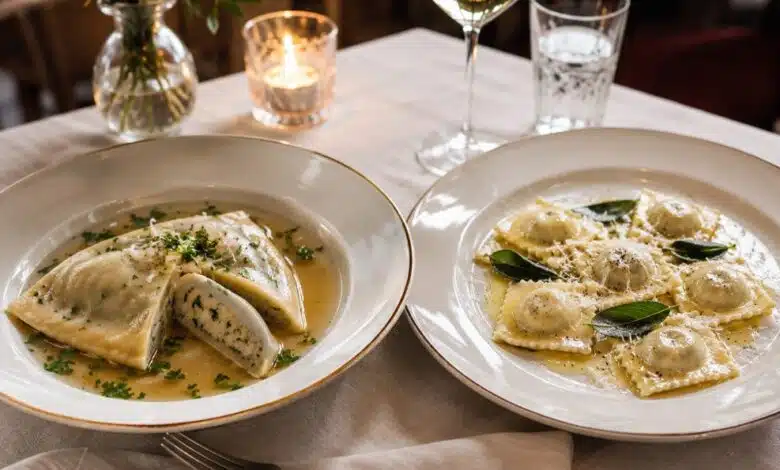
Vesti Food Comparisons · Swabian and Italian filled pasta
Maultaschen and ravioli both place a filling inside pasta dough, but that shared idea does not make them the same dish. They differ in regional identity, customary scale, construction, filling logic, and the ways they are usually brought to the table.
The clearest distinction is not simply “large versus small.” A proper comparison looks at the whole eating system: how the pasta is formed, what the filling is designed to do, whether the dish is served in broth or sauce, and whether it is expected to remain whole, be sliced, or return to the frying pan.
The central difference
Maultaschen are a Swabian filled pasta tradition, commonly made as substantial square or rectangular pockets and served in broth, boiled and plated, or sliced and pan-fried. Ravioli are an Italian family of filled pastas with many regional shapes, fillings, sizes and sauce traditions.
“German ravioli” is useful as a first visual explanation, but it is not a complete definition. It tells a new diner that Maultaschen contain filling inside pasta dough; it does not explain their Swabian identity or their characteristic serving paths.
Are Maultaschen just German ravioli?
No. They are comparable because both are filled pasta, but “German ravioli” works only as a bridge for someone who has never encountered Maultaschen. It should not replace the actual name or suggest that the Swabian dish is merely a copy of an Italian one.
The comparison breaks down in several places. Maultaschen are often much larger than the ravioli most diners expect. Their fillings frequently combine meat, spinach or other greens, bread, onion and herbs. They may be served whole in broth, placed beside potato salad or onions, or sliced and browned in a pan. Ravioli, meanwhile, belong to a wide Italian family whose fillings and shapes change dramatically from one region and preparation to another.
The phrase also creates the wrong expectation at restaurants. Someone hearing “German ravioli” may expect a small pasta course covered in tomato or cream sauce. A plate of sliced Maultaschen browned with onions—or a bowl containing a few large pockets in clear broth—follows a different logic.
Names, origin and protected identity
Maultasche and Maultaschen
Maultasche is singular. Maultaschen is plural. On English-language menus, the plural is commonly used even when a portion contains only a few large pieces.
Raviolo and ravioli
Raviolo is singular in Italian; ravioli is plural. English menus nearly always use “ravioli” for the dish.
Maultaschen are associated with Swabia, especially Baden-Württemberg and the Swabian area of Bavaria. The names Schwäbische Maultaschen and Schwäbische Suppenmaultaschen are registered in the European Union as a Protected Geographical Indication. That protection applies to a defined geographical product specification, not automatically to every filled pasta pocket sold anywhere under the general word “Maultaschen.”
Ravioli are not one single standardized Italian recipe. They appear across regional cuisines with different doughs, fillings, sizes and names. Cheese-and-spinach ravioli may be the most familiar international model, but it is only one branch of a much larger tradition that also includes meat, pumpkin, seafood, herbs, vegetables and local cheeses.
Shape and size: the visual difference is real, but not absolute
It is safe to say that Maultaschen are commonly larger than standard restaurant ravioli, but not that every raviolo is small. Large ravioli exist, including oversized single-piece presentations. Shape alone is therefore not sufficient for identification.
The more reliable clues are the combination of size, menu language, filling and service. A large rectangular filled pasta in clear broth on a Swabian menu strongly points to Maultaschen. A large round pasta filled with egg yolk or ricotta and served with butter can still be ravioli.
Dough and wrapper: strength, tenderness and purpose
Both dishes rely on pasta dough strong enough to contain a filling, but the wrapper is designed around different common uses.
Maultaschen wrapper
Often needs enough structure to hold a generous filling, survive simmering, sit in broth and sometimes endure a second cooking step after being sliced. The wrapper may therefore feel more substantial, especially around folded edges.
Ravioli wrapper
Often aims for delicacy while still sealing securely. The ideal thickness depends on the filling and sauce; a rich or liquid center may require different construction from a dry cheese filling.
A thicker wrapper is not automatically inferior, and a thinner one is not automatically more refined. The correct question is whether the pasta supports the intended dish. Maultaschen dough that remains gummy at the seam is undercooked or too dense. Ravioli that burst in the pot may be too thin, poorly sealed or overfilled.
In both cases, quality means a cooked-through wrapper with no raw flour line, no hard leathery corners, and no seam failure. The pasta should be noticeable but should not erase the filling.

Filling comparison: neither dish has one universal formula
What may be inside Maultaschen
A traditional meat-filled Maultasche may contain pork, beef, veal, sausage meat or a mixture, combined with spinach, bread, egg, onion, parsley and spices. Some versions contain bacon; others do not. The bread functions as a binder and texture component when balanced correctly.
Vegetarian versions may use spinach and cheese, mushrooms, lentils, vegetables or plant-based meat alternatives. Their presence is not a modern contradiction of the dish; producers and restaurants often offer several filling styles.
What may be inside ravioli
Ravioli fillings span a wide range: ricotta and spinach, meat, pumpkin, squash, mushrooms, seafood, potato, local cheeses, herbs and regional combinations. Even the familiar ricotta-and-spinach model can vary in texture, seasoning and cheese blend.
It is misleading to compare “meat Maultaschen” with “cheese ravioli” as though each represented the only version of its category. A stronger comparison focuses on structural tendencies: Maultaschen fillings are often cohesive and substantial enough for a large pocket, while ravioli fillings are adapted to many shapes and sauce pairings.
The cut-open test: how each filling should behave
For both dishes, the cut-open view is more informative than a polished exterior photo. It exposes whether the seam is fully cooked, whether the filling reaches the edges, and whether the center has dried out or separated.
Cooking methods: where the traditions separate most clearly
Maultaschen
- Simmered in water or broth
- Served whole or halved in clear broth
- Boiled and plated with butter, onions or sides
- Sliced after cooking and pan-fried
- Sometimes fried with onions and egg
Ravioli
- Usually boiled gently
- Finished in butter, sauce or broth
- Served whole as a pasta course
- Sometimes baked or fried in specialized preparations
- Usually not sliced and refried as a standard next step
Sliced pan-fried Maultaschen are not simply leftovers treated randomly. They are a recognizable serving path. Cooked pockets are cut into pieces, browned, and often paired with onions or egg. The goal is crisped surfaces with a moist center.
Fried ravioli usually means something else: whole filled pasta that may be breaded or toasted and served crisp. That style emphasizes an intact crunchy exterior, not sliced cross-sections browned in a pan.

Broth, sauce and frying: how the plate changes the identity
Maultaschen in broth
Clear broth is one of the most recognizable Maultaschen presentations. The wrapper must remain intact, the center must heat through, and the broth should support rather than drown the filling. Chives, parsley or onion may provide a restrained finish.
Ravioli in broth
Italian filled pastas can also be served in broth. Tortellini, cappelletti, anolini and some ravioli traditions demonstrate that broth does not belong exclusively to Maultaschen. The presence of broth therefore narrows the possibilities but does not settle the identity by itself.
Ravioli with sauce
Ravioli are commonly paired with butter, sage, tomato, meat sauces, cream-based sauces or preparations tailored to the filling. No single sauce defines all ravioli. Delicate fillings may need a restrained finish, while robust meat fillings can support stronger accompaniments.
Maultaschen without Italian-style sauce
Maultaschen do not require tomato or cream sauce to feel complete. Broth, butter, browned onions, potato salad and pan-frying are more useful cultural signals. A restaurant can serve a modern sauced version, but sauce is not the defining default.
Packaged Maultaschen and packaged ravioli
Retail format can create a misleading sense that the products are interchangeable. Both may appear refrigerated or frozen in sealed trays or bags, but their cooking instructions and intended uses may differ.
Follow the package rather than applying one product’s method to the other. Large frozen Maultaschen can split if boiled violently. Delicate fresh ravioli can overcook quickly and release their filling.
Allergens and dietary differences
Both dishes usually contain wheat and may contain egg. Beyond that, assumptions become risky.
- Maultaschen: may contain pork, beef, veal, sausage, bacon, breadcrumbs, dairy, egg, celery, mustard, soy or meat broth.
- Ravioli: may contain ricotta or other cheeses, egg, meat, seafood, nuts, pumpkin, spinach, breadcrumbs or sauces with dairy.
- Vegetarian: does not automatically mean vegan. Dough, filling, butter, cheese or broth may contain animal products.
- Pork-free: cannot be assumed from a beef-forward description because sausage or bacon may still be present.
- Gluten-free: requires explicit confirmation; ordinary pasta dough contains wheat.
Shared equipment matters as well. A restaurant may prepare vegetarian ravioli beside meat-filled pasta, or cook vegetarian Maultaschen in meat broth. Ask about the complete plate rather than only the filling.
Common identification mistakes
Calling every large raviolo a Maultasche
Large size is a clue, not proof. Origin, filling and service still matter.
Calling every Maultasche German ravioli
The shorthand hides the dish’s Swabian identity and serving traditions.
Assuming all Maultaschen contain pork
Meat mixtures vary, and vegetarian versions are widely available.
Assuming all ravioli contain cheese
Meat, pumpkin, seafood, vegetables and many other fillings exist.
Using broth as the only test
Italian filled pastas can also be served in broth.
Trusting stock photos
A generic pasta image may not show the product described on the menu or package.
Which should you choose?
Choose Maultaschen for a hearty broth meal
The large pockets and savory filling can turn a clear broth into a complete lunch or dinner.
Choose Maultaschen for browned sliced edges
Pan-fried slices with onions offer a texture that ordinary boiled ravioli do not usually pursue.
Choose ravioli for a sauce-led pasta course
Ravioli give you a broader range of filling-and-sauce combinations shaped by Italian regional cooking.
Choose either for vegetarian options
Both categories offer meat-free fillings, but verify egg, dairy, broth and cooking fat.
Choose packaged Maultaschen for flexible German-deli cooking
A refrigerated or frozen pack can move from broth to a pan-fried meal depending on the label directions.
Choose fresh ravioli when the filling is the star
A good pasta shop may offer seasonal cheese, vegetable, meat or seafood centers designed around a specific sauce.
Maultaschen vs ravioli: final comparison
- Shared category: both are filled pasta.
- Regional identity: Maultaschen are Swabian; ravioli form a broad Italian family.
- Scale: Maultaschen are commonly substantial, while ravioli range widely.
- Shape: Maultaschen are often square or rectangular; ravioli take many forms.
- Filling: Maultaschen often combine meat, greens, bread and seasonings; ravioli fillings vary extensively.
- Serving: Maultaschen are strongly associated with broth, onions and sliced pan-frying; ravioli are frequently finished with sauce or butter.
- Best conclusion: they are related by technique, not interchangeable by name.
Continue exploring filled dough traditions
Are Maultaschen the same as ravioli?
No. Both are filled pasta, but Maultaschen are a Swabian dish with their own typical scale, fillings and serving styles. Ravioli are a broad family of Italian filled pastas.
Why are Maultaschen called German ravioli?
The phrase gives first-time diners a quick visual reference because both foods contain filling inside pasta dough. It is only shorthand and does not fully describe Maultaschen’s Swabian identity or broth and pan-fried traditions.
What is the main difference between Maultaschen and ravioli?
Maultaschen are commonly large square or rectangular Swabian pockets often served in broth or sliced and fried. Ravioli vary widely across Italy and are frequently served as a pasta course with butter or sauce.
Are Maultaschen larger than ravioli?
Maultaschen are often larger than standard ravioli, but large ravioli also exist. Size should be considered together with shape, filling, origin and serving method.
What is inside traditional Maultaschen?
Fillings vary and may include pork, beef, veal, sausage meat, spinach, bread, egg, onion, parsley and spices. Vegetarian fillings are also available.
What fillings are used in ravioli?
Ravioli may contain ricotta and spinach, meat, pumpkin, mushrooms, seafood, vegetables, herbs or regional cheeses. There is no single universal ravioli filling.
Can Maultaschen and ravioli both be served in broth?
Yes. Broth is a particularly recognizable Maultaschen service, but Italian filled pastas can also appear in broth. Shape, filling and regional context still distinguish them.
Are Maultaschen usually fried?
They may be served in broth, boiled and plated, or sliced and pan-fried. Fried Maultaschen are a common serving path, but not the only one.
Are vegetarian Maultaschen and ravioli available?
Yes. Both can have vegetarian fillings. Check the dough, cheese, butter and broth because vegetarian does not automatically mean vegan.
Which is better for freezing, Maultaschen or ravioli?
Both can freeze well when produced and packaged correctly. Quality depends on wrapper strength, filling moisture, package integrity and following the manufacturer’s cooking directions.


