
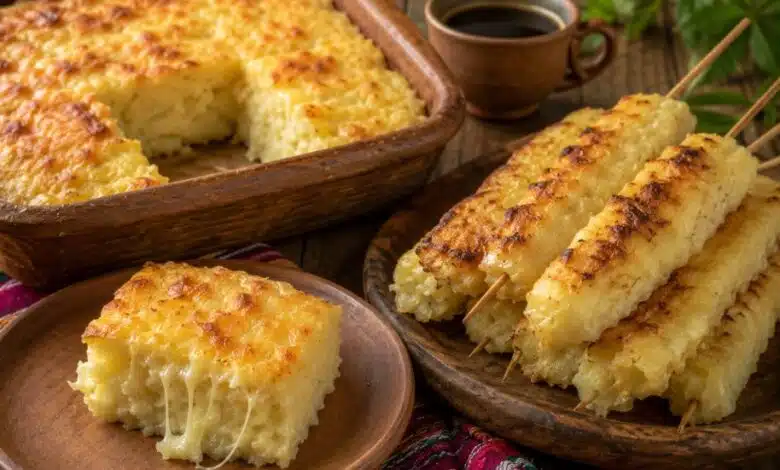
Sonso de yuca is a warm Bolivian dish made by combining tender cooked yuca with cheese before baking, browning in a skillet or grilling around a wooden stick. The outside can become golden and lightly crisp, while the center stays soft, dense and filled with melted cheese.
The dish is closely connected with Santa Cruz and the eastern lowlands of Bolivia, where it is commonly enjoyed for breakfast, as an afternoon snack or alongside coffee. Some families prepare it in a baking dish and cut it into squares. Others shape the mixture into thick portions or press it around wooden sticks to make sonso al palo.
This recipe begins with a baked version because it is the easiest method for a first attempt. The same mixture can then be adapted for skillet sonso or sonso al palo without preparing a separate dough.
Traditional Sonso de Yuca Recipe
This recipe makes a baked sonso with a soft cassava-and-cheese center and a golden top. After preparing the mixture, you can also shape part of it for a skillet or grill it on wooden sticks.
Ingredients
- 2 pounds / 900 grams peeled yuca, fresh or frozen
- 10 ounces / 285 grams queso fresco, crumbled or coarsely grated
- 4 ounces / 115 grams low-moisture mozzarella, grated
- 3 tablespoons / 42 grams unsalted butter, softened
- ¼ cup / 60 milliliters whole milk, plus more only if needed
- ½ teaspoon fine salt, adjusted to the saltiness of the cheese
- 1 tablespoon butter or neutral oil for greasing the baking dish
- 2 ounces / 55 grams additional cheese for the top, optional
Step-by-step instructions
- Prepare the fresh yuca. Cut off both ends of each root and divide it crosswise into sections about 3 to 4 inches long. Stand each section upright on a stable cutting board and carefully remove the thick brown skin together with the pale layer underneath. If you are using frozen peeled yuca, keep it frozen until you are ready to cook it.
- Place the yuca in a large pot. Add enough cold water to cover the pieces by at least 1 inch. Season the water lightly with salt. Using enough water helps the yuca cook evenly and prevents exposed pieces from drying out.
- Cook until completely tender. Bring the water to a boil, then reduce it to a steady simmer. Cook fresh or frozen yuca until the pieces begin to split and a fork slides easily through the thickest section. This usually takes about 25 to 40 minutes, depending on the size and age of the root.
- Check every piece before draining. Do not rely only on the cooking time. The yuca is ready when there is no firm or chalky center. Any piece that still resists the fork should remain in the pot for several more minutes.
- Drain the yuca thoroughly. Transfer the cooked pieces to a colander and leave them for several minutes so excess water and steam can escape. Watery yuca can make the final mixture too loose.
- Remove the central fibers. Split each warm piece lengthwise. Pull out the firm, string-like core running through the center. Some pieces may contain one thick strip, while others may have several smaller fibers.
- Mash while the yuca is still warm. Place the yuca in a large bowl and mash it with a potato masher or sturdy fork. Break up all firm pieces, but do not use a blender or high-speed food processor because overworking the starch can make the mixture gluey.
- Add the butter. Mix the softened butter into the warm mashed yuca. The heat will help it melt and spread evenly through the mixture.
- Add both cheeses. Fold in the crumbled queso fresco and grated mozzarella. Continue mixing until the cheese is distributed throughout the yuca rather than sitting only on the surface.
- Season carefully. Add the salt and taste only after the yuca has been fully cooked and mixed with the cheese. Some cheeses are already salty, so the mixture may need less salt than expected.
- Adjust the consistency. Add the milk one tablespoon at a time. Mix after each addition. The sonso should be soft enough to press into a dish but firm enough to hold a mound on a spoon. Stop adding milk as soon as that texture is reached.
- Heat the oven. Preheat the oven to 400°F / 205°C. Grease an 8-inch square baking dish or another shallow dish of similar capacity.
- Fill the baking dish. Spoon the mixture into the prepared dish. Spread it evenly to a depth of about 1½ to 2 inches. Press lightly, but do not compact it so firmly that the finished sonso becomes heavy.
- Add the optional cheese topping. Sprinkle a thin layer of additional cheese over the surface. Keep the layer light so the top browns without becoming greasy.
- Bake until hot and golden. Bake for 22 to 30 minutes. The edges should begin to brown, the top should look lightly toasted and the center should be completely hot.
- Brown the surface if needed. If the sonso is hot but still pale, place it briefly under the broiler. Watch it continuously because the exposed cheese can darken quickly.
- Rest before cutting. Remove the dish from the oven and let it stand for 8 to 10 minutes. This short rest allows the soft center to settle while keeping the cheese warm.
- Serve warm. Cut the sonso into squares or spoon it directly from the baking dish. Serve it while the center remains soft and the browned surface is still fresh.
What you need to make good sonso
The ingredient list is short, so the quality and moisture of the yuca and cheese matter more than adding extra seasonings.
Yuca
Yuca is also known as cassava or manioc. Once fully cooked, it becomes tender enough to mash but remains denser and slightly more elastic than a potato.
Do not replace it with tapioca starch or cassava flour. Those ingredients are useful for breads such as cuñapé, but they do not create the same texture as cooked yuca.
Butter
Butter softens the mixture and keeps the baked sonso from tasting dry. It also adds richness without overwhelming the mild flavor of the cassava.
Milk
Milk should be treated as an adjustment rather than a fixed amount. Some yuca is naturally moist, while other batches become dry after draining. Add only what the mixture needs.
Fresh yuca or frozen yuca?
Both can make excellent sonso. Frozen peeled yuca is often easier for a first attempt because it eliminates the peeling step and is usually cut into manageable pieces.
| Type | Advantages | What to watch |
|---|---|---|
| Fresh yuca | Firm texture and easy to inspect before cooking | Requires careful peeling and may contain thick fibers |
| Frozen peeled yuca | Convenient and ready for the pot | Some brands cook softer and absorb more water |
| Pre-cooked yuca | Saves preparation time | May contain added salt, oil or excess moisture |
| Canned yuca | Easy to find and already cooked | Often too wet or soft for the best sonso texture |
Which cheese works best?
A combination of queso fresco and low-moisture mozzarella works well when Bolivian cheese is unavailable. Queso fresco provides a mild, fresh dairy flavor, while mozzarella melts and helps hold the mixture together.
| Cheese | Result | How to use it |
|---|---|---|
| Queso fresco | Mild, crumbly and fresh | Use as the main flavor cheese |
| Low-moisture mozzarella | Soft melting and good binding | Combine with queso fresco |
| Farmer’s cheese | Firm and slightly tangy | Use instead of queso fresco |
| Monterey Jack | Mild and smoothly melting | Use instead of mozzarella |
| Cotija | Salty and dry | Use only in a small amount |
| Feta | Tangy and noticeably salty | Mix with a mild melting cheese |
Avoid using only wet fresh mozzarella because it may release too much liquid. Very aged cheese can also make the sonso oily or excessively salty.
How to prepare yuca without leaving hard fibers
The most important part of the recipe happens before the cheese is added. The yuca must be completely tender and free from its central core.
Peel beyond the brown skin
Fresh yuca has a dark outer skin and a pale layer beneath it. Remove both until only the clean white flesh remains.
Cook every piece until tender
Some pieces may soften faster than others. Check the thickest section with a fork. If the center still looks chalky or feels firm, continue cooking.
Remove the core after boiling
The woody center is often easier to see after the cooked yuca begins to split. Pull it out before mashing so it does not remain as hard strings in the finished dish.
Let steam escape
Leave the drained yuca in the colander for a few minutes. This prevents excess cooking water from thinning the mixture.
How the sonso mixture should feel
The correct mixture is soft, slightly sticky and easy to press together. It should not resemble a liquid casserole filling, but it should not crack apart like dry mashed potatoes.
- It should hold a mound on a spoon.
- It should press into the baking dish without falling apart.
- No liquid should collect at the bottom of the bowl.
- Small streaks of cheese may remain visible.
- The yuca should feel tender rather than grainy or fibrous.
How to make baked sonso de yuca
Best for beginners and family-style serving
Spread the prepared mixture in a greased baking dish and keep the layer approximately 1½ to 2 inches deep. A thinner layer develops more browned surface, while a deeper layer remains softer inside.
Bake uncovered at 400°F / 205°C until the center is hot and the edges are golden. Leaving the dish uncovered allows steam to escape and helps the top brown.
Let the sonso rest briefly before cutting. The cheese will still be soft, but the squares will hold their shape more cleanly.
How to make sonso in a skillet
Best for smaller portions with browned edges
- Allow the prepared mixture to cool until it can be handled comfortably.
- Divide it into 6 to 8 equal portions.
- Shape each portion into a thick oval or round patty.
- Heat a lightly greased skillet over medium-low heat.
- Add the portions without crowding the pan.
- Cook until the first side develops a golden crust.
- Turn carefully with a wide spatula.
- Brown the second side and serve while hot.
If the portions break, chill the mixture for 15 to 20 minutes before shaping. Avoid making them too thin because thick pieces preserve the soft interior.
How to make sonso al palo
Best for grilling and a more traditional presentation
- Prepare the mixture with less milk so it remains firm.
- Let it cool until it can be shaped without sticking excessively.
- Divide the mixture into portions of about 4 to 5 ounces each.
- Press one portion firmly around the upper part of a wooden stick.
- Shape it into an even cylinder without making it excessively thick.
- Place it over moderate heat rather than direct flames.
- Rotate the stick slowly as the surface begins to set.
- Continue grilling until all sides show golden toasted patches.
- Serve immediately while the center remains warm and cheesy.
Starting over gentle heat helps the exterior firm up before the cheese becomes too soft. Sudden turning or very high heat can cause the mixture to slide from the stick.
Common sonso problems and simple fixes
| Problem | Likely cause | What to do |
|---|---|---|
| Dry mixture | Yuca or cheese is low in moisture | Add warm milk one tablespoon at a time |
| Loose mixture | Too much milk or wet cheese | Add more mashed yuca or low-moisture cheese |
| Gluey texture | Yuca was blended or overworked | Mash by hand and mix only until combined |
| Hard strings | Central fibers were not removed | Remove the core from every cooked piece |
| Patties break | Mixture is too warm or soft | Chill briefly before shaping |
| Top stays pale | Surface contains too much moisture | Bake uncovered and broil briefly |
| Cheese becomes oily | Too much aged or high-fat cheese | Use more queso fresco and less aged cheese |
| Bland flavor | Cheese is mild or mixture lacks salt | Add a small amount of salt or sharper cheese |
How to serve sonso de yuca
Sonso is best served warm, when the cheese is soft and the toasted exterior still contrasts with the center.
For breakfast
Serve one warm square or grilled skewer with coffee, tea or hot chocolate.
As a snack
Offer a smaller portion on its own or beside fresh fruit.
As a side dish
Pair it with grilled meat, roast chicken or vegetables.
For a Bolivian table
Serve it with salteñas, cuñapé, humintas and a fresh tomato-and-onion salad.
A fresh salad with tomato, onion, herbs and citrus balances the richness of the cheese. Sonso can also replace potatoes, rice or bread beside a larger meal.
How to store and reheat sonso
Refrigerating
Allow leftovers to cool briefly, transfer them to a covered container and refrigerate promptly. For the best quality, eat refrigerated sonso within three to four days.
Reheating in the oven
Place the portion in a small baking dish and heat at 350°F / 175°C until hot through the center. Leave it uncovered for the final few minutes to refresh the surface.
Reheating in a skillet
Warm a small amount of butter or oil over medium-low heat. Brown the sonso gently on both sides, turning it carefully with a wide spatula.
Reheating in a microwave
The microwave keeps the center soft but does not restore a browned exterior. Heat in short intervals so the edges do not become tough.
Can sonso de yuca be frozen?
Yes. You can freeze the prepared mixture before baking or freeze individual baked portions.
Before baking
Press the mixture into a freezer-safe container or shape it into portions. Cover tightly and thaw overnight in the refrigerator before cooking.
After baking
Cool the sonso completely, cut it into portions and separate the pieces with parchment before placing them in a freezer-safe container.
Use frozen sonso within two to three months for the best flavor and texture.
Is sonso vegetarian or gluten-free?
Vegetarian
This recipe contains no meat and may be suitable for many vegetarians. Check the cheese label if animal-derived enzymes are a concern.
Gluten-free
Yuca naturally contains no gluten, and this recipe does not require wheat flour. Use packaged ingredients labeled gluten-free when cross-contact matters.
Egg-free
This version contains no eggs. Some family recipes use eggs as an additional binder, but they are not necessary here.
Vegan and dairy-free
Traditional sonso is not vegan or dairy-free because cheese is one of its defining ingredients. Butter and milk may also be included.
Frequently asked cooking questions
Can I make sonso with cassava flour?
No direct substitution will give the same result. Sonso depends on the texture of cooked yuca, while cassava flour and tapioca starch behave more like baking ingredients.
Can I use leftover boiled yuca?
Yes. Warm it slightly before mashing so it combines more easily with the butter and cheese. Add milk only if the mixture feels dry.
Can I prepare the mixture a day ahead?
Yes. Cover and refrigerate it. Let it soften slightly before spreading it in the baking dish or shaping it around sticks.
Does sonso need a sauce?
No. Properly prepared sonso is moist and flavorful enough to eat without sauce. A fresh salsa or tomato-and-onion salad can add contrast.
Can I add herbs or spices?
You can add a small amount of black pepper, green onion or mild chile, but the yuca and cheese should remain the main flavors.
Start with the baked version, then try the grill
Baked sonso is the easiest version to master because the mixture can set inside the dish without being turned or shaped around a stick. Once you understand the correct consistency, use the same base for skillet portions or sonso al palo.
The best results come from fully tender yuca, carefully removed fibers, enough cheese to flavor and bind the mixture, and only as much milk as the yuca actually needs.
To look for restaurants, bakeries and Bolivian kitchens that may prepare the dish, return to our guide to the sonso de yuca near me.
What is sonso de yuca made from?
Sonso de yuca is mainly made from fully cooked yuca and cheese. Butter, milk, salt and sometimes eggs may also be included depending on the recipe.
Can I use frozen yuca to make sonso?
Yes. Frozen peeled yuca works well. Boil it until completely tender, remove any central fibers and drain it thoroughly before mashing.
What cheese should I use for sonso de yuca?
A combination of queso fresco and low-moisture mozzarella works well. Farmer’s cheese or Monterey Jack can also be used.
Can sonso de yuca be baked?
Yes. Baked sonso is one of the easiest versions to make at home. Spread the mixture in a greased dish and bake until hot and golden.
How do I keep sonso al palo from falling off the stick?
Use a firm mixture, allow it to cool before shaping, press it tightly around the stick and begin grilling over moderate heat.
Why is my sonso mixture too wet?
The yuca may not have drained fully, the cheese may be moist or too much milk may have been added. Add more mashed yuca or low-moisture cheese.
Can I make sonso without eggs?
Yes. Eggs are not required. Warm mashed yuca, cheese and controlled moisture are enough to create a mixture that holds together.
Is sonso de yuca gluten-free?
A simple sonso recipe can be gluten-free because yuca contains no gluten and wheat flour is not required. Check packaged ingredients when cross-contact matters.
How long does cooked sonso last in the refrigerator?
Cooked sonso should be refrigerated promptly and is best eaten within three to four days.
Can sonso de yuca be frozen?
Yes. The uncooked mixture or baked portions can be frozen for approximately two to three months for the best quality.


