
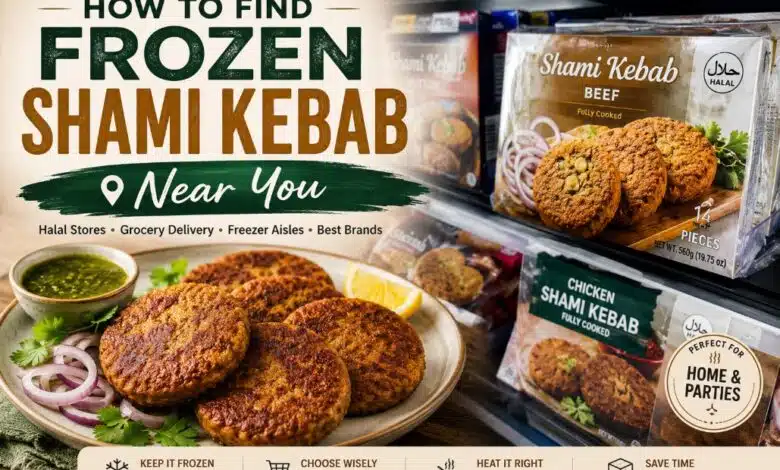
Frozen shami kebab is often the most realistic way to enjoy the dish when no nearby restaurant keeps it on a permanent menu. A good frozen pack can solve several practical problems at once: it can be stored for later, cooked in small portions, used for breakfast or lunch, turned into bun kebab, and kept on hand for guests without depending on restaurant hours.
The difficulty is that a search for frozen shami kebab can lead to very different products. Some patties are fully cooked and only need reheating. Others are raw and require complete cooking. Some use beef, chicken or mutton; others use a mixed formula that is not obvious from the front of the package. A product title may say “halal,” while the current package, seller or certification details tell a more complicated story. Marketplace listings can also show an item that is not actually stocked by a store near your ZIP code.
This guide explains how to search grocery stores, halal markets, South Asian supermarkets, delivery marketplaces and prepared-food counters without treating every listing as equally reliable. It also covers package reading, freezer transport, serving size, cooking state, reheating, texture, storage and the questions worth asking before buying a large pack.
Why frozen shami kebab deserves its own guide
Finding a restaurant and buying a frozen pack are different tasks. Restaurant searches depend on menus and daily availability. Frozen-food searches depend on store inventory, package condition, product labeling, seller accuracy and correct handling after purchase. This page focuses on those grocery-specific decisions while the main Kebabs Shami Near Me guide covers the broader restaurant, market and delivery search.
Where frozen shami kebab is usually sold
Frozen shami kebab is most often found through businesses that already serve South Asian communities rather than through ordinary general-food searches. A store can have a strong freezer section without maintaining a detailed product page, while a delivery marketplace can display a product without making it clear which local retailer supplies it. That is why the search should begin with business type, not only with the exact product phrase.
Pakistani grocery stores
These are among the strongest places to check because shami kebab is familiar to the customer base and may be stocked in several meat options or pack sizes.
Bangladeshi markets
Frozen patties, prepared snacks and house-made batches may appear even when the store’s website does not list them individually.
Large South Asian supermarkets
Bigger stores may carry multiple brands, compareable pack sizes and separate beef or chicken versions.
Halal markets
These can be useful, but “halal market” is broad. Some focus on Middle Eastern foods and may not carry South Asian frozen patties.
International supermarkets
A well-developed regional freezer aisle can contain shami kebab even when the store is not specifically Pakistani or Bangladeshi.
Prepared-food counters
Some stores sell frozen house-made patties, refrigerated cooked patties or trays prepared for local customers rather than national distribution.
The freezer aisle and the prepared-food counter should be treated as separate searches. A store employee may say that the freezer carries packaged beef shami throughout the week while the counter sells a fresh chicken version only on weekends. Looking in one area does not rule out the other.
A search method that works better than typing one phrase once
Product discovery improves when the search is repeated with several spellings and purchase formats. “Frozen shami kebab near me” is useful, but many stores and sellers use shami kabab, shammi kabab, beef shami, chicken shami or simply frozen kabab. The safest method is to search broadly enough to find leads, then verify the exact product.
| Search phrase | What it is good for | What to watch for |
|---|---|---|
| frozen shami kebab near me | General local discovery | Marketplace pages may not reflect current local stock |
| frozen shami kabab near me | South Asian menu and product spelling | May still return restaurants rather than grocery packs |
| Pakistani grocery + city | Finding stores with the right regional inventory | The store may not publish freezer stock online |
| beef shami kebab frozen | Filtering by meat | Product titles can omit pack size or cooking state |
| chicken shami kabab delivery | Delivery-first shopping | The seller, fee and cold-chain timing depend on ZIP code |
| halal frozen shami kebab | Locating halal-labeled products | Verify the current package and certifying information |
| shami kebab freezer pack | Finding larger household packs | Check whether patties are individually separated |
Store-specific searching is often more productive than generic searching. Once a promising market appears, search its name together with “shami,” “kabab,” “frozen snacks” and “prepared food.” Then call if the website gives no reliable answer. A two-minute call can confirm meat, pack size and stock before a long drive.
Which store type gives you the best chance?
The best store depends on what matters most. A large supermarket may offer choice and visible package information. A neighborhood market may have a fresher house-made product. A delivery marketplace may save time but provide less certainty about freezer condition and seller substitution.
| Store type | Main advantage | Main limitation | Best for |
|---|---|---|---|
| Pakistani supermarket | Strong product relevance and brand variety | May be far from your neighborhood | Comparing beef, chicken and pack sizes |
| Neighborhood South Asian market | Staff may know local preferences and house-made options | Inventory may change without online updates | Personal recommendations and small purchases |
| International chain supermarket | Broader opening hours and organized freezer aisles | Regional selection may be limited | Convenience and label comparison |
| Halal butcher-market combination | Meat transparency and possible local production | May focus on raw meat rather than prepared foods | Asking about house-made or special-order patties |
| Restaurant or caterer selling frozen packs | Recipe may be closer to fresh restaurant shami | Advance ordering and pickup rules may apply | Larger batches and specialty recipes |
| Delivery marketplace | Fast comparison across several local stores | Stock, seller and substitutions can be unclear | Convenience and ZIP-code searching |
The most efficient approach is often to use a marketplace for discovery, then inspect the supplying store or product page directly. This gives you a better chance of confirming the actual retailer, package image and ingredient details before checkout.
What grocery delivery marketplaces can and cannot confirm
Grocery delivery services are useful because they can search multiple stores at once. They are less useful when a reader assumes that a product page represents stable inventory everywhere. A listing may be active nationally while unavailable in your ZIP code. The same product can also be supplied by different retailers, each with its own price, storage history and delivery window.
Product availability without a ZIP code is often only theoretical.
The same listing can lead to different local retailers or no retailer at all.
Old images and updated product names do not always match perfectly.
A shopper may replace shami kebab with another frozen kebab product unless substitutions are restricted.
Frozen food should not spend unnecessary time in a warm car, lobby or doorstep.
Marketplace reviews should also be interpreted carefully. A review may describe delivery service rather than the food itself, and a star rating may combine several package sizes or formulations. Ingredient labels and cooking directions are more reliable than a vague comment saying the product was “good” or “bad.”
How to read a frozen shami kebab package before buying
The front of the package is designed to attract attention. The useful information is usually on the back or side: ingredients, net weight, patty count, cooking state, storage instructions, allergen statements and manufacturer details. A careful reader can often predict the product’s texture and convenience before opening it.
Confirm the meat
Do not assume that a red or brown package means beef or that a pale package means chicken. Read the product name and ingredient list.
Find the cooking-state statement
Look for wording such as fully cooked, ready to heat, cook thoroughly, raw, or previously cooked.
Check net weight and patty count
A heavy box is not automatically a better value if patties are large, tightly packed or difficult to separate.
Read storage instructions
Some products must remain frozen until cooking. Others allow refrigeration for a limited period after thawing.
Review allergens and facility statements
Egg, wheat, dairy or cross-contact information may appear outside the main ingredient list.
Inspect halal labeling
Look at the current package rather than relying only on a marketplace title or an old online image.
Fully cooked, partially cooked or raw: why the distinction changes everything
Frozen shami kebab can look cooked because the surface is browned, yet appearance alone does not tell you whether the product is safe to eat after brief reheating. Some patties are fully cooked before freezing. Others are shaped from a raw or partially cooked mixture and need complete cooking.
| Package wording | What it generally means | How to approach it |
|---|---|---|
| Fully cooked | The product has already been cooked | Reheat according to package directions until properly hot |
| Ready to heat | Usually fully cooked, but directions still matter | Use the recommended method and time |
| Cook thoroughly | The product may be raw or insufficiently cooked | Follow full cooking instructions rather than a quick reheat |
| Raw product | Requires complete cooking | Prevent cross-contamination and verify doneness |
| No clear statement | Information is incomplete | Do not guess; contact the manufacturer or choose another product |
Beef, chicken or mutton: choosing the right frozen version
Meat choice changes flavor, moisture and how forgiving the patty feels during reheating. It also affects how you may want to serve it. Beef versions often feel rich and substantial. Chicken can be lighter but may dry more quickly. Mutton brings a stronger aroma that works well with chutney, onion and warm bread.
Beef
A common frozen option with deep flavor and enough richness to work in a bun, paratha roll or simple plate.
Chicken
Often milder and lighter. It benefits from careful reheating because lean formulations can become dry.
Mutton
More pronounced in flavor and sometimes harder to find in ordinary grocery delivery searches.
Unspecified meat
Avoid guessing. A clear package should identify the protein in the product name or ingredient list.
Meat percentage also matters, although it may not be stated directly. If the ingredient list begins with pulses, water, fillers or starches before meat, the product may taste less meaty and feel softer or more processed. That is not automatically unacceptable, but it should match your expectations.
What the ingredient list can tell you about texture and flavor
A shami kebab ingredient list should normally show a relationship among meat, pulses, aromatics and spices. Additional ingredients may be used for consistency, shelf life or binding. The important question is whether those additions support the product or replace the defining meat-and-pulse character.
| Ingredient or category | What it contributes | What to consider |
|---|---|---|
| Meat | Savory flavor and protein structure | Should be clearly identified |
| Chana dal or lentils | Traditional body and fine texture | Too much can make the patty taste pulse-heavy |
| Onion, ginger and garlic | Aromatic foundation | Dried and fresh forms can taste different |
| Egg | Binding and surface structure | Important allergen for some shoppers |
| Breadcrumbs or wheat flour | Binding and consistency | Introduces gluten unless a gluten-free ingredient is specified |
| Starch or gums | Stability during freezing and reheating | Heavy use can make the interior feel processed or gummy |
| Spices and chile | Warmth, aroma and heat | “Spices” may be listed broadly without exact detail |
| Preservatives | Shelf-life support | Read the full label if avoiding specific additives |
Home cooks who want more control over the ingredient profile can compare the pantry and equipment choices in the Shami Kebab Essentials guide. That page focuses on what to buy for homemade batches rather than where to find a ready-made frozen pack.
How to verify halal claims without relying on the product title alone
“Halal shami kebab” in a search result is a useful lead, not the final verification. Sellers can reuse product titles, marketplace descriptions can remain online after packaging changes, and a store can carry several similar products with different labeling.
Verify the halal mark, wording and manufacturer rather than relying on an old product photo.
Different shoppers may follow different standards or require more information.
A brand may sell both halal and non-halal products in different markets.
A market counter should be able to explain the meat source and handling process.
A halal market can stock imported or third-party items with different certification details.
When the package is unclear, the safest buying decision is a product with better transparency. A stronger label is more useful than an online description written by a seller who may never have inspected the current box.
Allergens, binders and cross-contact questions
Shami kebab sounds like a simple meat-and-lentil food, but commercial products may include ingredients that are not obvious from the dish name. Egg is common in some recipes. Wheat may appear through breadcrumbs, flour or a coating. Dairy may be present in sauces included with the product, and shared facilities may handle nuts, sesame or other allergens.
Egg
May be used inside the mixture or as a coating before frying.
Wheat
Can appear as breadcrumbs, flour or an ingredient in included bread.
Dairy
More likely in raita or sauce than in the patty, but the package should be checked.
Shared equipment
Facility or cross-contact statements may matter even when the recipe itself looks suitable.
A shopper with a serious allergy should rely on the current package and manufacturer information, not on a general article, product photo or restaurant-style description. Formulations can change while the product name stays the same.
Pack size, patty count and the difference between weight and value
A low price can be misleading if the package contains very small patties, a large amount of ice, or pieces that are frozen together. A larger box can also be inconvenient if the entire block must be thawed before one serving can be separated.
Net weight alone does not show how many meals the box will provide.
Two small patties may be a snack; a full meal may require more.
This matters when cooking one or two pieces at a time.
A cheaper product is not a value if the texture or flavor does not work for your household.
A bulky box may be difficult to store after opening.
For a first purchase, a smaller pack can be more sensible than a family-size box. It lets you test seasoning, meat flavor, texture and cooking behavior without committing freezer space to a product you may not enjoy.
Commercial packs and house-made frozen patties are not the same purchase
A factory-produced box and a bag of patties frozen by a local restaurant or market counter can both be good, but they solve different problems. Commercial packs are built for consistency, distribution and long freezer life. House-made patties may taste fresher and more personal, yet the labeling, portioning and storage guidance can be less standardized.
| Feature | Commercial frozen pack | House-made frozen patties |
|---|---|---|
| Consistency | Usually similar from box to box | May vary by batch, cook or season |
| Ingredient information | Normally printed in detail | May require asking the store or kitchen directly |
| Cooking directions | Usually printed and standardized | Often given verbally or on a simple label |
| Texture | Designed to survive transport and reheating | May be softer and closer to freshly made shami |
| Pack size | Fixed by the manufacturer | May be sold by piece, dozen or custom tray |
| Halal and allergen details | More likely to appear on the package | Depends on the transparency of the seller |
| Best use | Routine household storage and predictable portions | Special orders, local flavor and larger gatherings |
House-made does not automatically mean better, and commercial does not automatically mean lower quality. The useful question is whether the product provides enough information for the way you intend to use it. A family buying twelve patties for a party may prefer a trusted caterer. Someone trying shami kebab for the first time may prefer a smaller labeled box with clear directions.
When buying a house-made pack, ask when the patties were prepared, whether they were frozen immediately, how long the seller recommends storing them, whether they are raw or fully cooked, and whether they should be thawed before frying. Also ask whether the patties contain egg, wheat or any sauce mixed into the filling. These questions are not excessive; they replace the information that would normally appear on a commercial label.
How to evaluate the first pack before buying it again
The first box should be treated as a test, not as proof that a brand or store is permanently good or bad. Frozen products can perform differently depending on cooking method, storage condition and how long they remained in transit. A fair evaluation separates product quality from preparation mistakes.
Cook a small batch first
Prepare two or three patties rather than the entire package. This leaves room to adjust method without wasting the rest.
Follow the printed directions exactly once
Use the manufacturer’s method before deciding that a different pan, oven or air-fryer approach is necessary.
Taste one patty without heavy sauce
Chutney can hide dryness, saltiness or weak meat flavor. Judge the product itself before building a full meal.
Check how it behaves after cooling
A patty that tastes good immediately may become hard, oily or crumbly in a lunchbox or after ten minutes on the table.
Record what worked
Note heat level, cooking time, whether thawing helped, and which accompaniments suited the product.
A strong frozen shami kebab should be useful beyond one perfect serving. It should reheat reasonably, fit the portions your household actually eats and work in at least two formats, such as a simple plate and a bun or lunchbox. If a box requires complicated handling every time, its low purchase price may not represent real convenience.
How to organize an opened pack so the remaining patties stay useful
Opening a package changes the storage problem. The original box may be too bulky, the inner bag may not reseal well, and air exposure can create freezer burn. Good organization is not about making the freezer look perfect; it is about protecting texture and preventing forgotten patties from becoming an unidentified frozen block.
Save the cooking directions, ingredient list, lot information and best-quality date even if the outer box is discarded.
Remove excess air without crushing delicate patties.
Parchment or freezer-safe separators can keep patties from freezing into one stack.
A clear label prevents confusion with chapli, burger or kofta patties.
Grouping two or three patties per packet can make weeknight use easier.
Different products may require different cooking methods and contain different allergens.
Freezer organization also helps avoid unnecessary thawing. If every patty is stored in one tightly compressed bag, the entire pack may need to sit out before one serving can be removed. Smaller portions protect the rest of the batch and reduce the temptation to refreeze food that has been allowed to soften.
For house-made patties, ask the seller whether they were frozen individually or as a tray. If they are still soft when purchased, arrange them in a single layer at home before freezing only when the seller confirms that this handling is appropriate. Do not create your own storage plan when the product has already been thawed or when its prior temperature history is unknown.
How to judge whether the package has been handled well
Frozen food quality depends not only on the recipe but also on the cold chain. A good product can suffer when it partially thaws and refreezes. Heavy frost, torn packaging, large ice crystals or patties fused into an unusual solid block can suggest handling problems.
| What you notice | What it may suggest | Best response |
|---|---|---|
| Package is firm and clean | Product appears consistently frozen | Continue checking label and date |
| Large loose ice crystals | Temperature fluctuation or moisture exposure | Choose a better package when possible |
| Box is wet or softened | Partial thawing may have occurred | Do not buy unless store staff can explain immediate handling |
| Torn inner bag | Risk of freezer burn or contamination | Select an intact package |
| Patties fused together unexpectedly | Possible thaw-refreeze cycle | Compare with another box |
| Heavy frost on patties | Long storage or air exposure | Expect weaker texture and choose another pack if available |
Date labels matter, but condition matters too. A package can be within date and still show poor handling. Conversely, a clean well-frozen package close to its best-quality date may still perform well when cooked promptly and according to directions.
Getting frozen shami kebab home without weakening the product
Frozen food should be one of the last things added to the cart and one of the first things placed in the freezer at home. This becomes especially important in hot climates, during long drives or when several errands are planned after grocery shopping.
Delivery requires similar attention. Choose a window when someone can receive the order. A frozen box left in direct sun, a warm lobby or outside a door can lose quality before the buyer even sees it. If the package is soft on arrival, photograph it and contact the delivery service promptly.
How to cook or reheat frozen shami kebab without drying it out
The best method depends on the package directions, but the general goal is controlled heating. Shami kebab has a fine interior that can become dry when exposed to high heat for too long. The surface benefits from browning, yet the center should remain tender.
Skillet
A lightly oiled skillet gives strong control over browning and works well for both thawed and some frozen fully cooked patties. Moderate heat is usually more forgiving than very high heat. Turn carefully after the first side has set.
Air fryer
The air fryer can restore a lightly crisp surface with little added oil. It works best when patties are arranged in one layer with space around them. Thin chicken patties may dry more quickly than richer beef versions.
Oven
An oven is practical for a larger batch. A lightly oiled tray and careful timing help reduce sticking and dryness. Turning midway can improve evenness.
Microwave
The microwave is convenient but usually gives the least browned surface. It can work for reheating a fully cooked product, especially when followed by a brief skillet finish. Long microwave cycles can toughen edges and create uneven hot spots.
What good frozen shami kebab should taste and feel like
A frozen patty does not need to imitate a freshly fried restaurant version perfectly to be successful. It should still preserve the defining identity of shami kebab: a fine meat-and-pulse interior, integrated seasoning, a stable shape and a surface that can brown without turning hard.
Tender but stable
The patty should cut easily while remaining intact on the plate.
Meat and pulse in balance
Neither component should erase the other.
Integrated spice
The seasoning should taste distributed through the patty rather than sitting only on the surface.
Limited freezer flavor
Heavy frost, staleness or cardboard-like notes can signal storage problems.
A slightly firmer texture is normal because commercial patties must survive packaging, transport and reheating. What should be avoided is a gummy center, hard dry edges, excessive oil release or a structure that falls apart before reaching the plate.
How to make a frozen pack feel like a complete meal
Frozen shami kebab becomes more satisfying when the accompaniments add freshness, moisture and contrast. The easiest improvement is not a complicated recipe; it is a balanced plate.
Simple plate
Serve two patties with mint chutney, sliced onion, lemon and warm paratha.
Bun kebab
Place a patty in a soft bun with chutney, onion and optional egg.
Lunchbox
Pair with rice, cucumber, tomato and a separate container of sauce.
Breakfast
Serve with egg, flatbread and tea for a savory start.
Party tray
Use smaller patties with toothpicks, chutney and lemon wedges.
Rice bowl
Add salad, raita, chutney and warmed patties over rice.
Chutney can rescue a slightly dry patty, but it should not hide poor flavor. If the product is new to you, taste one patty with minimal accompaniments first. That makes it easier to judge the product itself before deciding how to serve the rest.
The buying mistakes that create most disappointment
Test a smaller pack before committing freezer space and money.
Seekh, chapli, kofta and grilled kebab products are different.
A browned surface does not prove that a product is fully cooked.
The current box is the better source for ingredients, allergens and halal information.
A shopper may replace the item with another kebab style or meat.
Cold-chain damage can ruin texture before cooking begins.
Excess heat dries the interior and hardens the surface.
Patty count, weight, separation, meat quality and household use all matter.
When making shami kebab at home is the better decision
Frozen products are useful, but they are not always the best fit. Homemade preparation offers more control over meat, pulse ratio, chile level, herbs, salt, allergens and patty size. It can also make sense when a household wants a large batch with a specific texture.
Homemade is especially attractive when commercial products feel too salty, too mild, too pulse-heavy or too firm. It also allows patties to be frozen individually on a tray before being packed, which makes later portioning easier.
The broader shami kebab guide explains the dish’s structure, taste, cooking sequence and serving styles in more detail. Use it when you want to understand what the product is trying to reproduce before comparing frozen versions.
Shoppers who are still learning how to navigate regional freezer aisles can also use the guide to choosing products at an international food market. It covers prepared-food counters, labels, regional organization and the questions that help when a store’s website is incomplete.
Frequently asked questions
Where is frozen shami kebab most likely to be sold?
Pakistani and Bangladeshi grocery stores, larger South Asian supermarkets, halal markets with regional freezer aisles, international supermarkets, caterers and grocery delivery marketplaces are the strongest places to check.
Why can a product appear online but not be available near me?
Marketplace pages can remain active even when no nearby store has stock. Availability depends on ZIP code, supplying retailer, delivery radius and current inventory.
How do I know whether frozen shami kebab is already cooked?
Read the package for wording such as fully cooked, ready to heat, raw or cook thoroughly. Do not judge only by surface color or a product photo.
Can frozen shami kebab go directly into an air fryer?
Some products can, but the package directions should decide. Cooking state, patty thickness and formulation vary, so one generic method does not fit every box.
Which meat is best for frozen shami kebab?
Beef is rich and common, chicken is lighter, and mutton has a stronger aroma. The best choice depends on taste, moisture preference and serving style rather than one universal ranking.
Does frozen shami kebab usually contain gluten?
Not always, but wheat can appear through breadcrumbs, flour or coatings. Check the ingredient and allergen statements on the current package.
How can I verify that the product is halal?
Inspect the current package for halal labeling and certifying information. Do not rely only on the product title, seller description or the fact that it is sold in a halal market.
What does heavy frost inside the package mean?
It may indicate air exposure, long storage or temperature fluctuation. Choose a cleaner, firmly frozen package when possible.
Are individually separated patties worth paying more for?
They can be, especially for small households. Individual separation makes it easier to cook one or two patties without thawing the entire pack.
How should frozen shami kebab be served?
Common options include a simple plate with chutney and paratha, bun kebab, rice bowls, lunchboxes, breakfast with egg or a small party tray.
When is homemade shami kebab better than frozen?
Homemade is better when you need control over meat, pulse ratio, spices, allergens, salt, patty size or texture. Frozen is better when convenience and portion control matter most.
What should I ask a store employee before buying a house-made frozen pack?
Ask which meat is used, whether the patties are fully cooked, when they were prepared, how long they can be stored, whether allergens are present and how the store recommends reheating them.


