
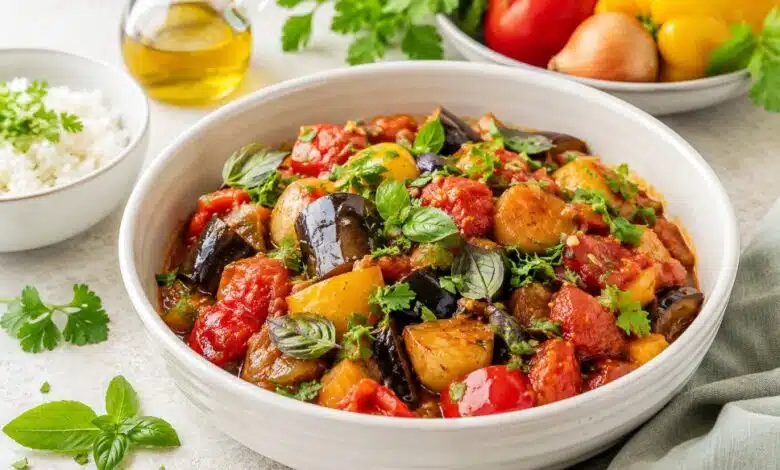
Traditional ajapsandali can be both vegan and gluten-free because its basic ingredients are eggplant, tomatoes, peppers, onions, garlic, herbs, spices and plant-based oil. However, not every restaurant or household version follows the same formula. Butter, cheese, meat broth, bread garnishes and shared kitchen equipment can change whether a particular serving fits a strict vegan or gluten-free diet.
Ajapsandali is naturally vegetable-centered. Unlike many restaurant dishes that require substitutions to become vegan, the basic preparation does not need meat, dairy or eggs. It also does not require wheat flour, breadcrumbs, pasta or another gluten-containing ingredient.
The uncertainty begins with the details that may not appear in a short menu description. A restaurant may sauté onions in butter, finish the dish with Georgian cheese or serve it beside bread. A kitchen may label the stew gluten-free based on its ingredients while preparing it near khachapuri dough, flour-dusted surfaces or shared utensils.
This distinction matters because “contains no obvious gluten ingredients” is not the same as “prepared safely for someone with celiac disease.” Similarly, “vegetarian” does not automatically mean vegan. A vegetarian ajapsandali may still contain butter, cheese or another dairy ingredient.
Searching for a restaurant that serves the dish? Our guide to ajapsandali near me includes current menu leads, city guidance and practical questions to ask before visiting.
Is ajapsandali vegan and gluten-free?
Ajapsandali is often vegan and naturally gluten-free when it is prepared from vegetables, fresh herbs, spices, salt and plant-based oil. The standard ingredients do not require meat, dairy, eggs or wheat.
A restaurant version may stop being vegan if it contains butter, cheese, cream, meat broth or a dairy garnish. It may become unsuitable for a strict gluten-free diet if bread is added to the plate, a seasoning contains wheat or the food is prepared on flour-contaminated equipment.
For a diner who follows a flexible plant-based diet, ajapsandali is one of the more promising choices on a Georgian menu. For someone managing a medically necessary gluten-free diet, the answer depends more heavily on the restaurant’s kitchen procedures.
It is also important to separate dietary labels. A dish may be:
- vegetarian but not vegan;
- vegan but exposed to gluten cross-contact;
- made without gluten ingredients but served with wheat bread;
- dairy-free but cooked in meat broth;
- gluten-free but not safe for a severe wheat allergy;
- plant-based but prepared in a shared kitchen.
What is traditional ajapsandali made from?
The central ingredients are vegetables and herbs. A typical version may contain:
- eggplant;
- tomatoes;
- bell peppers;
- onions;
- garlic;
- cilantro;
- parsley;
- basil;
- ground coriander;
- black pepper;
- salt;
- vegetable or sunflower oil.
Potatoes are common in many versions, although they are not universal. Zucchini, carrots, fresh chile or adjika may also appear.
| Ingredient | Vegan? | Gluten-free? | Important note |
|---|---|---|---|
| Eggplant | Yes | Yes | Naturally plant-based and gluten-free |
| Tomatoes | Yes | Yes | Fresh or plain canned tomatoes are usually suitable |
| Bell peppers | Yes | Yes | Sweet or hot varieties may be used |
| Onions | Yes | Yes | The cooking fat must still be checked |
| Garlic | Yes | Yes | Fresh garlic presents no inherent issue |
| Potatoes | Yes | Yes | Increase starch and total carbohydrates |
| Zucchini | Yes | Yes | May release additional moisture |
| Fresh herbs | Yes | Yes | Plain herbs are suitable |
| Ground spices | Usually | Usually | Check blended or packaged seasonings when strict avoidance is necessary |
| Vegetable oil | Yes | Yes | Suitable unless another dietary restriction applies |
| Butter | No | Yes | Vegetarian but not vegan or dairy-free |
| Cheese | No | Usually | Not vegan or dairy-free; flavored cheese may need verification |
| Wheat bread | Often vegan | No | Common accompaniment and cross-contact concern |
The vegetables themselves create very little dietary uncertainty. Most questions come from cooking fat, broth, garnishes, commercial seasoning products and how the restaurant handles the finished dish.
When is ajapsandali vegan?
Ajapsandali is vegan when all its ingredients come from plants and no animal-derived cooking fat, broth or garnish is used.
A clearly vegan version normally contains
- eggplant and other vegetables;
- fresh tomatoes or plain canned tomatoes;
- onions and garlic;
- cilantro, parsley and basil;
- coriander, pepper and chile;
- sunflower, olive or another vegetable oil;
- salt;
- plant-based adjika without unexpected animal ingredients.
No substitute is necessary for the traditional core. The dish does not need vegan meat, plant-based cheese or egg replacement to feel complete.
Why ajapsandali works well as vegan food
Eggplant creates a soft, substantial texture and absorbs oil and seasoning. Tomatoes provide acidity and sauce. Peppers and onions contribute sweetness. Potatoes add body when included.
This means the dish can feel satisfying without relying on animal protein or dairy. It also pairs naturally with beans, bread, salad, pickles and other vegetable dishes.
Does vegan ajapsandali taste incomplete?
No. A properly seasoned plant-based version is not a reduced or substitute form of the dish. Vegetables, herbs and spices are the foundation rather than replacements for meat.
Can ajapsandali be called plant-based?
Yes, when prepared without animal ingredients. The phrase “plant-based” can be used more loosely than “vegan,” however, so someone following a strict vegan diet should still confirm butter, cheese and broth.
When is ajapsandali not vegan?
The most common exceptions are dairy, broth and restaurant garnishes.
Butter
A cook may use butter for onions, potatoes or the final finish. Butter is vegetarian but not vegan.
A menu description may list only vegetables and herbs without naming the cooking fat. Asking “Is it made with oil or butter?” is more useful than asking only whether meat is present.
Cheese
Some restaurants serve ajapsandali with a slice, crumble or topping of Georgian cheese. The vegetable base may be vegan before the cheese is added.
Ask whether the garnish can be omitted and whether cheese is mixed into the stew or placed only on top.
Meat broth
Vegetable dishes are sometimes enriched with chicken or beef broth. This is not necessary for ajapsandali, but restaurant adaptations are possible.
Animal fat
A kitchen could cook vegetables in a pan containing meat drippings or another animal fat. This is less predictable than clearly listed cheese.
Dairy-based sauce
A modern plated version may include yogurt, sour cream, cheese sauce or another dairy component around the vegetables.
Honey in a seasoning or sauce
Honey is not a traditional requirement, but it could appear in an adapted glaze or commercial condiment. Some vegans avoid honey.
Shared cooking equipment
Shared equipment does not necessarily make the ingredients non-vegan, but individual diners differ in how they approach shared fryers, grills and utensils. Ask when this is important to you.
Is ajapsandali always vegetarian?
Traditional ajapsandali is understood as a vegetable dish and is usually vegetarian. Meat is not required to define it.
A restaurant may still use meat broth or serve it alongside meat. A menu label is helpful but should not replace a direct question when strict avoidance matters.
Vegetarian does not mean vegan
Vegetarian dishes may contain:
- butter;
- cheese;
- milk;
- cream;
- yogurt;
- eggs;
- honey.
Ajapsandali does not normally need most of these ingredients, but cheese and butter are realistic restaurant additions.
What should a vegan diner ask?
Instead of asking only “Is it vegetarian?” ask:
- Is there any butter or dairy in the vegetables?
- Is cheese added to the plate?
- Is the dish cooked with vegetable oil?
- Is any meat or chicken broth used?
- Does the adjika or sauce contain animal ingredients?
Is ajapsandali dairy-free?
It can be naturally dairy-free, but the answer depends on butter, cheese and garnishes.
Dairy-free traditional base
Eggplant, tomatoes, peppers, onions, garlic, herbs, spices and vegetable oil contain no dairy.
Common dairy risks
- butter used during cooking;
- cheese placed on top;
- yogurt sauce served beside the dish;
- cream added in a modern interpretation;
- shared utensils touching dairy dishes.
Dairy allergy versus vegan preference
A person avoiding dairy by preference may be comfortable asking for the cheese to be removed. Someone with a serious milk allergy needs to know whether dairy touched the pan, utensils or preparation surface.
Is cheese necessary?
No. Cheese can complement the vegetables, but ajapsandali remains complete without it. Removing a cheese garnish does not remove an essential component of the traditional vegetable base.
Is traditional ajapsandali gluten-free?
Yes, the standard vegetable ingredients are naturally gluten-free. The recipe does not require wheat, barley or rye.
Plain versions made from fresh vegetables, oil, herbs and spices can fit a gluten-free diet without ingredient substitutions.
Naturally gluten-free components
- eggplant;
- tomatoes;
- peppers;
- onions;
- garlic;
- potatoes;
- zucchini;
- fresh herbs;
- plain oil;
- unmixed spices.
Why restaurants may still require verification
Georgian kitchens often handle bread dough, flour and dumplings. Khachapuri, khinkali and other wheat-based dishes may be prepared near the vegetables.
A restaurant may correctly say that ajapsandali contains no gluten ingredients but still be unable to guarantee protection from cross-contact.
Can flour be used to thicken ajapsandali?
Flour is not necessary because tomato reduction and potatoes can create body naturally. An adapted restaurant recipe could still use flour or a packaged sauce, so asking is reasonable when strict avoidance matters.
Can adjika contain gluten?
Traditional homemade adjika may consist of peppers, garlic, salt, herbs and spices. Commercial products can contain additional ingredients or be produced on shared equipment. Check the product label or ask the kitchen.
Is ajapsandali safe for someone with celiac disease?
The ingredients can be suitable, but restaurant safety depends on cross-contact controls.
Celiac disease requires more than choosing a dish without visible bread or flour. Small amounts of gluten transferred from surfaces, utensils or hands may matter.
Potential restaurant exposure points
- flour used on nearby work surfaces;
- shared cutting boards;
- shared knives and serving spoons;
- bread placed on the same plate;
- shared fryers;
- pans previously used for breaded food;
- staff handling dough and vegetables without changing gloves;
- seasonings stored near flour;
- garnishes added from a contaminated station.
Questions for the restaurant
- Does the ajapsandali contain any wheat or flour?
- Is it prepared in a clean pan?
- Are the vegetables fried in a shared fryer?
- Can bread be omitted from the plate?
- Can clean utensils be used?
- Is the restaurant able to reduce gluten cross-contact?
What answer should raise concern?
If staff cannot identify the ingredients, do not understand the difference between gluten and dairy or cannot explain how the dish is prepared, the label alone may not be sufficient for a medically strict diet.
What about a wheat allergy?
A wheat allergy and celiac disease are different conditions, although both may require avoiding wheat and preventing cross-contact.
A person with a severe wheat allergy should communicate the allergy directly rather than asking only whether the dish is gluten-free.
Why the wording matters
A product may be gluten-free but still contain another ingredient that is not appropriate for a specific allergy. Conversely, a dish may contain no wheat but be exposed to wheat flour during preparation.
Restaurant communication
Tell the server:
- that it is an allergy rather than a preference;
- which ingredients must be avoided;
- whether shared equipment is acceptable;
- whether bread should be kept away from the plate;
- whether emergency-level cross-contact is a concern.
Where can gluten cross-contact happen in a Georgian restaurant?
Georgian restaurants frequently prepare wheat-based foods, making kitchen procedure especially important.
Khachapuri station
Flour may be present on counters, hands, trays and utensils used for Georgian cheese bread.
Khinkali preparation
Dumpling dough involves flour and may be rolled or shaped near other food.
Shared ovens
Ajapsandali baked or reheated in a shared oven may be safe when contained in its own clean dish, but open trays or shared surfaces require consideration.
Shared fryers
Eggplant or potatoes may be fried in oil also used for breaded foods or dough products. Shared oil is a significant concern for strict gluten avoidance.
Shared serving spoons
A buffet or prepared-food display may use one utensil across several dishes.
Bread garnish
A cook may place bread on the bowl or plate automatically. Requesting “no bread anywhere on the plate” is clearer than removing it after service.
Takeout containers
Bread may be packed in the same container, allowing crumbs to spread through the vegetables.
What oil is used in ajapsandali?
Vegetable or sunflower oil is common, while olive oil may be used in some homes and modern recipes. All of these are vegan and gluten-free in plain form.
Sunflower oil
Sunflower oil has a relatively neutral flavor and allows the herbs, garlic and vegetables to remain prominent.
Olive oil
Olive oil adds its own fruity or peppery character. It can work well but may move the flavor slightly closer to Mediterranean vegetable dishes.
Mixed oil and butter
A restaurant may use both. Asking only whether vegetable oil is present does not rule out butter.
Shared frying oil
The type of oil may be suitable while the shared fryer is not. Diners avoiding gluten should ask what else is cooked in the same oil.
Oil quantity and nutrition
Eggplant absorbs oil readily. A dish can be completely vegan and gluten-free while still being calorie-dense because of frying.
Does ajapsandali contain broth?
Traditional preparation can rely on vegetable juices rather than broth. Tomatoes, peppers, onions, eggplant and zucchini release enough moisture to create a stew.
Some restaurants may add stock for consistency or flavor.
Vegetable broth
Vegetable broth can be vegan, but commercial products may contain gluten, yeast extracts, sugar, soy or other allergens.
Chicken or beef broth
These make the dish unsuitable for vegetarians and vegans even when no visible meat appears in the bowl.
Bouillon powder
Bouillon may be difficult to identify by taste because it dissolves completely. Ask specifically about broth, stock and bouillon.
Is broth necessary?
No. Slow cooking and ripe tomatoes provide enough moisture and flavor for a traditional vegetable-based result.
Why do some restaurants serve ajapsandali with cheese?
Cheese adds salt, richness and contrast to the soft vegetables. Georgian cheeses can connect the dish with the broader restaurant menu.
This presentation remains vegetarian but is not vegan or dairy-free.
Cheese on top
A slice or crumble may be added after cooking. This is the easiest form to omit, provided the vegetables themselves contain no dairy.
Cheese mixed into the dish
This is less easily removed. Ask whether the cheese is part of the stew or only a garnish.
Shared serving utensils
For a dairy allergy, removing visible cheese may not be sufficient if the plate or utensils have already touched it.
Does cheese make the dish more authentic?
No single cheese garnish defines ajapsandali. It is a restaurant choice rather than a requirement for the vegetable stew to be recognizable.
Is bread part of ajapsandali?
Bread is a common accompaniment but is not normally mixed into the vegetable stew.
Georgian bread helps absorb the tomato-rich juices and can turn a small vegetable starter into a more substantial meal.
Why bread matters for gluten-free diners
Even when the stew itself contains no gluten, bread may:
- sit directly on the vegetables;
- share the plate;
- be packed in the same takeout container;
- leave crumbs on serving utensils;
- be sliced on the same board used for garnishes.
How to order without bread
Say: “Please do not place any bread or bread crumbs on the plate, and please use clean utensils.”
Gluten-free alternatives
At home, ajapsandali can be served with:
- plain rice;
- quinoa;
- certified gluten-free bread;
- corn-based mchadi made without wheat contamination;
- roasted potatoes when potatoes are not already in the stew;
- beans or lentils.
Does ajapsandali contain nuts?
Nuts are not required in the basic recipe. Traditional ajapsandali is different from pkhali and badrijani nigvzit, which commonly contain walnuts.
The restaurant environment still matters because Georgian kitchens frequently use walnuts.
Potential nut exposure
- shared knives or food processors;
- walnut garnish added accidentally;
- adjacent pkhali preparation;
- shared serving spoons at a buffet;
- walnut sauces stored nearby;
- bread or garnish containing nuts.
Nut-free ingredients versus nut-safe preparation
A server may truthfully say that ajapsandali has no nuts while the kitchen cannot guarantee protection from walnut cross-contact.
What should someone with a severe allergy ask?
Ask whether walnuts are processed in the same preparation area and whether clean utensils, surfaces and gloves can be used.
Does ajapsandali contain soy?
Soy is not a traditional requirement. Fresh vegetable versions normally contain no soy.
Possible sources include:
- soybean oil;
- commercial bouillon;
- soy sauce in a modern adaptation;
- packaged seasoning blends;
- prepared sauces;
- cross-contact in the kitchen.
Refined soybean oil may be treated differently from soy protein by some allergy guidance, but anyone with a diagnosed soy allergy should follow medical advice and ask the restaurant about the specific product.
Does ajapsandali contain nightshade vegetables?
Yes. Several central ingredients belong to the nightshade family:
- eggplant;
- tomatoes;
- bell peppers;
- chile peppers;
- potatoes.
Ajapsandali is therefore not suitable for someone who has chosen or been advised to avoid nightshades.
Can nightshades be removed?
Removing eggplant, tomatoes and peppers would eliminate the central identity of the dish. A nightshade-free version would be a different vegetable preparation rather than recognizable ajapsandali.
Is ajapsandali low in carbohydrates?
A potato-free version can be relatively moderate in carbohydrates because eggplant, tomatoes, peppers and zucchini are non-starchy vegetables.
Potatoes significantly increase the starch content.
Does removing potatoes make it keto?
Not automatically. Tomatoes and onions still contribute carbohydrates, and portion size matters. Anyone following a medically supervised or strict ketogenic diet should calculate the ingredients used in the specific recipe.
Which accompaniments add carbohydrates?
- Georgian bread;
- khachapuri;
- rice;
- potatoes;
- cornbread or mchadi;
- beans;
- sweetened sauces.
Is ajapsandali a light dish?
It can be vegetable-rich and relatively light, but oil quantity has a major effect on calories.
Why eggplant absorbs oil
Eggplant has a porous structure. When fried, it can take in a substantial amount of oil before becoming tender.
Roasted version
Roasting allows the cook to measure oil more precisely and usually produces a lighter result.
Fried version
Separately fried vegetables can taste rich and silky but may be considerably more calorie-dense.
Potatoes
Potatoes add carbohydrates and make the dish more filling. They do not automatically make it unhealthy, but they change the nutritional profile.
Cheese and bread
A cheese garnish and bread can turn a modest vegetable starter into a substantial meal.
Vegan does not automatically mean low-calorie
A vegan ajapsandali may contain generous oil. Dietary labels describe ingredients, not calorie content or portion size.
What should you ask before ordering ajapsandali?
How should vegan or gluten-free diners order ajapsandali for takeout?
Takeout introduces packaging risks that may not exist on a restaurant plate.
Request separate packaging
Ask for bread, cheese, sauces and grilled foods in separate containers.
State the dietary need clearly
Ordering notes such as “no cheese” may not explain a severe allergy. Call the restaurant when the issue is medically important.
Check the container before eating
Look for:
- bread placed on top;
- cheese garnish;
- yogurt sauce;
- unidentified crumbs;
- mixed utensils;
- unexpected meat pieces.
Delivery platforms may have incomplete descriptions
A third-party menu may omit ingredient details that appear on the restaurant’s official menu. Contact the restaurant directly instead of relying only on an app checkbox.
Do not remove an allergen and assume the rest is safe
Taking bread off the plate does not reverse gluten cross-contact. Removing cheese may not be enough for a severe dairy allergy.
How to make vegan and gluten-free ajapsandali at home
Home preparation gives you complete control over cooking fat, broth, seasoning products and cross-contact.
Use a simple ingredient base
- eggplant;
- tomatoes;
- bell peppers;
- onions;
- garlic;
- optional potatoes or zucchini;
- cilantro, parsley and basil;
- ground coriander and black pepper;
- vegetable or olive oil;
- salt;
- optional chile or verified gluten-free adjika.
Use clean cookware
For celiac-safe preparation, use clean pans, cutting boards, knives and utensils. Wooden tools and scratched surfaces may retain crumbs when they are shared with wheat-based foods.
Check packaged ingredients
Read labels on:
- canned tomatoes;
- tomato paste;
- bouillon;
- adjika;
- spice blends;
- chile sauces;
- prepared broth.
Use plant-based fat
Sunflower oil, olive oil and other plain vegetable oils keep the dish vegan and dairy-free.
Do not add unnecessary flour
The sauce can thicken through tomato reduction and potatoes. Flour is not needed.
Keep accompaniments separate
Serve gluten-free bread or another safe side separately from wheat bread used by other diners.
Dietary substitutions that preserve the character of ajapsandali
Replace butter with vegetable oil
This is the simplest vegan substitution and does not damage the identity of the dish.
Omit cheese
Fresh herbs and a little additional salt can restore brightness and seasoning without dairy.
Replace meat broth with vegetable juices
Cook ripe tomatoes, onions and peppers long enough to create their own flavorful liquid.
Use verified vegetable broth
When extra moisture is needed, choose a vegan and certified gluten-free broth that fits your allergy requirements.
Replace wheat bread
Serve the stew with certified gluten-free bread, rice, quinoa or safe cornbread.
Reduce potatoes for a lower-starch version
Increase eggplant and peppers instead of trying to replace potatoes with a processed product.
Reduce oil through roasting
Roast the eggplant and peppers before combining them with the tomato base.
Use fresh seasoning instead of packaged bouillon
Garlic, herbs, coriander, black pepper, salt and tomato reduction can provide substantial depth without a commercial flavor base.
What vegan and gluten-free foods go with ajapsandali?
Plain rice
Rice absorbs the tomato and herb juices while keeping the meal gluten-free.
Quinoa
Quinoa adds protein and a firmer grain texture beside soft vegetables.
Lobio
Georgian beans can create a filling vegan meal when prepared without animal fat and protected from gluten cross-contact.
Georgian salad
Cucumber, tomato, onion and herbs add a fresh, crisp contrast.
Pickled vegetables
Acidity and crunch balance the soft eggplant and oil.
Grilled mushrooms
Mushrooms contribute savory flavor and a firmer texture without meat.
Certified gluten-free bread
Bread makes the sauce easier to enjoy, provided it is prepared and served safely.
Walnut-free vegetable spreads
These can expand the table for diners who do not have a nut allergy and when cross-contact is controlled.
What about pkhali?
Pkhali can be vegan and gluten-free, but it normally contains walnuts. It requires separate consideration for nut allergies and shared kitchen equipment.
What about khachapuri?
Traditional khachapuri contains wheat flour and cheese, so it is neither gluten-free nor vegan. It should not share the plate of someone with celiac disease or a severe dairy allergy.
What similar vegetable dishes may fit vegan or gluten-free diets?
Ajapsandali belongs to a broad family of cooked eggplant, tomato and pepper dishes found across different culinary traditions. Similarity does not make the dishes identical, but comparison can help diners understand what to expect.
Ratatouille
French ratatouille commonly combines eggplant, zucchini, tomatoes, peppers, onions, garlic, olive oil and herbs. Its basic form can also be vegan and gluten-free.
Ratatouille usually leans toward olive oil, thyme and Provençal herbs, while ajapsandali may use cilantro, coriander, stronger garlic, adjika and optional potatoes.
Pisto Manchego
Spanish pisto manchego is another vegetable-centered dish made with tomatoes, peppers, onions and often zucchini. It is usually softer and more tomato-forward, and eggplant may be present in some versions without always being central.
Pisto itself can be vegan and gluten-free, but restaurants often serve it with a fried egg, cured meat or bread. Those accompaniments change the dietary profile even when the vegetable base is suitable.
To compare restaurant options and learn what may come on the plate, see our guide to finding pisto manchego near you.
Caponata
Sicilian caponata centers on eggplant and may include tomato, celery, olives, capers and vinegar. The sweet-and-sour flavor distinguishes it from ajapsandali.
The vegetable base can be vegan and gluten-free, but bread and packaged ingredients still require checking.
Imam bayildi
Turkish imam bayildi consists of eggplant with onions, tomatoes, garlic and olive oil. Its traditional plant-based form can fit vegan and gluten-free diets.
Lecho
Lecho emphasizes peppers and tomatoes. Some versions include sausage, so the name alone does not guarantee vegetarian or vegan preparation.
Can ajapsandali work for a mixed-diet group?
Yes. Its vegetable base can serve as a shared dish for vegetarians, vegans and many gluten-free diners, provided the restaurant prepares it appropriately.
For a group with vegans
Order the ajapsandali without butter, cheese, meat broth or dairy garnish.
For a group with gluten-free diners
Keep all wheat bread in separate containers and use separate serving utensils.
For a group with nut allergies
Do not place pkhali, walnut sauces or walnut-stuffed eggplant beside the ajapsandali without discussing cross-contact.
For a group with dairy allergies
Keep cheese bread, yogurt sauce and cheese garnishes away from the shared vegetable dish.
Use separate spoons
Every shared plate should have its own serving utensil. A spoon moved from khachapuri or pkhali into the ajapsandali can transfer dairy, gluten or walnuts.
Common dietary mistakes when ordering ajapsandali
| Mistake | Why it is a problem | Better approach |
|---|---|---|
| Assuming vegetarian means vegan | Butter or cheese may be present | Ask specifically about all dairy and broth |
| Assuming vegetables mean gluten-free | Bread, flour or shared fryers may introduce gluten | Confirm ingredients and cross-contact |
| Removing bread after service | Crumbs may already be in the stew | Request no bread before plating |
| Trusting only a delivery description | Third-party menus may omit garnishes | Contact the restaurant directly |
| Ignoring cooking fat | Butter makes the dish non-vegan | Ask whether oil or butter is used |
| Ignoring broth or bouillon | Animal ingredients or wheat may be hidden | Ask about stock and packaged seasoning |
| Assuming nut-free because nuts are not visible | Walnut cross-contact is common in Georgian kitchens | Discuss preparation procedures |
| Calling vegan food automatically healthy | Fried eggplant can absorb substantial oil | Consider method and portion size |
| Assuming gluten-free is celiac-safe | Menu labels may not address cross-contact | Ask about surfaces, fryers and utensils |
| Using one spoon for several dishes | Allergens transfer between shared plates | Give every dish its own utensil |
Frequently asked questions
Is ajapsandali vegan?
Ajapsandali can be vegan when prepared with vegetables, herbs, spices and plant-based oil. Restaurant versions may contain butter, cheese, broth or a dairy garnish.
Is ajapsandali vegetarian?
Traditional ajapsandali is generally vegetarian because it is a vegetable dish. Confirm that the restaurant does not use meat broth or animal fat.
Is ajapsandali gluten-free?
The traditional vegetable ingredients are naturally gluten-free. Bread, flour, packaged seasonings and kitchen cross-contact should still be checked.
Is ajapsandali safe for celiac disease?
The ingredients may be suitable, but safety depends on preparation. Ask about shared fryers, flour-covered surfaces, utensils and bread on the plate.
Does ajapsandali contain dairy?
The basic vegetable stew does not require dairy. Some restaurants cook it with butter or serve it with Georgian cheese or yogurt sauce.
Does ajapsandali contain eggs?
Eggs are not normally part of the traditional stew. A restaurant could add an egg as a modern accompaniment, so check the current presentation.
Does ajapsandali contain nuts?
Nuts are not required, but Georgian kitchens frequently use walnuts in pkhali, sauces and eggplant rolls, creating a possible cross-contact concern.
Does ajapsandali contain potatoes?
Some versions contain potatoes and others do not. Potatoes are vegan and gluten-free but increase the starch content.
Can ajapsandali be made without oil?
It can be prepared with very little oil by roasting or using a nonstick pan, although some fat helps create the traditional soft texture and carries the herbs and spices.
What should I ask before ordering ajapsandali?
Ask about butter, cheese, broth, flour, packaged seasonings, shared fryers, bread garnishes and cross-contact with gluten, dairy or walnuts.
Ajapsandali can fit several diets, but the restaurant version still needs confirmation
The traditional foundation of ajapsandali is naturally promising for vegetarian, vegan, dairy-free and gluten-free diners. Eggplant, tomatoes, peppers, onions, garlic, potatoes, herbs and plant-based oil require no animal products or wheat.
The most common vegan exceptions are butter, cheese, meat broth and dairy garnishes. The main gluten-free concerns are bread, commercial seasonings, shared fryers and flour exposure from khachapuri or khinkali preparation.
For casual dietary preferences, a plainly described vegetable version may be sufficient. For celiac disease, wheat allergy, milk allergy or severe nut allergy, ask about both the recipe and kitchen procedures.
Ajapsandali does not need complicated substitutions to work as a plant-based meal. Prepared with vegetable oil and served with beans, salad, rice or verified gluten-free bread, it can become a satisfying centerpiece rather than a minor side dish.


