
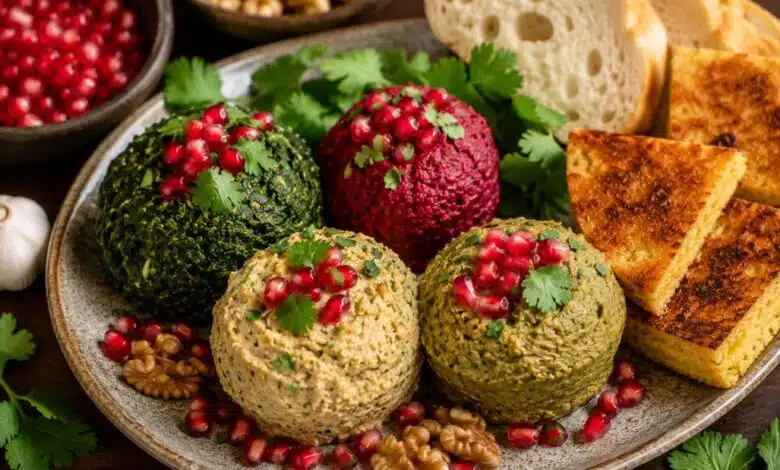
Pkhali is not one fixed spinach spread but an entire Georgian family of vegetables seasoned with walnuts, herbs, garlic and acidity
Its color, moisture, texture and flavor change with the vegetable, while the walnut-based seasoning connects beet, spinach, cabbage, bean, leek and wild-green versions.
Pkhali is a Georgian cold vegetable preparation made by combining cooked or softened vegetables with ground walnuts, garlic, herbs, spices and a sour element such as vinegar or pomegranate juice. It may be shaped into rounds or small mounds, served as a loose spread, or arranged as a colorful assortment of several vegetable varieties.
The dish is sometimes translated as Georgian vegetable pâté, but that description can be misleading if it suggests one fixed recipe or a completely smooth texture. Pkhali is better understood as a method. Spinach, beetroot, cabbage, beans, leeks, peppers, eggplant, beet greens, nettles and wild herbs can all become different forms of pkhali.
Walnuts usually provide richness and structure, while garlic, coriander, herbs and acidity keep the mixture lively rather than heavy. The resulting dish is commonly served chilled or at cool room temperature as part of a Georgian appetizer spread.
To find restaurants currently offering it, use the VESTI.LA guide to Georgian pkhali near you, which includes confirmed restaurant examples, menu wording, takeout advice and ordering questions.
What is pkhali?
Pkhali is a Georgian vegetable dish in which the main vegetable is finely chopped, minced or ground and seasoned with walnuts, garlic, herbs, spices and acidity.
The vegetable can be leafy, root-based, bean-based or seasonal. This flexibility is the reason two plates labeled pkhali may look entirely different. One may contain vivid burgundy beet portions. Another may be dark green from spinach. A third may combine several pale and green varieties made with leeks, cabbage, beans or wild plants.
Pkhali is generally served as a cold appetizer, shared side or part of a larger supra-style table. It is not normally eaten hot from the pan. Cooling gives the walnut mixture time to settle and allows the garlic, herbs and acidity to spread through the vegetables.
The dish is often shaped neatly for restaurant presentation, but decorative shaping is not what makes it pkhali. A rustic spooned mound or loose spread can use the same preparation and flavor structure.
How is pkhali spelled and pronounced?
Pkhali is the most common English transliteration, although menus may also use phali, fkhali or fkhal. These spellings generally refer to the same Georgian family of vegetable dishes.
The initial consonant does not have a perfect English equivalent. English speakers often simplify the name to something close to “pah-lee” or “fah-lee,” while the Georgian pronunciation includes a stronger sound near the beginning.
| Spelling | Where it may appear | What it usually means |
|---|---|---|
| Pkhali | Modern restaurant menus and English food guides | The standard English transliteration |
| Phali | Simplified English menus | The same dish family |
| Fkhali | Older transliterations and recipe sources | The same Georgian preparation |
| Assorted pkhali | Restaurant appetizer sections | Several vegetable versions on one plate |
| Vegetable pâté | Explanatory English menu wording | A pkhali variety described by texture |
| Walnut vegetable spread | Descriptive menu text | A simplified explanation rather than a formal Georgian name |
When searching online, use several spellings. A restaurant may rank for phali even though another menu uses pkhali. Searching by vegetable, such as spinach pkhali or beet pkhali, can also reveal menu items that do not appear under an assorted plate.
What makes a dish pkhali?
Pkhali is defined less by one vegetable than by the way the vegetable is combined with a seasoned nut mixture.
Vegetable or green
The vegetable contributes color, moisture and the main earthy, sweet, grassy or bean-like flavor.
Ground nuts
Walnuts are the most recognizable choice and commonly give the mixture richness and enough body to hold together.
Garlic and herbs
Garlic, coriander, cilantro and other herbs introduce freshness and savory depth.
Acid and seasoning
Vinegar, pomegranate juice, plum-based acidity, salt and spices keep the walnuts and cooked vegetables balanced.
The proportions shift with the vegetable. Spinach may require careful draining to prevent a watery mixture. Beetroot can support more acidity because of its sweetness. Beans can produce a thicker, heavier pkhali that needs enough herbs and sourness to remain lively.
A restaurant may describe the walnut mixture as bazhe or walnut paste, but pkhali is not simply vegetables served beside a separate walnut sauce. The vegetable and seasoning are normally worked together into one cohesive preparation.
Which vegetables can be used for pkhali?
Almost any vegetable or edible green that can be softened, drained and finely chopped can become pkhali. Some varieties are common on international restaurant menus, while others reflect season, region or household practice.
| Vegetable | Flavor contribution | Texture tendency | Typical color |
|---|---|---|---|
| Spinach | Green, leafy and mildly earthy | Soft and finely fibrous | Deep green |
| Beetroot | Sweet, earthy and mineral | Dense and moist | Burgundy or purple-red |
| Beet greens | Leafy, slightly earthy and less sweet than the root | Soft with fine stems | Green to dark red-green |
| Cabbage | Mild and slightly sweet | Fine but lightly fibrous | Pale green or beige |
| Leek | Sweet onion flavor | Soft with delicate fibers | Pale green |
| Green beans | Fresh, vegetal and mildly sweet | Fine with light bean texture | Green |
| White beans or kidney beans | Earthy and substantial | Dense and paste-like | Tan, beige or reddish brown |
| Bell pepper | Sweet and aromatic | Moist and soft | Red, orange or yellow |
| Eggplant | Smoky or mild and earthy | Soft and creamy | Beige, gray-green or brown |
| Nettles or wild greens | Green, mineral and strongly herbal | Fine and fibrous | Dark green |
The wide vegetable range means that the word pkhali alone may not tell you what will arrive. Restaurant menus often solve this by naming the vegetables, showing a photograph or offering an assortment.
What is spinach pkhali?
Spinach pkhali is a dark-green version made from cooked spinach combined with walnuts, garlic, herbs, spices and acidity.
It is one of the most recognizable forms outside Georgia because spinach is widely available and its deep-green color contrasts clearly with beet and pepper varieties on a mixed plate.
Good spinach pkhali should taste leafy and fresh rather than like plain cooked spinach. Walnut should add richness without hiding the vegetable. Garlic may be noticeable, but it should not produce a raw, burning finish.
Spinach holds a substantial amount of water, so draining is essential. Poorly drained spinach can release liquid after the dish rests, leaving a puddle around the shaped portions and weakening the walnut seasoning.
What should spinach pkhali feel like?
The mixture should be moist and cohesive, with fine vegetable fibers still perceptible. It should hold a shaped mound without feeling rubbery or dry. A completely silky texture similar to commercial hummus usually indicates excessive processing.
What is beet pkhali?
Beet pkhali combines cooked beetroot or beet greens with walnuts, garlic, herbs and acidity. Beetroot produces one of the most visually striking versions because its natural color turns the mixture burgundy, crimson or purple-red.
The flavor is generally sweeter and earthier than spinach pkhali. Vinegar, pomegranate or another sour element is especially important because it keeps the natural beet sweetness from becoming heavy.
Beetroot pkhali is usually denser and moister than leafy-green versions. It may hold a very smooth rounded shape, but small walnut and beet particles should remain visible on close inspection.
Beet-green pkhali is different from beetroot pkhali. It uses the leaves and sometimes tender stalks rather than the sweet root, creating a greener and less sweet result.
How do cabbage, leek and bean pkhali differ?
Cabbage and leek pkhali are usually milder and lighter in color, while bean pkhali is denser and more substantial.
Cabbage pkhali
Boiled or softened cabbage has a gentle sweetness and a faint vegetable bite. Because its flavor is mild, walnut, garlic, coriander and acidity may be more prominent than in spinach or beet versions.
The texture can remain slightly fibrous even after fine chopping. That light texture is normal and should not be mistaken for poor processing.
Leek pkhali
Leeks bring a soft onion sweetness without the sharpness of raw onion. The mixture may appear pale green and can taste especially fragrant when combined with coriander and fresh herbs.
Leek fibers require careful chopping. Good leek pkhali should be tender and cohesive rather than stringy.
Bean pkhali
Bean-based versions are thicker and can resemble a dense spread. They may use green beans, white beans, kidney beans or another locally available bean.
Because beans and walnuts are both rich, enough vinegar, herbs and garlic are needed to prevent the result from tasting dull. Bean pkhali can be one of the more filling items on an assorted plate.
Can pkhali be made with wild greens?
Yes. Georgian regional cooking includes pkhali made from wild plants, seasonal leaves and greens that may be unfamiliar outside the country.
Official Georgian food guides describe field pkhali made with mixed herbs and greens and seasoned with walnuts or hazelnuts, coriander, fennel, Welsh onion, pepper, garlic and vinegar. Other regional forms may include nettles, celery leaves, beet leaves or ekala.
Ekala is associated particularly with western Georgian cooking and may be seasoned differently by region. Some versions use walnuts, while others emphasize vinegar, leeks, herbs, green tkemali or savory.
This flexibility shows why pkhali should not be reduced to a single restaurant formula. The recognizable pattern is the transformation of vegetables or greens into a seasoned shared dish, not one mandatory ingredient list.
Why are walnuts important in pkhali?
Walnuts give pkhali richness, structure and one of its most recognizable Georgian flavor signatures.
Ground walnuts absorb vegetable moisture and help the mixture hold together. They also create a creamy impression without dairy. Their slight bitterness and earthy flavor work especially well with garlic, coriander and sour ingredients.
The walnuts should be finely ground but not reduced into a completely oily nut butter. When processed too aggressively, they may release excess oil and make the mixture greasy.
Freshness matters. Old walnuts can taste bitter, dusty or rancid. Because the walnut flavor is spread throughout the dish, poor-quality nuts affect every bite rather than only the garnish.
Can pkhali be made without walnuts?
Some regional or improvised vegetable preparations may use hazelnuts or rely more heavily on herbs and acidity. However, restaurant pkhali is commonly walnut-based, and diners should assume it contains walnuts unless the restaurant explicitly says otherwise.
Which herbs and spices are used in pkhali?
Garlic, coriander and fresh herbs are among the most consistent flavoring elements, while spice combinations vary by vegetable, region and cook.
Fresh cilantro can create a bright green aroma. Ground coriander adds a warmer citrus-like depth. Fenugreek or blue fenugreek may provide a distinctly Georgian savory note, while black pepper or red pepper introduces gentle heat.
Herbs should support the featured vegetable. A beet pkhali should still taste like beetroot, and spinach pkhali should retain a leafy character. When all varieties on a plate taste identical, the walnut and spice mixture may be overpowering the vegetables.
| Seasoning | Role in the dish | Possible effect when overused |
|---|---|---|
| Garlic | Savory sharpness and aroma | Raw burning finish |
| Fresh cilantro | Fresh herbal lift | Can dominate mild cabbage or leek |
| Ground coriander | Warm citrus-like depth | Dusty or flat flavor |
| Fenugreek | Warm, savory Georgian character | Bitterness when excessive |
| Black pepper | Gentle background heat | Harsh finish |
| Red pepper | Color, warmth and mild heat | Can hide delicate greens |
| Salt | Defines vegetable and walnut flavor | Makes chilled portions taste heavy |
Why does pkhali need acidity?
Acidity balances the rich walnuts and cooked vegetables and helps the herbs and garlic taste more distinct.
Wine vinegar is a common choice, but recipes may also use pomegranate juice, tart plum elements or another sour ingredient. The exact souring agent can change the character of the dish without changing its identity.
Beetroot may need enough acidity to balance its sweetness. Bean pkhali benefits from sourness because both beans and walnuts are dense. Delicate spinach can be overwhelmed when too much vinegar is added.
The finished dish should taste tangy but not pickled. Acidity should brighten the mixture rather than becoming the first and only flavor.
What does pkhali taste like?
Pkhali generally tastes nutty, garlicky, herbal, savory and tangy, with the selected vegetable determining whether the final dish is grassy, sweet, earthy or bean-like.
Spinach versions tend to taste green and herbaceous. Beetroot brings earthy sweetness. Cabbage is milder and allows the walnut seasoning to stand out. Leeks add gentle onion sweetness. Beans make the plate richer and more substantial.
Pomegranate seeds are often used as garnish. They provide small bursts of acidity and sweetness, but they are not the main flavor foundation.
Is pkhali spicy?
Pkhali is usually seasoned rather than strongly hot. Black pepper, red pepper or regional spice blends may provide warmth, but the dish is not generally defined by chile heat.
What texture should pkhali have?
Pkhali should be finely textured, moist and cohesive while still retaining small particles of vegetable and walnut.
It is finer than a chopped vegetable salad but usually less smooth than hummus or commercial nut butter. The correct consistency depends on the vegetable. Beet pkhali may be dense and soft, while spinach or cabbage versions can retain more visible fibers.
| Texture | What it may indicate | Quality assessment |
|---|---|---|
| Moist and cohesive | Vegetable and walnut proportions are balanced | Desirable |
| Fine with small particles | Careful chopping or grinding | Typical |
| Watery | Vegetables were not drained sufficiently | Quality problem |
| Dry and crumbly | Too little vegetable moisture or too many walnuts | Quality problem |
| Oily | Walnuts were overprocessed or too much oil was added | Usually undesirable |
| Completely smooth | Heavy machine processing | Possible restaurant style, but less traditional in feel |
| Stringy | Leeks or greens were not chopped finely enough | Can be unpleasant |
How is pkhali generally prepared?
The vegetable is cooked or softened, drained carefully, finely chopped and mixed with seasoned ground walnuts before the dish is rested and served cool.
This is a general explanation rather than a measured recipe. Vegetable moisture, walnut freshness and the strength of the vinegar affect the final proportions.
How is pkhali served?
Pkhali is normally served chilled or at cool room temperature as an appetizer, side dish or part of a larger shared Georgian table.
Individual portions
A restaurant may offer spinach pkhali, beet pkhali or another variety as a separate order. This format is useful when you already know which vegetable you prefer.
Assorted pkhali plate
An assortment usually includes two to five varieties with contrasting colors and textures. This is the best introduction for first-time diners because the shared walnut seasoning becomes easier to understand when the vegetables are compared side by side.
Pkhali with bread
Shotis puri, lavash-style bread or another Georgian wheat bread may be served alongside the vegetable mixture. Some restaurants offer mchadi, a Georgian cornmeal bread, instead of or in addition to wheat bread.
Pkhali on a larger cold platter
Pkhali may appear beside eggplant rolls, cheese, pickles, nadughi, herbs or Georgian salad. Read the menu carefully because dietary information for the pkhali itself may not apply to every item on the platter.
Garnishes
Pomegranate seeds, fresh cilantro, walnut halves or finely chopped herbs are common. A garnish should add contrast without burying the vegetable portions.
How is pkhali different from similar Georgian dishes?
Pkhali is distinguished by having the vegetable mixed into the walnut seasoning rather than simply covered with a sauce or wrapped around a filling.
| Dish | Main structure | Key difference from pkhali |
|---|---|---|
| Badrijani nigvzit | Eggplant slices wrapped around walnut filling | The eggplant remains a visible wrapper |
| Bazhe | Pourable or spoonable Georgian walnut sauce | It is a sauce rather than a vegetable mixture |
| Satsivi | Food served in seasoned walnut sauce | Usually wetter and sauce-centered |
| Lobio | Georgian bean dish or stew | Not every lobio version is mixed with walnuts or served cold |
| Ajapsandali | Cooked vegetable dish with eggplant, tomato and peppers | Usually not based on ground walnuts |
| Georgian salad with walnuts | Fresh tomato and cucumber with walnut dressing | The vegetables remain fresh and separately identifiable |
Is pkhali the same as badrijani nigvzit?
No. Badrijani nigvzit uses cooked eggplant slices as an outer layer around a walnut-garlic filling. In pkhali, the vegetable is chopped directly into the seasoned walnut mixture.
Is pkhali the same as bazhe?
No. Bazhe is a Georgian walnut sauce. Its flavors may resemble the walnut component of pkhali, but it is usually more fluid and served with other foods rather than formed into vegetable portions.
Is bean pkhali the same as lobio?
Not always. Lobio is a broad category of Georgian bean dishes. A bean preparation mixed with walnuts and served cold may resemble or be described as pkhali, while a hot bean stew served in a clay pot is clearly different.
Is pkhali vegan, vegetarian and gluten-free?
The core vegetable, walnut, herb and vinegar mixture is commonly vegetarian and often vegan and gluten-free, but the restaurant’s complete serving must be checked.
Is pkhali vegan?
Traditional vegetable and walnut ingredients are plant-based. However, restaurant platters may include cheese, nadughi, matsoni, yogurt sauce or another dairy accompaniment.
Ask whether dairy is mixed into the vegetable mixture or only served beside it. The pkhali portions may be vegan while the complete plate is not.
Is pkhali gluten-free?
The pkhali mixture generally does not require wheat. Wheat bread served with it normally contains gluten. Cross-contact may also occur through shared cutting boards, utensils or serving plates.
Mchadi is based on cornmeal, but the restaurant should still confirm its recipe and handling when gluten avoidance is medically necessary.
Does pkhali contain nuts?
Yes. Restaurant pkhali commonly contains walnuts throughout the mixture. It should be treated as a nut-containing dish unless the restaurant provides a specific alternative.
Does it contain dairy?
The core preparation often contains no dairy. Dairy is more likely to appear in a side item, garnish or mixed platter than in the vegetable and walnut mixture itself.
Does it contain sesame?
Sesame is not a defining ingredient, but it may appear on bread or through shared preparation. Confirm directly when sesame is an allergen concern.
Is pkhali halal?
The common vegetable and walnut ingredients are plant-based and generally compatible with halal diets. Alcohol-containing vinegar, accompanying dishes and restaurant kitchen practices may still require personal verification depending on the diner’s standards.
How can you recognize good pkhali?
Good pkhali should preserve the identity of its vegetable while balancing walnut richness, garlic, herbs and acidity.
- The vegetable color should look natural rather than gray or dried out.
- The mixture should be moist but not watery.
- The walnuts should taste fresh and mildly earthy rather than bitter or rancid.
- Garlic should be noticeable without creating a harsh raw burn.
- Acidity should lift the mixture rather than make it taste sharply pickled.
- Each variety on an assorted plate should taste meaningfully different.
- The texture should be fine and cohesive without becoming completely smooth.
- Pomegranate and herb garnishes should look fresh and restrained.
| Problem | What you may notice | Likely cause |
|---|---|---|
| Watery mixture | Liquid collects around the portion | The vegetables were not drained thoroughly |
| Dry, crumbly texture | The mound breaks apart immediately | Too many walnuts or too little vegetable moisture |
| Greasy surface | Oil separates from the mixture | Walnuts were overprocessed or too much oil was added |
| Raw garlic burn | Garlic overwhelms every other flavor | Poor balance or insufficient resting time |
| Flat walnut-heavy flavor | The vegetables are difficult to identify | Too much walnut mixture or too little acidity |
| Rancid finish | Bitter, dusty or stale nut flavor | Old or poorly stored walnuts |
| Identical-tasting assortment | Beet, spinach and cabbage taste nearly the same | The seasoning overwhelms the vegetables |
| Crushed takeout presentation | Colors and varieties blend together | Loose packaging or stacked portions |
How should you order pkhali for the first time?
An assorted pkhali plate is usually the best first order because it lets you compare several vegetables prepared with a related walnut seasoning.
Look for an assortment containing at least one leafy-green version and one sweeter root or pepper version. Spinach and beet create a useful contrast. Cabbage, leek, bean or ekala can add a third texture and flavor.
A useful first order
Choose an assorted plate with spinach pkhali, beet pkhali and one milder cabbage, leek or bean version. Add mchadi or Georgian bread, but ask for the bread separately when takeout texture or gluten matters.
Questions to ask before ordering
- Which pkhali varieties are included today?
- Is the order one variety or a mixed plate?
- How many portions are included?
- Does every variety contain walnuts?
- Is dairy mixed into any of the pkhali?
- Does the platter include nadughi, cheese or yogurt sauce?
- Is it served with wheat bread or mchadi?
- Can the bread be packed separately?
- Are eggplant rolls included in the assortment?
- Is pkhali available by weight or for catering?
What should you order with pkhali?
Pkhali pairs naturally with Georgian bread, mchadi, cucumber and tomato salad, lobio, khachapuri and khinkali. Its chilled herbal acidity provides contrast to warm cheese breads and rich dumpling fillings.
For a broader view of the meal, read the VESTI.LA guide to Georgian food and shared-table dishes. For the warm bread course, compare regional styles in the guide to Georgian khachapuri.
Where can you find Georgian pkhali nearby?
Use the main VESTI.LA local guide for confirmed U.S. restaurant examples, menu wording, city sections, dietary notes, pickup options and questions to ask before traveling.
Find Georgian pkhali near youWhat is the most important thing to understand about pkhali?
Pkhali is a technique and dish family rather than one fixed spinach appetizer. The vegetable may change with season, region and restaurant, while walnuts, garlic, herbs and acidity create the common structure.
The best plate allows each vegetable to remain recognizable. Spinach should taste leafy, beetroot should retain earthy sweetness, cabbage should remain mild and bean versions should feel substantial. Walnuts should connect the varieties without making every portion taste identical.
What is Georgian pkhali?
Pkhali is a Georgian cold vegetable preparation made by combining cooked vegetables or greens with ground walnuts, garlic, herbs, spices and acidity.
Is pkhali one specific dish?
Pkhali is a family of related vegetable dishes rather than one fixed recipe. Spinach, beetroot, cabbage, beans, leeks, peppers and wild greens can all be used.
What does pkhali taste like?
Pkhali usually tastes nutty, garlicky, herbal, savory and tangy. The vegetable determines whether the finished dish is grassy, sweet, earthy or bean-like.
Why are walnuts used in pkhali?
Ground walnuts add richness, structure and earthy flavor while helping the finely chopped vegetables hold together.
What vegetables are used in pkhali?
Common varieties include spinach, beetroot, beet greens, cabbage, leeks, green beans, white beans, peppers, eggplant, nettles and seasonal wild greens.
Is pkhali vegan?
The core vegetable and walnut mixture is often vegan, but restaurant platters may include cheese, yogurt, matsoni or nadughi.
Is pkhali gluten-free?
The vegetable and walnut mixture generally does not require wheat, but pkhali may be served with Georgian wheat bread and may be affected by kitchen cross-contact.
Does pkhali contain nuts?
Yes. Traditional restaurant pkhali commonly contains ground walnuts throughout the mixture, not only as a garnish.
Is pkhali the same as Georgian eggplant rolls?
No. Pkhali mixes the vegetable directly with walnut seasoning, while Georgian eggplant rolls wrap cooked eggplant slices around a walnut filling.
Where can I find pkhali near me?
Search Georgian restaurants, bakeries and prepared-food markets for pkhali, phali, assorted pkhali, spinach pkhali or beet pkhali, and check the official menu before visiting.


