
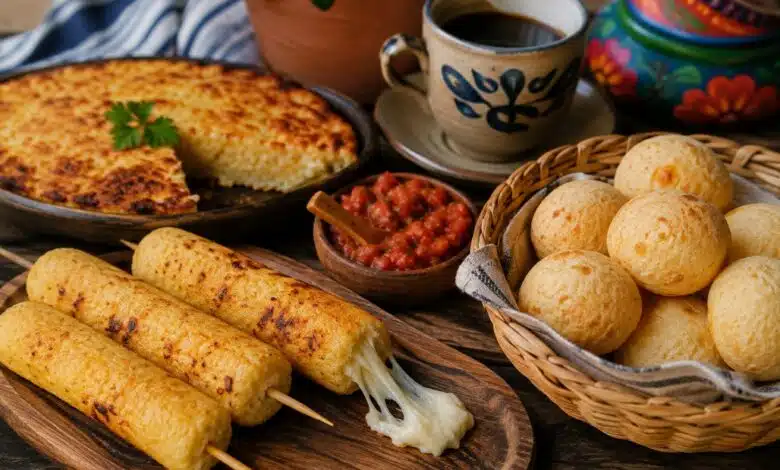
Sonso de yuca and cuñapé are traditional Bolivian foods made with cassava and cheese, but they are not two names for the same dish. Sonso begins with whole yuca that is peeled, boiled until tender and mashed before being mixed with cheese. Cuñapé is a cheese bread made primarily with cassava or yuca starch.
This difference changes nearly everything about the finished food. Sonso is dense, soft and substantial, with the texture of cooked cassava clearly present. Cuñapé is lighter, springier and more bread-like, with an elastic crumb created by starch, cheese and baking.
The two foods also tend to appear in different shapes. Sonso may be baked in a dish, browned as a thick portion or formed around a wooden stick as sonso al palo. Cuñapé is usually shaped into small buns or rolls and baked until the exterior becomes golden.
Anyone searching for a place to order the first dish can use our guide to the best sonso de yuca near me, including Bolivian restaurants worth calling and the alternate names that may appear on menus.
Sonso de yuca and cuñapé at a glance
| Feature | Sonso de yuca | Cuñapé |
|---|---|---|
| Main cassava ingredient | Whole yuca that is boiled and mashed | Cassava or yuca starch |
| Basic category | Cooked cassava-and-cheese preparation | Cassava-starch cheese bread |
| Texture | Dense, soft, moist and substantial | Springy, chewy, light and bread-like |
| Common shape | Square, wedge, patty or cylinder on a stick | Small round bun, ring or roll |
| Cooking methods | Baked, pan-cooked or grilled | Usually baked |
| Interior | Mashed cassava with cheese throughout | Elastic crumb made from starch and cheese |
| Serving style | Breakfast, snack, side dish or shared tray | Breakfast bread, bakery snack or coffee accompaniment |
| Best eaten | Warm, especially after browning or grilling | Fresh from the oven or gently reheated |
The two foods may share the same table, and both pair naturally with coffee. Their similarity comes from their Bolivian identity, cassava base and cheese flavor. Their difference comes from how cassava is processed before the dough or mixture is formed.
That single technical difference creates two distinct eating experiences. Sonso allows you to feel the cooked root. Cuñapé transforms cassava into a stretchy baked crumb.
What is sonso de yuca?
Sonso de yuca is a Bolivian dish made from cooked cassava and cheese. Fresh or frozen yuca is boiled until completely tender, drained and cleared of its tough central fibers. The warm flesh is then mashed and combined with cheese.
Butter, milk, salt or eggs may be added depending on the household and cooking method. These additions can improve richness, moisture or binding, but the central identity of sonso remains the same: cooked whole yuca forms the body of the dish.
Once mixed, sonso can take several forms.
Baked sonso
The mixture is spread in a baking dish and cooked until the top and edges become golden. It may be cut into squares or served by the spoonful.
Sonso al palo
The mixture is shaped around a wooden stick and grilled slowly, creating toasted patches around a soft center.
Skillet sonso
Thick portions are browned on a griddle or pan. This produces crisp edges without requiring an oven or outdoor grill.
Shared family-style sonso
A large baked portion can be placed in the center of the table and divided among several people.
Sonso is particularly associated with Santa Cruz and the eastern lowlands of Bolivia. It reflects a regional food tradition in which yuca is treated as a primary staple rather than an occasional side dish.
The dish is naturally filling. Even a modest square or skewer contains a substantial amount of cassava and cheese, so sonso can serve as more than a light bakery snack.
What is cuñapé?
Cuñapé is a Bolivian cheese bread made with cassava starch and cheese. Instead of boiling and mashing a whole yuca root, the cook begins with a dry starch that has already been separated from cassava.
The starch is mixed with cheese and other ingredients until it forms a dough. Depending on the recipe, the dough may also contain milk, eggs, butter or another fat. Small portions are shaped and baked until the exterior is golden and the interior becomes tender, elastic and slightly chewy.
Cuñapé is often associated with eastern Bolivia, especially Santa Cruz, and is commonly eaten for breakfast or with coffee. It fits naturally into bakery service because the pieces are individually portioned and easy to display.
A freshly baked cuñapé should feel light for its size. The outside may be lightly crisp, but the interior should remain soft and elastic rather than dry or crumbly.
Is cuñapé the same as pão de queijo?
Cuñapé and Brazilian pão de queijo belong to the same broad family of cassava-starch cheese breads, but they should not be treated as identical names. They come from different national traditions, and recipes can vary in cheese, starch treatment, shape and texture.
Is cuñapé the same as pan de bono?
No. Colombian pan de bono is another cassava-based cheese bread, but it has its own regional identity and recipe traditions. Similar ingredients do not erase the differences between the foods.
Cooked yuca and yuca starch behave differently
The contrast between sonso and cuñapé begins before the cheese is added. Whole cooked yuca and isolated cassava starch respond differently to moisture, pressure and heat.
Cooked yuca retains the structure of the root
When yuca is boiled, its flesh softens but remains dense. Mashing breaks the cooked root into a cohesive mass, yet the natural fibers and substantial body of the cassava remain noticeable.
This is why sonso feels closer to a mashed root preparation than to a bread. Cheese enriches and binds it, but the yuca still determines the weight and texture.
Yuca starch creates elasticity
Cassava starch is a refined ingredient. It contains the starch component of the root without the same amount of natural fiber and whole-root structure.
When hydrated, combined with cheese and baked, the starch can expand and create a springy, chewy interior. That elasticity is central to cuñapé.
Why cassava flour is not automatically the same as cassava starch
Packaging can be confusing in the United States. Cassava flour is generally made from more of the whole root, while tapioca starch or cassava starch is the separated starch component.
A cuñapé recipe calling for cassava starch may not work correctly with whole-root cassava flour. The flour absorbs moisture differently and may produce a heavier, less elastic result.
Why neither ingredient can simply replace the other
Replacing mashed yuca with starch would transform sonso into a dough rather than a cooked-root mixture. Replacing starch with mashed yuca would prevent cuñapé from developing its characteristic bread-like crumb.
How the ingredients compare
| Ingredient | Role in sonso | Role in cuñapé |
|---|---|---|
| Yuca or cassava | Cooked whole root provides the main body | Processed starch forms the dough structure |
| Cheese | Adds flavor, moisture and binding | Adds flavor, fat and elasticity |
| Milk | Adjusts a dry mashed-yuca mixture | Hydrates the starch dough |
| Butter or fat | Softens the mixture and encourages browning | Improves tenderness and richness |
| Egg | Optional binder in some versions | Common in many dough formulations |
| Salt | Adjusted according to the cheese | Adjusted according to the cheese |
| Wheat flour | Not required for the traditional concept | Not usually needed when cassava starch forms the dough |
Cheese is essential to both foods, but it does not perform exactly the same job. In sonso, cheese helps a mashed root hold together. In cuñapé, cheese becomes part of an elastic baked dough.
Do they use the same cheese?
They can, but the best cheese balance may differ. Sonso benefits from a cheese that provides flavor and enough melting to bind the yuca. Cuñapé needs cheese that works well inside a starch dough without releasing excessive oil.
Outside Bolivia, cooks often combine cheeses to reproduce the desired behavior. A fresh crumbly cheese supplies flavor, while a low-moisture melting cheese improves cohesion.
How the preparation methods differ
Preparing sonso de yuca
- Fresh yuca is peeled thoroughly, or frozen peeled yuca is prepared for boiling.
- The pieces are simmered until completely tender.
- The cooking water is drained.
- The hard central fibers are removed.
- The warm yuca is mashed.
- Cheese, fat, salt and any needed milk are mixed through it.
- The mixture is shaped, spread in a dish or pressed around sticks.
- It is baked, browned or grilled until hot and golden.
Preparing cuñapé
- Cassava starch is placed in a mixing bowl.
- Cheese is grated or crumbled into the starch.
- Egg, milk, butter or other recipe ingredients are added.
- The mixture is worked into a soft dough.
- The dough is divided into small portions.
- Each portion is shaped into a bun, roll or ring.
- The pieces are baked until puffed and golden.
- They are served warm while the interior remains tender.
Sonso requires more preparation of the root itself. Cuñapé avoids peeling and boiling but requires careful control of dough hydration.
Both foods can fail when too much liquid is added. Loose sonso may collapse or remain wet. Overhydrated cuñapé dough may spread instead of holding its shape.
Sonso and cuñapé have very different textures
Sonso is dense and soft
The cooked root gives sonso a substantial texture. A fork passes through it more like a soft casserole, mashed-root cake or thick patty than a bread roll.
The interior may include visible strands or pockets of melted cheese, but it should remain cohesive. Properly prepared sonso holds its shape without becoming dry or rubbery.
Cuñapé is springy and chewy
Cuñapé should have an elastic crumb. When torn open, it may stretch slightly and reveal small air pockets. It feels lighter and more bread-like than sonso.
The exterior can be thin and lightly crisp, especially when eaten soon after baking. As cuñapé cools, the interior may become firmer and chewier.
Which one is more filling?
Sonso usually feels more filling per piece because it is made from dense cooked cassava. Cuñapé may feel lighter, although several small buns can still become a substantial snack.
Which one has more visible cheese?
That depends on the recipe. Sonso can show clear pockets or strands of cheese in the mashed yuca. Cuñapé usually distributes the cheese more uniformly through the dough.
How do sonso and cuñapé taste?
Both foods taste savory, cheesy and mildly sweet from cassava. The difference is where the flavor seems to come from.
Sonso tastes more clearly of the root
Because it uses cooked whole yuca, sonso preserves more of the root’s natural flavor. The cassava may taste gently sweet, earthy or slightly nutty.
Grilling can add smoke, while baking creates toasted cheese flavors. Skillet cooking may add a buttery browned edge.
Cuñapé tastes more like cheese bread
The starch itself has a restrained flavor, allowing the cheese to become more prominent. A good cuñapé tastes milky, salty and toasted, with a subtle cassava background.
Which is saltier?
Either can be saltier depending on the cheese. Dry aged cheese can make both foods intense. Fresh mild cheese creates a softer flavor.
Are either of them sweet?
They are generally savory. Cassava has a mild natural sweetness, but neither dish is normally treated as a dessert.
How to tell them apart by appearance
Shape is helpful, but it is not a perfect guide because sonso can be prepared in several forms.
A typical sonso may look like:
- a golden square cut from a baking dish;
- a thick oval or round skillet portion;
- a cylinder formed around a wooden stick;
- a soft wedge served from a larger tray;
- a rustic portion with visible yuca texture.
A typical cuñapé may look like:
- a small round cheese bun;
- a slightly flattened roll;
- a ring-shaped baked bread;
- a smooth golden bakery piece;
- a compact roll with a lightly cracked surface.
Look at the interior
When cut open, sonso appears dense and moist, with the look of mashed cassava. Cuñapé reveals an elastic crumb with small air spaces.
Do not judge only by the exterior color
Both can develop a golden or dark-brown surface. Browning tells you how the food was cooked, not which cassava preparation was used.
How sonso and cuñapé are served
Sonso can act as a side dish
Its dense texture allows it to replace rice, bread or potatoes beside grilled meat, chicken or vegetables. A large baked tray can also be shared at the center of a meal.
Cuñapé usually acts as bread or a bakery snack
It is easy to hold, easy to pack and natural beside coffee. Several pieces may be served in a basket, much like rolls or breakfast bread.
Both work with hot drinks
Coffee, tea and hot chocolate suit both foods. The drinks balance the salt and richness of the cheese.
Fresh accompaniments suit sonso especially well
Tomato, onion, herbs and citrus help balance the dense yuca-and-cheese center. Sonso may also be served with grilled food or a light salsa.
Cuñapé rarely needs a topping
A warm cuñapé is usually eaten on its own. Butter, jam or sauces are not required, although individual preferences vary.
Which one is better for breakfast?
Both belong comfortably at breakfast, but they suit different appetites.
Choose sonso when you want a more substantial meal
A square of baked sonso or one grilled skewer can provide a dense, satisfying combination of starch and cheese. It works well when breakfast needs to carry you through several hours.
Choose cuñapé when you want a lighter bakery-style breakfast
One or two warm buns with coffee feel easier and more portable. Cuñapé also works well when several different breakfast pastries are being shared.
Can they be served together?
Yes. Serving both creates a useful comparison of two ways Bolivia uses cassava. Keep portions modest because both contain cheese and can be filling.
Which one is better for takeout?
Cuñapé is usually easier to carry
Small individual buns fit naturally into a paper bag or bakery box. They are less likely to break and do not require utensils.
Sonso needs more careful packing
Baked squares should be placed in a rigid container. Sonso al palo needs enough room so the skewers do not press against one another.
Steam affects both foods
A tightly sealed hot container traps moisture. Sonso may lose its browned exterior, while cuñapé may become softer and less crisp.
Ask when the batch was prepared
Both foods are best when fresh. A bakery item that has been sitting for several hours will not provide the same texture as one recently baked or grilled.
Storage and reheating differences
Storing sonso
Cooked sonso should be covered and refrigerated promptly. Individual pieces can be separated with parchment to prevent sticking.
An oven or skillet is usually the best way to restore its browned surface. A microwave warms the center but leaves the exterior soft.
Storing cuñapé
Cuñapé is best on the day it is baked. Once cooled, it may become firmer because the starch and cheese set.
A brief reheating in the oven or toaster oven can restore softness. Excessive microwave heating may make the bread rubbery.
Can sonso be frozen?
Yes. Baked pieces or an uncooked prepared mixture can be frozen. Thawing in the refrigerator generally produces more even reheating.
Can cuñapé be frozen?
Cuñapé dough portions may be frozen before baking, and baked pieces can also be frozen. The best method depends on the recipe and moisture level.
Gluten-free, vegetarian and allergen differences
Are sonso and cuñapé gluten-free?
Yuca and cassava starch naturally contain no gluten. Traditional versions of both foods can therefore be made without wheat flour.
Restaurant recipes may still contain flour, seasoning mixes or ingredients processed with gluten. Shared ovens, pans and work surfaces can also create cross-contact.
Are they vegetarian?
Basic versions may be suitable for many vegetarians. The cheese may contain animal-derived enzymes, and some sonso recipes can include lard or meat drippings.
Are they vegan?
No traditional version is vegan because cheese is central to both foods. Eggs, milk and butter may also be used.
Do they contain eggs?
Cuñapé recipes commonly include eggs, although formulas vary. Sonso may be prepared with or without them.
Do they contain dairy?
Yes. Cheese is a defining ingredient in both foods. Milk and butter may add more dairy.
What should someone with an allergy ask?
- Does the current recipe contain eggs?
- Is wheat flour added?
- What type of cheese is used?
- Is butter or milk included?
- Is the food prepared on shared equipment?
- Does the kitchen use nuts or peanuts nearby?
How to order the correct dish at a restaurant
If both names appear on a menu, ordering is easy. The challenge comes when a restaurant uses only an English description or a shortened name.
Ask for sonso this way
“Is this made from boiled yuca that is mashed and mixed with cheese?”
A second useful question is whether the portion is baked, pan-cooked or grilled on a stick.
Ask for cuñapé this way
“Is this a small Bolivian cheese bread made with yuca or cassava starch?”
Do not use only the phrase yuca with cheese
That description can refer to fried yuca with cheese, boiled cassava served beside cheese, cheese-filled croquettes or several unrelated breads.
Check the portion size
One sonso order may be a large square, one skewer or a shared tray. One cuñapé order may mean one bun or several pieces.
Can sonso and cuñapé replace each other?
They can occupy a similar place on the table, but they are not direct substitutes in cooking.
As a breakfast food
Either can accompany coffee, so one may replace the other when the goal is simply to provide a Bolivian breakfast item.
As a side dish
Sonso is usually the more natural choice because it has the body of a cooked starch. Cuñapé behaves more like bread.
In a recipe
Mashed cooked yuca cannot be exchanged cup-for-cup with cassava starch. The moisture, structure and cooking behavior are entirely different.
For grilling
Sonso al palo is designed to brown around a stick. Cuñapé dough is more naturally shaped for baking.
For a bakery display
Cuñapé is easier to portion and stack. Baked sonso generally needs a tray, plate or rigid container.
Should you try sonso or cuñapé first?
Try sonso first if you enjoy:
- dense and filling foods;
- the flavor of cooked cassava;
- golden baked casseroles;
- grilled or smoky surfaces;
- soft cheese-filled centers;
- substantial breakfast dishes.
Try cuñapé first if you enjoy:
- cheese bread;
- springy and chewy textures;
- small bakery snacks;
- portable breakfast foods;
- lightly crisp baked crusts;
- coffee with warm bread.
The best choice is to try both
Tasting them together makes the difference immediately clear. Sonso shows what whole cooked yuca can become when mixed with cheese. Cuñapé shows what cassava starch can become when turned into bread.
The comparison also reveals the range of Bolivian cassava cooking. The same root can produce a dense grilled preparation, a soft baked tray or an elastic cheese bun depending on how it is processed.
Making sonso de yuca at home
Sonso is often easier to make than to find in the United States. Frozen peeled yuca reduces preparation time and removes the need to cut through the thick outer skin.
The essential steps are:
- boil the yuca until completely tender;
- drain it well;
- remove the hard central fibers;
- mash it while warm;
- mix in cheese and butter;
- add milk only when the mixture feels dry;
- bake, pan-cook or grill until golden.
Our complete sonso de yuca recipe includes exact U.S. and metric measurements, cheese substitutions, fresh and frozen yuca instructions, baked sonso, skillet portions and sonso al palo.
Common mistakes when comparing the two dishes
Calling both dishes cassava bread
Cuñapé is appropriately described as cheese bread. Sonso is better described as a cooked cassava-and-cheese preparation.
Assuming every round piece is cuñapé
Skillet sonso can also be rounded. The interior texture provides a more reliable clue than shape alone.
Assuming sonso must be served on a stick
Sonso al palo is one form, but baked and pan-cooked versions are also established preparations.
Assuming starch and flour mean the same thing
Cassava starch, tapioca starch and whole-root cassava flour do not always behave identically. The package and recipe should be read carefully.
Expecting every cheese to stretch
Fresh cheeses may soften without producing long strands. Flavor and texture matter more than a dramatic cheese pull.
Thinking one dish is more genuinely Bolivian
Both belong to Bolivian food culture. Their different techniques show the versatility of cassava rather than a competition for authenticity.
Frequently asked questions
Is sonso de yuca the same as cuñapé?
No. Sonso is made from cooked whole yuca mashed with cheese, while cuñapé is a cheese bread made primarily with cassava starch.
Which is more bread-like?
Cuñapé is more bread-like because cassava starch creates a springy baked crumb. Sonso remains dense and similar to a mashed-root preparation.
Which one is grilled on a stick?
Sonso al palo is formed around a wooden stick and grilled. Cuñapé is normally shaped into small pieces and baked.
Which one uses whole yuca?
Sonso uses whole yuca that has been peeled, boiled, drained and mashed.
Which one uses yuca starch?
Cuñapé uses cassava or yuca starch to create its characteristic dough and elastic texture.
Are sonso and cuñapé gluten-free?
Traditional versions can be gluten-free because yuca and cassava starch contain no gluten. Individual recipes and cross-contact should still be checked.
Are both foods vegetarian?
Basic versions may be vegetarian, but the cheese, cooking fat and current restaurant recipe should be checked.
Which one is more filling?
Sonso is usually more filling per piece because it is made from dense cooked cassava rather than a lighter starch dough.
Can I use cassava flour instead of starch for cuñapé?
Not as a simple equal substitution. Whole-root cassava flour and cassava starch absorb liquid and bake differently.
Can sonso and cuñapé be served together?
Yes. Serving them together is an excellent way to compare cooked yuca with cassava starch and to experience two eastern Bolivian food traditions.
Two Bolivian foods, two very different uses of cassava
Sonso de yuca and cuñapé share cassava, cheese and a strong connection with eastern Bolivian cooking, but their structures are fundamentally different.
Sonso keeps the character of the whole root. The yuca is boiled, mashed and combined with cheese before being baked, browned or grilled. Cuñapé begins with starch and turns that ingredient into a small elastic cheese bread.
Choose sonso when you want something dense, soft and substantial. Choose cuñapé when you want a lighter, chewy bakery item. Try both when you want to understand just how many textures one cassava root can create.

