
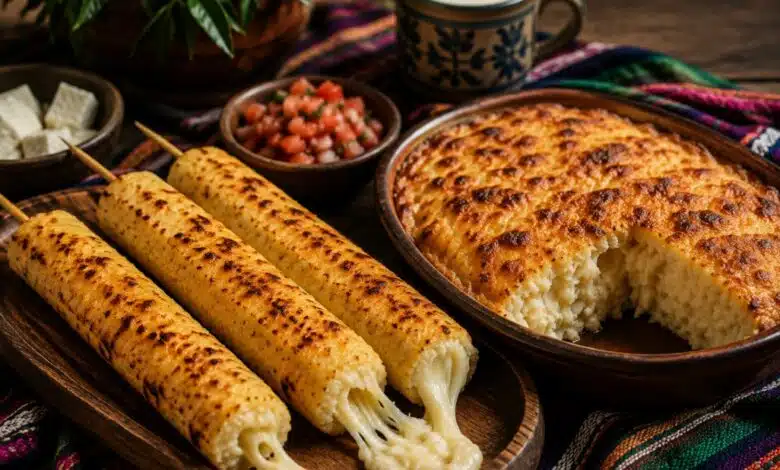
Sonso al palo and baked sonso begin with the same comforting Bolivian combination of cooked yuca and cheese, but the way they are shaped and heated creates two noticeably different dishes. Sonso al palo is formed around a wooden stick and slowly browned over heat, giving it a toasted exterior, a soft center and a distinctive outdoor presentation. Baked sonso is spread in a dish and cooked until the top and edges become golden, producing a deeper, softer portion that is easy to divide and share.
Neither method changes the basic identity of sonso. In both versions, the yuca is cooked until tender, stripped of its firm central fibers, mashed while warm and mixed with cheese before the final cooking stage. The contrast comes from surface area, heat exposure, thickness and serving style.
Grilled sonso usually offers more browning around each portion because several sides are exposed directly to heat. A baked tray has less exposed surface but protects more of the moist interior. One feels rustic and highly toasted; the other feels generous, soft and suited to a family table.
When you would rather order the dish than prepare it yourself, our guide to finding good sonso de yuca near you explains which Bolivian restaurants are worth calling and what names may appear on menus.
Sonso al palo and baked sonso at a glance
| Feature | Sonso al palo | Baked sonso |
|---|---|---|
| Shape | Cylinder formed around a wooden stick | Tray, square, wedge or spooned portion |
| Heat exposure | Several sides exposed directly to heat | Top and edges receive most of the browning |
| Exterior | More toasted surface and charred patches | Golden top with browned edges |
| Interior | Soft center surrounded by a firmer shell | Deeper, softer and more evenly moist |
| Aroma | Toasted, grilled and sometimes lightly smoky | Warm dairy, baked cheese and cassava |
| Preparation difficulty | Requires firmer mixture and careful turning | Easier to shape and more forgiving |
| Best setting | Outdoor grill, festival or individual serving | Home oven, café tray or family meal |
| Takeout | Needs room for the sticks and careful packing | Easy to pack as squares in a rigid container |
| Serving style | Handheld or plated individually | Cut and shared from one dish |
The table shows the practical differences, but the decision is not simply grilled versus baked. The consistency of the yuca mixture matters just as much as the heat source. A loose mixture may work in a baking dish but slide from a stick. A very firm mixture may stay securely on the skewer but produce a dry baked tray.
Good results depend on adjusting the same base for the chosen method. Sonso al palo usually needs slightly less added milk and enough cheese to help the mixture bind. Baked sonso can tolerate a softer consistency because the dish supports the mixture as it heats.
Both styles begin with the same sonso base
The difference between sonso al palo and baked sonso begins only after the central mixture has been prepared. Before that point, both follow the same essential method.
Yuca is peeled and boiled until completely tender. It should not merely be soft around the edges. A fork needs to pass easily through the thickest part, and there should be no hard or chalky center.
After draining, each piece is split so the firm central fiber can be removed. This woody strip is not part of the desired texture. Leaving it inside creates unpleasant strings in the finished sonso.
The warm yuca is mashed by hand and mixed with cheese. Butter may be added for richness, while milk can correct a mixture that feels too dry. Salt depends on the cheese, since some fresh cheeses are mild and others already contribute considerable salinity.
Why the mixture should not be blended
Yuca contains a great deal of starch. Aggressive blending can overwork that starch and produce a gluey paste. A masher, sturdy fork or food mill offers more control and preserves a natural cassava texture.
Why the base may need to be divided before seasoning
When making both styles from one batch, it helps to prepare the common base first and then divide it. The portion intended for grilling can remain firmer, while the baked portion can receive a little more milk or butter if needed.
This is easier than trying to use one identical consistency for every cooking method.
What is sonso al palo?
Sonso al palo means sonso prepared on a stick. The cooked yuca-and-cheese mixture is pressed around a wooden stick to form a thick cylinder, then turned over moderate heat until the exterior becomes golden and firm.
The stick is not simply decorative. It shapes the portion, allows several sides to face the heat and makes the food easy to hold. It also creates one of the most recognizable presentations of sonso.
A properly grilled portion should stay attached to the stick without becoming hard. The outside should develop toasted patches, while the interior remains soft and warm.
How thick should sonso al palo be?
A very thin cylinder may dry out before it develops enough color. A very thick one may sag from the stick or remain cool in the middle. A moderate thickness offers the best balance between a browned exterior and a tender center.
Home portions commonly work well when the mixture forms a cylinder approximately 1½ to 2 inches thick around the stick. The exact size can vary according to the strength of the stick and the firmness of the mixture.
Why moderate heat matters
High flames can burn exposed cheese before the exterior has time to set. Gentle to moderate heat allows the surface starch and cheese to firm gradually. Once the sonso holds securely, it can be moved closer to stronger heat for deeper browning.
Why it is turned slowly
Fast or sudden rotation can pull a soft mixture away from the stick. Turning slowly gives each section time to set and prevents the heavy cylinder from twisting loose.
What is baked sonso?
Baked sonso uses the same yuca-and-cheese mixture but supports it inside an oven-safe dish. The mixture is spread to an even depth and baked uncovered until the top and edges become golden.
This format is practical for home kitchens because it does not require sticks, an outdoor grill or careful turning. It also allows a softer mixture to cook successfully.
After baking, the sonso may be cut into neat squares, served as wedges or spooned directly from the dish. A firmer mixture and longer rest create cleaner slices. A softer mixture produces a more generous, casserole-like presentation.
How deep should baked sonso be?
A layer approximately 1½ to 2 inches deep usually gives a good balance. A shallower tray creates more top and edge browning, while a deeper dish protects a larger soft center.
Should baked sonso be covered?
It is normally better left uncovered. Covering the dish traps steam, which may keep the top pale and wet. Baking uncovered allows moisture to escape and encourages browning.
Why the dish should rest after baking
Fresh from the oven, the cheese is soft and the starch is still settling. Resting for several minutes allows the portion to hold together more cleanly without becoming cold.
Can the top be broiled?
A brief broil can deepen the color when the center is already hot but the surface remains pale. The dish should be watched continuously because exposed cheese can move from golden to burned quickly.
Shape changes how each sonso cooks
The long cylindrical form of sonso al palo exposes more of the mixture to heat. A baked tray exposes mostly the upper surface and the edges touching the dish.
This geometric difference influences browning, moisture loss and the proportion of crust to center.
Sonso al palo has more exterior per serving
Because the cylinder can be rotated, several sides develop a toasted surface. Every bite is likely to include both browned exterior and soft interior.
Baked sonso has a larger uninterrupted center
The middle of a tray remains protected from direct heat. This creates a broader area of soft cassava and melted cheese.
Individual shapes cook faster
Smaller grilled cylinders or baked portions warm more quickly than one very deep tray. However, small pieces also lose moisture faster.
A tray is easier to portion for different appetites
Baked sonso can be cut into small breakfast squares or larger meal-sized portions. A stick usually represents one predetermined serving.
How the heat source changes sonso
Grill heat and oven heat both cook the same yuca-and-cheese mixture, but they reach the food differently.
Direct heat produces stronger contrast
Sonso al palo receives concentrated heat on the side facing the coals or grill. The cook rotates it so the surface browns progressively. This creates darker patches and more variation from one side to another.
Oven heat surrounds the dish
Baked sonso warms more evenly. The upper surface browns through hot air and radiant heat, while the sides gain color from contact with the dish.
Smoke can affect grilled sonso
Cooking over charcoal or wood may add a light smoky aroma. The effect should complement the yuca and cheese rather than make the food taste burned.
The baking dish stores heat
Ceramic, glass and metal dishes behave differently. Metal generally browns edges more quickly. Ceramic and glass often hold heat well and can continue cooking the sonso briefly after it leaves the oven.
Outdoor conditions matter
Wind, distance from the coals and uneven heat can make sonso al palo less predictable. An indoor oven is easier to control, especially for a first attempt.
How the textures compare
Sonso al palo has a firmer shell
The exterior dries slightly as it turns over heat. Cheese near the surface browns, while the starch helps form a thin supporting layer.
The shell should not become hard like deep-fried breading. It should offer light resistance before giving way to the softer center.
Baked sonso is softer through the middle
The protected center retains more moisture. A deep portion may feel creamy and dense, particularly when made with fresh cheese and enough butter.
Grilled sonso has more textural variation
One side may be deeply toasted while another remains lightly golden. That irregularity is part of the appeal of cooking over fire.
Baked sonso is more uniform
Each central piece from the same tray tends to have a similar softness. Edge pieces are firmer and more browned, giving diners a choice.
Which one is chewier?
Either can become chewy if the yuca is overworked or the cheese is very elastic. In a well-prepared comparison, sonso al palo may feel slightly firmer outside, while baked sonso is generally softer overall.
Flavor and aroma differences
The basic flavor remains savory, cheesy and gently sweet from the cassava. The cooking method changes the aromas surrounding that foundation.
Sonso al palo tastes more toasted
Direct heat encourages stronger browning. The surface may develop nutty, smoky and caramelized dairy notes.
Baked sonso tastes more buttery and mellow
The protected interior allows the flavors of yuca, butter and cheese to blend gently. The top adds toastiness without dominating the entire portion.
Char should remain controlled
A few dark patches can add complexity to grilled sonso. A heavily blackened surface may taste bitter and hide the mild cassava flavor.
The cheese affects both more than the method alone
A salty aged cheese creates a stronger flavor in either style. A fresh mild cheese gives a softer dairy profile. Method and cheese should therefore be considered together.
How cheese behaves in each method
Cheese provides flavor, moisture and binding, but it also creates different challenges during grilling and baking.
Grilled sonso needs cheese that helps the mixture hold
A small amount of low-moisture melting cheese can improve cohesion. Very wet cheese may release liquid and weaken the portion around the stick.
Baked sonso can handle softer cheese
The dish supports the mixture, so fresh crumbly cheese can be used generously without requiring the same structural strength.
Exposed cheese browns quickly on the grill
Large pieces near the surface may melt out or burn. Mixing cheese evenly through the yuca produces a more stable exterior.
Cheese on top of baked sonso needs restraint
A light topping can create an attractive golden crust. A very thick layer may release oil and make the surface heavy.
A cheese pull is not required
Some Bolivian-style fresh cheeses soften without creating long strands. A good sonso can have a rich, tender center even when the cheese does not stretch dramatically.
Which version develops more browning?
Sonso al palo generally offers more browned surface per serving. Its cylindrical shape can be turned so multiple sides receive direct heat.
Baked sonso develops most of its color on the top and around the perimeter. The center of a large tray remains pale and soft.
| Type of browning | Sonso al palo | Baked sonso |
|---|---|---|
| Top surface | No single top; several sides are exposed | Broad golden surface across the tray |
| Dark toasted patches | Common when turned over direct heat | Usually limited to cheese and raised areas |
| Edge browning | Distributed around the cylinder | Strongest where the mixture touches the dish |
| Control | Requires close attention and rotation | Easier to monitor through the oven door |
| Risk | Burning one side before the center is hot | Drying the edges while waiting for the top to color |
Diners who value toasted flavor may prefer sonso al palo. Those who want a broad golden top with a soft center may prefer the baked version.
Which version stays softer and moister?
Baked sonso usually retains more moisture because much of the mixture is protected inside the dish. Sonso al palo loses more moisture from its exposed surface.
This does not mean grilled sonso should be dry. A well-balanced cylinder has a thin set exterior and a tender center.
Why baked sonso may become too wet
Excess milk, poorly drained yuca or very wet cheese can create a loose tray. The oven cannot always remove enough moisture without overbrowning the edges.
Why sonso al palo may become too dry
A cylinder that is too thin, cooked too far from the center or left over heat for too long can lose its tenderness.
Resting affects moisture perception
Baked sonso appears very soft when first removed from the oven. After a short rest, the starch settles and the portion feels more cohesive.
Grilled sonso should rest only briefly. A long wait allows the thin exterior to soften and the cheese to firm.
Which method is easier for a first attempt?
Baked sonso is easier for most home cooks. The baking dish supports the mixture, the oven provides steady heat and no turning is required.
Sonso al palo demands more attention. The mixture must be firm enough to stay on the stick, and every portion needs to be shaped evenly and rotated during cooking.
Choose baked sonso for your first batch when:
- you have never prepared yuca dough or mash before;
- you are unsure how much milk the mixture needs;
- you do not have an outdoor grill;
- you are serving several people at once;
- you want leftovers that are easy to portion.
Try sonso al palo when:
- you already understand the correct mixture consistency;
- you enjoy cooking over charcoal or wood;
- you want more toasted surface;
- you prefer individual handheld portions;
- you can stay near the grill and turn every stick.
Making baked sonso first is useful because it teaches how the base should taste and feel. A later batch can be made slightly firmer for the grill.
Equipment needed for each style
For sonso al palo
- a charcoal, wood or gas grill;
- thick wooden skewers or food-safe sticks;
- a heat-resistant surface for holding prepared portions;
- tongs or gloves for handling hot sticks;
- a moderate, controllable heat zone;
- enough grill space to rotate each portion.
For baked sonso
- an oven;
- a shallow baking dish;
- butter or oil for greasing;
- a spatula or spoon for spreading the mixture;
- a knife or serving spoon for dividing the finished dish.
Can sonso al palo be made indoors?
An indoor grill pan may brown the exterior, but it does not surround the cylinder with heat as effectively as a grill. The shape can also make full contact difficult.
A broiler can provide direct heat, but the sticks need to be turned carefully and kept a safe distance from the heating element.
Does the baking dish material matter?
Metal usually creates faster edge browning. Ceramic offers attractive table presentation and steady heat. Glass makes it easier to observe the sides but may brown differently from metal.
Serving and presentation differences
Sonso al palo feels informal and immediate
The stick makes it natural for outdoor meals, markets and gatherings where people are eating while standing or moving. It can be served directly from the grill.
Baked sonso suits a shared table
A warm dish can be placed in the center and divided as needed. This works well for breakfast, brunch and family meals.
Plating sonso al palo
One or two sticks may be placed on a rustic plate with a fresh tomato-and-onion salad, grilled vegetables or a small bowl of salsa. Wet accompaniments should not be poured over the sonso because they soften the toasted surface.
Plating baked sonso
A square or wedge can be served beside fresh salad, grilled meat, eggs or fruit. Softer baked sonso may be spooned into a small bowl rather than forced into a neat shape.
Which one looks more distinctive?
Sonso al palo has a more immediately recognizable presentation because few other dishes place a cassava-and-cheese mixture around a wooden stick. Baked sonso can resemble another casserole until it is cut open and described.
Which style works better for breakfast or a snack?
Both suit breakfast and afternoon coffee, but they create different experiences.
Baked sonso is easy to serve in the morning
A tray can be prepared for several people and kept warm briefly. Portions are easy to adjust, and no one needs to wait for individual sticks to finish grilling.
Sonso al palo feels more special
Freshly grilled portions require more effort but provide stronger aroma and browning. They work especially well for a weekend breakfast or outdoor gathering.
For a small snack
A narrow baked square is easy to pair with coffee. A full grilled cylinder may be more filling than expected because it contains dense yuca and cheese.
For a mixed Bolivian breakfast table
Baked sonso is easy to divide alongside cuñapé, salteñas, humintas and fruit. Grilled sticks take more table space but create a memorable centerpiece.
Which style is better for a group?
Baked sonso is generally more practical for a large group. One tray requires less shaping and active cooking than many separate sticks.
Advantages of a baked tray
- It can be prepared before guests arrive.
- Portions can be cut in different sizes.
- It uses less grill space.
- It stays warm in the baking dish.
- Leftovers are easy to refrigerate.
Advantages of grilled sticks
- Every guest receives an individual portion.
- The food can be eaten without a full place setting.
- Grilling becomes part of the gathering.
- Each cylinder offers browned surface on several sides.
- Different batches can be cooked to different levels of browning.
A practical combination
For a large event, a baked tray can provide the main quantity while a smaller number of sonso al palo portions create visual interest. This allows guests to compare the methods without requiring every serving to be grilled individually.
What to expect when ordering either style
Restaurant menus may use only the word sonso without explaining the method. Asking how it is cooked prevents surprises.
Questions for sonso al palo
- Is it grilled to order?
- How many sticks come in one order?
- Is the portion intended as a snack or side dish?
- Is it cooked over charcoal, wood or a gas grill?
- How long will preparation take?
Questions for baked sonso
- Was the tray baked today?
- Is one order a square, wedge or larger portion?
- Will it be reheated before serving?
- Is cheese baked on top?
- Is the center soft enough to spoon or firm enough to cut?
Why availability may differ
A restaurant may bake one tray in the morning and sell portions until it is gone. Sonso al palo may appear only during weekends, festivals or times when the grill is operating.
Why the menu photo may not match the portion
Sonso varies in size, shape and cheese content. A restaurant may also change its presentation according to available equipment or whether the order is for dine-in or takeout.
Which version travels better?
Baked sonso is generally easier to pack. Squares fit into a rigid container and can be separated with parchment.
Sonso al palo needs a longer container, and the sticks can press against one another. A broken cylinder may still taste good, but the distinctive presentation is lost.
Steam affects both styles
Hot sonso releases steam. Inside a tightly closed container, that moisture softens the exterior.
How to pack baked sonso
- Use a rigid, shallow container.
- Keep wet salads and sauces separate.
- Avoid stacking several warm pieces tightly.
- Allow slight ventilation when appropriate.
How to pack sonso al palo
- Use a container long enough for the sticks.
- Place the portions in one layer.
- Do not place heavy items over them.
- Keep sauces in sealed cups.
- Carry the container level.
For a very long trip, baked sonso is usually the safer choice because it can be reheated and replated without depending on the original stick presentation.
How to reheat sonso al palo and baked sonso
Reheating sonso al palo in the oven
Place the sticks on a baking sheet and warm them at moderate heat until the center is hot. Turning once helps the exterior warm more evenly.
Reheating sonso al palo in a skillet
Remove the stick only when it can be done without breaking the portion. Brown the cylinder gently over medium-low heat, rotating it carefully.
Reheating baked sonso in the oven
Place the portion in a small baking dish. Cover loosely during the first part of reheating if it seems dry, then uncover for the final minutes to refresh the surface.
Reheating baked sonso in a skillet
A firm square can be browned on both sides in a lightly buttered pan. A very soft portion may break and is better reheated in the oven.
Using a microwave
The microwave warms the interior quickly but softens browned surfaces. Short intervals help prevent the cheese from becoming oily and the edges from turning tough.
Storage and freezing
Both styles should be refrigerated promptly after cooling briefly. Store them in covered containers and use them within several days for the best texture.
Storing sonso al palo
The sticks take up space, so the cylinders may be removed after cooling if they hold together. Separate portions with parchment to prevent sticking.
Storing baked sonso
Cutting the tray into individual squares makes later reheating easier. Keep the pieces in one layer or separate stacked layers with parchment.
Freezing the prepared mixture
The uncooked mixture can be frozen in a covered container. After thawing in the refrigerator, check the consistency before shaping because the yuca may release moisture.
Freezing finished portions
Baked squares freeze more conveniently than finished skewers. Grilled cylinders can also be frozen, but the exterior will need fresh browning after thawing.
For the best flavor and texture, use frozen sonso within two to three months.
Common problems with both methods
| Problem | Likely cause | How to improve it |
|---|---|---|
| Sonso slides from the stick | Mixture is too warm, wet or heavy | Cool it, reduce milk and use smaller portions |
| Grilled exterior burns | Heat is too strong or the stick is not turned | Move to moderate heat and rotate gradually |
| Grilled center remains cool | Cylinder is too thick | Use a smaller diameter and slower cooking |
| Baked sonso is watery | Yuca was not drained or too much milk was added | Drain thoroughly and add liquid gradually |
| Baked top remains pale | Surface is wet or oven heat is low | Bake uncovered and broil briefly if needed |
| Both versions feel gluey | Yuca was overprocessed | Mash by hand instead of blending |
| Hard strings remain | Central yuca fibers were not removed | Split every cooked piece before mashing |
| Cheese leaks excessively | Large pockets of very wet cheese | Distribute cheese evenly and use lower-moisture cheese |
| Sonso tastes bland | Cheese is mild or salt is insufficient | Adjust seasoning after adding the cheese |
| Finished portion is dry | Too little fat or excessive cooking | Add butter and shorten the final cooking time |
Which style should you choose?
Choose sonso al palo when you want:
- more toasted surface;
- a lightly smoky grilled aroma;
- an individual handheld portion;
- a distinctive traditional presentation;
- food prepared outdoors;
- strong contrast between the exterior and center.
Choose baked sonso when you want:
- a softer and deeper center;
- an easier method for beginners;
- a dish that feeds several people;
- clean squares for breakfast or brunch;
- simple storage and reheating;
- a method that works in any home oven.
Which one is more traditional?
Sonso al palo may be the more visually iconic preparation, but baked sonso is also part of the broader cooking tradition. Authenticity depends on more than shape. The cooked yuca, cheese, regional identity and preparation technique matter together.
Which one tastes better?
That depends on whether you value browning or softness. Grilled sonso offers stronger toasted flavor. Baked sonso offers a larger moist center and a mellow dairy character.
Which one should a restaurant serve?
A restaurant with an active grill can offer sonso al palo as a memorable special. A café or bakery may find baked sonso easier to prepare in batches and serve throughout the day.
How to make both styles at home
The easiest approach is to prepare one large yuca-and-cheese base, then divide it before the final cooking stage.
For the baked portion
Keep the mixture soft enough to press comfortably into a greased dish. Add milk only if the yuca feels dry. Spread it evenly and bake uncovered until golden.
For sonso al palo
Use a firmer portion of the mixture. Let it cool before shaping, press it securely around thick wooden sticks and grill over moderate heat.
Why dividing the batch works well
It allows you to compare the methods without cooking twice as much yuca. It also shows how a small change in moisture and shape affects the final texture.
Questions people often ask about the two styles
What is the main difference between sonso al palo and baked sonso?
Sonso al palo is shaped around a wooden stick and grilled on several sides, while baked sonso is spread in a dish and cooked until the top and edges are golden.
Do both versions use the same ingredients?
They can use the same basic mixture of cooked yuca, cheese, butter, salt and optional milk, although the grilled version usually needs a firmer consistency.
Which version has more browned surface?
Sonso al palo normally has more browned surface because the cylinder is rotated and exposed to heat on several sides.
Which version stays softer inside?
Baked sonso usually has a larger soft center because the interior of the tray is protected from direct heat.
Is sonso al palo always cooked over charcoal?
No. It may be cooked over charcoal, wood or another controlled grill, although charcoal and wood can add a light smoky aroma.
Can sonso al palo be made in an oven?
It can be browned under a broiler or in a hot oven while being turned, but the result may not match the flavor or surface created by an outdoor grill.
Why does sonso fall from the stick?
The mixture may be too wet, too warm or too heavy. Cooling it, reducing added milk and forming smaller cylinders can help.
Can baked sonso be cut into clean squares?
Yes. Use a moderately firm mixture, avoid excess milk and let the dish rest for several minutes before cutting.
Which style is better for takeout?
Baked sonso is generally easier to pack because squares fit securely in a rigid container and do not require space for wooden sticks.
Can both versions be served at the same meal?
Yes. Serving both allows diners to compare the smoky, browned exterior of sonso al palo with the softer center and golden top of baked sonso.
One traditional mixture, two different experiences
Sonso al palo and baked sonso show how much shape and heat can change a simple combination of yuca and cheese.
The grilled version surrounds a soft center with more toasted surface and may add a light smoky aroma. The baked version protects more moisture, feeds a group easily and creates a warm golden tray that can be cut or spooned according to its consistency.
Start with baked sonso when you want the most forgiving introduction. Move to sonso al palo when you are ready to control a firmer mixture over direct heat. Trying both is the best way to understand why the same Bolivian dish can feel rustic, festive, comforting and familiar in two very different forms.


