
Vesti Food Atlas · Turkish Food Discovery
Finding mercimek köfte nearby is rarely as simple as typing one spelling into a map. The dish may appear as mercimek köftesi, lentil köfte, Turkish lentil balls, red lentil patties, a cold meze, or a prepared-food item that is not listed on the restaurant’s main online menu. This guide explains where to look, how to recognize the dish, what should arrive on the plate, and what to ask before making a special trip.
Mercimek köftesi is a Turkish meatless dish made primarily from cooked red lentils and fine bulgur, then seasoned and shaped by hand. To find it near you, search Turkish restaurants, meze counters, bakeries with savory prepared foods, specialty markets, vegetarian Turkish kitchens, caterers, and community food events. Try several spellings—mercimek köfte, mercimek koftesi, mercimek köftesi, and Turkish lentil köfte—because English menus are inconsistent.
A practical route for finding mercimek köfte near you
What mercimek köftesi actually is
Mercimek köftesi belongs to the broad Turkish köfte vocabulary, but it is not a meatball disguised as vegetarian food. The word köfte can describe foods shaped by hand into compact portions, and the lentil version uses that familiar form without relying on minced meat. Cooked red lentils provide softness and body. Fine bulgur absorbs moisture and gives the mixture enough structure to hold the grooves left by the cook’s fingers. Onion, tomato paste, pepper paste, olive oil, lemon, scallions, parsley and spices build the flavor.
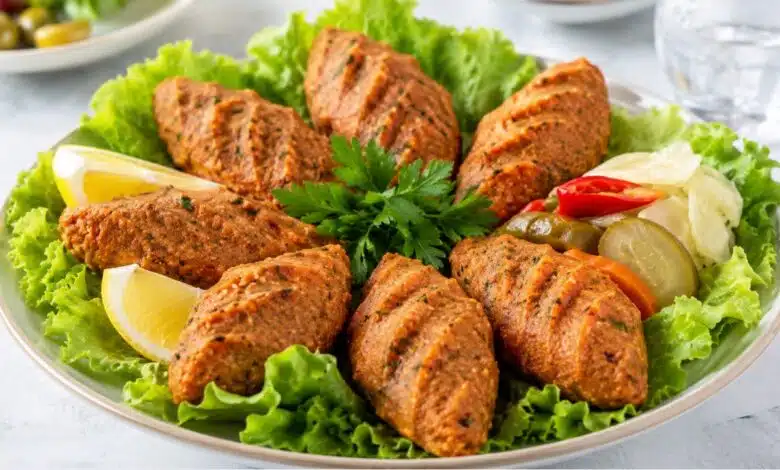
The finished pieces are usually elongated rather than perfectly round. They may look like small ridged ovals, tapered logs or hand-pressed quenelles. Their color ranges from muted orange to deep brick red depending on the lentils, pastes and spices used. A good piece feels moist and cohesive, not wet, brittle or rubbery. It should be easy to pick up with a lettuce leaf while still yielding when bitten.
Unlike falafel, mercimek köftesi is normally not deep-fried. Unlike many meat köfte, it is not grilled. The lentils are cooked, the bulgur softens in the hot mixture, the seasonings are worked in, and the portions are shaped after the mixture has cooled enough to handle. That method gives the dish its distinctive tender texture and makes it particularly suitable for a cold meze spread, lunch box, buffet or catered tray.
Restaurants sometimes translate the name as “lentil balls” or “lentil patties.” Those descriptions are understandable, but they can create the wrong expectation. “Ball” suggests a round shape; “patty” can suggest frying. The Turkish name is more informative once you know what to look for: a hand-shaped red lentil and bulgur mixture served with crisp greens and fresh acidity.
Why the dish may hide behind several names
The search difficulty begins with transliteration. Turkish uses the letters ö and ş, but many American websites, delivery platforms and point-of-sale systems remove diacritics. The full Turkish name mercimek köftesi may therefore appear as mercimek koftesi. Some menus shorten it to mercimek kofte. Others translate only part of the name and use “lentil köfte,” “red lentil köfte,” “Turkish lentil balls” or “vegan lentil patties.”
No single spelling guarantees authenticity, and an imperfect English translation does not automatically mean the kitchen is careless. A small family restaurant may use the spelling its customers recognize. A catering menu may use plain English because clients are ordering large trays. A grocery label may omit Turkish letters because of software limitations. The practical goal is not to police every accent mark; it is to identify the same dish across different menu systems.
| Menu wording | What it probably means | What to confirm |
|---|---|---|
| Mercimek köftesi | The standard Turkish name | Whether it is available that day |
| Mercimek koftesi | The same name without Turkish characters | Serving size and accompaniments |
| Mercimek köfte | A shortened English-menu form | Whether the plate is individual or shared |
| Turkish lentil balls | An English description of the hand-shaped pieces | That they are not fried falafel-style pieces |
| Vegan lentil patties | Possibly mercimek köftesi, but the wording is broad | Ingredients, bulgur and preparation |
Search engines also treat singular and plural forms inconsistently. You may see köfte, köftesi, kofta and even “kofteh.” The last two can point toward other culinary traditions or different dishes, so pair the term with “Turkish lentil,” “red lentil,” “bulgur,” or “meze” to reduce noise.
Where to look beyond a standard Turkish dinner menu
A Turkish restaurant is the obvious starting point, but it is not the only useful place. Mercimek köftesi is especially common in settings that prepare foods for sharing, takeaway or home-style service. The dish keeps its identity without needing a grill or fryer at the last minute, which makes it well suited to meze displays, refrigerated cases and catered events.
Turkish restaurants
Check the cold appetizers, meze, vegan and vegetarian sections. Some kitchens include mercimek köftesi only in a mixed platter, while others serve a dedicated plate with lettuce, lemon and herbs. A restaurant may also offer it at lunch but not display it on the dinner menu.
Turkish bakeries and cafés
A bakery focused on bread and sweets may still have a refrigerated savory counter. Mercimek köftesi can appear beside börek, stuffed grape leaves, salads and sandwiches. Availability is often tied to daily production rather than a permanent printed menu.
Specialty markets
Look in the prepared-food refrigerator, not only the packaged grocery aisles. Some Turkish and Mediterranean markets sell portions by weight, sealed trays, or mixed meze boxes. Ask whether the food is made in-house, supplied by a local kitchen or delivered on particular days.
Caterers and home kitchens
Mercimek köftesi is popular for gatherings because it is meatless, visually neat and easy to portion. A caterer may list it only under party trays, tea tables, women’s gatherings, vegan menus or Turkish breakfast and brunch packages.
Community events
Turkish cultural festivals, school fundraisers, mosque events and community bazaars may offer foods that do not appear regularly in local restaurants. These events can be excellent places to encounter home-style versions, though schedules and vendors change.
Delivery platforms
Delivery apps are useful for discovery but incomplete as culinary directories. Search both the dish and the restaurant type. Then verify on the business’s own menu or by phone, because app listings may omit limited items or preserve outdated names.
If “mercimek köfte near me” returns nothing, search “Turkish meze near me,” “Turkish prepared food,” “Turkish vegan food,” “Turkish catering,” and “Turkish market.” The dish may be available even when it is not indexed as a separate menu item.
Where it sits on the menu—and why that matters
Mercimek köftesi can occupy several menu roles. It may be a cold appetizer, a meze, a vegetarian entrée component, a side, a salad-adjacent plate or part of a tasting assortment. Knowing the category helps you estimate the portion and avoid ordering too much or too little.
On a meze menu, a dedicated order might contain several small pieces arranged over lettuce. In a mixed platter, you may receive only one or two pieces beside hummus, eggplant spreads, stuffed grape leaves, yogurt dips and salads. A café may tuck the mixture into lettuce wraps or bread, while a catering kitchen may sell twenty, forty or more pieces on a decorated tray.
The online description may be minimal—sometimes only “lentil köfte.” Open the photo gallery if the business maintains one, but do not assume every social-media photograph represents current availability. A post from a holiday event may show a special tray that is not offered daily. The safest question is direct: “Do you have mercimek köftesi today, and is it available as an individual plate or only by advance order?”
Also ask whether the listed count refers to pieces or servings. A piece can be small enough for a two-bite appetizer or large enough to fill a lettuce leaf. “Six pieces” therefore says less about quantity than it first appears. For a shared table, describe the number of diners and the rest of your order; the staff can often suggest an appropriate amount.
What should arrive on the plate
A recognizable mercimek köftesi plate usually combines warm earthy colors with fresh green and yellow accents. The lentil pieces sit on or beside crisp lettuce leaves. Lemon wedges provide brightness. Parsley, scallions or other herbs may appear in the mixture and around the plate. The arrangement can be rustic or highly decorative, but the food should still be easy to pick up and eat.
The pieces should hold their shape without looking dry. Finger grooves are common and useful: they increase the surface area and reflect the hand-shaping method. Very smooth factory-perfect cylinders are not automatically bad, but the classic handmade appearance is more irregular. The surface may glisten lightly from olive oil and paste; it should not appear greasy.
Color is not a reliable quality score by itself. A deeper red can come from pepper paste, tomato paste or paprika. A paler orange may reflect a gentler seasoning profile. What matters is balance: lentil sweetness, savory onion, herb freshness, acidity, spice and the slight grain of bulgur should work together rather than compete.
Lettuce is more than decoration. A leaf can serve as a crisp wrapper, adding contrast to the soft köfte. Lemon is similarly functional. A squeeze just before eating wakes up the lentils and cuts through the richness of olive oil and concentrated paste. Some diners also enjoy pomegranate molasses, pickles, radishes or fresh vegetables alongside, but these are additions rather than a single universal rule.
If the menu photo shows a crisp breaded shell or a deep-fried round ball, confirm what the kitchen is serving. It may be another lentil croquette, a house interpretation or falafel—not the typical cool, hand-shaped mercimek köftesi described here.
How to judge texture, moisture and seasoning
The ideal texture is tender but organized. When lifted, a piece should remain intact. When bitten, it should compress easily and reveal a fine, slightly grainy interior from the bulgur. It should not bounce like a commercial veggie burger, crumble like dry stuffing or smear like a loose dip.
Too much moisture can make the mixture sticky and shapeless. Too little can make it crack around the edges. The cook manages this balance through the lentil cooking stage, the amount and grade of bulgur, resting time, oil and other liquid seasonings. Because red lentils break down naturally, the dish can become dense if the mixture is overworked or the bulgur ratio is too high.
Flavor should begin savory and gently earthy, then open into acidity and fresh herbs. Pepper paste may add sweetness, depth and heat. Onion can be cooked until mellow or used in a way that leaves a sharper edge. Cumin and paprika are common flavor directions, but recipes differ. The best version for you may be mild and lemony or robust and peppery; neither profile is automatically more legitimate.
Freshness matters because herbs and onion change as the dish sits. A properly chilled prepared-food version can still be excellent, but very cold storage mutes aroma and firms the texture. Letting a portion lose the refrigerator’s deepest chill for a short period before eating can make the seasoning easier to perceive, provided it is handled safely and not left out for an extended time.
When buying from a deli counter, look for tidy pieces that have not dried at the exposed edges. Condensation inside a sealed container is not always a problem, but pooled liquid can indicate that the lettuce was packed wet or the mixture is releasing moisture. If possible, keep the greens and lemon separate until serving so the pieces do not become waterlogged.
Mercimek köftesi is not meat köfte, çiğ köfte or falafel
English menus often group several compact, hand-shaped foods under words such as balls, patties or köfte. That shorthand is convenient, but it can flatten important differences. Mercimek köftesi has its own ingredient logic and eating experience.
| Food | Foundation | Typical cooking or preparation | Usual texture and service |
|---|---|---|---|
| Mercimek köftesi | Cooked red lentils and fine bulgur | Mixed, rested and hand-shaped; normally not fried | Tender, cool or room temperature, with lettuce and lemon |
| Meat köfte | Ground meat with seasonings and possible binders | Often grilled, pan-cooked, baked or simmered | Hot, savory and meat-forward |
| Çiğ köfte | Fine bulgur with pepper paste and seasonings in common modern meatless versions | Kneaded extensively rather than cooked like lentils | Chewier, more intensely spiced, often wrapped in lettuce or flatbread |
| Falafel | Usually chickpeas or fava beans | Shaped and fried | Crisp outside, crumbly or fluffy inside, commonly served hot |
The closest source of confusion is çiğ köfte because both foods may be reddish, ridged, meatless and served with lettuce and lemon. The texture offers an immediate clue. Mercimek köftesi is softer and more lentil-forward. Çiğ köfte usually has a chewier, more cohesive bulgur texture and a stronger pepper-paste identity. A Turkish shop may sell both, so read the label rather than relying only on appearance.
Falafel confusion often comes from English translation. “Lentil balls” sounds like something that should be fried. If you are seeking the classic Turkish lentil dish, ask whether the pieces are fried or formed from cooked lentils and bulgur. That one question usually resolves the issue.
Vegan does not automatically mean gluten-free
Mercimek köftesi is commonly prepared without meat, eggs or dairy, making it a natural choice on many vegan and vegetarian tables. Still, restaurant ingredients should be confirmed rather than assumed. A kitchen may use a stock, seasoning blend or finishing ingredient that differs from a home recipe. Cross-contact also depends on the facility.
The major point many first-time buyers miss is bulgur. Bulgur is wheat, so traditional mercimek köftesi is not gluten-free. The lentils themselves are gluten-free, but they do not stand alone in the classic mixture. A menu that calls the dish “lentil patties” may not make the wheat content obvious.
For a medically necessary gluten-free diet, ask the kitchen exactly what grain or binder is used and whether preparation surfaces are shared. A restaurant offering a modified gluten-free version should identify its substitute rather than simply removing the word bulgur from the description. Do not rely on the appearance of the food.
Other ingredient questions may include onion, garlic, heat level and specific pepper pastes. The dish is often nut-free, but a mixed meze platter can place it beside foods containing walnuts, sesame or dairy. Ask about the complete plate, not only the lentil pieces, when allergies are involved.
What to order with Turkish lentil köfte
Mercimek köftesi works best when the rest of the table supplies contrast. It is soft, savory, earthy and often gently spicy. Crisp vegetables, tart pickles, bright salad, creamy yogurt dishes and warm bread can each pull the meal in a different direction.
For a light lunch
Pair a dedicated mercimek köftesi plate with salad, pickled vegetables and a cold drink. Use lettuce leaves as wrappers and add lemon immediately before eating.
For a first meze table
Add one creamy element, one smoky vegetable dish, one fresh or chopped salad and bread. This creates variety without covering the flavor of the lentils under too many similar spreads.
For a vegetarian dinner
Combine the köfte with a substantial vegetable dish, rice or bulgur pilaf, salad and yogurt or a plant-based alternative. Confirm whether every shared component meets the diner’s needs.
For a catered gathering
Ask for lettuce and lemon to be packed separately, clarify the number of pieces per guest, and include serving tongs or a layout that lets guests take a piece without compressing the tray.
Ayran is a particularly natural drink with a savory Turkish spread because its cool, lightly salty character refreshes the palate. Readers unfamiliar with the drink can use our guide to what ayran tastes like and how it is served. The link is relevant here because it helps complete the same ordering decision rather than diverting the reader to an unrelated cuisine page.
Tea can also fit the setting, especially when the food appears on a daytime table or at a bakery café. Water remains useful if the pepper paste is assertive. Sweet drinks are a matter of preference, but they can make a heavily seasoned plate feel richer, while a tart or lightly salty drink keeps the meal more balanced.
Takeout, delivery and catering formats
Mercimek köftesi travels better than many foods because it does not depend on a crisp fried crust or immediate heat. That advantage does not make packaging irrelevant. The main risks are compression, excess moisture, dried edges and wilted lettuce.
For a small takeout order, a shallow container is better than a deep pile. The pieces should lie in one or two layers rather than bear the weight of the entire order. Lettuce can line the container if it is dry, but wet greens quickly soften the surface. Lemon wedges are best kept to the side so juice does not soak into the köfte during transit.
Delivery can make the food arrive colder and firmer than it would at the restaurant. This is not the same problem as cold fries; the dish is meant to be cool or at room temperature. Still, refrigerator-cold lentils reveal less aroma. Once received, follow safe handling practices and allow only an appropriate short tempering period before serving.
Catering trays require a different calculation. The pieces may be smaller because they are one item among many. Ask how many pieces the business recommends per guest and whether the quoted tray size assumes a full meal or a buffet with several foods. For a mixed crowd, mercimek köftesi often disappears quickly because meat-eaters also enjoy it; do not count only the known vegetarians.
Presentation matters less than food quality, but a good catering tray should remain practical. Elaborate rows of lettuce and vegetables can look impressive while leaving too few actual portions. Ask for both the piece count and approximate tray dimensions. If pickup happens many hours before the event, confirm storage instructions directly with the business.
What to ask before making a special trip
A thirty-second phone call can prevent the most common disappointment: arriving at a Turkish restaurant that knows the dish but does not have it that day. Mercimek köftesi is sometimes prepared in batches, reserved for weekends, offered for catering, or produced only when enough customers request it.
Pronunciation should not stop anyone from asking. You can say the words slowly or simply ask for “the Turkish red lentil and bulgur köfte.” Showing the written name on your phone is also practical. A helpful restaurant would rather clarify the dish than have a customer order the wrong item.
How to read photos and reviews without being misled
Customer photographs can reveal whether a business has served mercimek köftesi, but they cannot confirm that the dish is available now. Check the date, read the surrounding caption and compare the photo with the current menu. A tray from a private event may appear in a review even though the restaurant requires advance notice.
Reviews are most useful when they describe the exact food rather than the restaurant in general. Look for comments about freshness, moisture, seasoning, piece count and accompaniments. A complaint that the dish was “cold” may reflect a misunderstanding, since mercimek köftesi is not normally served like hot grilled meatballs. Conversely, praise focused only on presentation tells you little about texture.
Be cautious with review language that treats all reddish hand-shaped Turkish foods as interchangeable. If a reviewer uses çiğ köfte and mercimek köftesi as synonyms, verify the menu yourself. Photos can help: visible lentil softness and a lighter orange-red interior point toward mercimek köftesi, while a darker, smoother and chewier-looking mixture may be çiğ köfte. Yet appearance alone is not decisive.
Delivery-platform star ratings are even less specific. They combine packaging, timing, customer service and every item on the menu. Use them as one signal, not as proof that the lentil köfte is excellent. A smaller number of detailed dish-specific comments can be more informative than hundreds of generic ratings.
A first order that teaches you the dish
For a first tasting, choose a simple dedicated plate rather than a heavily modified wrap. You want to see the pieces, feel their texture and control the lemon yourself. Add one or two complementary meze, not an entire table of foods with the same soft consistency.
Begin with a piece on its own. Notice whether the lentil flavor is clear and whether the bulgur provides structure without turning dense. Then add lemon. Try the next piece in a lettuce leaf. If the restaurant provides pickles or a tart salad, use a small amount rather than overwhelming the seasoning.
If the dish is offered only in a mixed platter, ask the server to identify it when the food arrives. This sounds basic, but red pepper spreads, çiğ köfte and lentil köfte can sit close together in a large assortment. Knowing which item you are tasting makes the experience useful rather than merely abundant.
Do not judge the entire dish family from a single dry supermarket tray or an overly wet delivery order. Mercimek köftesi is sensitive to ratio and handling, and versions can differ noticeably in heat, lemon, herbs and firmness. A second tasting from a restaurant or home-style caterer may feel like a different dish while still belonging to the same tradition.
Buying it from a market or prepared-food refrigerator
A market purchase shifts more responsibility to the buyer. Inspect the date label, storage temperature, ingredient list and packaging. The product may be made in-house, supplied by a local Turkish caterer or distributed in a sealed commercial pack. Each format can be good, but the freshness window and texture will differ.
Look for a container that protects the ridged shapes rather than pressing them into a single mass. If lettuce is included, it should look crisp rather than translucent. Excess liquid at the bottom can come from wet greens, lemon or the mixture itself. A little oil sheen is normal; a puddle is less appealing.
The ingredient list should help confirm identity. Red lentils and bulgur should be prominent. Tomato paste, pepper paste, onion, oil, lemon or pomegranate molasses, herbs and spices may follow. Recipes vary, so absence of one optional ingredient is not a disqualifier. What matters is that the package is not using the name for a completely different fried lentil snack.
Ask staff when the next batch arrives. A market that sells out on Fridays may restock for the weekend. A prepared-food counter may take phone orders even when the online shop does not show the item. This is precisely why local discovery requires more than checking a single map result.
Search phrases that uncover different kinds of sellers
Different phrases surface different businesses. Exact dish searches favor menus that spell the name clearly. Broader searches favor kitchens that sell the food but have weak websites. Use several combinations and compare the results.
Exact dish search
“mercimek köfte near me,” “mercimek koftesi near me,” and “mercimek köftesi restaurant.” Best for indexed menus.
English description
“Turkish lentil balls,” “Turkish red lentil patties,” and “lentil bulgur köfte.” Useful when menus translate the name.
Place-type search
“Turkish meze near me,” “Turkish prepared food,” “Turkish bakery savory food,” and “Turkish market deli.” Useful for counters and daily specials.
Event and tray search
“Turkish catering lentil köfte,” “vegan Turkish catering,” and “mercimek köftesi tray.” Useful for parties and advance orders.
Add your city, neighborhood or nearby larger metro area. A suburban Turkish market may rank poorly for a city-center search even though it is the closest dependable source. Also check neighboring terms such as Mediterranean market, but verify the cuisine and the exact dish rather than assuming every broad regional business carries it.
Common mistakes when searching and ordering
Searching only one spelling
A business may use perfect Turkish spelling while your search engine strips accents, or the reverse. Try the name with and without Turkish characters and include an English description.
Assuming “köfte” means meat
In this dish, the shaped form does not require ground meat. Do not reject the listing because the menu uses köfte, and do not assume every köfte is vegetarian.
Confusing it with çiğ köfte
The two may share lettuce, lemon, a ridged shape and red color. Confirm whether the base is cooked red lentils with bulgur or a heavily kneaded bulgur mixture.
Expecting a hot fried appetizer
Mercimek köftesi is typically served cool or at room temperature and is not known for a crisp crust. “Cold” is not automatically a service error.
Driving based on an old photo
Social posts and reviews prove only that the food existed at a certain time. Call the business when the item is central to your visit.
Ignoring bulgur
The dish may be vegan while still containing wheat. Confirm ingredients for gluten-related needs.
Ordering a catering tray without a count
Tray labels such as small, medium and large are not standardized. Ask for piece count and the recommended number of guests.
Choose the right source for the way you plan to eat it
The “best” source is therefore situational. A polished restaurant plate is useful for a first tasting. A deli counter may offer the most convenient family portion. A home-style caterer may produce the most generous tray. The goal of a near-me guide is not to force every buyer toward one format; it is to make the differences visible before money and travel time are spent.
Questions people ask while looking for mercimek köfte
Availability, spelling and ingredients create most of the confusion. The answers below cover the practical details that matter before ordering.
What is mercimek köfte made from?
Mercimek köftesi is usually made from cooked red lentils, fine bulgur, onion, tomato or pepper paste, oil, herbs, lemon and seasonings. Recipes vary by household and business, so ask about specific ingredients when dietary restrictions matter.
Is mercimek köftesi served hot or cold?
It is commonly served cool or at room temperature rather than piping hot. The lentils are cooked during preparation, but the shaped pieces are generally presented as a cold meze with lettuce and lemon.
Is mercimek köftesi vegan?
Many traditional and restaurant versions are vegan because the basic mixture uses lentils, bulgur, vegetables, herbs, oil and seasonings. Nevertheless, confirm stock, finishing ingredients and kitchen cross-contact with the business instead of relying only on the menu category.
Is mercimek köfte gluten-free?
Traditional mercimek köftesi contains fine bulgur, which is wheat, so it is not gluten-free. A modified version would need a clearly identified substitute and appropriate preparation controls.
What is the difference between mercimek köftesi and çiğ köfte?
Mercimek köftesi is based on cooked red lentils and fine bulgur and has a soft, tender texture. Common modern meatless çiğ köfte is more bulgur-forward, intensively kneaded, often darker and chewier, and frequently more assertively seasoned.
Why can’t I find mercimek köfte on a Turkish restaurant menu?
The dish may be listed under cold appetizers, meze, vegan items, catering trays or an English name such as Turkish lentil balls. It may also be a daily or weekend preparation. Search several spellings and call the business to confirm same-day availability.
How is mercimek köftesi usually eaten?
Pick up a piece with a lettuce leaf or fork, squeeze fresh lemon over it, and eat it with salad, pickles, bread or other meze. The lettuce adds crispness while the lemon brightens the lentil and pepper-paste flavors.
Can mercimek köftesi be ordered for catering?
Yes. Many Turkish caterers and prepared-food kitchens sell it in trays because it portions neatly and does not depend on last-minute frying. Ask about piece count, tray size, advance notice, refrigeration, garnishes and how long the food may remain out during service.
How long does takeout mercimek köfte keep?
Storage time depends on the business’s preparation date, packaging and ingredients. Keep it refrigerated, follow the seller’s instructions and use the stated date. For catered or unpackaged food, ask the kitchen directly rather than applying a generic rule.


