
Vesti Food Skills · Package-first cooking guide
Frozen Maultaschen are convenient, but they are not all the same product. One package may contain raw meat-filled pasta, another may hold fully cooked pockets that only need reheating, and a third may be frozen in broth. That difference determines whether you should simmer, thaw, pan-fry, microwave or avoid handling the pieces until they are heated through.
The safest and most reliable rule is simple: read the package before choosing a method. This guide explains how to interpret those instructions, protect the seams, prevent gummy dough or dry filling, and choose the best finishing method without pretending that every brand cooks for the same amount of time.
Start with the package, not the pan
Use the product label as the primary cooking authority. Frozen Maultaschen may be raw, partially cooked or fully cooked, and appearance alone cannot tell you which one you have.
If it says “cook from frozen”
Do not thaw automatically. Use the stated liquid, heat level and cooking time. Handle the pockets gently and confirm that the center reaches the manufacturer’s doneness guidance.
If it says “thaw before cooking”
Use the recommended thawing method and keep the product refrigerated. Meat-filled pasta should not sit on the counter while you prepare the rest of the meal.
If it says “fully cooked”
The goal is thorough reheating rather than raw-meat cooking. Gentle simmering, warming in broth or heating before slicing and frying are common options when the label permits them.
If instructions are missing
Contact the producer, deli or retailer. Determine whether the filling is raw or precooked before choosing a method. Do not use floating or surface browning as a substitute for that information.
First check: what kind of frozen Maultaschen do you have?
Raw frozen Maultaschen
The dough and filling require complete cooking. If the filling contains raw meat, surface browning is not enough. The center must reach the product’s specified safe doneness.
Partially cooked Maultaschen
The wrapper or filling may have received some heat, but the final cooking step is still required. Instructions vary significantly, so do not treat “par-cooked” as the same as ready-to-eat.
Fully cooked and frozen
These products need thorough reheating. They are often easier to finish in broth or simmer gently before slicing and pan-browning.
Frozen in broth
Treat this as a prepared soup product. The package may direct stovetop or microwave reheating and may not be designed for separating the components while frozen.
Frozen restaurant leftovers
These differ from factory-sealed products because the original cooking, cooling and freezing history may be less clear. Use them only when you know how and when they were handled.
Frozen deli packs
A deli may package house-made or supplier-made Maultaschen without the detailed directions found on a retail box. Ask the counter whether they are raw, cooked or ready to heat.
Read the label before choosing a cooking method
- Find the cooking status. Look for words such as raw, uncooked, par-cooked, fully cooked, ready to heat or ready to eat.
- Check whether thawing is required. “Cook from frozen” and “thaw before cooking” are not interchangeable instructions.
- Identify the intended cooking medium. The package may specify water, broth, stovetop reheating, microwave or oven.
- Read the full time range. Time may depend on portion size, equipment and whether the pieces are frozen together.
- Look for internal-temperature guidance. This matters especially when the filling contains raw meat.
- Check allergen and filling information. Pork, beef, egg, dairy, wheat, soy, mustard and celery may appear in different products.
- Read storage instructions. Note freezer temperature, use-by information and directions after opening.
- Check refreezing guidance. Do not assume every thawed product can be returned to the freezer unchanged.
Do frozen Maultaschen need to be thawed?
There is no universal answer. Some frozen Maultaschen are engineered to go directly into simmering water or broth. Others are intended to thaw in the refrigerator before reheating or pan-frying. Both “always thaw” and “never thaw” are unreliable rules.

Gentle simmering: the most useful all-purpose method
Gentle simmering works well for many packaged Maultaschen because it heats the wrapper and filling evenly without the impact of hard boiling. It is also the natural first step when you plan to serve the pockets whole or slice them for later pan-frying.
- Use a wide pot. The pieces need room to move without stacking tightly.
- Add enough liquid. Crowded Maultaschen rub against one another and heat unevenly.
- Bring the liquid to the level specified on the package. Do not assume a rolling boil is necessary.
- Lower the pieces carefully. Dropping frozen pockets can crack corners or splash hot liquid.
- Separate only when needed. Use a gentle utensil rather than prying with force.
- Keep the movement controlled. Small bubbles are easier on seams than aggressive turbulence.
- Follow the package’s timing and doneness guidance. Thick seams and dense fillings heat more slowly than the flat surface.
- Lift with a slotted spoon. Support the full pocket rather than grabbing a soft edge.
Why a rolling boil causes problems
A hard boil throws the pieces against the pot, increases friction between wrappers and can force steam or filling through weak seams. Fully cooked dough may swell and become soft before the center is evenly hot. Raw or partially cooked filling can still lag behind the wrapper, so faster-looking boiling is not necessarily better cooking.
Water versus broth
Cooking in water
Water is neutral, makes salt easier to control and is useful when the Maultaschen will be pan-fried afterward. It also lets you taste the filling without a broth changing the seasoning.
Cooking in broth
Broth adds flavor and creates an immediate soup service. It can also make an already seasoned filling taste saltier, especially when a stock cube or concentrated packaged broth is used.
Vegetarian Maultaschen are not automatically a vegetarian meal when heated in meat broth. Check both the filling and the liquid. Homemade broth, prepared stock and concentrated bouillon differ greatly in salt and fat, so season only after tasting the finished combination.
Frozen Maultaschen in broth
Broth service is one of the clearest ways to evaluate the wrapper and seams. When the product instructions allow it, heat the broth gently, add the Maultaschen carefully and keep the liquid below an aggressive boil.
Add herbs, chives or onions after the pockets are heated so the garnish does not interfere with cooking. For leftovers, storing the broth separately when practical can help keep the wrapper from continuing to swell.

How to pan-fry frozen Maultaschen correctly
Many frozen Maultaschen should be cooked or heated through before they are sliced and fried. Putting a raw frozen meat-filled pocket straight into a skillet can brown the outside while leaving the center undercooked. Use direct-from-frozen frying only when the product instructions explicitly support it.
- Cook or reheat according to the package. The center must be ready before browning becomes the priority.
- Drain and rest briefly. Surface water prevents browning and increases splattering.
- Slice evenly. Moderately thick pieces retain moisture better than thin scraps.
- Heat the skillet before crowding it. A crowded pan steams the slices instead of browning them.
- Use a restrained amount of fat. Enough to prevent sticking is different from a shallow pool of oil.
- Place cut faces against the pan. This exposes the filling and pasta to controlled browning.
- Turn carefully. The wrapper is softer after simmering and can tear at the edges.
- Add or finish onions without burning them. Onion timing may differ from the Maultaschen timing.
- Stop while the center is still moist. Extra browning is not worth a dry filling.
Why wet Maultaschen do not brown
Water on the surface turns to steam. The slices stick, spatter and soften while the pan struggles to build color. Drain well, let excess moisture evaporate and avoid stacking freshly simmered pieces in a deep wet bowl.
Whole versus sliced pan-frying
Whole pockets
Whole Maultaschen retain more internal moisture but offer less browned surface. Large pieces can remain cold in the center if they were not reheated first.
Sliced pieces
Slices create more browned cut area and make the filling visible. They also lose moisture more quickly, especially when cut thin or fried for too long.
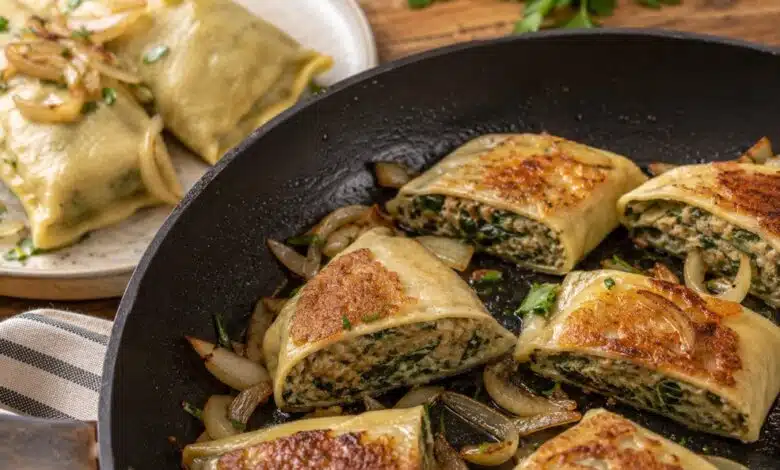
Pan-frying with onions
Onions and Maultaschen may need different cooking times. Start the onions earlier when they need a long softening period, or remove them temporarily if they brown faster than the slices. Burnt onions create bitterness that can overpower the filling.
Pan-frying with egg
Egg turns the dish into a softer, more substantial skillet meal. It reduces crisp contrast and can make the pan feel heavy if too much fat is used. Add it because you want that style, not as a way to hide dry Maultaschen.
Microwaving frozen or cooked Maultaschen
The microwave is practical for a single portion, but it produces the greatest risk of uneven heating, rubbery corners and a cold center. Follow the package’s microwave directions precisely when they are provided.
Advantages
- Fast for one portion
- Minimal cookware
- Useful for fully cooked products
- Convenient for broth-based packs designed for microwave reheating
Risks
- Cold center
- Dry folded edges
- Rubbery wrapper
- Split seams
- Uneven heating between pieces
Use a microwave-safe covered dish when the package directs it, rotate or rearrange the pieces and respect any standing time. USDA guidance for leftovers recommends reheating to 165°F and checking in several places because microwave heating can be uneven.
Oven and air fryer: useful only in the right context
Oven
An oven can handle a larger portion, especially when the Maultaschen are baked with broth, sauce or another source of moisture. Exposed pasta dries easily, so use the product’s directions rather than applying a generic frozen-pasta temperature.
Air fryer
An air fryer is not automatically suitable. The wrapper can harden before the filling heats, especially with large raw frozen pockets. Use it only when the manufacturer provides a method or when fully cooked pieces are being finished with a verified approach.
Neither method should be treated as the default traditional preparation. Their value is convenience or texture, not authenticity.
How to keep frozen Maultaschen from splitting
- Inspect the seams and corners before cooking.
- Do not drop the pieces into violently boiling liquid.
- Use a pot wide enough to prevent crowding.
- Separate frozen pieces gently rather than twisting them apart.
- Avoid aggressive stirring with a hard spoon.
- Keep the heat controlled once the pieces are in the liquid.
- Lift with a slotted spoon that supports the full pocket.
- Stop at the package’s doneness point rather than cooking “a little longer to be safe.”
- Avoid repeated freeze-thaw cycles that weaken the wrapper.
A small crack does not always mean the product is unusable, but multiple open seams increase filling loss. Cook damaged pieces separately when possible so they do not cloud an entire pot of broth.
How to prevent gummy dough
Gummy dough usually appears in thick folded seams or where pieces stick together. It is different from a naturally tender wrapper: gummy dough feels pasty, floury or glue-like at the center of the fold.
Common causes
- Too little liquid
- Overcrowding
- Thawed pieces sticking together
- Removing the pockets before thick seams heat through
- Uneven microwave heating
Better practice
- Use a wide pot
- Keep pieces separated
- Follow the full package method
- Check the thickest seam, not only the flat center
- Allow standing time when directed
How to prevent a dry filling
Dry filling is usually caused by too much total heat rather than too little fat. Overboiling, repeated reheating, thin slicing, high oven heat and long pan-frying all allow moisture to escape.
- Cook only until the required doneness is reached.
- Use moderately thick slices for frying.
- Brown the surfaces, not the entire center.
- Serve promptly after pan-frying.
- Reheat only the portion you plan to eat.
- Use broth or onions as part of the serving style, not as camouflage for overcooked filling.
Freezer quality audit before cooking
Frost alone is not proof that the food is unsafe. It is a quality signal that should be interpreted together with package integrity, temperature history and seller instructions.
Frozen versus refrigerated Maultaschen
Frozen
- Longer storage potential
- Useful for shipping and stocking
- Requires freezer space
- Greater risk of cracks and freezer burn
- May need direct-from-frozen cooking
Refrigerated
- Shorter shelf life
- Often easier to handle and slice
- Convenient for immediate pan-frying after heating
- Must remain cold
- Cannot be assumed shelf-stable
The better choice depends on access and timing. A well-frozen product handled correctly can outperform an old refrigerated pack, while a fresh refrigerated product may offer easier cooking and a more supple wrapper.
What to do with shipped frozen Maultaschen
- Open the parcel immediately. Do not leave a cold shipment on the porch or counter.
- Inspect the outer box and insulated liner. Look for damage, leakage or prolonged exposure.
- Check the product against the seller’s arrival standard. Some sellers specify that food should arrive frozen, partly frozen or refrigerator-cold.
- Move acceptable products to the freezer or refrigerator at once.
- Do not taste a questionable shipment to test safety.
- Photograph damage and contact the seller promptly. Follow the company’s replacement and food-safety process.
Dry ice or cold packs can help maintain temperature, but their presence does not guarantee that the food remained safely cold. USDA mail-order guidance advises consumers to inspect perishable deliveries immediately and handle them safely as soon as they arrive.
How to check whether Maultaschen are done
Floating is not a universal doneness test. A pocket may rise because steam or air is trapped inside while the thick seam or meat filling still needs more heat. Wrapper appearance can also mislead because the outer layer softens before the center is ready.
- Use the package’s internal-temperature guidance when provided.
- Check the thickest part, not only the outer dough.
- Use a food thermometer when the product or filling requires one.
- Cut one test piece only when presentation is not critical and the manufacturer’s method allows it.
- Do not rely on browning as proof that a raw center is cooked.
For reheated leftovers, USDA guidance calls for 165°F throughout. Raw meat fillings may have product-specific safe-temperature instructions depending on the meat blend, so the label remains the priority.
How to reheat cooked Maultaschen
In broth
Warm gently, avoid aggressive boiling and check that the center is hot. Separate broth and pockets during storage when practical.
In a skillet
Best for restoring browned surfaces. Use moderate heat and only enough fat to prevent sticking.
In the microwave
Convenient but uneven. Cover when directed, rearrange pieces and check several points.
Repeated reheating degrades the wrapper and dries the filling. Reheat only the portion you need. Refrigerate perishable leftovers promptly and follow current food-safety guidance.
Common frozen Maultaschen cooking mistakes
- Assuming every frozen product is fully cooked.
- Thawing without checking the label.
- Using a violent rolling boil.
- Crowding a small pot.
- Stirring with a hard spoon that tears the wrapper.
- Frying raw frozen meat-filled Maultaschen without product approval.
- Slicing before the center is heated.
- Pan-frying wet pieces and expecting crisp browning.
- Using too much oil.
- Burning onions while waiting for the Maultaschen to brown.
- Treating floating as proof of doneness.
- Using one cooking time for every brand and size.
- Refreezing without checking guidance.
Best cooking method by serving goal
Clear broth meal
Use package-directed gentle simmering in water or broth, then serve whole with restrained garnish.
Pan-fried with onions
Cook or reheat first, drain well, slice evenly and brown the cut faces in a lightly greased skillet.
Fast lunch
Use the approved microwave or stovetop method rather than improvising a shortcut.
Family dinner
Use a wide pot and uncrowded batches. Hold cooked pieces gently rather than leaving them in hot liquid too long.
First-time tasting
Choose boiled or broth service because these methods show the wrapper, filling and seam quality most clearly.
Leftovers
Pan-frying can restore texture, but repeated reheating will eventually dry the filling.
Vegetarian meal
Verify both the filling and the broth. Egg or dairy may still be present.
Delivered frozen pack
Inspect arrival condition before storing or cooking. Contact the seller when temperature or packaging is questionable.
For a deeper comparison of finishes, see Maultaschen in broth versus pan-fried. To find stores and restaurants, use the guide to where to buy Maultaschen near you.
Final package-first checklist
- Is the product raw, partially cooked or fully cooked?
- Does the label say cook from frozen?
- Is thawing required?
- What cooking medium is specified?
- Is broth included?
- Is the filling meat, vegetarian or plant-based?
- Are the seams and package intact?
- Has the product remained frozen?
- What internal heating guidance is provided?
- Can the product be pan-fried after cooking?
- What storage rules apply after opening?
- What should you do if a shipped package arrives warm or damaged?
Useful next reads
Can you cook Maultaschen from frozen?
Some Maultaschen are designed to cook directly from frozen, while others must be thawed or are intended only for reheating. Follow the package directions because products may be raw, partially cooked or fully cooked.
Should frozen Maultaschen be thawed before cooking?
Only when the package says to thaw them. Thawing can soften the wrapper and increase sticking, while some products are specifically designed for direct-from-frozen simmering.
How long do frozen Maultaschen take to cook?
There is no universal time. Size, filling, cooking status and manufacturer method all affect the timing. Use the package instructions and doneness guidance rather than a generic number.
Can frozen Maultaschen be cooked in broth?
Yes, when the product instructions allow it. Use a gentle simmer, avoid overcrowding and account for the broth’s salt level. Vegetarian Maultaschen require vegetarian broth if the full meal must remain vegetarian.
Can you pan-fry frozen Maultaschen?
Many frozen Maultaschen should be cooked or reheated before slicing and pan-frying. Do not fry raw frozen meat-filled pockets directly unless the manufacturer provides that method.
Why do Maultaschen split while cooking?
Common causes include violent boiling, crowded pots, damaged frozen seams, rough stirring, forced separation and overcooking. A wide pot and controlled simmer reduce the risk.
How do you know when Maultaschen are fully cooked?
Follow the package’s time and internal-temperature guidance. Floating is not a universal doneness test, and a soft outer wrapper can hide a cold or undercooked center.
Can frozen Maultaschen be microwaved?
Use the microwave only when the package provides suitable directions. Microwave heating can be uneven, so cover, rotate or rearrange as instructed and check that the center is fully heated.
How should cooked Maultaschen be reheated?
They can be warmed gently in broth, heated in a skillet or microwaved according to the product and food-safety guidance. Reheat only the portion needed to protect the wrapper and filling.
What should I do if frozen Maultaschen arrive warm?
Inspect the package immediately, compare the condition with the seller’s arrival standard and contact the seller. Do not taste questionable food to determine whether it is safe.


