
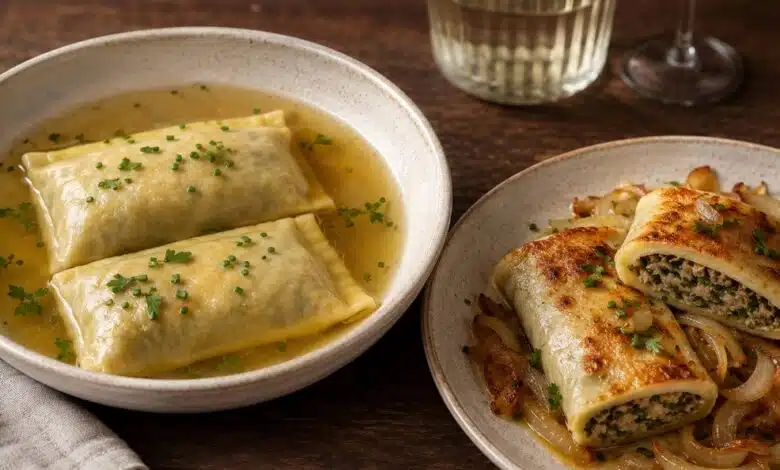
Vesti Food Atlas · Swabian serving-style guide
Maultaschen in broth and pan-fried Maultaschen begin with the same filled pasta pocket, but they reveal very different qualities. Broth softens the wrapper and tests whether the seams hold. Pan-frying exposes the filling, creates browned edges and tests whether the interior can stay moist under direct heat.
Neither style is automatically better. The right choice depends on whether you want a soup-like meal, a browned and onion-forward plate, the clearest first taste of the whole pocket, or the version most likely to survive pickup and delivery.
Choose the serving style by the experience you want
Choose Maultaschen in broth
Best when you want a softer wrapper, a whole-pocket presentation and a clear look at seam strength, dough tenderness and broth balance.
Choose pan-fried Maultaschen
Best when you want browned surfaces, sweeter onion flavor, firmer pasta edges and a hearty plate rather than a soup course.
Choose boiled and plated
Best when you want the most neutral comparison. Butter, herbs or onions add flavor without the swelling risk of broth or the drying risk of frying.
Choose a chilled pack for home
Best when pickup or delivery is long. You control the final simmering, slicing and browning instead of accepting a dish that has softened in transit.
What do “in broth,” “fried” and “geschmälzt” mean?
English menus often compress several German serving descriptions into one vague word. Understanding the original wording helps you predict what will arrive.
Maultaschen in der Brühe
Whole or halved Maultaschen served in broth. The dish may also appear as Maultaschensuppe. The broth can be a light first course or a substantial meal depending on the number and size of the pockets.
Geröstete Maultaschen
Usually cooked Maultaschen that are sliced or browned in a pan. “Roasted” is the literal menu clue, but the cooking action is typically pan-browning rather than oven roasting.
Geschmälzte Maultaschen
Often associated with butter and browned onions poured over or served with cooked Maultaschen. This is not necessarily the same as aggressively frying every surface.
Maultaschen mit Ei
Sliced Maultaschen cooked with egg, often alongside onions. The result is softer and more cohesive than a plate focused only on crisp browned surfaces.
Do not assume that every menu using the word “fried” means deep-fried. Traditional pan preparations usually begin with already cooked Maultaschen and use a skillet, butter or oil, onions and sometimes egg.
Are broth and fried Maultaschen both traditional?
Yes. Broth service is one of the most recognizable ways to present Maultaschen, while browned or onion-topped preparations are also well established in Swabian cooking. The styles serve different purposes rather than forming a simple authentic-versus-modern hierarchy.
The protected names Schwäbische Maultaschen and Schwäbische Suppenmaultaschen are registered as a Protected Geographical Indication in the European Union. That protection concerns a defined product and geographical specification; it does not mean only one serving method is legitimate, and it does not make every product sold elsewhere under the generic name part of the protected designation.
The biggest difference is what happens to the wrapper
A tender wrapper should still hold its shape. In broth, softness should not become gumminess or collapse. In the pan, browning should not turn the pasta into a leathery shell. The best preparation understands that the wrapper has already done the difficult work of containing a moist filling.
What happens to the filling?
In broth
The filling stays enclosed, so moisture loss is limited. Gentle heating can preserve a cohesive meat, spinach and bread filling, but the broth amplifies salt. A filling that seems balanced on its own may taste over-seasoned in a salty soup. If the seams split, crumbs of filling cloud the bowl and the pocket loses structure.
In the pan
Sliced faces expose the interior directly to heat. This creates more roasted flavor, but it also allows moisture to escape. Meat fillings with too little fat or too much bread binder can become dry and crumbly. Vegetarian fillings based on mushrooms, greens or cheese can leak or separate when overheated.
The ideal fried slice has two textures at once: a lightly browned outer face and a center that still looks moist when cut. A dark crust does not compensate for a dry interior.
Flavor and texture: a direct comparison

How to judge Maultaschen in broth
Intact seams
The edges should remain sealed. A few crumbs are not a disaster, but a bowl filled with escaped filling suggests rough cooking or overholding.
Fully heated center
The middle should be hot without the wrapper being boiled to collapse. A lukewarm core is both unpleasant and a sign of rushed reheating.
Balanced broth
The broth should taste complete on its own but not be so salty or fatty that every Maultasche tastes identical.
Supportive garnish
Chives, parsley or restrained onion can add freshness. Heavy garnish should not conceal split dough or an oily surface.
Warning signs in the bowl
- A wrapper that has swollen until the filling feels remote.
- Gummy folded seams or floury undercooked corners.
- A center that is cooler than the broth.
- Filling dispersed through the soup because the pockets split.
- A heavy grease layer that coats the mouth.
- Broth dominated by salt or commercial bouillon flavor.
- Maultaschen held so long that they tear when lifted.

How to judge fried Maultaschen
Evenly cut pieces
Consistent slices brown at the same rate. Very thin slices dry before thicker ones heat through.
Browned, not burned
Look for golden to deep brown cut faces. Black spots and bitter onions indicate heat that was too high.
Moist interior
The filling should remain cohesive and moist. Dry crumbs around the plate are a warning that the pieces were fried too long.
Controlled fat
A light coating helps browning. Oil pooling under the slices makes the wrapper heavy and masks the filling.
Warning signs on the plate
- Leathery pasta corners and a hard underside.
- Burned onions mixed with pale, unbrowned slices.
- Cold centers beneath a dark exterior.
- A dry meat-and-bread filling that crumbles when cut.
- Egg cooked into a greasy, rubbery scramble.
- Deep-fried breading presented as the standard Swabian form without explanation.
“Fried Maultaschen” can describe several different plates
Menu wording is not always precise. Ask how the dish is prepared when the texture matters to you.
Sliced and pan-fried
The most recognizable browned format. Cut faces contact the skillet and the filling remains visible.
Whole and pan-browned
The exterior colors while the filling stays enclosed. This preserves moisture but creates less browned filling surface.
With onions
Onions may be cooked in the same pan or browned separately. Their sweetness can become a major part of the dish.
With egg
Egg binds around the slices and softens the crisp-versus-tender contrast. It is a distinct choice, not a minor garnish.
Browned in butter
Butter adds nutty flavor and richness but can burn faster than neutral oil if the heat is uncontrolled.
Breaded and deep-fried
This can be a modern appetizer or novelty preparation. It should not be confused with the usual pan-fried Swabian plate.
Which serving style is best for a first-time diner?
A whole Maultasche in broth is usually the most revealing introduction because the pocket arrives intact. You can judge the seam, wrapper, filling and broth separately. It also shows why Maultaschen are more than a generic filled pasta.
Boiled and plated is the most neutral option. It gives you the whole product without asking the broth to carry the meal or frying to create extra flavor. This is especially useful when comparing two producers.
Pan-fried Maultaschen may be the easiest entry point for someone who strongly prefers browned textures. They are often more immediately savory and familiar, but onions, butter and egg can hide subtle differences in the original filling.
Which style travels better for pickup and delivery?
Broth risks
Broth can leak, soften the wrapper during the ride and create steam inside the container. The safest configuration is usually Maultaschen and broth packed separately. Combine them only when ready to eat.
Fried risks
Fried slices lose crispness as steam condenses. Onions soften, and egg can dry or become rubbery. A vented container helps preserve the browned surface, but a short pickup trip is still better than a long delivery route.
The most reliable takeaway
A refrigerated deli pack often travels better than either finished plate because you control the final cooking. For a local restaurant order, pickup normally gives you more control over timing than third-party delivery.
Which version reheats better?
Broth version
Gentle reheating is essential. Aggressive boiling can split the seams and make the wrapper rough. Store broth separately when possible so the dough does not keep absorbing liquid.
Fried version
A skillet usually restores the surface better than a microwave. Use moderate heat and only as much fat as needed to prevent sticking.
Follow restaurant or manufacturer instructions when available. Packaged Maultaschen can be raw, partially cooked or fully cooked, so one universal reheating rule is not reliable.
Whole versus sliced Maultaschen
Whole Maultaschen preserve moisture and make the seam easier to evaluate. They also show the true size of each pocket. In soup, one large Maultasche can represent a meaningful portion even when the piece count looks low.
Slicing exposes the filling and increases browning area. The thickness of the slices determines whether the center stays moist. Thin slices brown quickly but dry faster; thick slices preserve moisture but may remain pale or cool in the middle.
When comparing portions, ask how many whole Maultaschen the slices represent. A plate described as “six pieces” may contain only one or two sliced pockets.
Broth quality can change the entire judgment
A clean, savory broth supports the pasta without erasing it. Beef, vegetable and other broths can all work, but the base affects dietary status and flavor. A vegetarian Maultasche served in meat broth is not a vegetarian dish.
Appearance alone cannot prove whether the broth is homemade or commercial. Judge what is in the bowl: salt balance, fat level, clarity where clarity is intended, freshness of garnish and whether the broth allows the filling to remain recognizable.
Very salty broth can make the filling seem over-seasoned. Weak broth can make good Maultaschen feel unfinished. The best bowl creates a partnership rather than using the pasta as decoration.
Onion and egg versions change more than the garnish
Onions
Well-cooked onions add sweetness and browned flavor. They should be soft or lightly crisp depending on the preparation, not black and bitter. When onions are cooked separately, the kitchen can brown them properly without overcooking the Maultaschen.
Egg
Egg turns the dish into a more cohesive skillet meal. It fills the spaces between slices and softens the crispness. Ask whether egg is included if you want clearly browned edges or need to avoid egg for dietary reasons.
A plate with egg is not automatically inferior; it is simply a different texture target. The problem arises when an oily scramble overwhelms the Maultaschen.
How meat and vegetarian fillings behave
Meat-filled
Fat content influences moisture. Lean or bread-heavy fillings can dry quickly in the pan, while broth often keeps the center more protected.
Spinach and cheese
Cheese may soften beautifully in broth but can leak from split seams. In the pan, high heat may separate fat or toughen the exposed edge.
Mushroom or vegetable
Vegetables with high water content can weaken the seam in broth and release liquid in the pan if the filling is not well bound.
Plant-based meat alternatives
These products vary widely in fat and binder content, so they may brown or dry differently from traditional meat fillings.
Vegetarian does not automatically mean vegan, and a meat-free filling does not guarantee meat-free broth, butter or shared cooking equipment.
Best Maultaschen style by situation
First taste
Whole in broth or simply boiled and plated.
Cold-weather lunch
Broth for warmth and a complete soup-style meal.
Hearty dinner
Pan-fried with onions, optionally with egg.
Crispy-edge preference
Sliced and browned in a skillet.
Delivery order
Separate broth or a short-distance fried pickup.
Family meal
Chilled or frozen pack finished at home.
Restaurant comparison
Boiled and plated to minimize extra variables.
Leftover use
Sliced and pan-fried, provided storage was safe.
Vegetarian order
Either style after checking broth, butter and egg.
Final decision matrix
Pick broth when you want:
- A softer wrapper
- A whole-pocket experience
- The clearest test of seam strength
- A soup-style meal
Pick fried when you want:
- Browned flavor
- Onions and stronger savory notes
- Greater texture contrast
- A hearty plate
Pick boiled and plated when you want:
- The most neutral comparison
- Less broth absorption
- Less risk of drying from frying
- Butter, herbs or onions without a heavy sauce
The useful conclusion: broth and fried Maultaschen are not competing definitions of the dish. Broth tests tenderness, seam strength and seasoning balance. Pan-frying tests moisture, browning and oil control. The better choice is the one that matches the texture you want and the kitchen’s strongest preparation.
Continue exploring Maultaschen
Are Maultaschen traditionally served in broth or fried?
Both are established serving styles. Maultaschen may be served whole in broth, boiled and plated, or sliced and pan-fried with onions and sometimes egg.
What are fried Maultaschen called in German?
Menus may use geröstete Maultaschen for browned or pan-fried Maultaschen. Maultaschen mit Ei indicates a version cooked with egg, while geschmälzte Maultaschen often refers to butter and browned onions.
Are fried Maultaschen deep-fried?
Usually not. Traditional fried preparations are commonly pan-browned whole or sliced. Breaded deep-fried versions may exist as modern appetizers but are not the standard meaning.
What do Maultaschen in broth taste like?
The broth adds savory depth and softens the wrapper while the filling remains enclosed. The final taste depends strongly on broth salt, fat level, herbs and the filling itself.
Why are Maultaschen sliced before frying?
Slicing creates more surface area for browning and exposes the filling. Even slices are important because very thin pieces can dry before thicker ones heat through.
Are fried Maultaschen served with egg?
They can be. Egg is one recognized skillet preparation, but many fried Maultaschen are served only with onions, butter or oil. Check the menu if you want a specific texture or avoid egg.
Which Maultaschen style is better for a first-time diner?
Whole Maultaschen in broth or simply boiled and plated usually provide the clearest first look at the wrapper, seams and filling. Fried versions are ideal for diners who prefer browned flavor.
Which version travels better for delivery?
Neither is perfect for a long trip. Broth should be packed separately to prevent swelling and leaks, while fried slices benefit from a vented container. Pickup or a chilled retail pack is often safer for texture.
Can vegetarian Maultaschen be served in broth?
Yes, but verify that the broth is also vegetarian. A meat-free filling served in beef or chicken broth is not a vegetarian dish.
How should leftover Maultaschen be reheated?
Reheat broth versions gently without aggressive boiling. Fried versions usually regain texture better in a skillet than in a microwave. Follow restaurant or manufacturer instructions when available.


